Your browser does not fully support modern features. Please upgrade for a smoother experience.
Submitted Successfully!
Thank you for your contribution! You can also upload a video entry or images related to this topic. For video creation, please contact our Academic Video Service.
Version Summary Created by Modification Content Size Created at Operation
1 Alexander Haro-Sarango -- 1499 2026-11-12 06:26:30 |
2 formatted Perry Fu Meta information modification 1499 2026-11-12 06:37:40 |

Video Upload Options

We provide professional Academic Video Service to translate complex research into visually appealing presentations. Would you like to try it?
Cite
If you have any further questions, please contact Encyclopedia Editorial Office.
Haro-Sarango, A.; Castillo-Martínez, D.; Cachay-Salcedo, S.; Saavedra-Vasconez, J.; Campos-Ku, J.; Sotelo-Castro, B.; Saavedra-Vasconez, C.E. Exploring Synthetic Data in Financial Analytics: A Bibliometric Review of Generation Methods, Validation Challenges, and Future Directions. Encyclopedia. Available online: https://encyclopedia.pub/entry/62213 (accessed on 12 November 2026).
Haro-Sarango A, Castillo-Martínez D, Cachay-Salcedo S, Saavedra-Vasconez J, Campos-Ku J, Sotelo-Castro B, et al. Exploring Synthetic Data in Financial Analytics: A Bibliometric Review of Generation Methods, Validation Challenges, and Future Directions. Encyclopedia. Available at: https://encyclopedia.pub/entry/62213. Accessed November 12, 2026.
Haro-Sarango, Alexander, Diana Castillo-Martínez, Silvia Cachay-Salcedo, Jessica Saavedra-Vasconez, José Campos-Ku, Briseida Sotelo-Castro, Carlos Eduardo Saavedra-Vasconez. "Exploring Synthetic Data in Financial Analytics: A Bibliometric Review of Generation Methods, Validation Challenges, and Future Directions" Encyclopedia, https://encyclopedia.pub/entry/62213 (accessed November 12, 2026).
Haro-Sarango, A., Castillo-Martínez, D., Cachay-Salcedo, S., Saavedra-Vasconez, J., Campos-Ku, J., Sotelo-Castro, B., & Saavedra-Vasconez, C.E. (2026, November 12). Exploring Synthetic Data in Financial Analytics: A Bibliometric Review of Generation Methods, Validation Challenges, and Future Directions. In Encyclopedia. https://encyclopedia.pub/entry/62213
Haro-Sarango, Alexander, et al. "Exploring Synthetic Data in Financial Analytics: A Bibliometric Review of Generation Methods, Validation Challenges, and Future Directions." Encyclopedia. Web. 12 November, 2026.
Peer Reviewed

Exploring Synthetic Data in Financial Analytics: A Bibliometric Review of Generation Methods, Validation Challenges, and Future Directions

This is a peer-reviewed entry published in Encyclopedia Journal, full entry can be found at https://doi.org/10.3390/encyclopedia6110250

Synthetic data generation has become a strategic capability in financial analytics, promising to reconcile the sector’s appetite for data-hungry machine learning with strict privacy, confidentiality, and regulatory constraints. This review provides a structured, evidence-based account of the field that is both conceptual and empirical. On the conceptual side, it explains how the principal generators work, states their objectives formally, and derives the practical consequences of each mechanism for financial data; it then organises evaluation into an operational fidelity–utility–privacy framework, extends it to incorporate the fairness and model-risk requirements imposed by regulated lending and insurance and the validation constraints that differ by data type, and offers explicit guidance on selecting a generator. On the empirical side, it maps the intellectual structure of the field through a science-mapping study of 313 Scopus-indexed documents (1997–2026) retrieved with a four-block Boolean query executed on 27 July 2026 and screened from 591 retrieved records. Performance analysis reveals sustained exponential growth, at an annual rate of 14.1% to 17.5% depending on how the endpoints are set, with 2026 covering only the first 208 days of the year, and 73.8% of output published since 2023. The corpus has accumulated 4359 citations with an h-index of 35 and pronounced inequality (Gini = 0.737; 26.2% of documents uncited), although 96.3% of the uncited documents appeared in 2025 or 2026 and the Gini falls to 0.599 once the analysis is restricted to documents with at least eighteen months of citation exposure, so these figures reflect the citation window as much as scientific impact. Co-word analysis, a strategic thematic map computed from the equivalence index, and an unsupervised clustering pipeline validated using the silhouette, Davies–Bouldin, and Calinski–Harabasz indices, together with seed, subsample, and specification stability tests, identify five overlapping and provisional research fronts: risk modelling and Monte Carlo simulation; fraud and credit-risk detection under class imbalance; privacy-preserving generation; machine-learning analytics and benchmarking; and biomedical simulation methods transferable to finance. The internal validation indices are weak in absolute terms, so these fronts are best read as an exploratory summary of a densely connected intellectual space rather than as sharply delineated lines of enquiry. We conclude that the field’s binding constraint has shifted from generation to certification: realistic financial data can now be produced, but the evidence that would establish a given synthetic dataset as simultaneously realistic, useful and safe—downstream performance on representative financial tasks, quantified disclosure risk, and robustness across market regimes—is still assembled on a study-by-study basis rather than through shared benchmarks.

synthetic data financial analytics generative adversarial networks variational autoencoders diffusion models differential privacy data validation bibliometric analysis topic modelling credit risk

The Problem Synthetic Data Solve

Financial institutions operate under an apparent paradox. They generate vast quantities of granular data—transactions, orders, prices, credit files, and claims—yet the analytically most valuable records are precisely the ones most tightly restricted by privacy law, commercial confidentiality, and prudential regulation [1]. Four structural constraints follow. First, sensitive records cannot be freely shared with vendors, academic partners, or even across a firm’s own business units, which starves model development of data. Second, the events that matter most for risk—defaults, fraud, and market dislocations—are rare, producing class imbalance so extreme that a classifier can achieve 99.9% accuracy by predicting that nothing ever happens. Third, historical data document only the scenarios that actually occurred, which is a poor basis for stress testing against those that have not. Fourth, regulatory scrutiny of model risk requires reproducible development environments that cannot always be populated with live customer data.
Synthetic data address all four at once, and this is the source of their strategic appeal. The core idea is deceptively simple: instead of protecting a dataset by perturbing or redacting it, one builds a model of the process that generated it and samples entirely new records from that model [2][3]. Because a synthetic record is a draw from a fitted distribution rather than a disguised real record, the one-to-one correspondence with an identifiable individual is severed in principle. The qualification ‘in principle’ is essential, and much of this review is devoted to it: a generator that memorises its training data reproduces real records under a synthetic label, which is why validation, not generation, is the field’s central methodological problem.

Intellectual Lineage

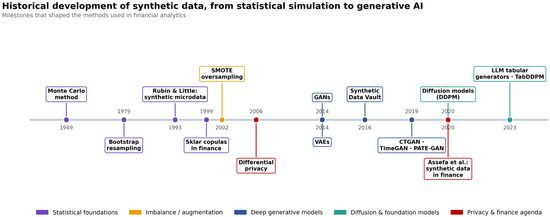
The idea is considerably older than the current deep-learning wave (Figure 1). Its statistical roots lie in Monte Carlo experimentation, introduced in the late 1940s to study systems too complex for closed-form solution [4], and in resampling methods such as the bootstrap, which manufactures new samples from an empirical distribution [5]. The decisive conceptual step for privacy came in 1993, when Rubin and Little independently proposed generating fully or partially synthetic microdata as a principled route to statistical disclosure limitation [6][7]. Their insight—that multiple imputation machinery could be repurposed to release analytically useful data without releasing anyone’s actual record—is the direct ancestor of the modern field.
Figure 1. Historical development of synthetic data, from statistical simulation to generative AI. Milestones are grouped by the methodological family they inaugurated; the acceleration after 2014 corresponds to the deep-generative era documented bibliometrically in Section 3. Source: Authors’ own elaboration [1].
Quantitative finance developed a parallel and equally rich tradition of simulating markets and risk factors. Agent-based artificial markets reproduced stylised facts of returns such as volatility clustering and fat tails [8]; GARCH-type models generated value-at-risk paths [9]; multivariate stochastic-volatility and time-varying density models captured evolving dependence structures [10][11]; nonparametric and kernel methods supported time-series prediction [12]; and copula theory supplied a flexible apparatus for reproducing nonlinear dependence [13][14]. Applied work compared model-generated against real observations for prediction [15], while the plasmode paradigm—resampling real records with known effects injected—showed how realism and controlled ground truth could coexist [16]. For the imbalance problem, the Synthetic Minority Oversampling Technique (SMOTE) interpolated between minority-class neighbours and became the durable baseline against which later generators are measured [17].
The field was then transformed by deep generative modelling. Generative adversarial networks framed generation as a minimax game between two competing networks [18], while variational autoencoders offered a probabilistic, latent-variable alternative [19]. These architectures were rapidly specialised for the tabular and sequential data that dominate finance [20][21][22][23] and coupled with formal privacy guarantees through differential privacy [24][25] and teacher-ensemble mechanisms [26]. Since 2020, denoising diffusion models [27][28] and large language models repurposed as tabular generators [29][30][31] have advanced the frontier further. An influential industry statement of the opportunities and pitfalls of synthetic data in finance crystallised the agenda for the current decade [1].

Scope and Contribution of This Review

Despite this momentum, two gaps persist. The field lacks a consolidated, quantitatively grounded map of its own structure, and practitioners face a fragmented evaluation landscape in which no single metric certifies that synthetic data are simultaneously realistic, useful, and safe [32][33]. This review addresses both. It explains the mechanisms of the principal generators and states their objectives formally, so that the reader understands not merely what each method is called but why it behaves as it does; it characterises the literature empirically through a bibliometric and natural-language-processing analysis of 313 documents; it organises methods into a four-family taxonomy with explicit selection guidance; and it articulates an operational validation framework. Section 2 describes the corpus and analytical pipeline, Section 3 reports the science-mapping results, Section 4 and Section 5 develop generation methods and validation, Section 6 reviews applications, and Section 7 and Section 8 set out future directions and conclusions.

Synthetic, Simulated, Augmented, and Privacy-Preserving Data

Four terms circulate in this literature and are often used interchangeably, although they denote different objects and carry different evidentiary burdens. Simulated data are drawn from a stochastic process specified by the analyst; their properties are known by construction, and the question of whether they resemble any particular real dataset need not arise. Synthetic data are drawn from a model fitted to a specific real dataset with the intention that the two be statistically substitutable, which makes resemblance something to be measured rather than assumed. Augmented data are derived from real records by transformation or interpolation—SMOTE is the canonical financial example—so that every new point remains anchored to observations that exist; augmentation enriches a sample without claiming to replace it. Privacy-preserving synthetic data are synthetic data produced under a mechanism that bounds disclosure risk formally, adding a guarantee that ordinary synthesis does not supply.
The distinction matters because each term implies a different validation obligation: simulated data must be justified by the plausibility of the assumed process, synthetic data by measured fidelity to a reference sample, augmented data by whether the interpolation respects the geometry of the region it fills, and privacy-preserving synthetic data by a declared budget together with an explicit attack model. Conflating them licenses a common inferential slip in which the privacy guarantee attaching to one category is claimed for another. The looseness is visible in the corpus itself: 76 of the 313 documents (24.3%) enter through the phrase ‘simulated data’ without using ‘synthetic data’ anywhere in the title, abstract or keywords; these are predominantly Monte Carlo and econometric studies whose purpose is scenario generation rather than record substitution. Throughout this review, ‘synthetic data’ is used in the narrow sense of model-generated records intended to substitute for real ones, and the other categories are named explicitly wherever they are meant.

References

  1. Assefa, S.A.; Dervovic, D.; Mahfouz, M.; Tillman, R.E.; Reddy, P.; Veloso, M. Generating Synthetic Data in Finance: Opportunities, Challenges and Pitfalls. In Proceedings of the First ACM International Conference on AI in Finance (ICAIF), New York, NY, USA, 15–16 October 2020; pp. 1–8.
  2. Jordon, J.; Szpruch, L.; Houssiau, F.; Bottarelli, M.; Cherubin, G.; Maple, C.; Cohen, S.N.; Weller, A. Synthetic Data—What, Why and How? arXiv 2022, arXiv:2205.03257.
  3. Nikolenko, S.I. Synthetic Data for Deep Learning; Springer Optimization and Its Applications; Springer: Cham, Switzerland, 2021; Volume 174.
  4. Metropolis, N.; Ulam, S. The Monte Carlo Method. J. Am. Stat. Assoc. 1949, 44, 335–341.
  5. Efron, B. Bootstrap Methods: Another Look at the Jackknife. Ann. Stat. 1979, 7, 1–26.
  6. Rubin, D.B. Statistical Disclosure Limitation. J. Off. Stat. 1993, 9, 461–468.
  7. Little, R.J.A. Statistical Analysis of Masked Data. J. Off. Stat. 1993, 9, 407–426.
  8. Chen, S.-H.; Lux, T.; Marchesi, M. Testing for Non-Linear Structure in an Artificial Financial Market. J. Econ. Behav. Organ. 2001, 46, 327–342.
  9. Hartz, C.; Mittnik, S.; Paolella, M. Accurate Value-at-Risk Forecasting Based on the Normal-GARCH Model. Comput. Stat. Data Anal. 2006, 51, 2295–2312.
  10. Asai, M.; McAleer, M. The Structure of Dynamic Correlations in Multivariate Stochastic Volatility Models. J. Econom. 2009, 150, 182–192.
  11. Billio, M.; Casarin, R.; Ravazzolo, F.; van Dijk, H.K. Time-Varying Combinations of Predictive Densities Using Nonlinear Filtering. J. Econom. 2013, 177, 213–232.
  12. Yang, H.; Huang, K.; King, I.; Lyu, M.R. Localized Support Vector Regression for Time Series Prediction. Neurocomputing 2009, 72, 2659–2669.
  13. Sklar, A. Fonctions de Répartition à n Dimensions et Leurs Marges. Publ. Inst. Stat. Univ. Paris 1959, 8, 229–231.
  14. Nelsen, R.B. An Introduction to Copulas, 2nd ed.; Springer Series in Statistics; Springer: New York, NY, USA, 2006.
  15. West, P.M.; Brockett, P.L.; Golden, L.L. A Comparative Analysis of Neural Networks and Statistical Methods for Predicting Consumer Choice. Mark. Sci. 1997, 16, 370–391.
  16. Franklin, J.M.; Schneeweiss, S.; Polinski, J.M.; Rassen, J.A. Plasmode Simulation for the Evaluation of Pharmacoepidemiologic Methods in Complex Healthcare Databases. Comput. Stat. Data Anal. 2014, 72, 219–226.
  17. Chawla, N.V.; Bowyer, K.W.; Hall, L.O.; Kegelmeyer, W.P. SMOTE: Synthetic Minority Over-Sampling Technique. J. Artif. Intell. Res. 2002, 16, 321–357.
  18. Goodfellow, I.; Pouget-Abadie, J.; Mirza, M.; Xu, B.; Warde-Farley, D.; Ozair, S.; Courville, A.; Bengio, Y. Generative Adversarial Nets. In Advances in Neural Information Processing Systems (NeurIPS); Curran Associates: Red Hook, NY, USA, 2014; Volume 27, pp. 2672–2680.
  19. Kingma, D.P.; Welling, M. Auto-Encoding Variational Bayes. In Proceedings of the 2nd International Conference on Learning Representations (ICLR), Banff, AB, Canada, 14–16 April 2014.
  20. Xu, L.; Skoularidou, M.; Cuesta-Infante, A.; Veeramachaneni, K. Modeling Tabular Data Using Conditional GAN. In Advances in Neural Information Processing Systems (NeurIPS); Curran Associates: Red Hook, NY, USA, 2019; Volume 32, pp. 7335–7345.
  21. Esteban, C.; Hyland, S.L.; Rätsch, G. Real-Valued (Medical) Time Series Generation with Recurrent Conditional GANs. arXiv 2017, arXiv:1706.02633.
  22. Yoon, J.; Jarrett, D.; van der Schaar, M. Time-Series Generative Adversarial Networks. In Advances in Neural Information Processing Systems (NeurIPS); Curran Associates: Red Hook, NY, USA, 2019; Volume 32, pp. 5508–5518.
  23. Patki, N.; Wedge, R.; Veeramachaneni, K. The Synthetic Data Vault. In Proceedings of the IEEE International Conference on Data Science and Advanced Analytics (DSAA), Montreal, QC, Canada, 17–19 October 2016; pp. 399–410.
  24. Dwork, C. Differential Privacy. In Automata, Languages and Programming (ICALP); Lecture Notes in Computer Science; Springer: Berlin/Heidelberg, Germany, 2006; Volume 4052, pp. 1–12.
  25. Dwork, C.; Roth, A. The Algorithmic Foundations of Differential Privacy. Found. Trends Theor. Comput. Sci. 2014, 9, 211–407.
  26. Jordon, J.; Yoon, J.; van der Schaar, M. PATE-GAN: Generating Synthetic Data with Differential Privacy Guarantees. In Proceedings of the 7th International Conference on Learning Representations (ICLR), New Orleans, LA, USA, 6–9 May 2019.
  27. Ho, J.; Jain, A.; Abbeel, P. Denoising Diffusion Probabilistic Models. In Advances in Neural Information Processing Systems (NeurIPS); Curran Associates: Red Hook, NY, USA, 2020; Volume 33, pp. 6840–6851.
  28. Sohl-Dickstein, J.; Weiss, E.; Maheswaranathan, N.; Ganguli, S. Deep Unsupervised Learning Using Nonequilibrium Thermodynamics. In Proceedings of the 32nd International Conference on Machine Learning (ICML), Lille, France, 6–11 July 2015; pp. 2256–2265.
  29. Brown, T.B.; Mann, B.; Ryder, N.; Subbiah, M.; Kaplan, J.; Dhariwal, P.; Neelakantan, A.; Shyam, P.; Sastry, G.; Askell, A.; et al. Language Models Are Few-Shot Learners. In Advances in Neural Information Processing Systems (NeurIPS); Curran Associates: Red Hook, NY, USA, 2020; Volume 33, pp. 1877–1901.
  30. Borisov, V.; Seßler, K.; Leemann, T.; Pawelczyk, M.; Kasneci, G. Language Models Are Realistic Tabular Data Generators. In Proceedings of the 11th International Conference on Learning Representations (ICLR), Kigali, Rwanda, 1–5 May 2023.
  31. Kotelnikov, A.; Baranchuk, D.; Rubachev, I.; Babenko, A. TabDDPM: Modelling Tabular Data with Diffusion Models. In Proceedings of the 40th International Conference on Machine Learning (ICML), Honolulu, HI, USA, 23–29 July 2023; pp. 17564–17579.
  32. Alaa, A.; van Breugel, B.; Saveliev, E.S.; van der Schaar, M. How Faithful Is Your Synthetic Data? Sample-Level Metrics for Evaluating and Auditing Generative Models. In Proceedings of the 39th International Conference on Machine Learning (ICML), Baltimore, MD, USA, 17–23 July 2022; pp. 290–306.
  33. van Breugel, B.; van der Schaar, M. Beyond Privacy: Navigating the Opportunities and Challenges of Synthetic Data. arXiv 2023, arXiv:2304.03722.

More
Upload a video for this entry
Information
Subjects: Business, Finance
Contributors MDPI registered users' name will be linked to their SciProfiles pages. To register with us, please refer to https://encyclopedia.pub/register : Alexander Haro-Sarango , , Silvia Cachay-Salcedo , Jessica Saavedra-Vasconez , , Briseida Sotelo-Castro , Carlos Eduardo Saavedra-Vasconez
View Times: 4
Online Date: 12 Nov 2026
Notice
You are not a member of the advisory board for this topic. If you want to update advisory board member profile, please contact office@encyclopedia.pub.
OK
Confirm
Only members of the Encyclopedia advisory board for this topic are allowed to note entries. Would you like to become an advisory board member of the Encyclopedia?
Yes
No
${ textCharacter }/${ maxCharacter }
Submit
Cancel
There is no comment~
${ textCharacter }/${ maxCharacter }
Submit
Cancel
${ selectedItem.replyTextCharacter }/${ selectedItem.replyMaxCharacter }
Submit
Cancel
Confirm
Are you sure to Delete?
Yes No
Write an Entry