
Synthetic data generation has become a strategic capability in financial analytics, promising to reconcile the sector’s appetite for data-hungry machine learning with strict privacy, confidentiality, and regulatory constraints. This review provides a structured, evidence-based account of the field that is both conceptual and empirical. On the conceptual side, it explains how the principal generators work, states their objectives formally, and derives the practical consequences of each mechanism for financial data; it then organises evaluation into an operational fidelity–utility–privacy framework, extends it to incorporate the fairness and model-risk requirements imposed by regulated lending and insurance and the validation constraints that differ by data type, and offers explicit guidance on selecting a generator. On the empirical side, it maps the intellectual structure of the field through a science-mapping study of 313 Scopus-indexed documents (1997–2026) retrieved with a four-block Boolean query executed on 27 July 2026 and screened from 591 retrieved records. Performance analysis reveals sustained exponential growth, at an annual rate of 14.1% to 17.5% depending on how the endpoints are set, with 2026 covering only the first 208 days of the year, and 73.8% of output published since 2023. The corpus has accumulated 4359 citations with an h-index of 35 and pronounced inequality (Gini = 0.737; 26.2% of documents uncited), although 96.3% of the uncited documents appeared in 2025 or 2026 and the Gini falls to 0.599 once the analysis is restricted to documents with at least eighteen months of citation exposure, so these figures reflect the citation window as much as scientific impact. Co-word analysis, a strategic thematic map computed from the equivalence index, and an unsupervised clustering pipeline validated using the silhouette, Davies–Bouldin, and Calinski–Harabasz indices, together with seed, subsample, and specification stability tests, identify five overlapping and provisional research fronts: risk modelling and Monte Carlo simulation; fraud and credit-risk detection under class imbalance; privacy-preserving generation; machine-learning analytics and benchmarking; and biomedical simulation methods transferable to finance. The internal validation indices are weak in absolute terms, so these fronts are best read as an exploratory summary of a densely connected intellectual space rather than as sharply delineated lines of enquiry. We conclude that the field’s binding constraint has shifted from generation to certification: realistic financial data can now be produced, but the evidence that would establish a given synthetic dataset as simultaneously realistic, useful and safe—downstream performance on representative financial tasks, quantified disclosure risk, and robustness across market regimes—is still assembled on a study-by-study basis rather than through shared benchmarks.
- synthetic data
- financial analytics
- generative adversarial networks
- variational autoencoders
- diffusion models
- differential privacy
- data validation
- bibliometric analysis
- topic modelling
- credit risk
The Problem Synthetic Data Solve
Intellectual Lineage
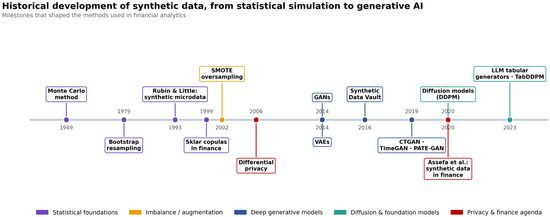
Scope and Contribution of This Review
Synthetic, Simulated, Augmented, and Privacy-Preserving Data
References
- Assefa, S.A.; Dervovic, D.; Mahfouz, M.; Tillman, R.E.; Reddy, P.; Veloso, M. Generating Synthetic Data in Finance: Opportunities, Challenges and Pitfalls. In Proceedings of the First ACM International Conference on AI in Finance (ICAIF), New York, NY, USA, 15–16 October 2020; pp. 1–8.
- Jordon, J.; Szpruch, L.; Houssiau, F.; Bottarelli, M.; Cherubin, G.; Maple, C.; Cohen, S.N.; Weller, A. Synthetic Data—What, Why and How? arXiv 2022, arXiv:2205.03257.
- Nikolenko, S.I. Synthetic Data for Deep Learning; Springer Optimization and Its Applications; Springer: Cham, Switzerland, 2021; Volume 174.
- Metropolis, N.; Ulam, S. The Monte Carlo Method. J. Am. Stat. Assoc. 1949, 44, 335–341.
- Efron, B. Bootstrap Methods: Another Look at the Jackknife. Ann. Stat. 1979, 7, 1–26.
- Rubin, D.B. Statistical Disclosure Limitation. J. Off. Stat. 1993, 9, 461–468.
- Little, R.J.A. Statistical Analysis of Masked Data. J. Off. Stat. 1993, 9, 407–426.
- Chen, S.-H.; Lux, T.; Marchesi, M. Testing for Non-Linear Structure in an Artificial Financial Market. J. Econ. Behav. Organ. 2001, 46, 327–342.
- Hartz, C.; Mittnik, S.; Paolella, M. Accurate Value-at-Risk Forecasting Based on the Normal-GARCH Model. Comput. Stat. Data Anal. 2006, 51, 2295–2312.
- Asai, M.; McAleer, M. The Structure of Dynamic Correlations in Multivariate Stochastic Volatility Models. J. Econom. 2009, 150, 182–192.
- Billio, M.; Casarin, R.; Ravazzolo, F.; van Dijk, H.K. Time-Varying Combinations of Predictive Densities Using Nonlinear Filtering. J. Econom. 2013, 177, 213–232.
- Yang, H.; Huang, K.; King, I.; Lyu, M.R. Localized Support Vector Regression for Time Series Prediction. Neurocomputing 2009, 72, 2659–2669.
- Sklar, A. Fonctions de Répartition à n Dimensions et Leurs Marges. Publ. Inst. Stat. Univ. Paris 1959, 8, 229–231.
- Nelsen, R.B. An Introduction to Copulas, 2nd ed.; Springer Series in Statistics; Springer: New York, NY, USA, 2006.
- West, P.M.; Brockett, P.L.; Golden, L.L. A Comparative Analysis of Neural Networks and Statistical Methods for Predicting Consumer Choice. Mark. Sci. 1997, 16, 370–391.
- Franklin, J.M.; Schneeweiss, S.; Polinski, J.M.; Rassen, J.A. Plasmode Simulation for the Evaluation of Pharmacoepidemiologic Methods in Complex Healthcare Databases. Comput. Stat. Data Anal. 2014, 72, 219–226.
- Chawla, N.V.; Bowyer, K.W.; Hall, L.O.; Kegelmeyer, W.P. SMOTE: Synthetic Minority Over-Sampling Technique. J. Artif. Intell. Res. 2002, 16, 321–357.
- Goodfellow, I.; Pouget-Abadie, J.; Mirza, M.; Xu, B.; Warde-Farley, D.; Ozair, S.; Courville, A.; Bengio, Y. Generative Adversarial Nets. In Advances in Neural Information Processing Systems (NeurIPS); Curran Associates: Red Hook, NY, USA, 2014; Volume 27, pp. 2672–2680.
- Kingma, D.P.; Welling, M. Auto-Encoding Variational Bayes. In Proceedings of the 2nd International Conference on Learning Representations (ICLR), Banff, AB, Canada, 14–16 April 2014.
- Xu, L.; Skoularidou, M.; Cuesta-Infante, A.; Veeramachaneni, K. Modeling Tabular Data Using Conditional GAN. In Advances in Neural Information Processing Systems (NeurIPS); Curran Associates: Red Hook, NY, USA, 2019; Volume 32, pp. 7335–7345.
- Esteban, C.; Hyland, S.L.; Rätsch, G. Real-Valued (Medical) Time Series Generation with Recurrent Conditional GANs. arXiv 2017, arXiv:1706.02633.
- Yoon, J.; Jarrett, D.; van der Schaar, M. Time-Series Generative Adversarial Networks. In Advances in Neural Information Processing Systems (NeurIPS); Curran Associates: Red Hook, NY, USA, 2019; Volume 32, pp. 5508–5518.
- Patki, N.; Wedge, R.; Veeramachaneni, K. The Synthetic Data Vault. In Proceedings of the IEEE International Conference on Data Science and Advanced Analytics (DSAA), Montreal, QC, Canada, 17–19 October 2016; pp. 399–410.
- Dwork, C. Differential Privacy. In Automata, Languages and Programming (ICALP); Lecture Notes in Computer Science; Springer: Berlin/Heidelberg, Germany, 2006; Volume 4052, pp. 1–12.
- Dwork, C.; Roth, A. The Algorithmic Foundations of Differential Privacy. Found. Trends Theor. Comput. Sci. 2014, 9, 211–407.
- Jordon, J.; Yoon, J.; van der Schaar, M. PATE-GAN: Generating Synthetic Data with Differential Privacy Guarantees. In Proceedings of the 7th International Conference on Learning Representations (ICLR), New Orleans, LA, USA, 6–9 May 2019.
- Ho, J.; Jain, A.; Abbeel, P. Denoising Diffusion Probabilistic Models. In Advances in Neural Information Processing Systems (NeurIPS); Curran Associates: Red Hook, NY, USA, 2020; Volume 33, pp. 6840–6851.
- Sohl-Dickstein, J.; Weiss, E.; Maheswaranathan, N.; Ganguli, S. Deep Unsupervised Learning Using Nonequilibrium Thermodynamics. In Proceedings of the 32nd International Conference on Machine Learning (ICML), Lille, France, 6–11 July 2015; pp. 2256–2265.
- Brown, T.B.; Mann, B.; Ryder, N.; Subbiah, M.; Kaplan, J.; Dhariwal, P.; Neelakantan, A.; Shyam, P.; Sastry, G.; Askell, A.; et al. Language Models Are Few-Shot Learners. In Advances in Neural Information Processing Systems (NeurIPS); Curran Associates: Red Hook, NY, USA, 2020; Volume 33, pp. 1877–1901.
- Borisov, V.; Seßler, K.; Leemann, T.; Pawelczyk, M.; Kasneci, G. Language Models Are Realistic Tabular Data Generators. In Proceedings of the 11th International Conference on Learning Representations (ICLR), Kigali, Rwanda, 1–5 May 2023.
- Kotelnikov, A.; Baranchuk, D.; Rubachev, I.; Babenko, A. TabDDPM: Modelling Tabular Data with Diffusion Models. In Proceedings of the 40th International Conference on Machine Learning (ICML), Honolulu, HI, USA, 23–29 July 2023; pp. 17564–17579.
- Alaa, A.; van Breugel, B.; Saveliev, E.S.; van der Schaar, M. How Faithful Is Your Synthetic Data? Sample-Level Metrics for Evaluating and Auditing Generative Models. In Proceedings of the 39th International Conference on Machine Learning (ICML), Baltimore, MD, USA, 17–23 July 2022; pp. 290–306.
- van Breugel, B.; van der Schaar, M. Beyond Privacy: Navigating the Opportunities and Challenges of Synthetic Data. arXiv 2023, arXiv:2304.03722.