

 +1 credit
| Version | Summary | Created by | Modification | Content Size | Created at | Operation |
|---|---|---|---|---|---|---|
| 1 | Umaima Gazal | -- | 1624 | 2026-10-27 07:18:05 | | | |
| 2 | Catherine Yang | Meta information modification | 1624 | 2026-10-27 08:53:56 | | |
Video Upload Options
Metal Oxide Nanocomposites for Environmental Photocatalysis
EditMetal oxide nanocomposites are multicomponent semiconductor materials of growing interest for environmental photocatalysis owing to their tunable structural, optical, and electronic properties. Among these materials, ZnO–CeO₂–TiO₂ ternary nanocomposites combine the distinctive characteristics of zinc oxide, cerium dioxide, and titanium dioxide, offering opportunities to modify phase composition, crystallinity, defect structures, and light absorption behavior. Their physicochemical properties are strongly influenced by synthesis conditions and subsequent thermal treatment. Co-precipitation provides a relatively simple and cost-effective approach for preparing ternary metal oxide nanocomposites. Calcination can further influence crystal growth, lattice imperfections, surface hydroxyl groups, and optical characteristics. Structural and spectroscopic techniques, including X-ray diffraction (XRD), Fourier-transform infrared spectroscopy (FTIR), and ultraviolet–visible spectroscopy, are essential for examining these changes and establishing relationships between material structure and optical response. Metal oxide nanocomposites have been investigated in the broader scientific literature for light-driven environmental applications, particularly the degradation of organic pollutants in aqueous systems. However, favorable structural and optical properties alone do not establish photocatalytic efficiency, which requires experimental evaluation under defined reaction conditions. This entry presents an overview of the synthesis, structural characteristics, optical behavior, and potential environmental applications of metal oxide nanocomposites, with particular emphasis on ZnO–CeO₂–TiO₂ systems. It also discusses the importance of thermal treatment, material characterization, and future investigations into photocatalytic activity, degradation kinetics, and catalyst stability for wastewater treatment applications.
1. Introduction
Semiconductor metal oxide nanocomposites have attracted considerable scientific interest owing to their tunable structural, optical, electronic, and surface properties. The integration of two or more metal oxides within a single material system offers opportunities to modify crystallinity, defect concentration, interfacial interactions, and light absorption behaviour. These characteristics are particularly relevant to environmental photocatalysis, in which semiconductor materials utilize incident light to initiate oxidation and reduction reactions capable of transforming organic contaminants [1][2][3].
Among commonly investigated metal oxide semiconductors, zinc oxide (ZnO), titanium dioxide (TiO₂), and cerium dioxide (CeO₂) are of particular interest because of their distinctive physicochemical characteristics. ZnO exhibits strong ultraviolet absorption and wide-bandgap semiconductor behaviour, while TiO₂, particularly its anatase crystalline phase, is extensively investigated for photocatalytic applications. CeO₂ is characterized by its reversible Ce³⁺/Ce⁴⁺ redox behaviour and oxygen-vacancy chemistry, which can influence defect states and interfacial charge-transfer processes. The combination of these metal oxides into binary or ternary nanocomposites provides opportunities to modify electronic interactions, structural characteristics, and optical properties [4].
Despite their advantageous properties, individual metal oxide semiconductors often exhibit limitations, including rapid recombination of photogenerated charge carriers and restricted absorption within the visible region of the solar spectrum. These limitations have encouraged research into multicomponent semiconductor systems in which interactions between different oxide phases may facilitate charge separation and alter photocatalytic behaviour. However, enhanced photocatalytic activity is not an inherent consequence of composite formation and must be established through appropriate experimental investigations [2][3].
Several preparation techniques, including sol–gel synthesis, hydrothermal and solvothermal methods, ultrasonic-assisted processing, and co-precipitation, have been employed for producing metal oxide nanocomposites. The selected synthesis method influences particle formation, crystallinity, composition, structural ordering, and surface characteristics. Co-precipitation is particularly attractive because of its relatively simple experimental procedure, cost-effectiveness, and potential applicability to the preparation of multicomponent oxide materials [4].
Thermal treatment is another important factor influencing the physicochemical properties of metal oxide nanocomposites. Calcination can promote crystalline phase development, increase crystallite size, reduce certain lattice imperfections, and modify surface hydroxyl groups and optical absorption characteristics. In a reported investigation of ZnO–CeO₂–TiO₂ ternary nanocomposites synthesized through co-precipitation, calcination at 600°C improved crystallinity, increased average crystallite size, and reduced microstrain and dislocation density. X-ray diffraction, Fourier-transform infrared spectroscopy, and ultraviolet–visible spectroscopy provided complementary information regarding phase composition, metal–oxygen bonding, and optical behaviour [4].
The environmental relevance of semiconductor metal oxide nanocomposites is associated with their potential application in light-driven pollutant transformation. Under suitable illumination, photogenerated electrons and holes can participate in surface reactions involving water, oxygen, and adsorbed chemical species. These reactions may lead to the generation of reactive intermediates capable of degrading certain organic contaminants. Nevertheless, photocatalytic performance depends on several factors, including catalyst composition, surface chemistry, incident light, pollutant concentration, reaction conditions, and charge-carrier recombination [2][3].
This entry provides an overview of metal oxide nanocomposites, with particular emphasis on ZnO-, TiO₂-, and CeO₂-based semiconductor systems. It discusses their synthesis methods, structural and optical properties, effects of calcination, fundamental photocatalytic mechanisms, and potential environmental applications. Attention is also given to current challenges and future research directions, including photocatalytic activity assessment, degradation kinetics, catalyst stability, and reusability in wastewater treatment applications.
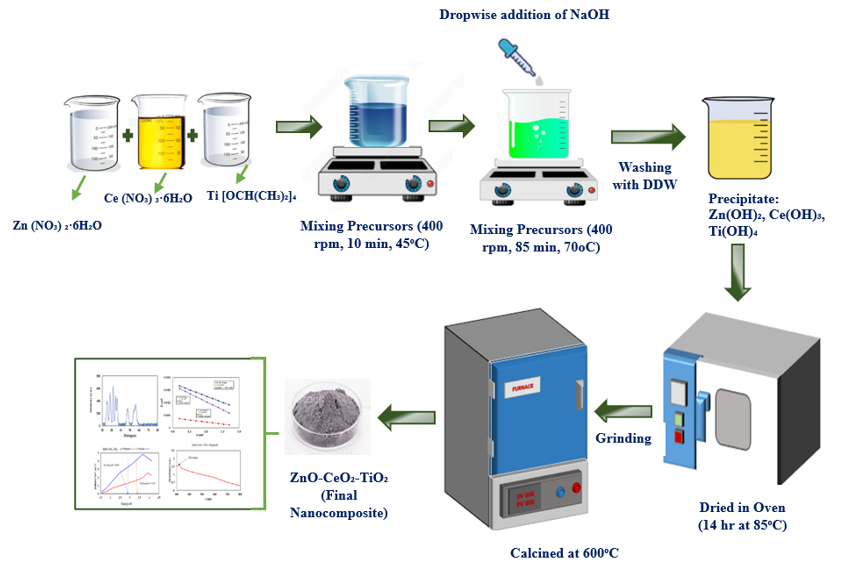
Figure 1. Graphical overview of the synthesis route and physicochemical characterization of ZnO–CeO₂–TiO₂ ternary nanocomposites relevant to environmental photocatalysis.
2. Structural Characteristics of Metal Oxide Nanocomposites
Metal oxide nanocomposites can contain multiple crystalline phases with distinct structural and electronic characteristics. Zinc oxide commonly crystallizes in a hexagonal wurtzite structure, cerium dioxide exhibits a cubic fluorite structure, and titanium dioxide occurs in several crystalline forms, including anatase and rutile. The structural arrangement and interactions among these oxide phases influence the physicochemical characteristics of multicomponent materials.
X-ray diffraction (XRD) is widely employed to identify crystalline phases, examine crystallinity, and estimate crystallite size. In ZnO–CeO₂–TiO₂ ternary nanocomposites prepared through co-precipitation, the coexistence of hexagonal ZnO, cubic CeO₂, and tetragonal anatase TiO₂ has been experimentally demonstrated. Characteristic diffraction reflections confirmed the multiphase nature of the synthesized material.
The evaluation of crystallite size, microstrain, and dislocation density provides additional information about structural ordering and lattice imperfections. The Debye–Scherrer equation is commonly used to estimate crystallite size from diffraction peak broadening, whereas the Williamson–Hall method considers contributions from both crystallite size and lattice strain. These methods help evaluate microstructural modifications associated with synthesis and thermal treatment [3].
3. Influence of Calcination on Structural and Optical Properties
Calcination is an important post-synthesis treatment affecting crystalline development, particle growth, and surface chemistry in metal oxide nanocomposites. During thermal processing, residual precursor species and adsorbed moisture may be removed, while crystallites can grow and lattice imperfections undergo partial relaxation. The resulting structural changes depend on calcination temperature, treatment duration, material composition, and initial synthesis conditions.
A comparative investigation of as-prepared and calcined ZnO–CeO₂–TiO₂ ternary nanocomposites demonstrated that thermal treatment at 600°C improved crystallinity without introducing detectable phase transformations. The calcined material showed increased diffraction peak intensity and reduced peak broadening. Crystallite growth was accompanied by decreases in microstrain and dislocation density for the constituent oxide phases [3].
Fourier-transform infrared spectroscopy (FTIR) provides information about chemical bonding and surface-associated functional groups. In multicomponent oxide materials, metal–oxygen vibrational bands may overlap because the constituent oxides exhibit absorption features in similar spectral regions. Thermal treatment can also decrease absorption associated with hydroxyl groups and adsorbed water.
Optical properties are commonly investigated using ultraviolet–visible spectroscopy. For ZnO–CeO₂–TiO₂ nanocomposites, strong ultraviolet absorption was observed before and after calcination. The absorption maximum shifted from approximately 338.44 nm in the as-prepared sample to 316.14 nm after calcination at 600°C [3]. These findings illustrate the influence of thermal treatment on the optical response of the ternary oxide system.
Although structural and optical characterization can provide information relevant to photocatalytic material design, such results do not independently demonstrate photocatalytic efficiency.
4. Fundamental Mechanisms of Environmental Photocatalysis
Semiconductor photocatalysis involves the absorption of photons with sufficient energy to promote electrons from the valence band to the conduction band, leaving positively charged holes in the valence band. These photogenerated charge carriers may participate in oxidation and reduction reactions at the semiconductor surface.
Conduction-band electrons can participate in the reduction of adsorbed oxygen, potentially generating reactive oxygen species such as superoxide radicals. Valence-band holes may oxidize suitable adsorbed species or participate in processes leading to hydroxyl radical formation. The occurrence of these pathways depends on semiconductor band-edge positions, reaction conditions, and the availability of surface reactants.
Reactive oxygen species and photogenerated holes may contribute to the transformation of organic contaminants into intermediate products and, under suitable conditions, further oxidation products. The reaction mechanism depends on the chemical nature of the pollutant and the properties of the photocatalyst.
A major limitation of semiconductor photocatalysis is the recombination of photogenerated electrons and holes before they participate in surface reactions. The incorporation of different semiconductor phases into composite materials may create interfacial pathways that influence charge separation and transport. Nevertheless, these effects depend on the actual electronic structure and contact between the constituent phases. Improved performance must therefore be established experimentally rather than assumed from composite formation alone [1][4].
5. Environmental Applications and Future Perspectives
Metal oxide semiconductor photocatalysts have been widely investigated for environmental applications, particularly the transformation of organic contaminants in aqueous systems. Research involving TiO₂, ZnO, and related semiconductor materials has examined the degradation of dyes and other organic pollutants under ultraviolet or visible illumination.
The development of multicomponent oxide nanocomposites provides opportunities to tailor structural, optical, and surface properties for these applications. However, several factors must be evaluated before a material can be considered suitable for practical wastewater treatment. These include its activity under defined illumination conditions, pollutant degradation kinetics, possible formation of intermediate products, catalyst stability, material recovery, and reusability.
Controlled photocatalytic experiments are necessary to determine the relationship between material properties and observed reaction performance. Appropriate investigations may include comparison with single-oxide materials, dark adsorption controls, light-only controls, and evaluation of catalyst behaviour during repeated treatment cycles.
Future studies of ZnO–CeO₂–TiO₂ ternary nanocomposites may investigate how calcination-induced changes in crystallinity, defect characteristics, and optical response influence photocatalytic behaviour. Such work could extend existing physicochemical characterization studies toward functional performance evaluation.
The broader development of environmentally relevant metal oxide nanocomposites requires an integrated understanding of synthesis, crystal structure, optical properties, surface reactions, and experimental photocatalytic performance. Establishing these relationships is essential for evaluating their potential applications in sustainable environmental remediation.
References
- Jenny Schneider *; Masaya Matsuoka; Masato Takeuchi; Jinlong Zhang; Yu Horiuchi; Masakazu Anpo; Detlef W. Bahnemann *. Understanding TiO2 Photocatalysis: Mechanisms and Materials. Chemical Reviews 2014, 114, 19. [CrossRef]
- Akira Fujishima; Kenichi Honda; Electrochemical Photolysis of Water at a Semiconductor Electrode. Nature 1972, 238, 37-38. [CrossRef]
- Gazal, U. Effect of Calcination on the Structural and Optical Characteristics of ZnO–CeO₂–TiO₂ Ternary Nanocomposites Synthesized by Co-Precipitation. Russian Journal of Physical Chemistry A 2026, 100, 1250–1258. [CrossRef]
- Michael R. Hoffmann; Scot T. Martin; Wonyong Choi; Detlef W. Bahnemann; Environmental Applications of Semiconductor Photocatalysis. Chem. Rev. 1995, 95, 69-96. [CrossRef]




