

Your browser does not fully support modern features. Please upgrade for a smoother experience.
Submitted Successfully!
Thank you for your contribution! You can also upload a video entry or images related to this topic. For video creation, please contact our Academic Video Service.
Version Summary Created by Modification Content Size Created at Operation
1 Alam Ahmad -- 1225 2026-09-17 07:21:48 |
2 Format Correction Abigail Zou Meta information modification 1225 2026-09-17 07:24:51 |

Video Upload Options

We provide professional Academic Video Service to translate complex research into visually appealing presentations. Would you like to try it?
Cite
If you have any further questions, please contact Encyclopedia Editorial Office.
Ahmad, A. From Cryptocurrencies to CBDCs: A Scoping–Integrative Review Proposing a Digital Money Ecosystem Taxonomy (DMET). Encyclopedia. Available online: https://encyclopedia.pub/entry/60082 (accessed on 25 September 2026).
Ahmad A. From Cryptocurrencies to CBDCs: A Scoping–Integrative Review Proposing a Digital Money Ecosystem Taxonomy (DMET). Encyclopedia. Available at: https://encyclopedia.pub/entry/60082. Accessed September 25, 2026.
Ahmad, Alam. "From Cryptocurrencies to CBDCs: A Scoping–Integrative Review Proposing a Digital Money Ecosystem Taxonomy (DMET)" Encyclopedia, https://encyclopedia.pub/entry/60082 (accessed September 25, 2026).
Ahmad, A. (2026, September 17). From Cryptocurrencies to CBDCs: A Scoping–Integrative Review Proposing a Digital Money Ecosystem Taxonomy (DMET). In Encyclopedia. https://encyclopedia.pub/entry/60082
Ahmad, Alam. "From Cryptocurrencies to CBDCs: A Scoping–Integrative Review Proposing a Digital Money Ecosystem Taxonomy (DMET)." Encyclopedia. Web. 17 September, 2026.
Peer Reviewed
From Cryptocurrencies to CBDCs: A Scoping–Integrative Review Proposing a Digital Money Ecosystem Taxonomy (DMET)

Digital money has transformed from a technological experiment into a central concern of monetary economics, financial regulation, and public policy. Despite rapid growth in cryptocurrencies, stablecoins, central bank digital currencies (CBDCs), and tokenized deposits, the literature remains fragmented across disciplines, with limited cross-cutting synthesis. This article adopts a scoping–integrative review methodology, combining systematic database (Scopus and Web of Science) searches with targeted retrieval of policy and institutional sources (BIS, IMF, Financial Stability Board (FSB), ECB, and national central bank repositories), covering the period 2008–2025, with integrative synthesis of academic, policy, and regulatory sources following PRISMA-ScR reporting principles. The review identifies four competing trust mechanisms underpinning digital money: algorithmic trust associated primarily with cryptocurrencies, private reserve backing trust (stablecoins), sovereign trust underpinning CBDCs, and regulated institutional intermediation supporting tokenized deposits. The proposed digital money ecosystem taxonomy (DMET) classifies digital money instruments across fourteen institutional, governance, technological, monetary, and regulatory dimensions, enabling systematic comparison of cryptocurrencies, stablecoins, CBDCs, and tokenized deposits. Future monetary systems will be hybrid, combining public and private digital money within layered governance arrangements. Interoperability, privacy, programmability, and cross-border governance represent the most critical unresolved policy and research challenges.
digital money cryptocurrencies stablecoins central bank digital currencies CBDC blockchain tokenized money tokenized deposits payment systems monetary sovereignty
Money is simultaneously a technological artefact and an institutional arrangement. Commodity money depended on the material scarcity of physical objects, fiat money depends on state authority, legal tender legislation, and public confidence, commercial bank deposits depend on regulated financial intermediation, and contemporary digital money increasingly depends on software architectures, data governance, cryptographic protocols, and platform infrastructures. The ongoing transformation of money, therefore, cannot be reduced to mere digitization. It represents a deeper reconfiguration of the institutions and technologies through which value is issued, transferred, stored, and governed across economies [1].
The global debate on digital money was catalyzed by the publication of the Bitcoin white paper in 2008 and the subsequent launch of the Bitcoin network in 2009 [2]. Bitcoin introduced a novel monetary architecture, which is a decentralized, peer-to-peer electronic cash system operating without central intermediaries, relying instead on cryptographic proof and distributed consensus. This innovation challenged foundational assumptions in monetary economics, particularly the necessity of centralized issuance, the role of trusted intermediaries, and the relationship between money and state sovereignty [3][4].
The subsequent decade witnessed an explosion of cryptocurrency experimentation, including alternative consensus mechanisms (proof-of-stake (PoS) and delegated proof-of-stake (PoS)), smart contract platforms (Ethereum, Solana, and Cardano), privacy-focused protocols (Monero and Zcash), and decentralized finance (DeFi) applications that replicate traditional financial services, including lending, borrowing, trading, and derivatives on blockchain infrastructure without traditional intermediaries [5][6]. As of May 2026, cryptocurrency market capitalization stood at approximately USD 2.56 trillion per CoinMarketCap [7], with thousands of digital assets in circulation and millions of users globally [8]. But the extreme price volatility of cryptocurrencies, such as Bitcoin, whose price fluctuated between USD 3000 and USD 69,000 between 2018 and 2021, has limited their utility as media of exchange or stable stores of value [9]. This volatility problem catalyzed the emergence of stablecoins: digital tokens designed to maintain stable value by pegging to fiat currencies (typically the US dollar), commodities, or algorithmic mechanisms [10]. Stablecoins, such as Tether (USDT), USD Coin (USDC), and Binance USD (BUSD), rapidly gained adoption in cryptocurrency trading, cross-border remittances, and DeFi protocols, with aggregate market capitalization exceeding USD 150 billion by 2024 [11], more than doubling to more than USD 300 billion as of May 2026, per DefiLlama [12]. However, BUSD circulation subsequently declined after Paxos ceased issuing new BUSD in February 2023.
The rise of cryptocurrencies and stablecoins, particularly Facebook’s 2019 announcement of the Libra project (later rebranded as Diem before abandonment in 2022), prompted central banks worldwide to accelerate research and development of central bank digital currencies (CBDCs) [13]. CBDCs represent sovereign digital money: direct liabilities of central banks, issued in digital form, potentially accessible to the general public (retail CBDC) or restricted to financial institutions (wholesale CBDC) [14]. By May 2026, 146 countries/currency unions representing 98% of global GDP were exploring CBDCs [15], with more than 20 countries having launched pilot programs or full implementations, including the Bahamas (Sand Dollar, 2020), Nigeria (eNaira, 2021), Jamaica (JAM-DEX, 2022), and China (e-CNY, ongoing pilot since 2020) [15].
More recently, tokenized deposits have emerged as a fourth pillar of the digital money ecosystem. Tokenized deposits represent commercial bank deposits issued on distributed ledger technology (DLT), combining the regulatory protections and deposit insurance of traditional banking with the programmability and composability of blockchain-based assets [16]. Major financial institutions, including JPMorgan, Citibank, HSBC, and Standard Chartered, have launched tokenized deposit pilots, and the Bank for International Settlements (BIS) has explored tokenized deposits through Project Agorá (2024), examining unified ledgers that integrate wholesale CBDC, tokenized deposits, and tokenized securities [17].
Despite exponential growth in academic research, policy analysis, and industry experimentation, the digital money literature remains fragmented across disciplinary boundaries. Economists focus on monetary policy transmission, financial stability, and macroeconomic implications [18][19]. Computer scientists emphasize cryptographic protocols, consensus mechanisms, scalability, and security. Legal scholars examine regulatory classification, jurisdictional challenges, and compliance frameworks [20][21]. Information systems researchers investigate adoption drivers, user behavior, and platform governance. Public policy analysts address financial inclusion, cross-border payments, and geopolitical implications [22][23]. This disciplinary fragmentation limits holistic understanding of the digital money ecosystem and its systemic implications.
This article addresses this gap through a scoping–integrative review that synthesizes multidisciplinary scholarship on cryptocurrencies, stablecoins, CBDCs, and tokenized deposits. The review is guided by three research objectives. (1) Synthesis: to provide a structured synthesis of the evolution of digital money across all four categories, mapping their conceptual foundations, design architectures, economic implications, governance models, and regulatory challenges. (2) Comparison: to develop a comparative framework examining trust mechanisms, governance architectures, liability structures, and regulatory exposures across cryptocurrencies, stablecoins, CBDCs, and tokenized deposits. (3) Taxonomy: to advance the digital money ecosystem taxonomy (DMET), a structured classification framework that categorizes digital money instruments across fourteen institutional, governance, technological, monetary, and regulatory dimensions, including issuer type, liability structure, governance arrangements, trust mechanisms, monetary control, settlement roles, regulatory exposure, primary use cases, degree of decentralization, privacy level, programmability, scalability, energy efficiency, and interoperability.
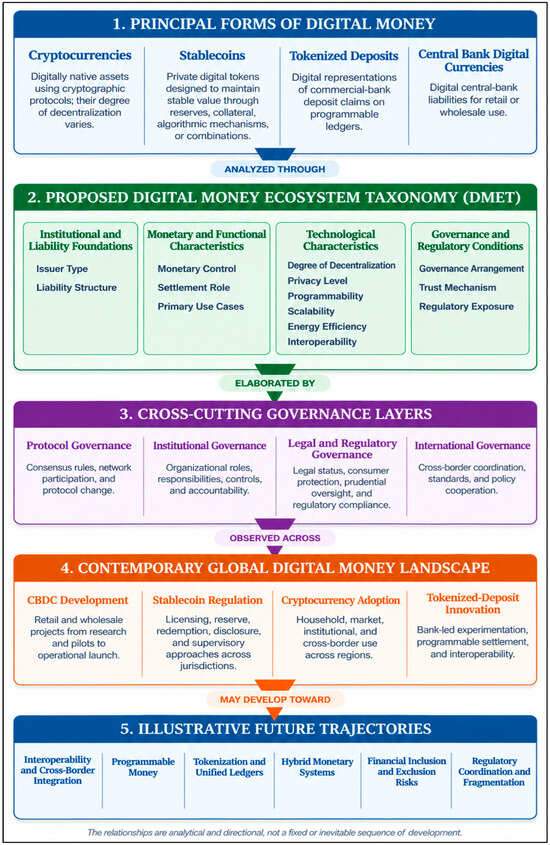
The paper makes three principal contributions. First, building on established classification frameworks, including the BIS money flower [24] and its extensions, it provides a multidisciplinary synthesis that is, to the author’s knowledge, the first to jointly integrate cryptocurrencies, stablecoins, CBDCs, and tokenized deposits within a unified analytical framework. Second, it advances a comparative analysis that reveals the trade-offs, complementarities, and tensions among different digital money architectures. Third, it introduces DMET, a multidimensional classification framework that evaluates cryptocurrencies, stablecoins, CBDCs, and tokenized deposits across fourteen institutional, governance, technological, monetary, and regulatory dimensions. The taxonomy provides a structured tool for researchers, policymakers, and practitioners to systematically compare and evaluate emerging forms of digital money. The overall conceptual structure of the digital money ecosystem examined in this review is illustrated in Figure 1.
Figure 1. Conceptual overview of the evolution, classification, governance, and future trajectories of digital money.
The remainder of this paper is organized as follows. Section 2 presents the conceptual foundations and methodological approach adopted in this review. Section 3 examines the evolution of digital money across four major pillars: cryptocurrencies, stablecoins, CBDCs, and tokenized deposits. Section 4 provides a comparative analysis of trust mechanisms, governance structures, and regulatory dimensions across these forms of digital money. Section 5 introduces DMET as a multidimensional classification framework. Section 6 discusses governance, regulatory, and economic implications associated with emerging digital money systems. Section 7 examines the global digital money landscape, practical implications, future research directions, and key limitations. Section 8 concludes the paper.

References

  1. Prasad, E.S. The Future of Money: How the Digital Revolution Is Transforming Currencies and Finance; Harvard University Press: Cambridge, MA, USA, 2021.
  2. Nakamoto, S. Bitcoin: A Peer-to-Peer Electronic Cash System. 2008, pp. 1–9. Available online: https://papers.ssrn.com/sol3/papers.cfm?abstract_id=3440802 (accessed on 14 August 2026).
  3. Yermack, D. Is Bitcoin a Real Currency? An Economic Appraisal. In Handbook of Digital Currency; Chuen, D.L.K., Ed.; Academic Press: San Diego, CA, USA, 2015; pp. 31–43.
  4. Auer, R.; Böhme, R. The Technology of Retail Central Bank Digital Currency. BIS Q. Rev. 2020, 85–100. Available online: https://www.bis.org/publications/technology-retail-central-bank-digital-currency (accessed on 14 August 2026).
  5. Aramonte, S.; Huang, W.; Schrimpf, A. DeFi Risks and the Decentralisation Illusion. BIS Q. Rev. 2021, 21–36. Available online: https://www.bis.org/publications/defi-risks-and-decentralisation-illusion (accessed on 14 August 2026).
  6. Abdallah-Ou-Moussa, S.; Wynn, M.; Kharbouch, O. Blockchain, Cryptocurrencies, and Decentralized Finance: A Case Study of Financial Inclusion in Morocco. Int. J. Financ. Stud. 2025, 13, 124.
  7. CoinMarketCap. Cryptocurrency Prices, Charts and Market Capitalizations. Available online: https://coinmarketcap.com/historical/20260517/ (accessed on 14 August 2026).
  8. Papazian, A.V. The Logic of Money: Crypto Mechanics and the Limits of Tokenisation. J. Risk Financ. Manag. 2026, 19, 196.
  9. Martínez Raya, A.; Segura-de-la-Cal, A.; Espina Hellín, J. Assessing the Question of Whether Bitcoin Is a Currency or an Asset in Terms of Its Monetary Role. Economies 2025, 13, 357.
  10. Gorton, G.B.; Zhang, J.Y. Taming Wildcat Stablecoins. Univ. Chic. Law Rev. 2023, 90, 909–972.
  11. Li, D.; Han, D.; Weng, T.-H.; Zheng, Z.; Li, H.; Li, K.-C. On Stablecoin: Ecosystem, Architecture, Mechanism and Applicability as Payment Method. Comput. Stand. Interfaces 2024, 87, 103747.
  12. DefiLlama. Stablecoin Market Cap Chart, Supply & Peg Data. Available online: https://defillama.com/stablecoins (accessed on 14 August 2026).
  13. Arner, D.; Auer, R.; Frost, J. Stablecoins: Risks, Potential and Regulation; BIS Working Paper; Bank for International Settlements: Basel, Switzerland, 2020; pp. 1–31.
  14. Cœuré, B.; Cunliffe, J. Central Bank Digital Currencies: Foundational Principles and Core Features: Report No. 1 in a Series of Collaborations from a Group of Central Banks; Series of Collaborations from a Group of Central Banks; Bank for International Settlements: Basel, Switzerland, 2020.
  15. Atlantic Council Central Bank Digital Currency Tracker. Available online: https://www.atlanticcouncil.org/cbdctracker/ (accessed on 19 August 2026).
  16. Proskurovska, A.; Birch, K. Tokenization of Everything? Exploring the Limits of Blockchain Technologies in the Governance of Financial Markets and Assets. Financ. Soc. 2025, 1–21.
  17. BIS Innovation Hub. Project Agorá: A Shared Programmable Platform for Wholesale Cross-Border Payments; BIS Innovation Hub Report; Bank for International Settlements: Basel, Switzerland, 2026; pp. 1–97.
  18. Davoodalhosseini, S.M. Central Bank Digital Currency and Monetary Policy. J. Econ. Dyn. Control 2022, 142, 104150.
  19. Barrdear, J.; Kumhof, M. The Macroeconomics of Central Bank Digital Currencies. J. Econ. Dyn. Control 2022, 142, 104148.
  20. Zetzsche, D.A.; Buckley, R.P.; Arner, D.W. Regulating Libra. Oxf. J. Leg. Stud. 2021, 41, 80–113.
  21. FATF. Updated Guidance for a Risk-Based Approach to Virtual Assets and Virtual Asset Service Providers; Financial Action Task Force: Paris, France, 2021; pp. 1–111.
  22. Allen, S.; Čapkun, S.; Eyal, I.; Fanti, G.; Ford, B.; Grimmelmann, J.; Juels, A.; Kostiainen, K.; Meiklejohn, S.; Miller, A.; et al. Design Choices for Central Bank Digital Currency: Policy and Technical Considerations; NBER Working Paper 27634; National Bureau of Economic Research: Cambridge, MA, USA, 2020; pp. 1–110.
  23. Auer, R.; Cornelli, G.; Frost, J. Rise of the Central Bank Digital Currencies: Drivers, Approaches and Technologies; BIS Working Papers; Monetary and Economic Department—BIS: Basel, Switzerland, 2020.
  24. Bech, M.L.; Garratt, R. Central Bank Cryptocurrencies. BIS Q. Rev. 2017, 55–70. Available online: https://www.bis.org/publications/central-bank-cryptocurrencies (accessed on 14 August 2026).

More
Upload a video for this entry
Information
Subjects: Business, Finance
Contributor MDPI registered users' name will be linked to their SciProfiles pages. To register with us, please refer to https://encyclopedia.pub/register : Alam Ahmad
View Times: 12
Online Date: 17 Sep 2026
Notice
You are not a member of the advisory board for this topic. If you want to update advisory board member profile, please contact office@encyclopedia.pub.
OK
Confirm
Only members of the Encyclopedia advisory board for this topic are allowed to note entries. Would you like to become an advisory board member of the Encyclopedia?
Yes
No
${ textCharacter }/${ maxCharacter }
Submit
Cancel
There is no comment~
${ textCharacter }/${ maxCharacter }
Submit
Cancel
${ selectedItem.replyTextCharacter }/${ selectedItem.replyMaxCharacter }
Submit
Cancel
Confirm
Are you sure to Delete?
Yes No
Academic Video Service



