
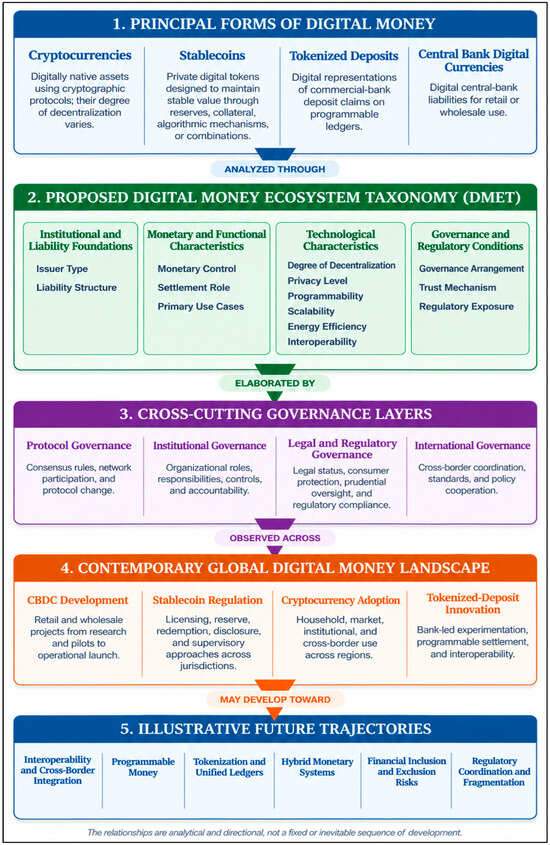
Digital money has transformed from a technological experiment into a central concern of monetary economics, financial regulation, and public policy. Despite rapid growth in cryptocurrencies, stablecoins, central bank digital currencies (CBDCs), and tokenized deposits, the literature remains fragmented across disciplines, with limited cross-cutting synthesis. This article adopts a scoping–integrative review methodology, combining systematic database (Scopus and Web of Science) searches with targeted retrieval of policy and institutional sources (BIS, IMF, Financial Stability Board (FSB), ECB, and national central bank repositories), covering the period 2008–2025, with integrative synthesis of academic, policy, and regulatory sources following PRISMA-ScR reporting principles. The review identifies four competing trust mechanisms underpinning digital money: algorithmic trust associated primarily with cryptocurrencies, private reserve backing trust (stablecoins), sovereign trust underpinning CBDCs, and regulated institutional intermediation supporting tokenized deposits. The proposed digital money ecosystem taxonomy (DMET) classifies digital money instruments across fourteen institutional, governance, technological, monetary, and regulatory dimensions, enabling systematic comparison of cryptocurrencies, stablecoins, CBDCs, and tokenized deposits. Future monetary systems will be hybrid, combining public and private digital money within layered governance arrangements. Interoperability, privacy, programmability, and cross-border governance represent the most critical unresolved policy and research challenges.
- digital money
- cryptocurrencies
- stablecoins
- central bank digital currencies
- CBDC
- blockchain
- tokenized money
- tokenized deposits
- payment systems
- monetary sovereignty
This entry is adapted from the peer-reviewed paper https://doi.org/10.3390/encyclopedia6090196
References
- Prasad, E.S. The Future of Money: How the Digital Revolution Is Transforming Currencies and Finance; Harvard University Press: Cambridge, MA, USA, 2021.
- Nakamoto, S. Bitcoin: A Peer-to-Peer Electronic Cash System. 2008, pp. 1–9. Available online: https://papers.ssrn.com/sol3/papers.cfm?abstract_id=3440802 (accessed on 14 August 2026).
- Yermack, D. Is Bitcoin a Real Currency? An Economic Appraisal. In Handbook of Digital Currency; Chuen, D.L.K., Ed.; Academic Press: San Diego, CA, USA, 2015; pp. 31–43.
- Auer, R.; Böhme, R. The Technology of Retail Central Bank Digital Currency. BIS Q. Rev. 2020, 85–100. Available online: https://www.bis.org/publications/technology-retail-central-bank-digital-currency (accessed on 14 August 2026).
- Aramonte, S.; Huang, W.; Schrimpf, A. DeFi Risks and the Decentralisation Illusion. BIS Q. Rev. 2021, 21–36. Available online: https://www.bis.org/publications/defi-risks-and-decentralisation-illusion (accessed on 14 August 2026).
- Abdallah-Ou-Moussa, S.; Wynn, M.; Kharbouch, O. Blockchain, Cryptocurrencies, and Decentralized Finance: A Case Study of Financial Inclusion in Morocco. Int. J. Financ. Stud. 2025, 13, 124.
- CoinMarketCap. Cryptocurrency Prices, Charts and Market Capitalizations. Available online: https://coinmarketcap.com/historical/20260517/ (accessed on 14 August 2026).
- Papazian, A.V. The Logic of Money: Crypto Mechanics and the Limits of Tokenisation. J. Risk Financ. Manag. 2026, 19, 196.
- Martínez Raya, A.; Segura-de-la-Cal, A.; Espina Hellín, J. Assessing the Question of Whether Bitcoin Is a Currency or an Asset in Terms of Its Monetary Role. Economies 2025, 13, 357.
- Gorton, G.B.; Zhang, J.Y. Taming Wildcat Stablecoins. Univ. Chic. Law Rev. 2023, 90, 909–972.
- Li, D.; Han, D.; Weng, T.-H.; Zheng, Z.; Li, H.; Li, K.-C. On Stablecoin: Ecosystem, Architecture, Mechanism and Applicability as Payment Method. Comput. Stand. Interfaces 2024, 87, 103747.
- DefiLlama. Stablecoin Market Cap Chart, Supply & Peg Data. Available online: https://defillama.com/stablecoins (accessed on 14 August 2026).
- Arner, D.; Auer, R.; Frost, J. Stablecoins: Risks, Potential and Regulation; BIS Working Paper; Bank for International Settlements: Basel, Switzerland, 2020; pp. 1–31.
- Cœuré, B.; Cunliffe, J. Central Bank Digital Currencies: Foundational Principles and Core Features: Report No. 1 in a Series of Collaborations from a Group of Central Banks; Series of Collaborations from a Group of Central Banks; Bank for International Settlements: Basel, Switzerland, 2020.
- Atlantic Council Central Bank Digital Currency Tracker. Available online: https://www.atlanticcouncil.org/cbdctracker/ (accessed on 19 August 2026).
- Proskurovska, A.; Birch, K. Tokenization of Everything? Exploring the Limits of Blockchain Technologies in the Governance of Financial Markets and Assets. Financ. Soc. 2025, 1–21.
- BIS Innovation Hub. Project Agorá: A Shared Programmable Platform for Wholesale Cross-Border Payments; BIS Innovation Hub Report; Bank for International Settlements: Basel, Switzerland, 2026; pp. 1–97.
- Davoodalhosseini, S.M. Central Bank Digital Currency and Monetary Policy. J. Econ. Dyn. Control 2022, 142, 104150.
- Barrdear, J.; Kumhof, M. The Macroeconomics of Central Bank Digital Currencies. J. Econ. Dyn. Control 2022, 142, 104148.
- Zetzsche, D.A.; Buckley, R.P.; Arner, D.W. Regulating Libra. Oxf. J. Leg. Stud. 2021, 41, 80–113.
- FATF. Updated Guidance for a Risk-Based Approach to Virtual Assets and Virtual Asset Service Providers; Financial Action Task Force: Paris, France, 2021; pp. 1–111.
- Allen, S.; Čapkun, S.; Eyal, I.; Fanti, G.; Ford, B.; Grimmelmann, J.; Juels, A.; Kostiainen, K.; Meiklejohn, S.; Miller, A.; et al. Design Choices for Central Bank Digital Currency: Policy and Technical Considerations; NBER Working Paper 27634; National Bureau of Economic Research: Cambridge, MA, USA, 2020; pp. 1–110.
- Auer, R.; Cornelli, G.; Frost, J. Rise of the Central Bank Digital Currencies: Drivers, Approaches and Technologies; BIS Working Papers; Monetary and Economic Department—BIS: Basel, Switzerland, 2020.
- Bech, M.L.; Garratt, R. Central Bank Cryptocurrencies. BIS Q. Rev. 2017, 55–70. Available online: https://www.bis.org/publications/central-bank-cryptocurrencies (accessed on 14 August 2026).