

 +1 credit
| Version | Summary | Created by | Modification | Content Size | Created at | Operation |
|---|---|---|---|---|---|---|
| 1 | Chun-Lin Lee | -- | 735 | 2026-09-17 05:53:04 | | | |
| 2 | Abigail Zou | Meta information modification | 735 | 2026-09-17 07:09:39 | | |
Video Upload Options
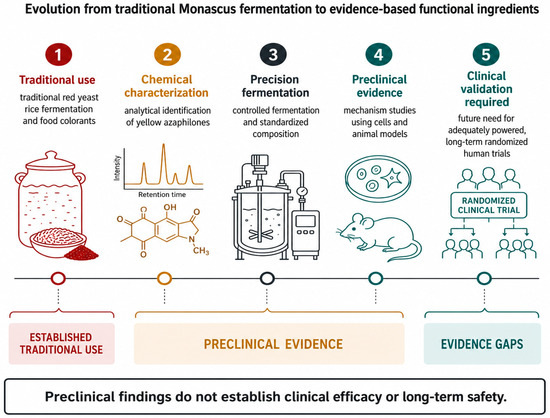
Monascus yellow pigments, including monascin, ankaflavin, and the derivative monascinol, are azaphilone secondary metabolites produced by Monascus species. They have attracted attention as candidate functional-food ingredients because experimental studies indicate activity in pathways relevant to lipid and glucose metabolism. Available evidence, however, is heterogeneous and is derived predominantly from in vitro and animal studies; the human evidence is limited to small, short-term studies of Monascus-fermented preparations rather than isolated pigments. Reported associations with PPAR-α/γ and AMPK signaling, and with gut–liver-axis outcomes, should therefore be interpreted as mechanistic or preclinical observations. Monascus yellow pigments may offer a promising safety profile relative to monacolin K-containing preparations, but their long-term efficacy, dose standardization, and safety require confirmation in adequately powered human trials. Monascus-fermented products are being investigated beyond their traditional use as colorants and sources of monacolin K, partly because monacolin K has statin-like safety concerns. This review summarizes the structural diversity, biosynthetic pathways, and reported pharmacological activities of monascin, ankaflavin, and monascinol. Preclinical studies suggest that these azaphilones may influence PPAR-α/γ-, AMPK-, oxidative-stress-, and inflammation-related pathways and may affect lipid and glucose metabolism. Evidence for gut-microbiota modulation by monascinol is currently derived mainly from animal and mechanistic studies. Human data remain limited, including a small, short-duration trial of a Monascus-fermented preparation enriched in monascin and ankaflavin; these findings support short-term investigation but do not establish long-term clinical efficacy or comparative safety. Accordingly, Monascus yellow pigments should be regarded as promising candidate functional ingredients whose composition, bioavailability, dose, long-term safety, and clinical applicability require further rigorous evaluation.
1.1. Historical Background and Industrial Transition of Monascus Fermentation
1.2. Physicochemical Stability and Precision Fermentation Control
1.3. Reported Multi-Target Molecular Activities
1.4. Clinical Translational Evidence and Future Perspectives
References
- Hong, X.; Deng, J.; Liu, J.; Zhong, H.; Ren, J.; Zhou, B. Research advances in yellow pigments derived from Monascus, an edible filamentous fungus. Adv. Appl. Microbiol. 2025, 132, 83–122.
- Patakova, P. Monascus secondary metabolites: Production and biological activity. J. Ind. Microbiol. Biotechnol. 2013, 40, 169–181.
- Feng, Y.; Shao, Y.; Chen, F. Monascus pigments. Appl. Microbiol. Biotechnol. 2012, 96, 1421–1440.
- Lin, C.H.; Lin, T.H.; Pan, T.M. Alleviation of metabolic syndrome by monascin and ankaflavin: The perspective of Monascus functional foods. Food Funct. 2017, 8, 2102–2109.
- Liu, S.F.; Wang, Y.R.; Shen, Y.C.; Chen, C.L.; Huang, C.N.; Pan, T.M.; Wang, C.K. A randomized, double-blind clinical study of the effects of Ankascin 568 plus on blood lipid regulation. J. Food Drug Anal. 2018, 26, 393–400.
- Adin, S.N.; Gupta, I.; Panda, B.P.; Mujeeb, M. Monascin and ankaflavin-Biosynthesis from Monascus purpureus, production methods, pharmacological properties: A review. Biotechnol. Appl. Biochem. 2023, 70, 137–147.
- He, J.; Jia, M.; Li, W.; Deng, J.; Ren, J.; Luo, F.; Bai, J.; Liu, J. Toward improvements for enhancement the productivity and color value of Monascus pigments: A critical review with recent updates. Crit. Rev. Food Sci. Nutr. 2022, 62, 7139–7153.
- Chen, G.; Wu, Z. Production and biological activities of yellow pigments from Monascus fungi. World J. Microbiol. Biotechnol. 2016, 32, 160.
- Vendruscolo, F.; Meinicke Bühler, R.M.; Cesar de Carvalho, J.; de Oliveira, D.; Moritz, D.E.; Schmidell, W.; Ninow, J.L. Monascus: A Reality on the Production and Application of Microbial Pigments. Appl. Biochem. Biotechnol. 2016, 178, 211–223.
- Dudek, A.; Pietrzak, M.; Benkowska-Biernacka, D.; Pruchnik, H.; Boratynski, F.; El-Sayed, E.R. Nanoliposomal Encapsulation of Red, Yellow, and Orange Natural Pigments from Monascus ruber: Characterization, Stability, and Biological Activities. Curr. Microbiol. 2025, 82, 259.
- Bai, Y.; Zhang, W.; Guo, R.; Yu, J.; Wang, Y. Enhancement of yellow pigments production via high CaCl2 stress fermentation of Monascus purpureus. FEMS Microbiol. Lett. 2024, 371, fnae012.
- Liu, H.; Zhang, J.; Lu, G.; Wang, F.; Shu, L.; Xu, H.; Li, Z.; Wang, Y.; Guo, Q.; Wu, S.; et al. Comparative metabolomics analysis reveals the metabolic regulation mechanism of yellow pigment overproduction by Monascus using ammonium chloride as a nitrogen source. Appl. Microbiol. Biotechnol. 2021, 105, 6369–6379.
- Zhang, C.; Sun, Q.; Yang, L.; Ablimit, A.; Dong, H.; Wang, H.; Wang, C.; Wang, C. Mutation breeding of Monascus to produce a high yield of orange pigment and low citrinin content using the ARTP method. J. Fungi 2024, 10, 553.
- Hsu, W.H.; Chen, T.H.; Lee, B.H.; Hsu, Y.W.; Pan, T.M. Monascin and ankaflavin act as natural AMPK activators with PPARα agonist activity to down-regulate nonalcoholic steatohepatitis in high-fat diet-fed C57BL/6 mice. Food Chem. Toxicol. 2014, 64, 94–103.
- Lee, C.L.; Wen, J.Y.; Hsu, Y.W.; Pan, T.M. Monascus-fermented yellow pigments monascin and ankaflavin showed antiobesity effect via the suppression of differentiation and lipogenesis in obese rats fed a high-fat diet. J. Agric. Food Chem. 2013, 61, 1493–1500.
- Hsu, W.H.; Lee, B.H.; Chang, Y.Y.; Hsu, Y.W.; Pan, T.M. A novel natural Nrf2 activator with PPARγ-agonist (monascin) attenuates the toxicity of methylglyoxal and hyperglycemia. Toxicol. Appl. Pharmacol. 2013, 272, 842–851.
- Tan, H.; Xing, Z.; Chen, G.; Tian, X.; Wu, Z. Evaluating antitumor and antioxidant activities of yellow Monascus pigments from Monascus ruber fermentation. Molecules 2018, 23, 3242.




