Monascus yellow pigments, including monascin, ankaflavin, and the derivative monascinol, are azaphilone secondary metabolites produced by Monascus species. They have attracted attention as candidate functional-food ingredients because experimental studies indicate activity in pathways relevant to lipid and glucose metabolism. Available evidence, however, is heterogeneous and is derived predominantly from in vitro and animal studies; the human evidence is limited to small, short-term studies of Monascus-fermented preparations rather than isolated pigments. Reported associations with PPAR-α/γ and AMPK signaling, and with gut–liver-axis outcomes, should therefore be interpreted as mechanistic or preclinical observations. Monascus yellow pigments may offer a promising safety profile relative to monacolin K-containing preparations, but their long-term efficacy, dose standardization, and safety require confirmation in adequately powered human trials. Monascus-fermented products are being investigated beyond their traditional use as colorants and sources of monacolin K, partly because monacolin K has statin-like safety concerns. This review summarizes the structural diversity, biosynthetic pathways, and reported pharmacological activities of monascin, ankaflavin, and monascinol. Preclinical studies suggest that these azaphilones may influence PPAR-α/γ-, AMPK-, oxidative-stress-, and inflammation-related pathways and may affect lipid and glucose metabolism. Evidence for gut-microbiota modulation by monascinol is currently derived mainly from animal and mechanistic studies. Human data remain limited, including a small, short-duration trial of a Monascus-fermented preparation enriched in monascin and ankaflavin; these findings support short-term investigation but do not establish long-term clinical efficacy or comparative safety. Accordingly, Monascus yellow pigments should be regarded as promising candidate functional ingredients whose composition, bioavailability, dose, long-term safety, and clinical applicability require further rigorous evaluation.
1.1. Historical Background and Industrial Transition of Monascus Fermentation
Monascus species have been utilized in Asian food and pharmaceutical sectors for over a millennium, producing red, orange, and yellow pigments alongside pharmacologically active compounds such as monacolin K [
1,
2,
3]. While industrial production historically favored
Monascus red pigments, recent scientific focus has shifted toward
Monascus yellow pigments because of their reported biological activities and physicochemical properties. In cellular and animal studies, monascin and ankaflavin have shown lipid-regulatory and anti-inflammatory effects with low observed toxicity under the tested conditions. However, direct, standardized comparisons of their efficacy and safety with monacolin K are limited, particularly in humans. Thus, monascin and ankaflavin are more appropriately described as promising functional-food components for further investigation than as established alternatives to lipid-lowering therapeutics [
4,
5].
Recent reviews also describe monascin and ankaflavin as central yellow-pigment metabolites with relevance to biosynthesis, production, pharmacology, and functional-food development [
6,
7].
1.2. Physicochemical Stability and Precision Fermentation Control
Monascus yellow pigments exhibit high physicochemical stability and can outperform red and orange pigments in their tolerance to light, thermal stress, and extreme pH, which enhances their commercial viability [
8,
9]. To further improve systemic bioavailability, recent research has successfully introduced nanoliposomal encapsulation to protect these pigments within the gastrointestinal tract [
10]. Concurrently, precision fermentation has empowered researchers to manipulate secondary metabolic fluxes; for instance, the addition of calcium chloride (CaCl
2) strongly upregulates the mppE gene, effectively redirecting biosynthesis toward the overproduction of yellow pigments [
11]. Furthermore, utilizing specific nitrogen sources and optimizing pH levels can increase
Monascus yellow pigment proportions while concurrently curtailing the generation of the mycotoxin citrinin [
12]. This metabolic optimization addresses important safety bottlenecks, establishing a reliable foundation for toxin-free mass production [
13].
1.3. Reported Multi-Target Molecular Activities
The biological relevance of
Monascus yellow pigments stems from their multi-targeted molecular bioactivities. Natural monascin and ankaflavin have shown lipid-related, anti-inflammatory, and blood-pressure-related effects in experimental studies, including selective peroxisome proliferator-activated receptor modulation and activation of PPAR-α, PPAR-γ, and Nrf2-associated pathways [
14]. Experimental studies have also reported effects on adipogenesis, lipid absorption, methylglyoxal-related stress, and oxidative-stress pathways [
15,
16,
17]. These findings remain predominantly preclinical and should not be interpreted as established clinical efficacy.
1.4. Clinical Translational Evidence and Future Perspectives
These preclinical mechanisms have begun to be explored in small human studies of complex
Monascus-fermented preparations. In a randomized, double-blind study, an Ankascin 568 plus preparation was associated with improvements in blood-lipid measures over a short intervention period [
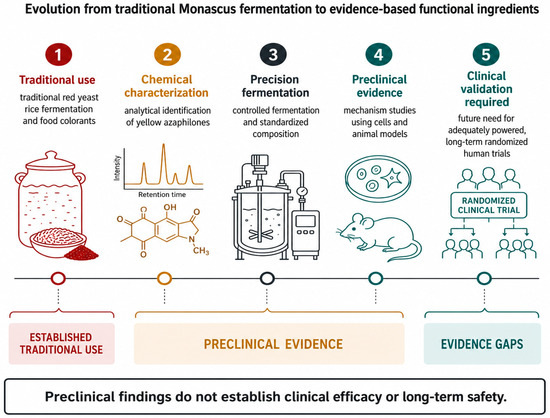
5]. Because the available trial was small, short in duration, and did not test isolated monascin or ankaflavin, the findings should be interpreted as preliminary rather than as proof of efficacy or long-term safety for individual yellow pigments. Larger, longer, well-standardized clinical trials are required before therapeutic positioning or comparative claims can be made (
Figure 1) [
1].
Figure 1. Evolution of
Monascus fermentation from traditional colorants to bioactive yellow pigments based on published reviews, preclinical studies, and limited human evidence [
1,
2,
3,
4,
5].
This entry is adapted from the peer-reviewed paper https://doi.org/10.3390/encyclopedia6080174