+1 credit
| Version | Summary | Created by | Modification | Content Size | Created at | Operation |
|---|---|---|---|---|---|---|
| 1 | Encyclopedia Editorial Office | -- | 949 | 2025-08-18 10:04:24 |
Video Upload Options
The horned lizard (genus Phrynosoma) is a distinctive group of reptiles within the family Phrynosomatidae, known for their flattened, toad-like bodies, short tails, and characteristic cranial horns. Often referred to as "horned toads" or "horny toads," these lizards are native to North and Central America and are noted for their unique morphological adaptations, cryptic coloration, and defensive behaviors, including the rare ability to squirt blood from their eyes.
1. Taxonomy and Classification
The horned lizard belongs to the order Squamata, suborder Iguania, and family Phrynosomatidae. The genus Phrynosoma comprises around 21 recognized species, distributed primarily across the United States, Mexico, and parts of Central America [1].
Species differentiation is based on morphology, horn arrangement, scalation, and geographical distribution. Notable species include:
-
Texas horned lizard (Phrynosoma cornutum)
-
Short-horned lizard (Phrynosoma hernandesi)
-
Desert horned lizard (Phrynosoma platyrhinos)
-
Regal horned lizard (Phrynosoma solare)
Molecular phylogenetic studies indicate that horned lizards are closely related to other phrynosomatid lizards but have diverged significantly due to their specialized ecological niches [2]. Fossil evidence suggests the genus dates back to the Miocene, illustrating its long evolutionary history [3].
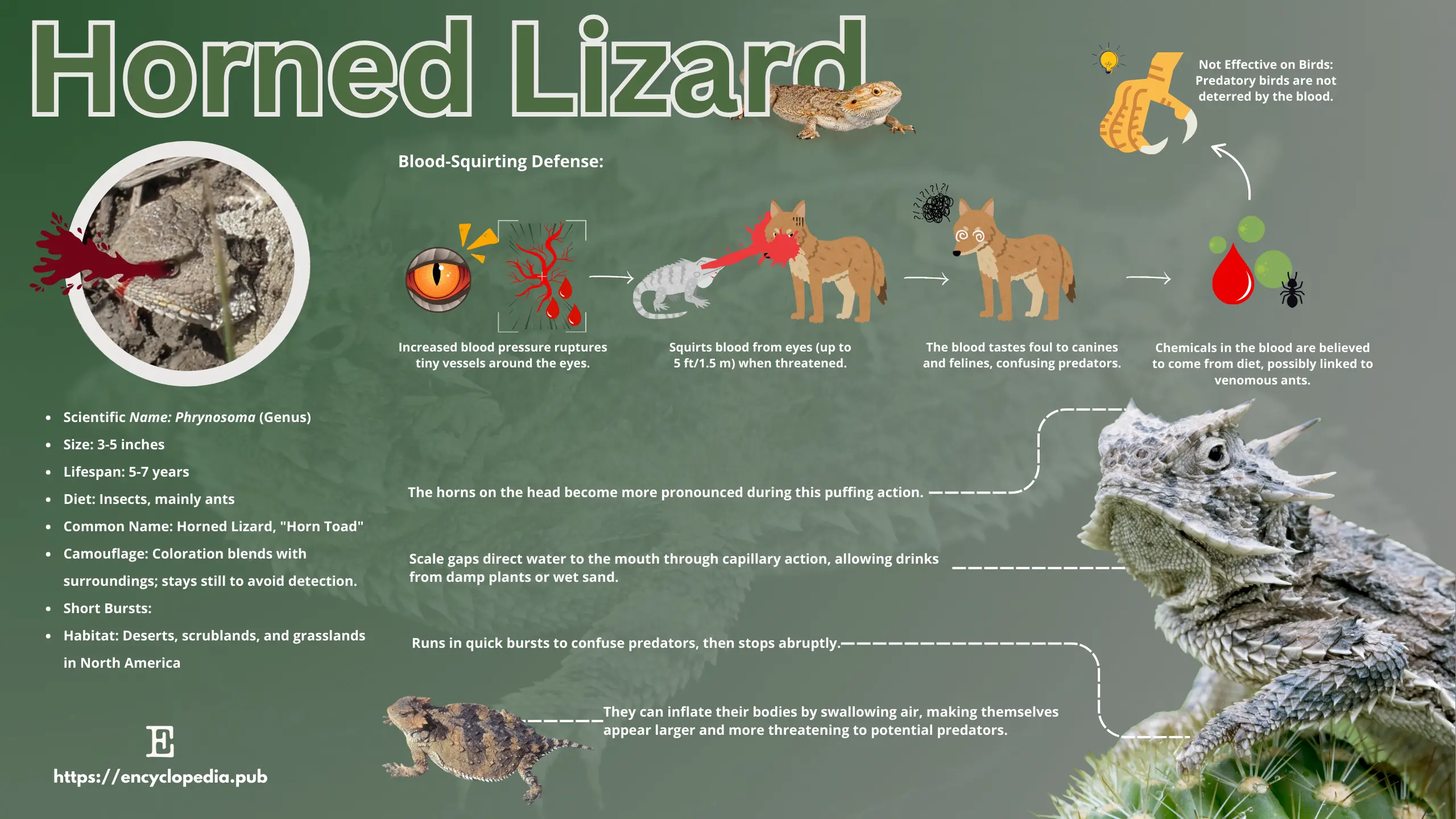
Source: Encyclopedia Infographic (https://encyclopedia.pub/image/3719)
2. Morphology and Physical Characteristics
Horned lizards are easily recognizable by their broad, flattened bodies and crown of horns located at the back of the skull. These horns are composed of bony cores covered by keratin, functioning both as a deterrent to predators and as a form of species-specific signaling [4].
2.1. Size and Appearance
-
Adult horned lizards range in length from 5 to 15 cm, depending on species.
-
Body coloration is typically gray, brown, or reddish, blending seamlessly with arid and sandy environments.
-
Many species exhibit cryptic patterning that enhances camouflage against predators.
2.2. Defensive Adaptations
Horned lizards possess several unique adaptations:
-
Cryptic coloration – camouflage that mimics sand, rocks, or soil.
-
Body inflation – puffing up to appear larger and more difficult to swallow.
-
Blood-squirting defense – some species, notably P. cornutum and P. solare, can eject blood from the ocular sinuses to deter predators such as canids.
-
Spiny scales and horns – reduce predation risk by making ingestion difficult.
These physical features not only serve survival purposes but also reflect ecological specialization for desert and scrubland habitats.
3. Distribution and Habitat
Horned lizards are primarily distributed in arid and semi-arid regions of North America, from southern Canada to Guatemala. The highest diversity is found in Mexico, where ecological niches range from deserts to high-altitude grasslands.
Habitat Preferences
-
Sandy or rocky desert basins
-
Grasslands and open woodlands
-
Areas with abundant ant populations (their primary prey)
Horned lizards are diurnal and rely heavily on sunlight for thermoregulation. They are most active during warm daylight hours but seek shade or burrow beneath the soil during extreme heat.
4. Diet and Feeding Behavior
Horned lizards are specialized ant-eating lizards (myrmecophages), with harvester ants forming the bulk of their diet [7]. Some species consume up to 90% ants, supplemented with beetles, grasshoppers, and other small arthropods.
Feeding Adaptations
-
Sticky tongue specialized for rapid prey capture.
-
Thick stomach lining that resists the toxic formic acid present in ants.
-
Sit-and-wait predation – horned lizards remain still, ambushing prey that comes within range.
The dependence on ants makes horned lizards vulnerable to habitat change, particularly when invasive ant species disrupt native populations.
5. Reproductive Biology
Horned lizards exhibit diverse reproductive strategies depending on species and climate:
-
Oviparous species: Lay clutches of 10–30 eggs in shallow burrows. Incubation lasts 6–8 weeks.
-
Viviparous species: Found in cooler, high-altitude habitats (e.g., P. hernandesi), giving birth to live young to ensure survival in shorter seasons.
Courtship typically occurs in spring and early summer, with males engaging in head-bobbing and other visual displays. Sexual dimorphism is minimal, though males are often slightly smaller than females.
6. Behavior and Ecology
Horned lizards are solitary reptiles, displaying minimal social interactions outside mating. Their daily activity is governed by thermoregulation, requiring alternating between basking in the sun and seeking shade.
6.1. Predator Avoidance
Natural predators include snakes, birds of prey, coyotes, and domestic animals. In addition to their unique blood-squirting defense, horned lizards rely heavily on camouflage and immobility to escape detection.
6.2. Ecological Role
As ant specialists, horned lizards play an essential role in regulating insect populations. They are also prey for larger carnivores, contributing to the balance of desert ecosystems.
7. Conservation Status
While some horned lizard species remain widespread, others face significant threats. The Texas horned lizard (P. cornutum), once common, has declined across much of its range due to:
-
Habitat loss from agriculture and urbanization.
-
Decline of native ant populations due to pesticide use.
-
Competition with invasive red imported fire ants (Solenopsis invicta).
Several species are listed under state-level conservation laws in the United States and are classified as species of concern by the IUCN.
8. Cultural and Historical Significance
Horned lizards hold cultural importance among Indigenous peoples of North America, often symbolizing resilience, protection, and survival in harsh environments. In modern times, they are iconic animals of the American Southwest, appearing in folklore, art, and as state symbols. For instance, the Texas horned lizard is the official state reptile of Texas.
9. Advantages and Limitations of Research
9.1. Advantages
-
Serve as model organisms for studying adaptation to arid environments.
-
Provide insights into specialized feeding ecology and predator-prey dynamics.
-
Unique defense mechanisms offer biomedical research potential.
9.2. Limitations
-
Specialized diets make horned lizards difficult to maintain in captivity.
-
Declining wild populations restrict experimental research.
-
Fragmented habitats challenge long-term population studies.
10. Conclusion
The horned lizard (Phrynosoma spp.) represents one of the most unique reptilian groups in North America, with its striking morphology, ant-specialist diet, and rare defensive behaviors. As both ecological regulators and cultural icons, they embody the evolutionary adaptations necessary to survive in challenging desert environments. However, conservation measures are urgently required to ensure their survival amid habitat loss, invasive species, and climate change.
References
- Montanucci, R. R. "Taxonomy of horned lizards (Phrynosoma)." Herpetologica 33.1 (1977): 1–21.
- Leaché, A. D., et al. "Molecular systematics of horned lizards (Phrynosoma)." Molecular Phylogenetics and Evolution 33.3 (2004): 877–892. https://doi.org/10.1016/j.ympev.2004.07.005
- Pregill, G. K. "Fossil lizards from the Quaternary of the Caribbean." University of Kansas Science Bulletin 38 (1983): 1–44.
- Sherbrooke, W. C. Introduction to Horned Lizards of North America. University of California Press, 2003.