+1 credit
| Version | Summary | Created by | Modification | Content Size | Created at | Operation |
|---|---|---|---|---|---|---|
| 1 | Encyclopedia Editorial Office | -- | 1278 | 2025-05-27 08:44:43 |
Video Upload Options
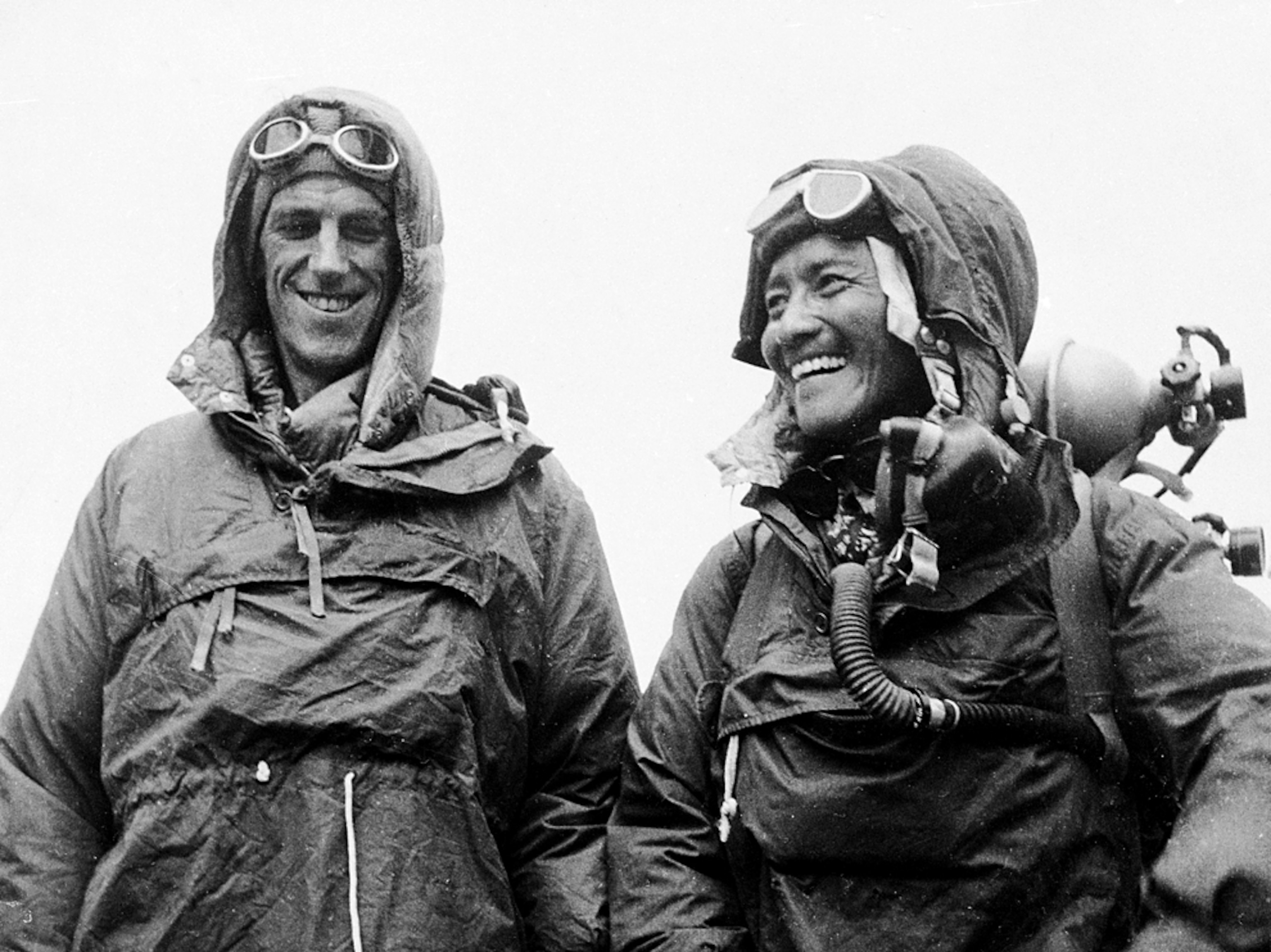
On May 29, 1953, New Zealand mountaineer Edmund Hillary (later knighted) and Nepali Sherpa Tenzing Norgay became the first confirmed climbers to reach the 8,848-meter summit of Mount Everest as part of the ninth British expedition led by John Hunt (later Lord Hunt). Their successful ascent via the Southeast Ridge route (using the South Col as a high camp) marked the culmination of 30 years of British attempts on the mountain. The news reached Britain on June 2, coinciding with Queen Elizabeth II's coronation. Hillary was knighted and Norgay received the George Medal, with their achievement revolutionizing high-altitude mountaineering.
1. Introduction
On May 29, 1953, Sir Edmund Hillary of New Zealand and Tenzing Norgay, a Sherpa mountaineer from Nepal, became the first climbers confirmed to have reached the summit of Mount Everest, the highest point on Earth at 8,848 meters (29,029 feet) above sea level [1]. This landmark achievement represented a milestone in human exploration and mountaineering history, symbolizing the limits of human endurance, technological innovation, and cross-cultural collaboration.
2. Geographic and Geological Context
Mount Everest, known as Sagarmatha in Nepali and Chomolungma in Tibetan, is situated in the Himalayan mountain range, straddling the international border between Nepal and the Tibet Autonomous Region of China. It holds the distinction of being the Earth's highest peak, with its summit reaching an elevation of 8,848 meters (29,029 feet) above sea level. The formation of Mount Everest and the surrounding Himalayan range is the result of a prolonged and dynamic geological process known as orogeny, which began roughly 50 million years ago during the Paleogene period. This process involved the collision of the Indian tectonic plate with the Eurasian plate, a convergent plate boundary interaction that caused the uplift of marine sedimentary rocks originally deposited on the Tethys Sea floor, transforming them into some of the tallest mountains on the planet [2].
This tectonic collision remains active today, with the Indian plate continuing to push northwards into the Eurasian plate at an average rate of approximately 5 centimeters per year. This ongoing convergence is responsible not only for the sustained elevation of Mount Everest but also for frequent seismic activity in the region [2]. The geology of Everest is characterized by stratified layers of sedimentary and metamorphic rocks, including limestone, marble, and schist, which provide valuable insights into the Earth's crustal movements and ancient marine environments [2].
The summit of Everest lies within the so-called “death zone”, a term used to describe altitudes exceeding 8,000 meters where atmospheric pressure falls to about one-third of that at sea level, resulting in severely reduced oxygen availability [3]. At these elevations, the partial pressure of oxygen is insufficient to support human life for extended periods without supplemental oxygen or acclimatization. The hypobaric hypoxia encountered in the death zone impairs physical performance and cognitive function, dramatically increasing the risk of altitude sickness, pulmonary edema, cerebral edema, and ultimately death if adequate precautions are not taken [3]. Beyond hypoxia, climbers face severe environmental hazards including extreme cold, with temperatures regularly plunging below -30°C, intense ultraviolet radiation due to thinner atmospheric layers, and highly variable and unpredictable weather patterns, including sudden storms and high-velocity winds [3]. These conditions necessitate specialized equipment, extensive acclimatization protocols, and meticulous logistical planning to ensure climber safety and mission success.
3. The 1953 British Expedition
The historic first successful ascent of Mount Everest on May 29, 1953, was the culmination of numerous earlier attempts by a variety of national expeditions dating back to the early 20th century. Notably, many of these efforts were British-led, reflecting the United Kingdom’s interest in Himalayan exploration during the colonial era. The 1953 expedition was organized by the Mount Everest Committee, a joint venture between the British Alpine Club and the Royal Geographical Society, dedicated to mounting a well-supported and scientifically informed bid for the summit [4].
Leadership of the 1953 expedition was entrusted to Colonel John Hunt, a highly experienced military officer and mountaineer. Hunt’s approach combined rigorous physical preparation, innovative logistical strategies, and a strong emphasis on teamwork, which set this expedition apart from previous attempts. A critical feature of the 1953 expedition was the effective use of supplemental oxygen systems, which were refined to be lighter and more reliable than those used in earlier climbs. These devices provided climbers with a vital physiological advantage in the death zone by increasing available oxygen, thereby improving stamina and reducing the risk of altitude-related illnesses.
Integral to the expedition’s success was the collaboration with experienced Sherpa climbers, indigenous Himalayan people renowned for their remarkable acclimatization and mountaineering skills. Sherpas not only served as high-altitude porters but also as technical climbing partners, crucial for route fixing, establishing camps, and carrying supplies across treacherous terrain.
The final summit team consisted of Edmund Hillary, a beekeeper and mountaineer from New Zealand, and Tenzing Norgay, a Sherpa from Nepal with extensive high-altitude experience. The pair ascended via the South Col route, a pathway first explored during earlier expeditions in the 1920s and 1930s but not successfully completed to the summit until 1953. This route involves a combination of steep ice and rock climbing, glacier travel, and high-altitude exposure [5].
One of the most technically challenging features on the route was the Hillary Step, a near-vertical rock face approximately 12 meters high, located just below the summit ridge. Negotiating this obstacle required technical skill, careful footing, and favorable weather conditions [5]. After a strenuous ascent marked by extreme physical exertion and exposure to the harsh mountain environment, Hillary and Norgay reached the summit at approximately 11:30 AM local time. They spent about 15 minutes at the summit, during which they took photographs, planted flags, and took in the panoramic views before beginning their descent, ultimately returning safely to base camp [5].
This successful ascent represented not only a triumph of human endurance and mountaineering skill but also a testament to international cooperation and the integration of indigenous expertise with modern expeditionary methods.
4. Physiological Challenges and Adaptations
Climbing at extreme altitudes requires overcoming severe hypobaric hypoxia, where reduced barometric pressure lowers oxygen availability to less than one-third of sea-level concentrations [3]. Both climbers utilized bottled supplemental oxygen to partially mitigate these effects, enabling enhanced physical performance and cognitive function during the ascent. However, acclimatization—physiological adjustments to high altitude, such as increased red blood cell production and ventilation—was also essential [6].
Exposure to cold temperatures, often dropping below -30°C, posed risks of frostbite and hypothermia. Physical exhaustion, dehydration, and altitude sickness were constant threats, underscoring the importance of careful pacing and teamwork [7].
5. Cultural and Historical Significance
The ascent had profound cultural implications. Tenzing Norgay’s participation highlighted the vital role of the Sherpa people, indigenous to the Himalayan region, who have long been indispensable to Himalayan expeditions due to their acclimatization and mountaineering expertise [5]. The success symbolized international cooperation and was celebrated worldwide, boosting national pride in both New Zealand and Nepal.
This achievement accelerated interest in high-altitude mountaineering and expanded scientific understanding of human physiological limits. It also marked the beginning of increased tourism and climbing activity in the Everest region, which has had complex environmental and social impacts [8].
6. Legacy and Continuing Research
The 1953 ascent remains a foundational moment in mountaineering history. Since then, thousands have attempted Everest, aided by advances in gear, weather forecasting, and climbing strategies. Scientific studies at Everest have provided valuable insights into hypoxia, human adaptation, and high-altitude medicine, contributing to treatments for related health conditions worldwide.
Environmental research also continues, as glacial retreat and ecosystem changes linked to climate change pose new challenges for Everest and its surroundings [9]. Conservation efforts seek to balance human activity with the preservation of this unique mountain environment.
References
- Hunt, John. The Ascent of Everest. Hodder & Stoughton, 1953.
- Searle, Michael P. “Tectonic Evolution of the Himalaya.” Journal of Asian Earth Sciences, vol. 5, no. 5-6, 1992, pp. 507–519. https://doi.org/10.1016/0743-9547(92)90039-Q
- West, John B. High Life: A History of High-Altitude Physiology and Medicine. Oxford University Press, 1998.
- Gill, Michael. Edmund Hillary: A Biography. HarperCollins, 1994.
- Ortner, Sherry B. Life and Death on Mt. Everest: Sherpas and Himalayan Mountaineering. Princeton University Press, 1999.
- Basnyat, Buddha, and Peter S. W. Davies. “The Physiology of High-Altitude Climbing.” Clinical Chest Medicine, vol. 27, no. 2, 2006, pp. 255–270. https://doi.org/10.1016/j.ccm.2006.02.003
- Hackett, Peter H., and Robert C. Roach. “High-Altitude Medicine.” New England Journal of Medicine, vol. 345, no. 2, 2001, pp. 107-114. https://doi.org/10.1056/NEJM200107123450206
- Beedie, Paul. “The Environmental Impact of Tourism on the Everest Region.” Mountain Research and Development, vol. 23, no. 4, 2003, pp. 294-298. https://doi.org/10.1659/0276-4741(2003)023[0294:TIEOTR]2.0.CO;2
- Yao, Tsering, et al. “Recent Glacial Retreat and Climatic Change in the Himalaya.” Science Advances, vol. 2, no. 6, 2016. https://doi.org/10.1126/sciadv.1501534