+1 credit
| Version | Summary | Created by | Modification | Content Size | Created at | Operation |
|---|---|---|---|---|---|---|
| 1 | Christian Bailly | -- | 1903 | 2022-09-27 09:12:01 | | | |
| 2 | Peter Tang | Meta information modification | 1903 | 2022-09-27 09:47:24 | | |
Video Upload Options
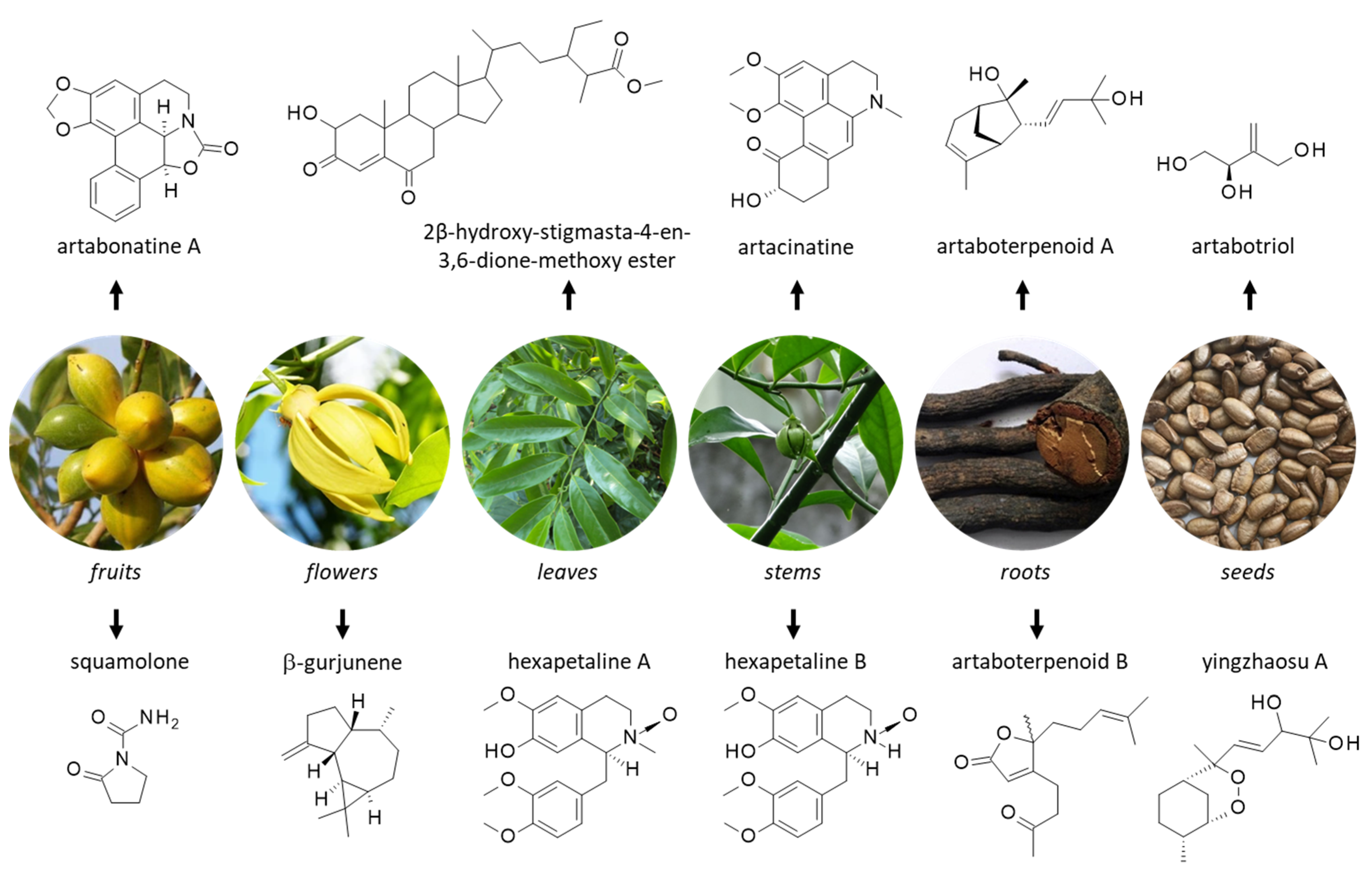
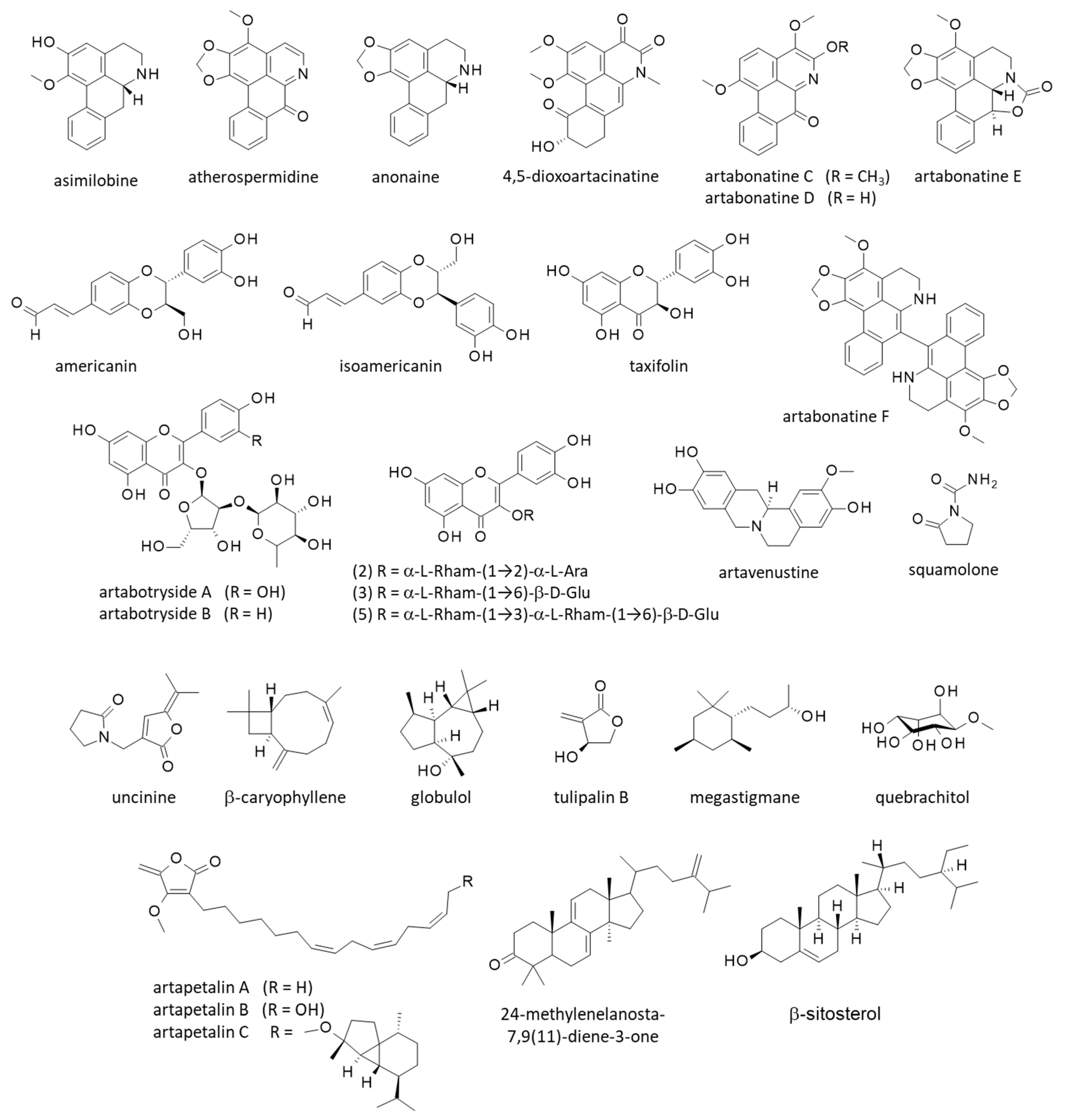
The medicinal plant Artabotrys hexapetalus (synonyms: A.uncinatus and A. odoratissimus) is known as yingzhao in Chinese. Extracts of the plant have long been used in Asian folk medicine to treat various symptoms and diseases, including fevers, microbial infections, ulcers, hepatic disorders and other health problems. In particular, extracts from the roots and fruits of the plant are used for treating malaria. Numerous bioactive natural products have been isolated from the plant, mainly aporphine (artabonatines, artacinatine) and benzylisoquinoline (hexapetalines) alkaloids, terpenoids (artaboterpenoids), flavonoids (artabotrysides), butanolides (uncinine, artapetalins) and a small series of endoperoxides known as yingzhaosu A-to-D. These natural products confer antioxidant, anti-inflammatory and antiproliferative properties to the plant extracts. The lead compound yingzhaosu A displays marked activities against the malaria parasites Plasmodium falciparum and P. berghei.
1. Introduction
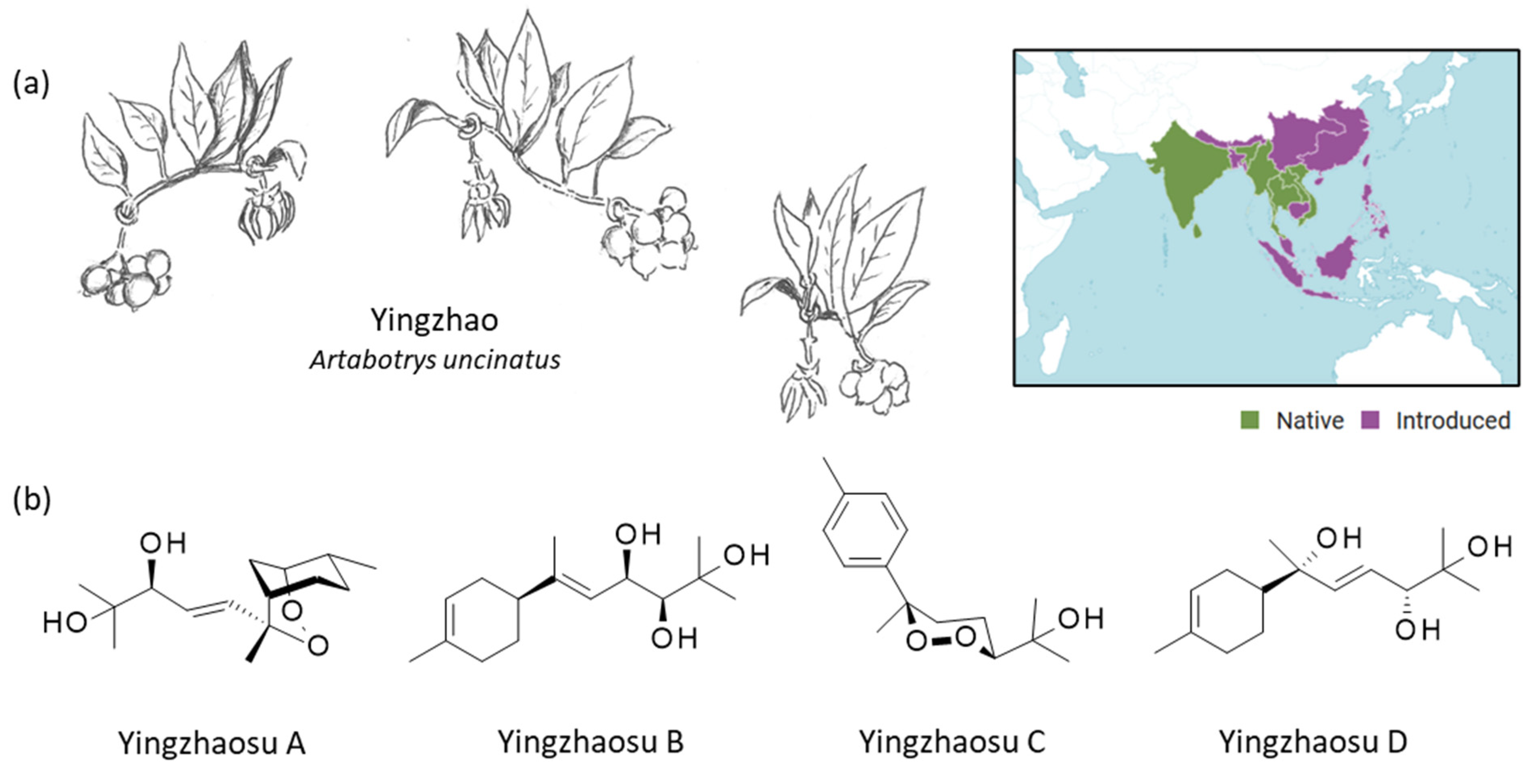
2. The Plant Yingzhao
|
Accepted Name |
Synonyms * |
Common Names ** |
|---|---|---|
|
Artabotrys hexapetalus (L.f.) Bhandari |
Annona hexapetala L.f. |
Tail grape (English); Hari champa, Kath champa, Madanmast (Hindi); Manoranidam (Tamil); Kothali-champa (Assamese); kenanga tanduk (Indonesian). Ylang-Ylang grimpant (French); Cay Móng rồng (Vietnamese); karawek (Thailand); iraniran noki, tsuru iraniran (Japanese); lanalana (Hawaiian); kathali champa, kaanthaali chaanpaa (Bengali). |
|
Annona uncinata Lam. |
||
|
Artabotrys hamatus (Dunal) Blume |
||
|
Artabotrys intermedius Hassk. |
||
|
Artabotrys odoratissimus R.Br. |
||
|
Artabotrys odoratissimus Wight & Arn. |
||
|
Artabotrys uncata (Lour.) Baill. |
||
|
Artabotrys uncatus (Lour.) Baill. |
||
|
Artabotrys uncinatus (Lam.) Merr. |
||
|
Unona uncata (Lour.) Dunal |
||
|
Unona uncinata (Lam.) Dunal Uvaria esculenta Roxb. ex Rottler Uvaria odoratissima Roxb. Uvaria uncata Lour. |
3. Traditional Medicinal Uses of Yingzhao
|
Pharmacological Activities |
Comments |
References |
|---|---|---|
|
Antiparasitic |
Extracts of the roots and fruits are used to treat malaria (Plasmodium falciparum infection) and leishmania (Leishmania donovani infection). Numerous antimalarial compounds characterized, principally the yingzhaosu. |
|
|
Antibacterial |
Activities against Salmonella, Staphylococcus, Pseudomonas and other bacteria reported with hydroalcoholic extracts of the flowers and leaves. Bactericidal effect of silver nanoparticles made with an aqueous extract of A. hexapetalus. |
|
|
Antifungal |
Activities against Candida albicans, Aspergillus niger and other fungi reported with a methanolic extract. |
|
|
Antifertility |
Reduction of sperm count and fertility with a hydroalcoholic leave extract, and modulation of the oestrus cycle. Regulation of steroidal hormone levels. |
|
|
Anticancer |
A fruit extract of A. odoratissimus reduced proliferation of MIA PaCa-2 pancreatic cancer cells and induced their apoptotic cell death. |
[31] |
|
Anti-ulcer and hepatoprotection |
Protection against liver injuries and oxidative stress with a hydroalcoholic extract. Anti-inflammatory activity of an ethanolic extract of aerial parts. Cytoprotection conferred by antioxidant flavonoids and alkaloids. |
|
|
Mosquito repellent |
Essential oils made from leaves and stem bark extracts obtained by hydro-distillation have revealed mosquito repellency activity, attributed to the presence of β-caryophyllene oxide. |
[11] |
References
- Moxon, C.A.; Gibbins, M.P.; McGuinness, D.; Milner, D.A., Jr.; Marti, M. New Insights into Malaria Pathogenesis. Annu. Rev. Pathol. 2020, 15, 315–343.
- Laurens, M.B. RTS,S/AS01 vaccine (Mosquirix™): An overview. Hum. Vaccin. Immunother. 2020, 16, 480–489.
- Badeliya, S.N.; Kapupara, P.P.; Chauhan, N.F.; Panchal, I.I. A contemporary chemical entities infiltrating in the antimalarial therapy era: A comprehensive review. Folia Med. 2021, 63, 637–646.
- Daily, J.P.; Minuti, A.; Khan, N. Diagnosis, Treatment, and Prevention of Malaria in the US: A Review. JAMA 2022, 328, 460–471.
- Bailly, C. Pyronaridine: An update of its pharmacological activities and mechanisms of action. Biopolymers 2021, 112, 23398.
- Pryce, J.; Taylor, M.; Fox, T.; Hine, P. Pyronaridine-artesunate for treating uncomplicated Plasmodium falciparum malaria. Cochrane Database Syst. Rev. 2022, 6, CD006404.
- Tu, Y. Artemisinin-A Gift from Traditional Chinese Medicine to the World (Nobel Lecture). Angew. Chem. Int. Ed. 2016, 55, 10210–10226.
- WFO. 2022. Available online: http://www.worldfloraonline.org/taxon/wfo-0000549776 (accessed on 14 September 2022).
- Prabhu, S.; Sathiyaseelan, R.; Aron, S.; Murugan, C. A Review of the Genus Artabotrys R. Br. (Annonaceae) from Andaman and Nicobar Islands, with a New Record for India. Indian J. For. 2015, 38, 159–164.
- Posluszny, U.; Fisher, J.B. Thorn and hook ontogeny in Artabotrys hexapetalus (Annonaceae). Am. J. Bot. 2000, 87, 1561–1570.
- Suleiman, R.A.; Mgani, Q.A.; Nyandoro, S. Chemical compositions and mosquito repellency of essential oils from Artabotrys hexapetalus and Artabotrys rupestris. Int. J. Biol. Chem. Sci. 2014, 8, 2804–2812.
- Handayani, T. Seed germination and seedling morphology of Artabotrys hexapetalus. Nusant. Biosci. 2017, 9, 23–30.
- Phan, G.M.; Phan, S.T.; König, W.A. Chemical Composition of the Flower Essential Oil of Artabotrys hexapetalus (L.f.) Bhandare of Vietnam. J. Essent. Oil Res. 2007, 19, 523–524.
- Kousalya, P.; Doss, V.A. Artabotrys hexapetalus (L.f.) Bhandari: Ethnomedicinal Uses, Pharmacological Properties and Bioactive Compounds-Review. J. Huazhong Univ. Sci. Technol. 2021, 50, 1–11.
- Grainge, M. Effects of extracts of Artabotrys uncinatus and Allium sativum on Xanthomonas campestris pv. oryzae. Curr. Sci. 1985, 54, 90.
- Grainge, M.; Alvarez, A. Antibacterial and Antifungal Activity of A. hexapetalus leaf extracts. Int. J. Trop. Plant Dis. 1987, 5, 173–179.
- Sowjanya, K.M.; Swathi, J.; Narendra, K.; Padmavathi, C.H.; Satya, A.K. Extraction and Antimicrobial Potential of Secondary Plant Metabolites from Artabotrys hexapetalus (Linn. F.) Bhandari. Int. J. Res. Ayurveda Pharm. 2013, 4, 764–768.
- Srivastava, B.; Singh, P.; Srivastava, A.K.; Shukla, R.; Dubey, N.K. Efficacy of Artabotrys odoratissimus oil as a plant based antimicrobial against storage fungi and aflatoxin B1 secretion. Int. J. Food Sci. Technol. 2009, 44, 1909–1915.
- Syam, S.K.; Anudeep, M.; Ramana, C.V.; Bhaskar, C. Screening of antimicrobial activity of flower extracts on human bacterial pathogens. J. Pharmacogn. Phytochem. 2015, 3, 153–156.
- Kim, H.S.; Begum, K.; Ogura, N.; Wataya, Y.; Tokuyasu, T.; Masuyama, A.; Nojima, M.; McCullough, K.J. Antimalarial activity of yingzhaosu A analogues. J. Med. Chem. 2002, 45, 4732–4736.
- Borstnik, K.; Paik, I.H.; Shapiro, T.A.; Posner, G.H. Antimalarial chemotherapeutic peroxides: Artemisinin, yingzhaosu A and related compounds. Int. J. Parasitol. 2002, 32, 1661–1667.
- Vasundhara, M.; Anjali, K.R.; Chithra, C.; Gupta, P.; Karthik, Y.P.; Roopa, C. Absence of anthelmintic activity of hydroalcoholic leaf extracts of Artabotrys hexapetalus (Linn.f). J. Pharm. Negat. Results 2014, 5, 1–3.
- Bajaj, S.; Wakode, S.R.; Khan, W.; Manchanda, S.; Kumar, S. Simultaneous HPTLC analysis and in vitro antileishmanic activity of various secondary metabolites in extract of the traditional medicinal herb Artabotrys hexapetalus (L.f.). AYU 2018, 39, 92–100.
- Manjula, M.; Kumuda, K.V.; Anitha, S.; Shashidhara, S. Antioxidant and antimicrobial activities of various extracts of Artabotrys hexapetalus flowers. Pharma Sci. Monit. 2011, 2, 42–50.
- Shankar, D.P.; Ananthi, P.; Devi, K.H.N. Bioinspired Synthesis and Characterization of Silver Nanoparticles using an Aqueous extract of Artabotrys hexapetalus. J. NanoSci. NanoTechnol. 2014, 2, 66–70.
- Geetha, M.; Shankar, M.B.; Mehta, R.S.; Saluja, A.K. Antifertility activity of Artabotrys odoratissimus Roxb. and Couroupita guianensis Aubl. J. Nat. Remedies 2005, 5, 121–125.
- Johri, P.K.; Tiwari, D.; Johri, R. Screenings of some indigenous medical plants for anti-implantation/anti-fertility activity in female Albino rats. Biochem. Cell. Arch. 2009, 9, 175–178.
- Karthik, Y.P.; Swamy, B.M.V.; Vishwanath, K.M. Evaluation of Anti-Fertility Activities of Leaves of Artabotrys hexapetalus (Linn. F). Res. J. Pharm. Biol. Chem. Sci. 2012, 3, 1121–1134.
- Kodithala, S.; Murali, R.; Srinivasan, N.; Agarwal, S.K. Anti-fertility activity of leaves and Stem parts of Artabotrys odoratissimus. (roxb.) R.Br. Annonaceae. J. Med. Pharm. Allied Sci. 2021, 10, 3524–3528.
- Kodithala, S.; Murali, R. A review on Artabotrys odoratissimus (Annonaceae). J. Pharmacog. Phytochem. 2018, 7, 1414–1416.
- Meghana, P.; Jain, R.S.K.; Prashanth, N.; Kumar, J.U.S.; Pallavi, M.; Monnenahally, K.H. Antiproliferative effects of Artabotrys odoratissimus fruit extract and its bioactive fraction through upregulation of p53/γH2AX signals and G2/M phase arrest in MIA PaCa-2 cells. Anticancer Agents Med. Chem. 2022, 22, 2998–3008.
- Rahini, D.; Anuradha, R. In-vitro antioxidant activity of Artabotrys hexapetallus. Res. J. Pharm. Biol. Chem. Sci. 2014, 5, 396–405.
- Veena Rani, I.; Annapurna, A.; Ganapathi, S. Evaluation of hepatoprotective activity and oxidative stress parameters of alcoholic extract of Artabotrys hexapetalus (L.F.) Bhandari. J. Glob. Trends Pharm. Sci. 2016, 7, 3192–3199.
- Bajaj, S.; Wakode, S. Effect of Extraction Solvent on Total Phenol content, Total Flavonoid content, Antioxidant and Anti-Inflammatory activity of Artabortrys hexapetalus. Int. J. Biol. Pharm. Allied Sci. 2017, 6, 1562–1577.
- Suresh, K.; Hindustan, A.A.; Satyanarayana, S.V. Antioxidant activity and Hepatoprotective potential of Ethanolic leaf extract of Artabotrys hexapetalus against various Hepatotoxins induced Hepatotoxicity in Albino wister Rats. Int. J. Res. Pharm. Sci. 2021, 12, 1679–1688.
- Chakrabarti, B.; Chaudhuri, A.; Chowdhury, P.R. Antifertility effect of green leaves of Artabotrys odoratissimus. J. Indian Med. Assoc. 1968, 51, 227–229.
- Kamboj, V.P.; Dhawan, B.N. Research on plants for fertility regulation in India. J. Ethnopharmacol. 1982, 6, 191–226.
- Li, T.M.; Li, W.K.; Yu, J.G. Flavonoids from Artabotrys hexapetalus. Phytochemistry 1997, 45, 831–833.
- Li, T.; Yu, J. Studies on the chemical constituents of the leaves from Artabotrys hexapetalus. Yao Xue Xue Bao 1998, 33, 591–596.
- Khaw, L.T.; Leerach, N.; Yap, N.J.; Jaturas, N.; Mahboob, T.; Tan, T.C.; Dungca, J.Z.; LosBaños, Z.D.; Sitthisak, S.; Chow, S.C.; et al. A preliminary screening of potentially antimalarial plants against Plasmodium falciparum in vitro. Trop. Biomed. 2015, 32, 676–683.
- Hsieh, T.J.; Chang, F.R.; Chia, Y.C.; Chen, C.Y.; Lin, H.C.; Chiu, H.F.; Wu, Y.C. The alkaloids of Artabotrys uncinatus. J. Nat. Prod. 2001, 64, 1157–1161.
- Hsieh, T.J.; Chen, C.Y.; Kuo, R.Y.; Chang, F.R.; Wu, Y.C. Two new alkaloids from Artabotrys uncinatus. J. Nat. Prod. 1999, 62, 1192–1193.
- Begum, A.S.; Nasser, A.J.A. Corrosion inhibition by aqueous extracts of Artabotrys hexapetalus plant leaves in 1 M hydrochloric acid solution. Aegaeum J. 2020, 8, 1101–1113.
- Rathod, M.R.; Minagalavar, R.; Sk, R.K. Effect of Artabotrys odoratissimus extract as an environmentally sustainable inhibitor for mild steel corrosion in 0.5 M H2SO4 media. J. Indian Chem. Soc. 2022, 99, 100445.