

You're using an outdated browser. Please upgrade to a modern browser for the best experience.
Submitted Successfully!
Thank you for your contribution! You can also upload a video entry or images related to this topic. For video creation, please contact our Academic Video Service.
Version Summary Created by Modification Content Size Created at Operation
1 Yalan Han -- 1146 2022-08-19 12:08:09 |
2 Format correction Sirius Huang Meta information modification 1146 2022-08-22 03:49:47 |

Video Upload Options

We provide professional Academic Video Service to translate complex research into visually appealing presentations. Would you like to try it?

Confirm

Are you sure to Delete?
Yes No
Cite
If you have any further questions, please contact Encyclopedia Editorial Office.
Han, Y.;  Kamau, P.M.;  Lai, R.;  Luo, L. Centipede Toxins Acting on the Nervous System. Encyclopedia. Available online: https://encyclopedia.pub/entry/26318 (accessed on 06 December 2025).
Han Y,  Kamau PM,  Lai R,  Luo L. Centipede Toxins Acting on the Nervous System. Encyclopedia. Available at: https://encyclopedia.pub/entry/26318. Accessed December 06, 2025.
Han, Yalan, Peter Muiruri Kamau, Ren Lai, Lei Luo. "Centipede Toxins Acting on the Nervous System" Encyclopedia, https://encyclopedia.pub/entry/26318 (accessed December 06, 2025).
Han, Y.,  Kamau, P.M.,  Lai, R., & Luo, L. (2022, August 19). Centipede Toxins Acting on the Nervous System. In Encyclopedia. https://encyclopedia.pub/entry/26318
Han, Yalan, et al. "Centipede Toxins Acting on the Nervous System." Encyclopedia. Web. 19 August, 2022.
Centipede Toxins Acting on the Nervous System
Edit

Centipedes are typical venomous arthropods that rely on their toxins primarily for predation and defense. Venoms are a complex cocktail of biologically active molecules, including peptides, proteins, polyamide, and enzymes widely produced by venomous organisms. Through long-term evolution, venomous animals have evolved highly specific and diversified peptides and proteins targeting key physiological elements, including the nervous system.

venom centipede peptide protein

1. Introduction

Centipedes are excellent predatory arthropods. They deploy a broad set of bioactive peptides to capture prey or defend against predators [1][2][3][4][5][6]. Neurotoxins are the primary predation and defense peptides in centipede venom and also important ingredients that have made significant progress in revealing the biological activities and action mechanisms in recent research. These components act on a wide array of targets, mostly the ion channels, either by activating or inhibiting their electric activity.

2. Toxins Targeting Voltage-Gated Sodium Channels
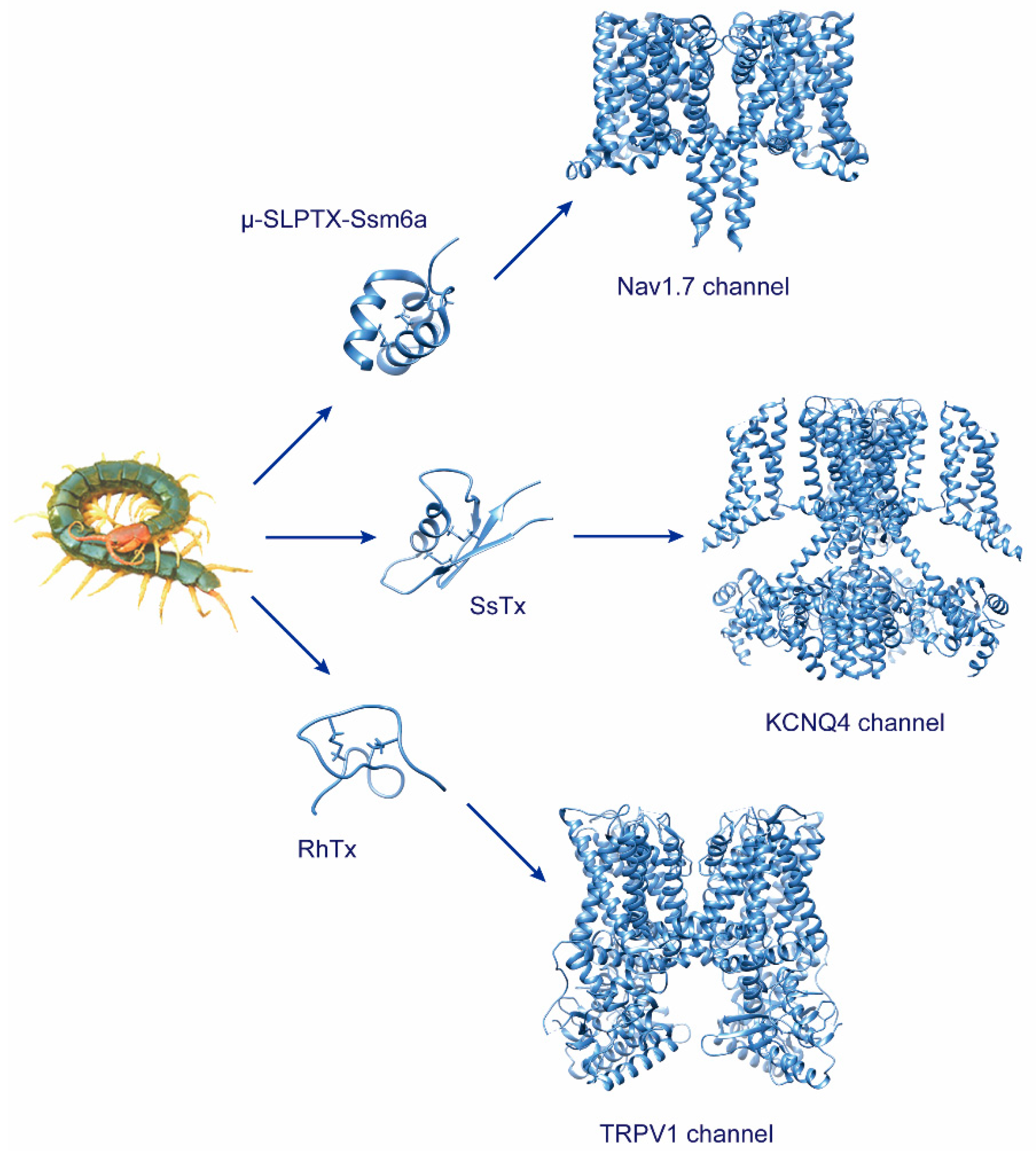
Voltage-gated sodium channels (NaV) are critical molecular determinants of electrical impulses (action potentials) initiation and propagation, which underlie the electrical hyperexcitability characteristic of chronic inflammatory and neuropathic pain [7][8]. In-depth research has been made on the venom of the Chinese red-head centipede, Scolopendra subspinipes mutilans L. Koch. μ-SLPTX-Ssm1a was a selective TTX-sensitive (TTX-S) NaV channel inhibitor with the complete amino acid sequence ADNKFENSLRREIACGQCRDKVKCDPYFYHCG [9]. Interestingly, another selective NaV channel inhibitor with an almost identical N-terminal sequence of μ-SLPTX-Ssm1a was further discovered from the S. subspinipes mutilans. μ-SLPTX-Ssm6a consists of 46 amino acid residues, yielding a molecular mass of 5318.4 Da. By using whole-cell patch-clamp recordings, this peptide potently inhibited the NaV1.7 channel with a half-maximal inhibitory concentration (IC50) of ~25 nM, which showed a much higher selective than other human sodium channels subtypes (Figure 1). In addition, μ-SLPTX-Ssm6a exhibited an analgesic effect than morphine in formalin-induced pain models. Moreover, μ-SLPTX-Ssm6a showed an almost equal analgesic effect with morphine in thermal and acid-related pain models [10]. Many neurotoxins from venomous animals such as scorpion, spider and snail also target NaV1.7. For instance, ProTx-II, a tarantula toxin, selectively targets the NaV1.7 channel, yielding an IC50 of 0.3 nM [11]. Similar to the effect of μ-SLPTX-Ssm6a on rat DRG neurons, ProTx-II shifted the conductance–voltage relationship in a depolarizing direction [11] despite their different structures. μ-SLPTX-Ssm6a is composed of three α helix structures, while ProTx-I contains two anti-parallel β-folds, which belong to the inhibitory cystine knot family [12].
Figure 1. Representative centipede toxins and related ion channel.
By the venomic and transcriptomic analysis of centipede Scolopendra subspinipes dehaani, Liu et al., identified only one group of peptides with five members coding for an identical mature peptide [13]. The Mexican centipede Scolopendra viridis crude venom was also reported to weakly inhibit hNaV1.2 and hNaV1.6 channel subtypes, indicating the existence of sodium channel inhibitors in S. viridis [14]. With the help of peptidomics combined with the cDNA library, researchers uncovered another precursor that has activity on the sodium channel [15].

3. Toxins Targeting Voltage-Gated Potassium Channels

Voltage-gated potassium channels (KV) distinctively modulate firing action potentials with the NaV channel. The NaV channel depolarizes the membrane potential while the KV channel repolarizes the membrane potential. The KV modulators account for a considerable portion in centipede venom. For instance, 10 families of KV inhibitors were identified from the S. subspinipes dehaani [13]. Moreover, the selectivity and potency of KV modulators are variable. SSD559, the most potent KV inhibitor, dose-dependently inhibits potassium channels in DRG neurons, and the IC50 for potassium channel inhibition was 10 nM [13]. In contrast, κ-SLPTX-Ssm3a was a weaker KV inhibitor. Application of 200 nM κ-SLPTX-Ssm3a on KV channels of dorsal root ganglion (DRG) neurons inhibits 25 ± 5% currents, and κ-SLPTX-Ssm3a does not entirely diminish the potassium peak currents even up to 5 µM, indicating that κ-SLPTX-Ssm3a is a weak inhibitor of potassium channel [9].
Based on centipede toxicity tracking, researchers isolated Ssm spooky toxin, SsTx, from the S. subspinipes mutilans. The structure of SsTx is polarized, with basic amino acids of arginine (position 12) and lysine (position 13) forming a positively charged surface. Further analyses showed that SsTx potently inhibited the KCNQ family with R12 and K13 on SsTx, and formed two pairs of salt bonds with residues 288 (aspartic acid) and 266 (aspartic acid) on KCNQ4, respectively (Figure 1). In addition, SsTx potently disrupts the cardiovascular, nervous, respiratory and muscular systems in rodent and mammal models [16]. In a further study, researchers showed that SsTx also inhibits the KV1.3 channel, amplifying the broad-spectrum destructive effect by inhibiting the KCNQ family, and shows that SsTx plays a key role in centipede defense and predation [17]. Yajamana et al. reported that SsTx, alone with three identified peptides (SsdTx1-3), could also inhibit the pore of the human Kir6.2 channel [18]. Another analog of SsTx, SsTx-4, effectively inhibits Kir1.1, Kir4.1, and Kir6.2/SUR1 channels, which are candidate targets for treating hypertension, depression, and diabetes, respectively [1]. Similar peptides were also discovered from other venomous species, including cone snails. κ-, κA-, κM- and I- superfamilies of conotoxins were reported to inhibit KV channels by interacting with the voltage-sensing or pore domains [19]. In comparison, most of the KV channel modulators from the centipede venoms target the pore region.

4. Toxins Targeting Voltage-Gated Calcium Channels

Both activators and inhibitors of the CaV channel have been discovered in centipede venoms. Researchers found that ω-SLPTX-Ssm1a potently activated voltage-gated calcium channel (CaV) in rat DRG neurons. Functionally, 10 µM ω-SLPTX-Ssm1a increased the calcium channel currents by ~120%, while ω-SLPTX-Ssm2a inhibits calcium channels in a dose-dependent manner. Functionally, 500 nM and 2.5 μM ω-SLPTX-Ssm2a inhibited the calcium channel current’s amplitude by 45% and 80%, respectively, yielding an IC50 of about 1590 nM [9]. SSD1052, a calcium channel inhibitor, was isolated from S. subspinipes dehaani crude venom. Ten nanometers of SSD1052 reversibly blocks the CaV current amplitude by 8.6% [13]. To date, most CaV modulators from centipedes are antagonists, and ω-SLPTX-Ssm1a is the only agonist. These peptides are structurally diverse with variable disulfide bonds, and all possess similar molecular mass (about 6 kDa). CaV modulators from other venomous animals, such as cone snails, have been extensively studied. Representative conotoxins, ω-GVIA and ω-MVIIA, potently inhibit N-type calcium channels. ω-MVIIA has been approved by the U.S. Food and Drug Administration to treat chronic pain. Thus, further detailed investigation of the pharmacological properties of centipede venoms is essential.

5. Toxins Targeting TRPV1 Channel

As exhibited earlier, centipede toxins are rich in neurotoxins. The Transient Receptor Potential Vanilloid 1 (TRPV1) channel mediates the heat and pain sensation in the periphery nervous system [20]. Yang et al. reported the discovery of a compact toxin from S. subspinipes mutilans. The gene encoding this toxin translated into a 69 aa, which yielded a toxin with 27 amino acids after post-translation modification. RhTx binds tightly to the charge-rich outer pore region of TRPV1 to induce severe pain and provides crucial structural information on the channel’s heat activation machinery (Figure 1) [21]. In addition, RhTx was used as a probe to investigate the heat-induced desensitization mechanism of the TRPV1 channel [22]. RhTx2 is an analog of RhTx with four more amino acids at the N-terminal. Functionally, RhTx2 desensitized the TRPV1 channel upon application to the extracellular domain, indicating that RhTx2 is also a good tool for the investigation of TRPV1 desensitization and a promising candidate for the development of new analgesics [23].

References

  1. Tang, D.; Xu, J.; Li, Y.; Zhao, P.; Kong, X.; Hu, H.; Liang, S.; Tang, C.; Liu, Z. Molecular mechanisms of centipede toxin SsTx-4 inhibition of inwardly rectifying potassium channels. J. Biol. Chem. 2021, 297, 101076.
  2. Undheim, E.A.; Fry, B.G.; King, G.F. Centipede venom: Recent discoveries and current state of knowledge. Toxins 2015, 7, 679–704.
  3. Zhao, F.; Lan, X.; Li, T.; Xiang, Y.; Zhao, F.; Zhang, Y.; Lee, W.H. Proteotranscriptomic Analysis and Discovery of the Profile and Diversity of Toxin-like Proteins in Centipede. Mol. Cell. Proteom. 2018, 17, 709–720.
  4. Chu, Y.; Qiu, P.; Yu, R. Centipede Venom Peptides Acting on Ion Channels. Toxins 2020, 12, 230.
  5. Dash, T.S.; Shafee, T.; Harvey, P.J.; Zhang, C.; Peigneur, S.; Deuis, J.R.; Vetter, I.; Tytgat, J.; Anderson, M.A.; Craik, D.J.; et al. A Centipede Toxin Family Defines an Ancient Class of CSalphabeta Defensins. Structure 2019, 27, 315–326.e7.
  6. Hakim, M.A.; Yang, S.; Lai, R. Centipede venoms and their components: Resources for potential therapeutic applications. Toxins 2015, 7, 4832–4851.
  7. Nguyen, P.T.; Yarov-Yarovoy, V. Towards Structure-Guided Development of Pain Therapeutics Targeting Voltage-Gated Sodium Channels. Front. Pharmacol. 2022, 13, 842032.
  8. Payandeh, J.; Scheuer, T.; Zheng, N.; Catterall, W.A. The crystal structure of a voltage-gated sodium channel. Nature 2011, 475, 353–358.
  9. Yang, S.; Liu, Z.; Xiao, Y.; Li, Y.; Rong, M.; Liang, S.; Zhang, Z.; Yu, H.; King, G.F.; Lai, R. Chemical punch packed in venoms makes centipedes excellent predators. Mol. Cell. Proteom. 2012, 11, 640–650.
  10. Yang, S.; Xiao, Y.; Kang, D.; Liu, J.; Li, Y.; Undheim, E.A.; Klint, J.K.; Rong, M.; Lai, R.; King, G.F. Discovery of a selective NaV1.7 inhibitor from centipede venom with analgesic efficacy exceeding morphine in rodent pain models. Proc. Natl. Acad. Sci. USA 2013, 110, 17534–17539.
  11. Xiao, Y.; Blumenthal, K.; Jackson, J.O., 2nd; Liang, S.; Cummins, T.R. The tarantula toxins ProTx-II and huwentoxin-IV differentially interact with human Nav1.7 voltage sensors to inhibit channel activation and inactivation. Mol. Pharmacol. 2010, 78, 1124–1134.
  12. Wright, Z.V.F.; McCarthy, S.; Dickman, R.; Reyes, F.E.; Sanchez-Martinez, S.; Cryar, A.; Kilford, I.; Hall, A.; Takle, A.K.; Topf, M.; et al. The Role of Disulfide Bond Replacements in Analogues of the Tarantula Toxin ProTx-II and Their Effects on Inhibition of the Voltage-Gated Sodium Ion Channel Nav1.7. J. Am. Chem. Soc. 2017, 139, 13063–13075.
  13. Liu, Z.C.; Zhang, R.; Zhao, F.; Chen, Z.M.; Liu, H.W.; Wang, Y.J.; Jiang, P.; Zhang, Y.; Wu, Y.; Ding, J.P.; et al. Venomic and transcriptomic analysis of centipede Scolopendra subspinipes dehaani. J. Proteome Res. 2012, 11, 6197–6212.
  14. González-Morales, L.; Pedraza-Escalona, M.; Diego-Garcia, E.; Restano-Cassulini, R.; Batista, C.V.; Gutiérrez Mdel, C.; Possani, L.D. Proteomic characterization of the venom and transcriptomic analysis of the venomous gland from the Mexican centipede Scolopendra viridis. J. Proteom. 2014, 111, 224–237.
  15. Rong, M.; Yang, S.; Wen, B.; Mo, G.; Kang, D.; Liu, J.; Lin, Z.; Jiang, W.; Li, B.; Du, C.; et al. Peptidomics combined with cDNA library unravel the diversity of centipede venom. J. Proteom. 2015, 114, 28–37.
  16. Luo, L.; Li, B.; Wang, S.; Wu, F.; Wang, X.; Liang, P.; Ombati, R.; Chen, J.; Lu, X.; Cui, J.; et al. Centipedes subdue giant prey by blocking KCNQ channels. Proc. Natl. Acad. Sci. USA 2018, 115, 1646–1651.
  17. Du, C.; Li, J.; Shao, Z.; Mwangi, J.; Xu, R.; Tian, H.; Mo, G.; Lai, R.; Yang, S. Centipede KCNQ Inhibitor SsTx Also Targets K(V)1.3. Toxins 2019, 11, 76.
  18. Ramu, Y.; Lu, Z. A family of orthologous proteins from centipede venoms inhibit the hKir6.2 channel. Sci. Rep. 2019, 9, 14088.
  19. Aguilar, M.B.; Perez-Reyes, L.I.; Lopez, Z.; de la Cotera, E.P.; Falcon, A.; Ayala, C.; Galvan, M.; Salvador, C.; Escobar, L.I. Peptide sr11a from Conus spurius is a novel peptide blocker for Kv1 potassium channels. Peptides 2010, 31, 1287–1291.
  20. Julius, D. TRP channels and pain. Annu. Rev. Cell Dev. Biol. 2013, 29, 355–384.
  21. Yang, S.; Yang, F.; Wei, N.; Hong, J.; Li, B.; Luo, L.; Rong, M.; Yarov-Yarovoy, V.; Zheng, J.; Wang, K.; et al. A pain-inducing centipede toxin targets the heat activation machinery of nociceptor TRPV1. Nat. Commun. 2015, 6, 8297.
  22. Luo, L.; Wang, Y.; Li, B.; Xu, L.; Kamau, P.M.; Zheng, J.; Yang, F.; Yang, S.; Lai, R. Molecular basis for heat desensitization of TRPV1 ion channels. Nat. Commun. 2019, 10, 2134.
  23. Zhu, A.; Aierken, A.; Yao, Z.; Vu, S.; Tian, Y.; Zheng, J.; Yang, S.; Yang, F. A centipede toxin causes rapid desensitization of nociceptor TRPV1 ion channel. Toxicon 2020, 178, 41–49.

More
Upload a video for this entry
Information
Contributors MDPI registered users' name will be linked to their SciProfiles pages. To register with us, please refer to https://encyclopedia.pub/register : Yalan Han , , Ren Lai , Lei Luo
View Times: 1.4K
Revisions: 2 times (View History)
Update Date: 22 Aug 2022
1000/1000
Hot Most Recent
Notice
You are not a member of the advisory board for this topic. If you want to update advisory board member profile, please contact office@encyclopedia.pub.
OK
Confirm
Only members of the Encyclopedia advisory board for this topic are allowed to note entries. Would you like to become an advisory board member of the Encyclopedia?
Yes
No
Academic Video Service



