You're using an outdated browser. Please upgrade to a modern browser for the best experience.
Submitted Successfully!
Thank you for your contribution! You can also upload a video entry or images related to this topic. For video creation, please contact our Academic Video Service.
Version Summary Created by Modification Content Size Created at Operation
1 Igor Erjavec + 2598 word(s) 2598 2022-01-12 09:44:06 |
2 format corrected. Beatrix Zheng + 74 word(s) 2672 2022-01-23 07:57:25 |

Video Upload Options

We provide professional Academic Video Service to translate complex research into visually appealing presentations. Would you like to try it?

Confirm

Are you sure to Delete?
Yes No
Cite
If you have any further questions, please contact Encyclopedia Editorial Office.
Erjavec, I. BMP3 Affects Mice Cortical and Trabecular Bone Development. Encyclopedia. Available online: https://encyclopedia.pub/entry/18629 (accessed on 05 December 2025).
Erjavec I. BMP3 Affects Mice Cortical and Trabecular Bone Development. Encyclopedia. Available at: https://encyclopedia.pub/entry/18629. Accessed December 05, 2025.
Erjavec, Igor. "BMP3 Affects Mice Cortical and Trabecular Bone Development" Encyclopedia, https://encyclopedia.pub/entry/18629 (accessed December 05, 2025).
Erjavec, I. (2022, January 21). BMP3 Affects Mice Cortical and Trabecular Bone Development. In Encyclopedia. https://encyclopedia.pub/entry/18629
Erjavec, Igor. "BMP3 Affects Mice Cortical and Trabecular Bone Development." Encyclopedia. Web. 21 January, 2022.
BMP3 Affects Mice Cortical and Trabecular Bone Development
Edit

Bone morphogenetic proteins (BMPs) have a major role in tissue development. BMP3 is synthesized in osteocytes and mature osteoblasts and has an antagonistic effect on other BMPs in bone tissue. The main aim of this study was to fully characterize cortical bone and trabecular bone of long bones in both male and female Bmp3−/− mice. To investigate the effect of Bmp3 from birth to maturity, we compared Bmp3−/− mice with wild-type littermates at the following stages of postnatal development: 1 day (P0), 2 weeks (P14), 8 weeks and 16 weeks of age. Bmp3 deletion was confirmed using X-gal staining in P0 animals. Cartilage and bone tissue were examined in P14 animals using Alcian Blue/Alizarin Red staining. Detailed long bone analysis was performed in 8-week-old and 16-week-old animals using micro-CT. The Bmp3 reporter signal was localized in bone tissue, hair follicles, and lungs. Bone mineralization at 2 weeks of age was increased in long bones of Bmp3−/− mice. Bmp3 deletion was shown to affect the skeleton until adulthood, where increased cortical and trabecular bone parameters were found in young and adult mice of both sexes, while delayed mineralization of the epiphyseal growth plate was found in adult Bmp3−/− mice. 

Bmp3 micro-CT long bone cortical bone growth plate

1. Introduction

Bone morphogenetic proteins (BMPs) are a large group of growth and differentiation factors that belong to the transforming growth factor-beta (TGF-β) protein superfamily. They have pleiotropic effects in numerous tissues during embryogenesis but also exhibit a prominent role in the regulation of physiological processes and final anatomy of the specimen during postnatal growth and development [1]. All BMP members elicit their cellular effects by ligand-induced activation of type I and II transmembrane serine/threonine kinase receptors. Type II receptors possess constitutional activity and phosphorylate type I receptors that further activate a signaling cascade by phosphorylating receptor-regulated Smads (R-Smads) and mitogen-activated protein kinase (MAPK) [2][3].
BMP3 was first isolated from bone as osteogenin and was determined to be the most abundant BMP in demineralized bone, comprising almost 65% of the total BMP quantity [4][5]. Osteogenin was found to induce osteogenic differentiation both in vitro [6] and in vivo [7] as well as cartilage formation [8]. It was also found in rat mesodermal tissues during embryonic development [9]. Later studies found that osteogenin contained small contaminants of other BMPs and thus expressed osteogenic properties, while pure BMP3 does not promote bone formation [10].
Therefore, the precise function of BMP3 in vivo was further explored in knockout mice (Bmp3−/−) [11]. Bmp3−/− mice are viable and show no obvious skeletal phenotype during development and in the neonatal period. Adult Bmp3−/− mice have more bone compared to wild-type mice [10][11], which supports that BMP3 is a negative regulator of bone density [12].
BMP3 is expressed and synthesized in mature osteoblasts and osteocytes [13][14], in the central nervous system of the adult rat [15], the testes of postnatal mice [16], and the bronchial epithelium and collecting tubules of the kidney, intestinal mucosa, perichondrium and periosteum in human development [17]. BMP3 was also shown to be involved in mesenchymal stem cell differentiation, where BMP3/Acvr2b interaction was defined as a key event in BMP mediated osteoblast differentiation. The loss of BMP3 increases colony-forming unit fibroblasts (CFU-F) and osteoblasts (CFU-OB) in bone marrow-derived stem/stromal cell (BMSC) cultures suggesting that BMP3 primarily affects bone formation [14][18][19].
BMP3 is also involved in articular cartilage repair in rabbits [20] and proper regulation of endochondral ossification in the chick limb [21], while overexpression of BMP3 in the developing skeleton alters endochondral bone formation and causes spontaneous rib fractures in mice [22]. Several studies demonstrated the role of BMP3 in regulating bone formation during fracture healing [23][24][25]. Inflammation in rheumatoid arthritis induces BMP3 expression contributing to erosive bone loss [26]. Furthermore, microRNA-450b (miRNA-450b), which was identified as a positive regulator of osteogenic differentiation, was found to directly target and inhibit BMP3 [27]. Interestingly, in vivo loading within a bone chamber model of a rat tibia metaphysis resulted in attenuation of Bmp3 expression that was followed by differentiation of bone marrow mesenchymal cells into chondrocytes. This finding was the first connection of any growth factor expression under loading conditions [28].
Alterations in BMP3 expression are found in a variety of cancers [29][30][31][32][33], indicating that BMP3 may have other roles besides regulating bone formation.

2. Current Insights

Previous studies on Bmp3 largely focused on its effect on trabecular bone, particularly that of the vertebrae. In this study, we examined, for the first time, the effect of the Bmp3 gene on the cortical bone of long bones—the femur and the tibia. Data on the effect of Bmp3 on distal long bones of the lower limb, in particular the tibia, has so far been lacking. In addition, we compared the effect of Bmp3 removal on male and female mice as well as the effect on mice at different stages of postnatal development, providing a more comprehensive overview of the effect of Bmp3 on bone tissue.
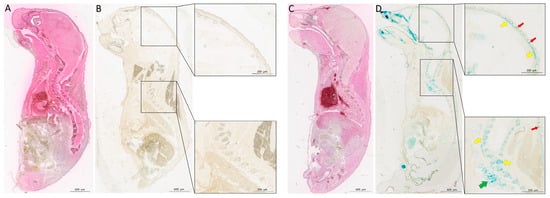
The deletion of the Bmp3 gene was confirmed in P0 mice via the expression of the β-galactosidase enzyme in Bmp3−/− mice, in which the LacZ gene sequence was inserted in-frame in the first exon of the Bmp3 gene [14][34]. Previous research demonstrated that Bmp3 mRNA is expressed in bone, teeth, lungs, kidneys, intestines, and hair follicles [17][35]. Using the LacZ gene reporter we confirmed these results on a protein level, as the activity of the β-galactosidase enzyme was detected in bone, hair follicles, and lungs. Bmp3 was visualized by X-gal staining in the flat bones of the skull, the ribs, and the vertebrae. Interestingly, the reporter signal was most pronounced in the viscerocranium, the base of the skull and the teeth buds. It should be noted that the enzyme activity observed in the intestine could potentially originate from externally ingested bacteria (milk) and not from intestinal cells since the mice samples were collected postpartum.
Figure 1. Expression of β-galactosidase (LacZ) in P0 mice. H&E staining shows no abnormalities in Bmp3−/− mice (C) compared to WT (A) mice. X-gal staining shows no LacZ reporter protein in WT (B), while in Bmp3−/− mice (D) localization of LacZ reporter protein can be observed in bone (yellow arrows), hair follicles (red arrows), and lungs (green arrow). X-gal staining was particularly pronounced in the viscerocranium and the base of the skull.
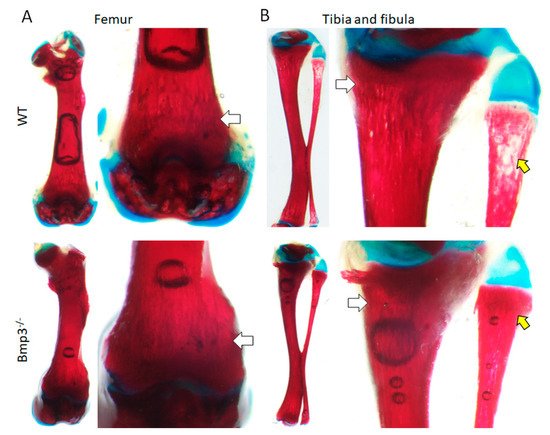
Bmp3−/− mice had no observable defects and developed at the same rate as WT animals. Bone mineralization was examined 14 days after birth, with differential skeleton staining of the mineralized and cartilaginous portion of the skeleton. The long bones of Bmp3−/− mice were more opaque, indicating a higher cartilage replacement rate and more calcium deposition compared to WT mice. This observation, even at a young age, is in accordance with the role of Bmp3 as a negative bone regulator [12]. The lack of a major effect of Bmp3 gene removal on mouse size indicates the existence of redundancy for BMP inhibition during bone growth and development [36][37]. Nevertheless, Bmp3 plays a major role in BMP inhibition, mostly due to its abundance [38].
Figure 2. Differential skeletal staining of long bones in P14 mice. Mineral deposition (white arrows) in the distal femur (A) and proximal tibia (B) appears more pronounced in Bmp3−/− mice compared to WT mice. The effect is the most pronounced in the proximal fibula (yellow arrow) where observable vesicles were present in all WT mice, but not in any of the analyzed Bmp3−/− mice.
Although muscle tissue was not the focus of this research, the fact that no significant difference in body mass was observed between Bmp3−/− and WT mice warrants further investigation of the possible effect of Bmp3 on skeletal muscles [39]. Even though excess bone tissue could require more muscle mass for movement, we did not observe any significant changes in body mass in Bmp3−/− mice, and thus, indirectly no significant increase in muscle mass. This finding could possibly be explained by the predominantly sedentary life of laboratory mice which might cause any existing effects on muscle mass to be less pronounced.
Experimental research has shown that Bmp3 is expressed in the hypertrophic cell layer of the femur growth plate, which supports findings that Bmp3 is involved in trabecular bone growth [24]. Furthermore, significant effects of genetic manipulation on animal phenotype at a young age were observed in numerous mouse models [40]. The findings in our study suggest that the differences in bone mineralization in Bmp3−/− mice observed at P14 may persist until maturity. At P14 we analyzed only male mice due to the fact that sexual dimorphism in bone length in mice is not observed prior to three weeks of age [40].
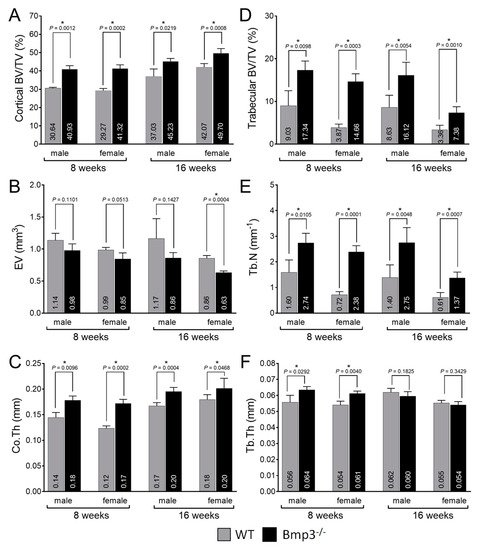
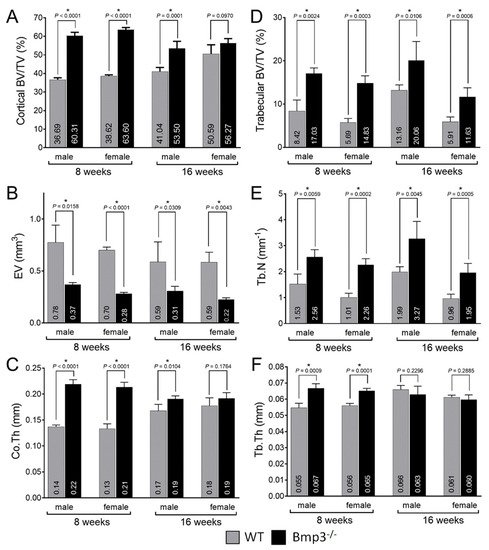
Figure 3. Morphometric analysis of the distal femur of Bmp3−/− and WT mice at 8 and 16 weeks of age. (A) BV/T, (B) EV and (C) Co.Th for femoral cortical bone. (D) BV/TV, (E) Th.N and (F) Tb.Th for femoral trabecular bone. Statistically significant differences are indicated by *.
Nevertheless, it might be reasonable to assume that functional knockout animals could display differences in bone metabolism between sexes at a mature age due to different responses to sex hormones [41]. For example, deletion of estrogen receptors reveals a regulatory role for estrogen receptors-beta in bone remodeling in females, but not in males. In addition, Bmp3 could affect male and female mice differently due to sexual dimorphism in mice. In this study, we examined the potential sex differences in Bmp3 bone metabolism regulation by comparing the effects of Bmp3 deletion in both male and female mice. When the effect of mice size on bone volume was eliminated by normalizing it according to tissue volume, a significant increase in bone volume fraction (BV/TV) in Bmp3−/− mice was observable in both sexes and in both analyzed age groups. This supports the notion that the fundamental inhibitory effect of Bmp3 is similar in both sexes, even though effect size analysis suggests that it might be slightly more pronounced in female mice.
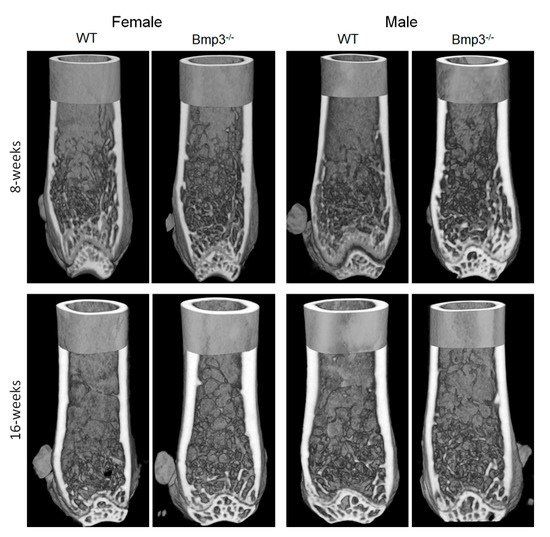
Figure 4. Femur cortical and trabecular bone render of 8-week- and 16-week-old female and male Bmp3−/− and WT mice.
Since our findings demonstrated a significant effect of Bmp3 on cortical bone volume, it is important to note that the formation of cortical bone comprises of two distinct processes: diaphyseal cortical bone is formed by sub-periosteal apposition, while metaphyseal cortical bone is formed by trabecular coalescence [42] and is more pronounced in male mice [43]. Bone corticalization requires local SOCS3 activity and is promoted by androgen action via interleukin-6. In our research, the effect of Bmp3 deletion on cortical bone parameters followed the same trends in both male and female mice. In general, physiological decrease in femoral cortical thickness occurs in both male and female mice as a result of decreased periosteal formation, increased endosteal resorption, medullary expansion, increased osteocyte DNA damage, cellular senescence, and increased levels of RANKL [44]. Higher responsiveness of the endocortical bone surface to mechanical loading could also serve as a mechanism for increased bone resorption due to lower animal activity in older age [45]. In our study, the cortical bone analysis revealed that both male and female Bmp3−/− mice had, on average, a lower endosteal volume which corresponds to a smaller medullar canal, although the difference was significant only in female mice (16-week-old mice for the femur and both age groups for the tibia). Other studies found that the porosity of the femoral cortical bone in mice increased with age and had a significantly higher incidence in females, which, along with increased endosteal resorption, led to a reduction in cortical thickness in older animals [46]. In addition, Bmp3−/− mice in our study had a higher femoral diaphyseal cortical thickness with significant differences for most groups, with the exception of the tibia in 16-week-old mice. The fact that Bmp3−/− mice had a higher cortical thickness, but a lower endosteal volume suggests that endosteal resorption in Bmp3−/− mice was decreased compared to WT animals.
In addition to the effect on cortical bone, our study also confirmed the effect of the removal of the Bmp3 gene on the trabecular bone of long bones in both male and female mice. Trabecular bone analysis of the femur revealed that Bmp3−/− mice had an approximately two times higher bone volume fraction than WT mice, which is in line with results from previous studies [11][12]. A similar trend was observed for the trabecular bone of the tibia, further establishing the effect of the Bmp3 gene on long bones. From the trabecular parameters that reflect BV/TV, only the trabecular number was shown to have a consistent significant increase in Bmp3−/− mice. Trabecular thickness increased significantly only in 8-week-old Bmp3−/− mice, while it decreased in 16-week-old Bmp3−/− mice, albeit not significantly. Furthermore, the correlation coefficient between bone volume fraction and trabecular number is much higher than the correlation coefficient between bone volume fraction and trabecular thickness. This indicates that the increase in trabecular bone volume in Bmp3−/− mice is primarily due to an increase in the number of trabeculae, while the changes in trabecular thickness contribute much less to the increase in trabecular bone volume in Bmp3−/− mice.
Histological analysis of the distal femur of 16-week-old mice revealed that more trabeculae were present in Bmp3−/− mice, which was in line with the quantitative findings from the micro-CT analysis. Furthermore, no mineralized cartilage was observed in the epiphyseal growth plate of Bmp3−/− mice. This finding is relevant because, unlike in humans, the epiphyseal growth plate in mice does not close during puberty [46], but rather undergoes extensive cartilage mineralization causing plate bridging and subsequent thinning of the growth plate [47][48]. We found signs of epiphyseal growth plate bridging only in WT mice, which indicates that the process is either completely absent in Bmp3−/− mice, or at least significantly delayed not to be observable at 16 weeks of age. It is interesting to note that previous research found Bmp3 mRNA expression in hypertrophic chondrocytes, but not in other parts of the growth plate [24]. Altogether, this supports the notion that Bmp3 expression is attenuated prior to chondrocyte differentiation from bone marrow osteoprogenitor cells [28]. Since there is no difference in the length of long bones between Bmp3−/− and WT mice, it can be concluded that Bmp3 deficiency does not significantly affect long bone cortical growth, thus, it likely affects neither chondrocyte differentiation nor proliferation. Instead, Bmp3 deficiency appears to primarily affect chondrocyte hypertrophy and extracellular matrix deposition in the epiphyseal region, resulting in increased formation of trabecular bone, with higher expression of Runx2 in that region. This is caused by an excess availability of osteoinductive molecules, such as BMP2 in Bmp3−/− mice.
Figure 5. Morphometric analysis of the proximal tibia of Bmp3−/− and WT mice at 8 and 16 weeks of age. (A) BV/TV, (B) EV and (C) Co.Th for tibial cortical bone. (D) BV/TV, (E) Th.N and (F) Tb.Th for tibial trabecular bone. Statistically significant differences are indicated by *.
The aforementioned results demonstrated that Bmp3 in mice has a significant role in the regulation of long bone formation, affecting both cortical and trabecular bone respectively. Similar effects of Bmp3 on long bones were observed in both male and female mice, excluding a significant role of sex hormones in the mechanism of its action. These results further corroborate a significant regulatory role of Bmp3 deficiency in bone metabolism leading to an increased trabecular and cortical bone volume of long bones in mice.

3. Conclusions

Bmp3 gene deletion in mice caused an increase in the cortical and trabecular bone volume of the distal femur and proximal tibia, further confirming the inhibitory role of Bmp3 in bone tissue. An increase in bone calcification was observed in P14 Bmp3−/− mice, while an increase in bone volume was observed in 8-weeks- and 16-weeks-old Bmp3−/− mice in both sexes. The increase in cortical bone volume and cortical thickness in Bmp3−/− mice was mostly a consequence of decreased endosteal resorption, while periosteal apposition seemingly remained unaffected. Trabecular bone was increased due to the impaired inhibitory effect of Bmp3 on cartilage to bone transition in the epiphyseal growth plate. Comprehensive analysis of cortical and trabecular bone suggests that Bmp3 antagonizes the effects of osteogenic BMPs in bone, preventing uncontrolled bone formation and offering a mechanical link to growth factor expression in the adaptation of bone to load.

References

  1. Vukicevic, S.; Sampath, K.T. (Eds.) Bone Morphogenetic Proteins: From Laboratory to Clinical Practice; Birkhäuser Verlag: Basel, Switzerland, 2002; ISBN 3-7643-6509-9.
  2. Chen, D.; Zhao, M.; Mundy, G.R. Bone morphogenetic proteins. Growth Factors 2004, 22, 233–241.
  3. Katagiri, T.; Watabe, T. Bone Morphogenetic Proteins. Cold Spring Harb. Perspect. Biol. 2016, 8, a021899.
  4. Wozney, J.M. Bone morphogenetic proteins. Prog. Growth Factor Res. 1989, 1, 267–280.
  5. Wozney, J.M.; Rosen, V. Bone morphogenetic protein and bone morphogenetic protein gene family in bone formation and repair. Clin. Orthop. Relat. Res. 1998, 346, 26–37.
  6. Vukicevic, S.; Luyten, F.P.; Reddi, A.H. Stimulation of the expression of osteogenic and chondrogenic phenotypes in vitro by osteogenin. Proc. Natl. Acad. Sci. USA 1989, 86, 8793–8797.
  7. Luyten, F.P.; Cunningham, N.S.; Vukicevic, S.; Paralkar, V.; Ripamonti, U.; Reddi, A.H. Advances in osteogenin and related bone morphogenetic proteins in bone induction and repair. Acta Orthop. Belg. 1992, 58 (Suppl. 1), 263–267.
  8. Luyten, F.P.; Yu, Y.M.; Yanagishita, M.; Vukicevic, S.; Hammonds, R.G.; Reddi, A.H. Natural bovine osteogenin and recombinant human bone morphogenetic protein-2B are equipotent in the maintenance of proteoglycans in bovine articular cartilage explant cultures. J. Biol. Chem. 1992, 267, 3691–3695.
  9. Vukicevic, S.; Paralkar, V.M.; Cunningham, N.S.; Gutkind, J.S.; Reddi, A.H. Autoradiographic localization of osteogenin binding sites in cartilage and bone during rat embryonic development. Dev. Biol. 1990, 140, 209–214.
  10. Bahamonde, M.E.; Lyons, K.M. BMP3: To be or not to be a BMP. J. Bone Jt. Surg. Am. 2001, 83 (Suppl. 1), S56–S62.
  11. Bialek, P.; Parkington, J.; Li, X.; Gavin, D.; Wallace, C.; Zhang, J.; Root, A.; Yan, G.; Warner, L.; Seeherman, H.J.; et al. A myostatin and activin decoy receptor enhances bone formation in mice. Bone 2014, 60, 162–171.
  12. Daluiski, A.; Engstrand, T.; Bahamonde, M.E.; Gamer, L.W.; Agius, E.; Stevenson, S.L.; Cox, K.; Rosen, V.; Lyons, K.M. Bone morphogenetic protein-3 is a negative regulator of bone density. Nat. Genet. 2001, 27, 84–88.
  13. Zoricic, S.; Maric, I.; Bobinac, D.; Vukicevic, S. Expression of bone morphogenetic proteins and cartilage-derived morphogenetic proteins during osteophyte formation in humans. J. Anat. 2003, 202, 269–277.
  14. Kokabu, S.; Gamer, L.; Cox, K.; Lowery, J.; Tsuji, K.; Raz, R.; Economides, A.; Katagiri, T.; Rosen, V. BMP3 suppresses osteoblast differentiation of bone marrow stromal cells via interaction with Acvr2b. Mol. Endocrinol. 2012, 26, 87–94.
  15. Yamashita, K.; Mikawa, S.; Sato, K. BMP3 expression in the adult rat CNS. Brain Res. 2016, 1643, 35–50.
  16. Ciller, I.M.; Palanisamy, S.K.; Ciller, U.A.; McFarlane, J.R. Postnatal expression of bone morphogenetic proteins and their receptors in the mouse testis. Physiol. Res. 2016, 65, 673–682.
  17. Vukicevic, S.; Helder, M.N.; Luyten, F.P. Developing human lung and kidney are major sites for synthesis of bone morphogenetic protein-3 (osteogenin). J. Histochem. Cytochem. 1994, 42, 869–875.
  18. Zhou, X.; Tao, Y.; Liang, C.; Zhang, Y.; Li, H.; Chen, Q. BMP3 Alone and Together with TGF-β Promote the Differentiation of Human Mesenchymal Stem Cells into a Nucleus Pulposus-Like Phenotype. Int. J. Mol. Sci. 2015, 16, 20344–20359.
  19. Cernea, M.; Tang, W.; Guan, H.; Yang, K. Wisp1 mediates Bmp3-stimulated mesenchymal stem cell proliferation. J. Mol. Endocrinol. 2016, 56, 39–46.
  20. Zhang, Z.; Yang, W.; Cao, Y.; Shi, Y.; Lei, C.; Du, B.; Li, X.; Zhang, Q. The Functions of BMP3 in Rabbit Articular Cartilage Repair. Int. J. Mol. Sci. 2015, 16, 25934–25946.
  21. Gamer, L.W.; Ho, V.; Cox, K.; Rosen, V. Expression and function of BMP3 during chick limb development. Dev. Dyn. 2008, 237, 1691–1698.
  22. Gamer, L.W.; Cox, K.; Carlo, J.M.; Rosen, V. Overexpression of BMP3 in the developing skeleton alters endochondral bone formation resulting in spontaneous rib fractures. Dev. Dyn. 2009, 238, 2374–2381.
  23. Liu, J.; Hu, Y.; Ma, Z. The experimental study on expression of BMP3 gene during fracture healing. Zhonghua Wai Ke Za Zhi 1996, 34, 585–588.
  24. Zheng, L.; Yamashiro, T.; Fukunaga, T.; Balam, T.A.; Takano-Yamamoto, T. Bone morphogenetic protein 3 expression pattern in rat condylar cartilage, femoral cartilage and mandibular fracture callus. Eur. J. Oral Sci. 2005, 113, 318–325.
  25. Kloen, P.; Lauzier, D.; Hamdy, R.C. Co-expression of BMPs and BMP-inhibitors in human fractures and non-unions. Bone 2012, 51, 59–68.
  26. Matzelle, M.M.; Shaw, A.T.; Baum, R.; Maeda, Y.; Li, J.; Karmakar, S.; Manning, C.A.; Walsh, N.C.; Rosen, V.; Gravallese, E.M. Inflammation in arthritis induces expression of BMP3, an inhibitor of bone formation. Scand. J. Rheumatol. 2016, 45, 379–383.
  27. Fan, L.; Fan, J.; Liu, Y.; Li, T.; Xu, H.; Yang, Y.; Deng, L.; Li, H.; Zhao, R.C. miR-450b Promotes Osteogenic Differentiation In Vitro and Enhances Bone Formation In Vivo by Targeting BMP3. Stem Cells Dev. 2018, 27, 600–611.
  28. Aspenberg, P.; Basic, N.; Tägil, M.; Vukicevic, S. Reduced expression of BMP-3 due to mechanical loading: A link between mechanical stimuli and tissue differentiation. Acta Orthop. Scand. 2000, 71, 558–562.
  29. Dai, Z.; Popkie, A.P.; Zhu, W.-G.; Timmers, C.D.; Raval, A.; Tannehill-Gregg, S.; Morrison, C.D.; Auer, H.; Kratzke, R.A.; Niehans, G.; et al. Bone morphogenetic protein 3B silencing in non-small-cell lung cancer. Oncogene 2004, 23, 3521–3529.
  30. Loh, K.; Chia, J.A.; Greco, S.; Cozzi, S.-J.; Buttenshaw, R.L.; Bond, C.E.; Simms, L.A.; Pike, T.; Young, J.P.; Jass, J.R.; et al. Bone morphogenic protein 3 inactivation is an early and frequent event in colorectal cancer development. Genes Chromosomes Cancer 2008, 47, 449–460.
  31. Chen, X.-R.; Wang, J.-W.; Li, X.; Zhang, H.; Ye, Z.-Y. Role of BMP3 in progression of gastric carcinoma in Chinese people. World J. Gastroenterol. 2010, 16, 1409–1413.
  32. Kim, Y.O.; Hong, I.K.; Eun, Y.G.; Nah, S.-S.; Lee, S.; Heo, S.-H.; Kim, H.-K.; Song, H.-Y.; Kim, H.-J. Polymorphisms in bone morphogenetic protein 3 and the risk of papillary thyroid cancer. Oncol. Lett. 2013, 5, 336–340.
  33. Kisiel, J.B.; Li, J.; Zou, H.; Oseini, A.M.; Strauss, B.B.; Gulaid, K.H.; Moser, C.D.; Aderca, I.; Ahlquist, D.A.; Roberts, L.R.; et al. Methylated Bone Morphogenetic Protein 3 (BMP3) Gene: Evaluation of Tumor Suppressor Function and Biomarker Potential in Biliary Cancer. J. Mol. Biomark. Diagn. 2013, 4, 1000145.
  34. Valenzuela, D.M.; Murphy, A.J.; Frendewey, D.; Gale, N.W.; Economides, A.N.; Auerbach, W.; Poueymirou, W.T.; Adams, N.C.; Rojas, J.; Yasenchak, J.; et al. High-throughput engineering of the mouse genome coupled with high-resolution expression analysis. Nat. Biotechnol. 2003, 21, 652–659.
  35. Takahashi, H.; Ikeda, T. Transcripts for two members of the transforming growth factor-beta superfamily BMP-3 and BMP-7 are expressed in developing rat embryos. Dev. Dyn. 1996, 207, 439–449.
  36. Groppe, J.; Greenwald, J.; Wiater, E.; Rodriguez-Leon, J.; Economides, A.N.; Kwiatkowski, W.; Baban, K.; Affolter, M.; Vale, W.W.; Izpisua Belmonte, J.C.; et al. Structural basis of BMP signaling inhibition by Noggin, a novel twelve-membered cystine knot protein. J. Bone Jt. Surg. Am. 2003, 85 (Suppl. 3), 52–58.
  37. Matsumoto, Y.; Otsuka, F.; Hino, J.; Miyoshi, T.; Takano, M.; Miyazato, M.; Makino, H.; Kangawa, K. Bone morphogenetic protein-3b (BMP-3b) inhibits osteoblast differentiation via Smad2/3 pathway by counteracting Smad1/5/8 signaling. Mol. Cell. Endocrinol. 2012, 350, 78–86.
  38. Wozney, J.M.; Rosen, V.; Celeste, A.J.; Mitsock, L.M.; Whitters, M.J.; Kriz, R.W.; Hewick, R.M.; Wang, E.A. Novel regulators of bone formation: Molecular clones and activities. Science 1988, 242, 1528–1534.
  39. Goodman, C.A.; Hornberger, T.A.; Robling, A.G. Bone and skeletal muscle: Key players in mechanotransduction and potential overlapping mechanisms. Bone 2015, 80, 24–36.
  40. Sanger, T.J.; Norgard, E.A.; Pletscher, L.S.; Bevilacqua, M.; Brooks, V.R.; Sandell, L.J.; Cheverud, J.M. Developmental and genetic origins of murine long bone length variation. J. Exp. Zool. B Mol. Dev. Evol. 2011, 316, 146–161.
  41. Sims, N.; Dupont, S.; Krust, A.; Clement-Lacroix, P.; Minet, D.; Resche-Rigon, M.; Gaillard-Kelly, M.; Baron, R. Deletion of estrogen receptors reveals a regulatory role for estrogen receptors-β in bone remodeling in females but not in males. Bone 2002, 30, 18–25.
  42. Cadet, E.R.; Gafni, R.I.; McCarthy, E.F.; McCray, D.R.; Bacher, J.D.; Barnes, K.M.; Baron, J. Mechanisms responsible for longitudinal growth of the cortex: Coalescence of trabecular bone into cortical bone. J. Bone Jt. Surg. Am. 2003, 85, 1739–1748.
  43. Cho, D.-C.; Brennan, H.J.; Johnson, R.W.; Poulton, I.J.; Gooi, J.H.; Tonkin, B.A.; McGregor, N.E.; Walker, E.C.; Handelsman, D.J.; Martin, T.J.; et al. Bone corticalization requires local SOCS3 activity and is promoted by androgen action via interleukin-6. Nat. Commun. 2017, 8, 806.
  44. Piemontese, M.; Almeida, M.; Robling, A.G.; Kim, H.-N.; Xiong, J.; Thostenson, J.D.; Weinstein, R.S.; Manolagas, S.C.; O’Brien, C.A.; Jilka, R.L. Old age causes de novo intracortical bone remodeling and porosity in mice. JCI Insight 2017, 2, e93771.
  45. Birkhold, A.I.; Razi, H.; Duda, G.N.; Weinkamer, R.; Checa, S.; Willie, B.M. The Periosteal Bone Surface is Less Mechano-Responsive than the Endocortical. Sci. Rep. 2016, 6, 23480.
  46. Jilka, R.L. The relevance of mouse models for investigating age-related bone loss in humans. J. Gerontol. A Biol. Sci. Med. Sci. 2013, 68, 1209–1217.
  47. Hoshi, K.; Ogata, N.; Shimoaka, T.; Terauchi, Y.; Kadowaki, T.; Kenmotsu, S.-I.; Chung, U.-I.; Ozawa, H.; Nakamura, K.; Kawaguchi, H. Deficiency of insulin receptor substrate-1 impairs skeletal growth through early closure of epiphyseal cartilage. J. Bone Miner. Res. 2004, 19, 214–223.
  48. Staines, K.A.; Madi, K.; Javaheri, B.; Lee, P.D.; Pitsillides, A.A. A Computed Microtomography Method for Understanding Epiphyseal Growth Plate Fusion. Front. Mater. 2018, 4, 48.

More
Upload a video for this entry
Information
Contributor MDPI registered users' name will be linked to their SciProfiles pages. To register with us, please refer to https://encyclopedia.pub/register : Igor Erjavec
View Times: 762
Revisions: 2 times (View History)
Update Date: 23 Jan 2022
1000/1000
Hot Most Recent
Notice
You are not a member of the advisory board for this topic. If you want to update advisory board member profile, please contact office@encyclopedia.pub.
OK
Confirm
Only members of the Encyclopedia advisory board for this topic are allowed to note entries. Would you like to become an advisory board member of the Encyclopedia?
Yes
No
Academic Video Service