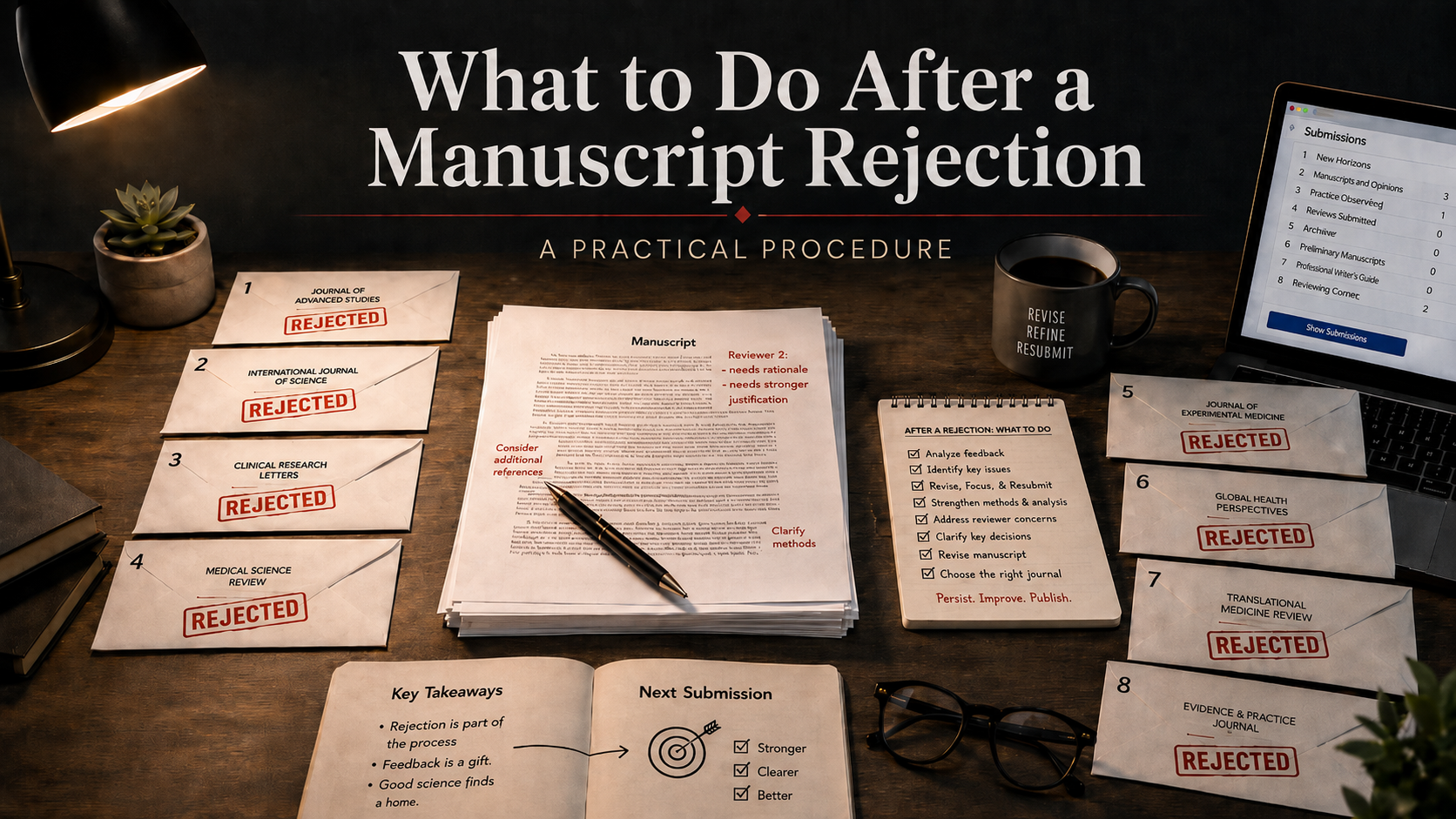
Over several months, eight journals rejected the same manuscript of mine—a multicentre real-world study on the renal effects of oral semaglutide in people with type 2 diabetes. It was eventually published as a Letter to the Editor. The useful lesson was not persistence, but that I had spent a year asking what I was doing wrong when the answerable question is narrower: what does this particular rejection tell me, and what is the next action?
A rejection is a data point, and, like any data point, it should be read before it is acted on.
1. Triage the Letter Before Reacting
Rejections are not interchangeable and do not carry the same amount of information.
Desk rejection on scope or priority—no scientific critique, a decision reached within days, an editorial judgement about fit and readership. It says little about the methods and a great deal about the positioning, and the appropriate response is re-targeting rather than rewriting.
Rejection after peer review with substantive critique—the most informative letter an author receives. Something in the design, analysis or reporting failed to convince an informed reader, and it must be addressed before the paper goes anywhere else.
Rejection after review with thin or contradictory comments—an editorial decision that would have been reached regardless. Extract whatever is concrete and do not spend weeks reconciling reviewers who disagree with each other.
A practical marker is the time from submission to decision: days indicates an editorial judgement, weeks or months with a report attached indicates a scientific one.
2. Decide Whether to Repair or to Relocate
The question is whether the failure lies in the positioning or in the science.
Positioning failure. The work is sound but reached the wrong audience, format or framing. Signals include a desk rejection, language about priority or fit, a suggestion to approach a specialist journal, and no methodological criticism. Reframe and resubmit elsewhere.
Scientific failure. The problem lies in the design, the analysis or the strength of the claim. Signals include reviewers questioning the estimand, confounding control, sample or endpoint definitions and, decisively, two independent reviewers converging on the same point. Such defects do not travel: the next journal will identify them too.
When a letter contains both, treat it as a scientific failure until proven otherwise. Descending the journal ladder before establishing that the manuscript is sound simply distributes the same defect across more editorial offices.
3. Read Reviewer Comments for Content, not Tone
A useful mechanism is deliberately bureaucratic. Wait twenty-four hours, then build a three-column table: the comment verbatim; what it is actually asking, restated in neutral language; the action required and its exact location in the manuscript. Anything that cannot be restated neutrally has not yet been understood, and the table later becomes the skeleton of the response letter at the next journal.
Each point can then be classified as a factual error, a methodological objection, an interpretive disagreement, a matter of preference, or a misreading. Factual errors are corrected without discussion; methodological objections are corrected or defended explicitly, never ignored; preferences may be declined politely. Misreadings deserve particular attention: when a reviewer objects to something that was not written, the text has usually permitted the misreading, and subsequent readers will repeat it.
4. Re-Examine the Scientific Decisions That Cannot be Defended
Before any resubmission, take each key decision—design, population, exposure definition, primary endpoint, statistical model, handling of missing data, choice of covariates—and write one or two sentences on what it does, what it assumes, and why the alternative was rejected, in your own words and without consulting sources. Any decision that cannot be written out is a gap a reviewer will find, and a response letter is a poor place to discover it.
When a reviewer asks why a mixed model was preferred to a simple pre-post comparison, "my statistician suggested it" is not an answer; it indicates a paper whose author cannot defend it. This is not an argument for working alone. The distinction is between delegating a task and delegating comprehension.
5. Revise Before Resubmitting Every Time
A manuscript sent unchanged to a second journal will usually produce an unchanged outcome. Revision is not limited to the points reviewers happened to raise: the previous submission demonstrated only that this version failed to convince, not that everything else in it was sound. The following is the minimum list I now work through before a manuscript goes anywhere else.
- Rewrite the title and abstract for the new journal’s readership rather than the previous journal’s readership.
- Confirm that the paper answers a question the new journal’s readers actually ask.
- Account for every reviewer point as corrected, defended, or deliberately declined, leaving none unaddressed.
- Verify that every number in the text matches the tables and figures, against the source data rather than a previous draft.
- Check every citation against the source itself, not against memory or another paper’s reading of it.
- Write the limitations as analysis rather than apology, drafted early enough to still change what is done.
- Apply the relevant reporting guideline line by line—PRISMA, STROBE, CONSORT, STARD—rather than citing it.
- Update authorship, contributions, conflicts of interest and data availability for the new venue.
- Reformat to the new journal’s instructions rather than the previous journal’s.
- Read the manuscript once as a reviewer, with the journal’s criteria alongside, and write the report you would send.
The last item is the one worth protecting. It is uncomfortable, and considerably faster than waiting three months to be told the same thing by a stranger. It comes more easily to those who review for journals themselves: reviewers are rarely searching for reasons to reject a paper, but for reasons to trust its conclusions, and every unjustified methodological choice, undiscussed limitation or ambiguous sentence withdraws a small amount of that trust.
Read this way, the eight letters were not eight verdicts on the data, but eight readers who could not find enough reasons to trust what had been written—a problem an author can act on.
Triage the letter, decide between repair and relocation, read the comments for content, defend or revise every scientific decision in your own words, and never resubmit a manuscript unchanged.
Biography
Antonio Maria Labate, MD, is a specialist in Internal Medicine working as an outpatient diabetology and internal medicine specialist at ASST Franciacorta and ASST Mantova, in Lombardy, Italy. He trained in Internal Medicine at the University of Messina and has broad clinical experience spanning internal medicine, emergency medicine, and diabetology. His work focuses on clinical diabetology, cardiovascular and cardiometabolic risk in type 2 diabetes, real-world evidence, and the clinical use of newer glucose-lowering therapies such as GLP-1 receptor agonists and SGLT2 inhibitors. He has authored peer-reviewed articles and congress communications on the cardiovascular, renal, and metabolic effects of these agents and serves as a reviewer for several international journals.