
We are pleased to feature insights from Professor Albrecht Classen, University Distinguished Professor of German Studies at the University of Arizona, who offers a timeless reflection on the philosophy of education. In a world increasingly shaped by artificial intelligence and instant access to information, Professor Classen reminds us that true education does not begin with technology—it begins with thought. His reflections challenge us to move beyond memorization and instead engage deeply with the sources of knowledge.
1. Education as an Intellectual and Moral Journey
Professor Classen argues that the heart of education lies in independent and reflective thinking. By revisiting original sources—whether the writings of Hrotsvit of Gandersheim, the tragic love of Tristan and Isolde, the moral lessons of the Bible, or the provocations of Nietzsche—students learn to think critically and empathetically. Such engagement nurtures intellectual growth, moral awareness, and spiritual depth. In this view, the humanities are not relics of the past, but essential tools for understanding the human condition.
2. The Value of Deep Engagement in the AI Era
In today's AI-driven world, information is abundant, but understanding remains rare. Professor Classen emphasizes that education must cultivate discernment—the ability to question, interpret, and connect ideas meaningfully. By engaging deeply with texts, students gain not only knowledge but also the capacity to innovate and navigate complex realities. True learning, he suggests, is a transformative process that equips us to face the challenges of modernity with wisdom and creativity.
Through his reflections, Professor Classen bridges the wisdom of the past with the demands of the present. His perspective reminds us that while technology changes, the essence of education—the search for truth and understanding—remains constant (More information can be found: https://encyclopedia.pub/entry/59172).
3. About Professor Albrecht Classen
Professor Classen is a leading authority on medieval and early modern European literature. He has published over 135 books and 850 articles, including influential works such as The Medieval Chastity Belt and the Handbook of Medieval Studies, and serves as editor for multiple journals and book series. His scholarship is complemented by creative pursuits, including poetry and satirical prose, exemplifying the integration of rigorous research with artistic expression.
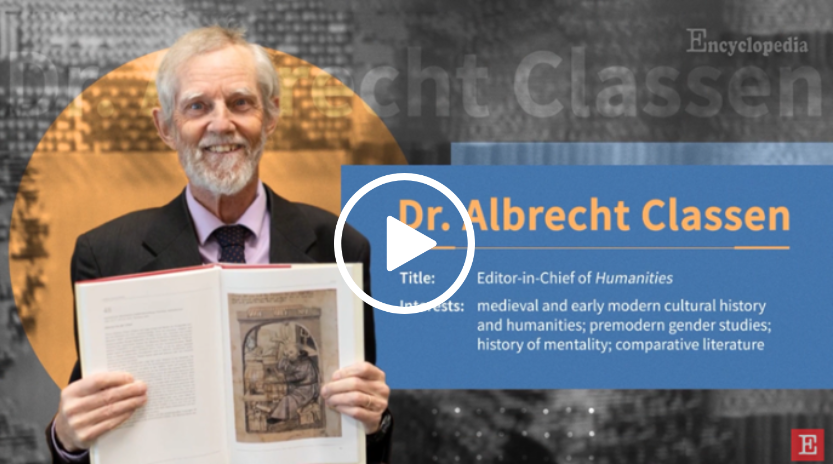
This profile video was produced by Encyclopedia, which offers an Academic Video Service to help researchers share their work in an accessible and engaging way. (https://encyclopedia.pub/video/1717).