
As global agriculture faces rising pressures from soil degradation, water scarcity, and climate instability, scientists are turning back to the ground—literally—for sustainable answers. Soil is not just a growth medium; it is a living ecosystem whose stability determines food security and ecological resilience. Among the many approaches to restoring degraded soils, two natural amendments—biochar and mulch—have emerged as promising solutions. But how exactly do they work, and what happens when they are combined? A recent study, “Biochar and Mulch: Hydrologic, Erosive, and Phytotoxic Responses Across Different Application Strategies and Agricultural Soils”, sheds new light on these questions.
1. Why Soil Loss Matters
In Mediterranean farmlands such as Portugal’s Alentejo region, soil erosion and organic matter loss have become pressing threats to agricultural productivity. Overexploitation, combined with low rainfall and poor ground cover, has accelerated the decline of once-productive vineyards and olive orchards. As erosion strips away fertile topsoil, water retention drops, and plants struggle to thrive. To address these challenges, researchers turned to biochar, a carbon-rich byproduct of biomass pyrolysis, and mulch, typically composed of organic residues like straw. Both have been proven to reduce runoff and improve moisture balance, yet their combined and comparative effects remained unclear—until now.
2. What the Research Found
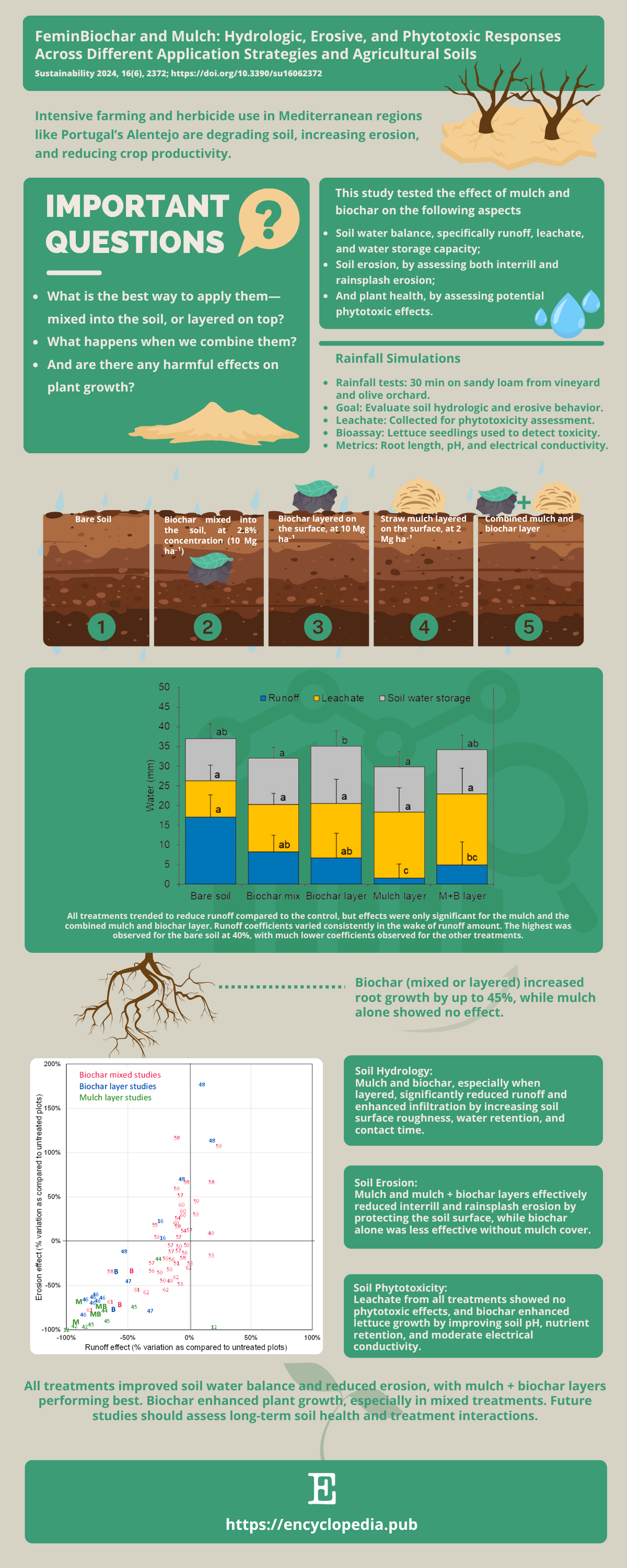
The research team designed rainfall simulation experiments on two types of Mediterranean agricultural soils to test four application strategies:
- Biochar mixed into the soil (2.8% by weight)
- Biochar applied as a surface layer (10 Mg ha⁻¹)
- Straw mulch applied on the surface (2 Mg ha⁻¹)
- A combined mulch + biochar layer
The results were striking. All treatments improved soil hydrology, reducing runoff by 52–91% and interrill erosion by 55–81%, with the strongest effects observed in treatments that included mulch. Moreover, biochar significantly enhanced plant root development—root length increased by up to 29-45%, while showing no harmful phytotoxicity. The combined mulch + biochar strategy emerged as the most effective, delivering complementary benefits: mulch protected the surface from rainfall impact, while biochar improved infiltration and nutrient availability.
Source: Encyclopedia Scientific Infographic (https://encyclopedia.pub/image/3810)
3. Building Resilience through Nature-Based Solutions
These findings carry strong implications for the future of sustainable and regenerative agriculture. As climate extremes intensify, the ability to retain water, reduce erosion, and sustain soil biodiversity will determine whether farming systems can remain productive. The combination of mulch and biochar provides a low-cost, no-tillage, and environmentally friendly solution that minimizes soil disturbance while enhancing ecosystem resilience. Beyond improving soil health, such practices contribute to carbon sequestration, reinforcing their value in global efforts to mitigate climate change.
Ultimately, this study underscores a vital truth: the path forward for agriculture lies not in synthetic interventions but in working with nature’s own processes. By integrating biochar and mulch, we can help restore degraded lands, protect future harvests, and ensure that the world’s soils remain fertile for generations to come.
For more information about topic, you can view the online video entitled "Biochar and Mulch: How Application Strategies Shape Soil Health".