As modern reading habits shift toward rapid digital consumption and AI-assisted parsing, relying solely on static PDFs risks burying groundbreaking research in a digital crypt.
Every single day, thousands of brilliant, groundbreaking papers are uploaded to academic repositories. Weeks, months, and sometimes years of exhaustive lab work, funding applications, and intellectual energy are condensed into a highly structured, peer-reviewed document. Then, for the vast majority of these papers, the trajectory flatlines. They are downloaded as a standard PDF, skimmed for a few seconds, and filed away into the silent crypts of reference managers, never to be opened again.
The hard truth is that the traditional academic paper was designed for the printing press, not the smartphone, the modern web browser, or the AI answer engine. We are still communicating 21st-century science using a 19th-century format. In an era where information velocity is measured in seconds, relying solely on an ossified, 20-page static PDF to convey your life's work isn't just an outdated habit—it is a massive career bottleneck.
If we want our research to actually change the world, or even just get cited, the way we communicate science must fundamentally evolve.
1. The Shifting Anatomy of Scholarly Attention
We need to be honest about how we, as researchers, actually consume the literature today. We do not read linearly from abstract to conclusion. Drowning in cognitive overload and constrained by shrinking schedules, modern academics browse, filter, parse, and prompt.
Increasingly, we rely on artificial intelligence tools and answer engines to summarize key findings, extract methodologies, and synthesize data before we ever commit to reading a full text. If your paper exists only as an unyielding wall of dense, academic prose trapped in a PDF—a format that is notoriously hostile to machine reading—you are making it incredibly difficult for the digital ecosystem to discover your work.
A striking gap has emerged between passive publishing and active, multi-channel engagement. Depositing a paper in a journal repository and expecting the scientific community to discover it by chance is an uphill battle against an unforgiving algorithm (Figure 1).
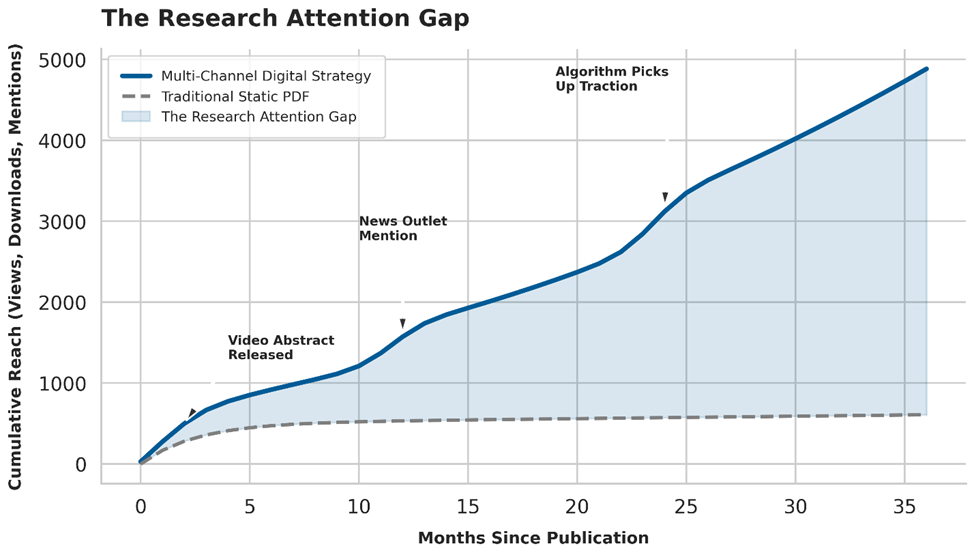
Figure 1. The research attention gap. A comparative projection of longitudinal reach showing traditional static publishing versus modern multi-channel digital engagement (conceptual model derived from aggregated institutional repository download analytics).
As Figure 1 visually illustrates, multi-channel visibility acts as a massive force multiplier for full-text downloads. When you wrap a core paper in a dynamic digital ecosystem, you are not "dumbing down" the science; you are building an explicit, frictionless pathway that guides readers directly to your data.
2. Beyond the Impact Factor: The Real-Time Attention Economy
For decades, the standard metric of academic success has been the journal Impact Factor. We have outsourced our professional worth to a single, lagging index. But waiting two to three years for a traditional citation to show up in a database is an archaic way to build a scientific reputation or demonstrate societal value to funding bodies.
The digital era has democratized impact through alternative metrics—such as Altmetrics and PlumX—which track the real-time footprint of a paper across mainstream news, policy documents, authoritative blogs, Wikipedia, and social platforms. This data matters because funding agencies and tenure committees are rapidly shifting their gaze toward verifiable, immediate societal impact (Figure 2).
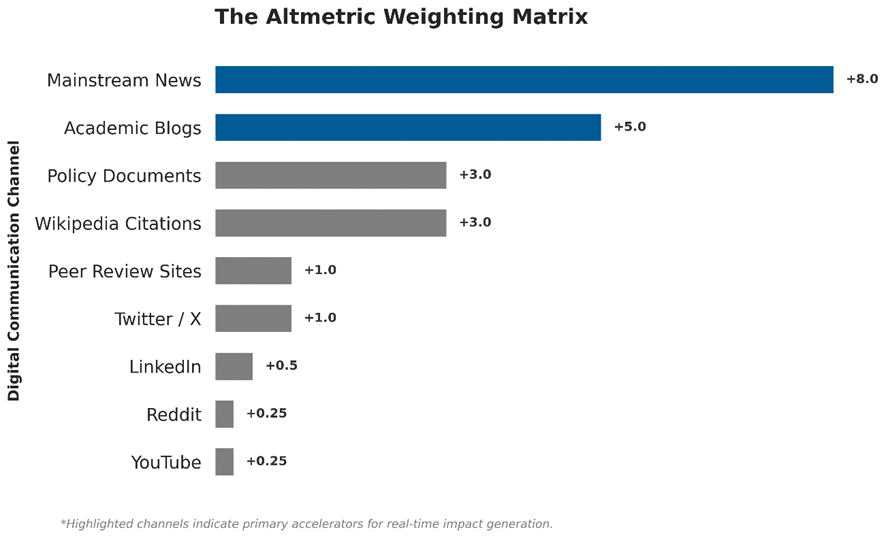
Figure 2. How the digital era tracks real-time impact. The official Altimetric statistical weighting matrix, showcasing the value assigned to non-traditional scholarly discussions.
Look closely at the data in Figure 2. A single mention in a mainstream news outlet, an inclusion in a public policy brief, or a highly shared thread by an authoritative academic moves the needle of your real-time research footprint far faster than a standard repository upload. Digital communication is no longer an optional hobby for eccentric scientists; it is actively indexed, mathematically weighted, and structurally embedded into how institutions measure visibility.
3. The 3-Tier Digital Dissemination Strategy
Transitioning into digital-first science communication does not mean you need to sacrifice your lab time to become a full-time content creator. It requires a strategic, highly efficient toolkit designed to layer over your existing publications.
3.1. The Micro-Abstract as an Algorithmic Hook
The moment your paper is accepted, translate your abstract into a high-impact digital thread. Strip away the heavy jargon and focus purely on three core questions:
- What was the problem?
- What did you find?
- Why does it matter to the world outside your lab?
Publish this on professional networks like LinkedIn or X (formerly Twitter). Think of it as a digital front door to your paper. You are giving both human readers and search algorithms the exact keywords they need to find you.
3.2. Frictionless Accessibility via the Open Access Pipeline
Never let your paper live exclusively behind an institutional paywall if you can legally avoid it. Maximize the use of green open-access repositories, pre-print servers, and academic research networks. If a policymaker, a science journalist, or a peer from an underfunded institution clicks your link and hits a $40 paywall, your research effectively ceases to exist for them. Remove the friction.
3.3. High-Density Encoding with Visuals and Video
Human brains process visuals thousands of times faster than text. Accompany your paper with a single visual abstract or a clean infographic that highlights your primary chart.
More importantly, embrace the video abstract. This does not require a cinematic budget. Record a raw, 60-second Zoom screen-share of your paper’s definitive figure with your webcam turned on. Explain the data exactly how you would to a colleague standing next to you at a conference poster session. Modern digital algorithms heavily prioritize authentic, face-to-camera human communication over polished, detached corporate marketing. A 60-second video can easily earn more engagement in a single afternoon than a static text abstract will accumulate over an entire semester.
4. Reclaiming the Power of Your Output
The traditional academic infrastructure has conditioned us to believe that our job ends the moment the "Submit" button turns into an "Accepted" notification. It doesn't. In a crowded, hyper-accelerated digital landscape, taking control of how your research is communicated is not an act of vanity—it is an act of professional survival.
We must stop treating public engagement as an administrative chore or a secondary distraction. By transforming our static findings into dynamic, discoverable multimedia assets, we bridge the gap between isolated laboratories and the global community.
Let your data live outside the margins of an 8.5x11-inch PDF. Evolve your communication style, break through the digital noise, and give your science the attention it genuinely deserves.
Biography
Dr. Akeem Adeyemi Oladipo is a Research Professor of Chemistry at Eastern Mediterranean University (Cyprus), where he heads the SMART LAB (Electro-Bio-Environmental & Energy Technologies). Recognized globally among the Top 2% of Scientists by Stanford University and Elsevier, his pioneering research sits at the critical nexus of nanotechnology, advanced materials, and AI-driven materials discovery. Refusing to let his findings languish in academic repositories, Dr. Oladipo is an active deep-tech entrepreneur and the founder of multiple commercial ventures, including TracePulse, Adsoora, and ReduOXLab. Through these startups, he actively translates complex laboratory breakthroughs—such as high-performance nanofluids and advanced environmental remediation strategies—into scalable, industry-ready technologies. A highly prolific author and Editorial Board Member, he is deeply passionate about bridging the gap between isolated laboratory data and high-visibility, real-world sustainable solutions.