

 +1 credit
| Version | Summary | Created by | Modification | Content Size | Created at | Operation |
|---|---|---|---|---|---|---|
| 1 | hongwei song | -- | 500 | 2026-08-17 11:56:09 | | | |
| 2 | hongwei song | + 59 word(s) | 564 | 2026-08-18 03:38:17 | | | | |
| 3 | Catherine Yang | Meta information modification | 564 | 2026-08-18 04:01:53 | | |
Video Upload Options
As the levels of intelligence and automation in landscaping equipment continue to rise, remote -controlled lawn mowers, as a new type of micro-agricultural and landscaping equipment, have demonstrated significant advantages in handling complex terrain, operating on steep slopes, and maintaining high-risk environments. This paper systematically reviews the core technical architecture of remote-controlled lawn mowers, focusing on the design of tracked chassis and remote control systems, and anti-rollover mechanisms on slopes, as well as their application value in lakeside and complex hilly environments. It also provides an outlook on the future development trends of this technology.
1. Introduction
Compared to traditional ride-on and zero-turn mowers, these machines offer higher operational efficiency on large, flat lawns and in residential yards. However, when faced with complex terrain such as slopes with an incline greater than 15 degrees, irregular rock edges, and open water surfaces, traditional equipment poses a very high risk of overturning and slipping, posing a potential threat to the operator's safety. The advent of remote-controlled mowers, through a human-machine separation operating mode, has fundamentally resolved the safety challenges associated with working in high-risk terrain.
2. Core Technical Features and System Configuration
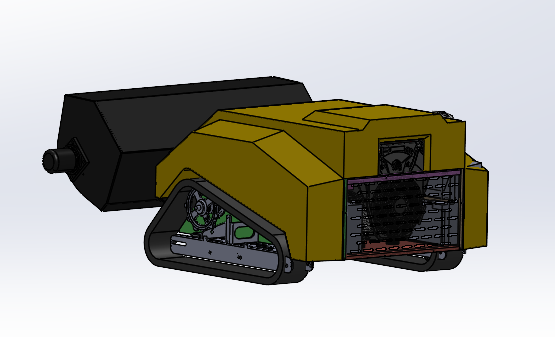
2.1. Tracked Chassis and Low Center of Gravity Design
To ensure traction on slopes and slippery surfaces, modern remote-controlled lawn mowers commonly employ rubber track chassis. The low center of gravity(LCG) mechanical layout, combined with the tracks'large ground contact area, effectively distributes the machine's load and prevents instability on soft mud or steep slopes(up to 30- 60 degrees,Image courtesy of Trimmora Technologies)
2.2. Hybrid and Gas-Electric Synergy Systems
Mainstream remote-controlled lawn mowers employ a hybrid architecture featuring"gasoline engine cutting+electric traction drive."The gasoline engine provides the powerful cutting force required for high -speed rotation of the cutting deck, while the electric motor precisely controls the differential steering of the left and right tracks, enabling 360 ° zero-turn capability. This significantly enhances maneuverability when turning around in tight spaces or along boundaries.
2.3. Wireless Remote Control and Safe Human-Machine Interaction
The remote control system typically uses a 2.4GHZ wireless communication protocol, with an effective control range of over 200 meters. Operators can perform full-function remote interventions from a safe line-of-sight distance, thereby avoiding noise, injuries from flying debris, and long-term occupational health hazards caused by vibration.
3. Typical Application Scenarios and Operational Efficiency Analysis
Maintenance of the Farnland Shores and Water Body Edges
Areas where land meets water, such as lakeshores, often feature rock piles and varying slopes, making it extremely easy for traditional mowers to lose control and slide into the water. Thanks to their ability to hug the ground and trim along edges, remote-controlled mowers can significantly reduce the amount of manual edge trimming(string trimming) required afterward.
Weed Control in Hilly Areas and at Solar Power Plants
In areas beneath solar panels or on steep slopes, where conventional equipment has difficulty accessing, remote-controlled mowers- thanks to their low-profile design and hill-climbing capabilities -have become the mainstream solution for such specialized scenarios.
4. Conclusions and Outlook
Remote-controlled lawn mower technology has marked a significant leap in landscaping machinery, shifting from a model where "people follow the machine" to one of "human-machine interaction." In the future, with the further integration of high-precision RTK-GPS positioning, LiDAR collision avoidance, and AI path planning technologies, remote-controlled lawn mowers will gradually evolve into fully autonomous, unmanned mowing robots, providing more efficient and safer intelligent solutions for landscaping maintenance in complex terrain.




