

 +1 credit
| Version | Summary | Created by | Modification | Content Size | Created at | Operation |
|---|---|---|---|---|---|---|
| 1 | Sergio Da Silva | -- | 380 | 2026-07-22 03:28:43 | | | |
| 2 | Perry Fu | Meta information modification | 380 | 2026-07-22 03:58:13 | | |
Video Upload Options
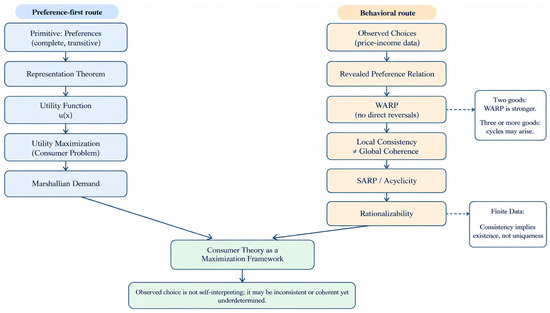
Revealed preference is an approach in consumer theory that infers preferences from observed choices rather than treating preferences or utility as directly given. If a consumer chooses one bundle when another bundle is also affordable, the chosen bundle is said to be revealed preferred to the alternative. The theory asks under what conditions such observed choices can be rationalized by a preference relation or a utility function. Observed choices may satisfy local consistency by avoiding direct reversals while still failing to support a single complete and transitive ordering. Stronger acyclicity conditions can restore rationalizability, although finite choice data may still leave the underlying preference ordering underdetermined rather than uniquely identified.
References
- Jehle, G.A.; Reny, P.J. Advanced Microeconomic Theory, 3rd ed.; Pearson: Harlow, UK, 2011.
- Samuelson, P.A. A note on the pure theory of consumer’s behaviour. Economica 1938, 5, 61–71.
- Samuelson, P.A. Consumption theory in terms of revealed preference. Economica 1948, 15, 243–253.
- Samuelson, P.A. The problem of integrability in utility theory. Economica 1950, 17, 355–385.
- Houthakker, H.S. Revealed preference and the utility function. Economica 1950, 17, 159–174.




