Your browser does not fully support modern features. Please upgrade for a smoother experience.
Submitted Successfully!
Thank you for your contribution! You can also upload a video entry or images related to this topic. For video creation, please contact our Academic Video Service.
Version Summary Created by Modification Content Size Created at Operation
1 Mihail Kolev -- 540 2026-06-16 04:51:52 |
2 formatted Vicky Zhou Meta information modification 540 2026-06-16 05:40:13 |

Video Upload Options

We provide professional Academic Video Service to translate complex research into visually appealing presentations. Would you like to try it?
Cite
If you have any further questions, please contact Encyclopedia Editorial Office.
Kolev, M.; Simeonova, T. Digital Tools in Aluminum Alloy Processing. Encyclopedia. Available online: https://encyclopedia.pub/entry/59801 (accessed on 16 June 2026).
Kolev M, Simeonova T. Digital Tools in Aluminum Alloy Processing. Encyclopedia. Available at: https://encyclopedia.pub/entry/59801. Accessed June 16, 2026.
Kolev, Mihail, Tatiana Simeonova. "Digital Tools in Aluminum Alloy Processing" Encyclopedia, https://encyclopedia.pub/entry/59801 (accessed June 16, 2026).
Kolev, M., & Simeonova, T. (2026, June 16). Digital Tools in Aluminum Alloy Processing. In Encyclopedia. https://encyclopedia.pub/entry/59801
Kolev, Mihail and Tatiana Simeonova. "Digital Tools in Aluminum Alloy Processing." Encyclopedia. Web. 16 June, 2026.
Peer Reviewed
Digital Tools in Aluminum Alloy Processing

Digital tools in aluminum alloy processing are computational, sensing-based, and data-driven methods used to understand, predict, monitor, optimize, and control how aluminum alloys are transformed into components. They support decisions across casting, deformation processing, heat treatment, welding, surface engineering, and additive manufacturing by linking processing conditions with geometry, microstructure, defects, properties, and service performance. In technical use, the term includes finite element method (FEM), computational fluid dynamics (CFD), CALculation of PHAse Diagrams (CALPHAD), microstructure models, machine-learning regressors, surrogate models, nondestructive digital inspection, image-analysis tools, and digital twins. These tools are most effective when they establish links among controllable processing variables, underlying metallurgical mechanisms, measurable quality indicators, and service-relevant performance outcomes.
aluminum alloys digital tools process simulation machine learning integrated computational materials engineering digital twin casting extrusion welding additive manufacturing
Aluminum alloys are processed by casting, deformation, heat treatment, welding, surface engineering, and additive manufacturing. Each processing route subjects the material to a unique thermal, mechanical, and chemical history. As a result, alloys with the same nominal composition may evolve different grain structures, precipitate distributions, residual stresses, porosity, texture, anisotropy, and damage tolerance. Digital tools make these process–structure–property relationships explicit and reduce reliance on trial-and-error experimentation. Digitalization in aluminum processing is developed from casting and solidification simulations, finite-element forming and extrusion models, thermodynamic calculations, and integrated computational material engineering (ICME) workflows. Current research increasingly integrates production sensors, image analysis, machine learning (ML), surrogate optimization, and digital twins. Examples include digital-twin direct-chill (DC) casting, computational materials-engineering design for low-pressure die-cast wheel alloys, microstructure-scale damage analysis of cast alloys, numerical ML DC-casting simulation, interpretable process–structure–property modeling for laser powder bed fusion (LPBF) AlSi10Mg, and the inverse design of Al-Mg-Si extrusions using industrial process data [1][2][3][4][5].
The need for a unified entry arises because digital tools for aluminum alloys are distributed across separate literatures on casting, welding, additive manufacturing, thermomechanical processing, heat treatment, inspection, and data-driven material design. This entry considers these tools as approaches for generating material-processing knowledge rather than as generic automation software. It delineates the principal tool classes, categorizes their functional roles, summarizes route-specific applications, identifies study-design principles, and outlines practical limitations.
This entry illustrates major digital-tool categories and processing routes rather than attempting a systematic review. Digitalization in this field may be conceptualized as a hierarchy of representations: raw process signals; microstructure and property descriptors; calibrated numerical models; statistical or ML regressors; inverse-design and optimization algorithms; and digital twins updated using experimental or production data. A digital thread is an organized chain of data linking process history, material state, inspection, and performance information. A digital twin is a maintained data-linked representation used for monitoring, prediction, or decision support. A tool is useful when it retains route-specific physical variables, such as heat extraction in casting, strain-rate-temperature paths in extrusion, aging time and temperature in heat treatment, melt-pool stability in laser welding, or layer-wise thermal cycling in additive manufacturing.
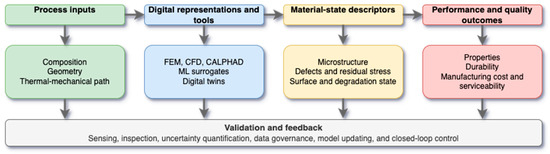
Figure 1 summarizes the digital ecosystem considered in this entry, showing how process inputs, digital-model classes, material-state descriptors, validation data, and implementation decisions are linked in a feedback-oriented workflow.
Figure 1. Schematic workflow of digital tools in aluminum alloy processing, linking process inputs, digital representations and tools, material-state descriptors, performance and quality outcomes, and validation/feedback data within a decision-support framework.

References

  1. Yağcı, T.; Cöcen, Ü.M.İ.T.; Çulha, O.S.M.A.N. Aluminum alloy development for wheel production by low pressure die casting with new generation computational materials engineering approaches. Arch. Foundry Eng. 2023, 21, 35–46.
  2. Ickler, T.; Jüngst, D.; Brückner-Foit, A.; Fehlbier, M. Analysis of Damage Mechanisms in an AlSi10Fe0.7 Model Casting Alloy Based on a “Digital Twin”. Mater. Charact. 2025, 229, 115506.
  3. Guo, G.; Yao, T.; Liu, W.; Tang, S.; Xiao, D.; Huang, L.; Wu, L.; Feng, Z.; Gao, X. Numerical Simulation and Machine Learning Prediction of the Direct Chill Casting Process of Large-Scale Aluminum Ingots. Materials 2024, 17, 1409.
  4. Liu, Q.; Chen, W.; Yakubov, V.; Kruzic, J.J.; Wang, C.H.; Li, X. Interpretable Machine Learning Approach for Exploring Process-Structure-Property Relationships in Metal Additive Manufacturing. Addit. Manuf. 2024, 85, 104187.
  5. Hayashi, Y.; Sugio, K.; Sasaki, G.; Shioi, M.; Okuno, M. Process Optimization of Al-Mg-Si Alloy Extrusions via Machine Learning and Inverse Design. J. Mater. Eng. Perform. 2026, 35, 22066–22084.

More
Upload a video for this entry
Information
Contributors MDPI registered users' name will be linked to their SciProfiles pages. To register with us, please refer to https://encyclopedia.pub/register : Mihail Kolev , Tatiana Simeonova
View Times: 4
Online Date: 16 Jun 2026
Notice
You are not a member of the advisory board for this topic. If you want to update advisory board member profile, please contact office@encyclopedia.pub.
OK
Confirm
Only members of the Encyclopedia advisory board for this topic are allowed to note entries. Would you like to become an advisory board member of the Encyclopedia?
Yes
No
${ textCharacter }/${ maxCharacter }
Submit
Cancel
There is no comment~
${ textCharacter }/${ maxCharacter }
Submit
Cancel
${ selectedItem.replyTextCharacter }/${ selectedItem.replyMaxCharacter }
Submit
Cancel
Confirm
Are you sure to Delete?
Yes No
Academic Video Service

Quick Survey

Encyclopedia MDPI is conducting a targeted survey to identify the specific barriers hindering efficient research. We invite you to spend 3 minutes defining the priorities for our next generation of structured knowledge tools.
Take Survey