Your browser does not fully support modern features. Please upgrade for a smoother experience.
Submitted Successfully!
Thank you for your contribution! You can also upload a video entry or images related to this topic. For video creation, please contact our Academic Video Service.
Version Summary Created by Modification Content Size Created at Operation
1 Ali Cheshmehzangi -- 1613 2026-03-24 01:57:35 |
2 Format Correct Abigail Zou Meta information modification 1613 2026-03-24 04:53:38 |

Video Upload Options

We provide professional Academic Video Service to translate complex research into visually appealing presentations. Would you like to try it?
Cite
If you have any further questions, please contact Encyclopedia Editorial Office.
Cheshmehzangi, A. Sustainable Built Environments at the Climate–Health Nexus: Mitigating Heat Risks for Urban Well-Being. Encyclopedia. Available online: https://encyclopedia.pub/entry/59629 (accessed on 24 March 2026).
Cheshmehzangi A. Sustainable Built Environments at the Climate–Health Nexus: Mitigating Heat Risks for Urban Well-Being. Encyclopedia. Available at: https://encyclopedia.pub/entry/59629. Accessed March 24, 2026.
Cheshmehzangi, Ali. "Sustainable Built Environments at the Climate–Health Nexus: Mitigating Heat Risks for Urban Well-Being" Encyclopedia, https://encyclopedia.pub/entry/59629 (accessed March 24, 2026).
Cheshmehzangi, A. (2026, March 24). Sustainable Built Environments at the Climate–Health Nexus: Mitigating Heat Risks for Urban Well-Being. In Encyclopedia. https://encyclopedia.pub/entry/59629
Cheshmehzangi, Ali. "Sustainable Built Environments at the Climate–Health Nexus: Mitigating Heat Risks for Urban Well-Being." Encyclopedia. Web. 24 March, 2026.
Peer Reviewed
Sustainable Built Environments at the Climate–Health Nexus: Mitigating Heat Risks for Urban Well-Being

“Sustainable Built Environments at the Climate–Health Nexus” refers to the planning and administration of metropolitan areas that tackle the interconnected problems of public health, climate change, and increasing heat hazards. By highlighting tactics that lessen urban heat islands, increase resilience, and advance equity, it establishes the built environment as a crucial link between environmental stresses and the welfare of multicultural urban communities. With an emphasis on how urban heat increases health risks and how design might act as a mediator between climate pressures and human well-being, this article explores the relationship between climate and health within the sustainable built environment. It criticizes the enduring “delusions of sustainable architecture”, regarded as metric substitution, which overlook fair health results in favour of sustainability being reduced to certification or spectacle. In this paper, “delusions” refer to two recurring patterns: (1) metric substitution, where carbon/energy performance is treated as a proxy for health protection, and (2) spectacle substitution, where iconic projects stand in for systemic heat-risk reduction. Through a critical examination of Singapore’s Gardens by the Bay and Abu Dhabi’s Masdar City, the conversation highlights the benefits and drawbacks of landmark sustainability initiatives. These programs highlight the risks of selected resilience, elitism, and dependence on resource-intensive technologies, even as they show technological creativity in lowering thermal stress and establishing microclimatic comfort. The study makes the case for a shift in the sustainable built environment toward design that is systemic, equitable, and health-centred. Including public health outcomes in sustainability measurements, giving everyday resilience precedence over showcase projects, and including governance, equity, and cultural transformation in planning frameworks are all highlighted in the recommendations. The climate–health nexus is used here as an evaluative lens to test whether sustainable built-environment interventions measurably reduce heat exposure and health risk, particularly for vulnerable groups. In a moment of increasing climatic stress, the conclusion urges shedding illusions and making sustainability a lived condition of justice, dignity, and resilience.

climate–health nexus sustainable built environment urban heat islands health equity governance resilient design sustainable architecture

1.1. Linking Climate, Health, and the Built Environment

The relationship between climate, health, and the built environment is sharply evident in the context of extreme heat. Dense construction, heat-absorbing materials, little greenery, and decreased air circulation all contribute to the urban heat island (UHI) effect, which increases heat exposure in cities [1][2][3]. These factors raise air and surface temperatures, elevating risks of dehydration, heat stress, cardiovascular strain, and early death [4][5]. The constructed environment thus becomes a source of vulnerability as well as a site for mitigation. This paper uses urban heat mitigation as the practical entry point for interrogating whether “sustainability” delivers verifiable health protection rather than symbolic performance.
The climate–health nexus frames this challenge as more than an environmental concern. Vulnerable populations, such as the elderly, children, outdoor labourers, and low-income homes without access to air conditioning—are disproportionately affected by heat exposure [6]. Longer-term health effects include exacerbated chronic diseases, disturbed sleep, and emotional stress are in addition to the immediate heat illness [7].
A clear method to lower these hazards is through the use of sustainable built environments. Cool roofs, reflecting facades, cross ventilation, and natural shading are building-level strategies that lower energy consumption and moderate interior temperatures [8]. Green roofs, tree canopies, permeable pavements, and water-sensitive architecture are examples of urban interventions that reduce ambient temperatures and revitalize local microclimates. In particular, blue–green infrastructure has several advantages, including flood control, evapotranspiration-based cooling, and areas that promote mental and physical well-being [9]. These strategies make the built environment determinant of exposure to better societal/population health.
The core of this relationship is still equity. Because cooling interventions are frequently dispersed unevenly, underprivileged neighbourhoods are more vulnerable [10][11]. Sustainable solutions run the risk of perpetuating or escalating inequality if social equity is not purposefully incorporated into planning and design [12]. Thus, the relationship between climate change and health emphasizes the built environment’s dual function of influencing the extent of exposure [13] to climatic risks and providing direct tools for mitigating harm. For clarity, this paper uses the following terms in specific ways: resilience refers to the capacity of urban systems to reduce heat exposure and health risk; infrastructure includes both physical and governance systems shaping exposure; equity denotes the fair distribution of protection; and governance refers to institutional coordination across planning, health, and environmental domains.

1.2. Between Aspirations and Realities: The Climate–Health Nexus and Facing the Limits of Contemporary Sustainability Paradigms
The promise of the sustainable built environment is frequently shown in tidy schematics and glossy renderings, energy-positive buildings, green roofs, and shaded boulevards that are intended to protect public health and shield communities from climatic shocks [14]. Despite the growing recognition of the connections between climate change and health in policy and design discourse, implementation is characterized by unequal ambition, incomplete adoption, and occasionally self-deception. When design choices prioritize reputational signals (certification, visual greening, flagship narratives) over measurable reductions in heat exposure and health risk, sustainability becomes performative rather than protective.
Much sustainable architecture still prioritizes carbon accounting and energy performance. The distribution of cooling advantages among populations, interior air quality, and thermal comfort are frequently neglected in favour of kilowatt savings or emission reductions in certifications, rating systems, and green labels [15]. Even buildings with high sustainability ratings may retain heat, deny vulnerable residents the opportunity to adapt effectively, or use energy-intensive mechanical systems to make up for poor design. A technocratic approach to sustainability that views health and climate change as unrelated [16] but parallel priorities could be strengthened by this constrained framing.
The expense of this disjunction is shown by urban heat. Many cities have “green” initiatives that highlight certain elements, such pocket parks, solar panels, or recycled materials, but neglect to address systemic exposure to heat stress. Luxury eco-districts, for instance, frequently have a wealth of cooling services, but the nearby low-income areas, where heat danger is greatest, are unable to take advantage of these advantages [17]. Such selective resilience creates the appearance of progress while reinforcing injustices. The idea that small-scale or high-profile actions are enough to close the gap between climate change and health is the illusion, not the technologies themselves.
Recognizing these inconsistencies requires evidence that “green” performance can coexist with harmful thermal outcomes, documented in post-occupancy studies, heat exposure mapping, and unequal access to cooling infrastructure. If sustainable design is to truly address the relationship between climate change and health, it needs to transcend the checklist mentality of marketing and compliance [18]. In addition to being energy-efficient, a fully sustainable built environment is also heat-resilient, distributes cooling advantages fairly, and actively works to lessen health costs [19]. This calls for frameworks and tools that include social vulnerability indicators, thermal mapping, and epidemiological data into design procedures.
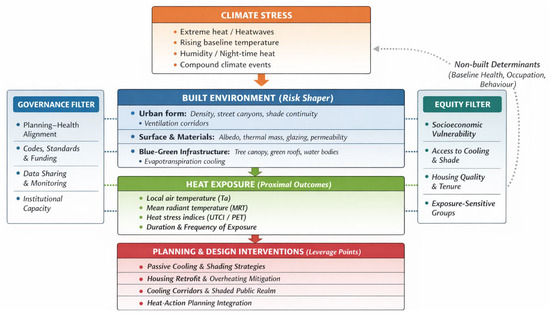
This paper’s contribution is to treat heat-health protection as the test condition for sustainability claims. The aim is not to reject carbon-focused practice, but to show that carbon metrics can mask unequal thermal risk unless health and equity indicators are built into design evaluation and governance. Without this adjustment, the industry runs the risk of continuing what is known as spectacle substitution (also “green mirages”), or projects that appear sustainable [20] but fall short in mitigating the most pressing and potentially fatal effects of climate change. In this paper, health protection is assessed conceptually through exposure reduction (e.g., local temperature moderation, shaded access), vulnerability reduction, and governance capacity rather than through direct epidemiological measurement. Figure 1 shows how climate stressors interact with built-form characteristics to shape heat exposure and downstream health outcomes, moderated by governance capacity and equity conditions. It clarifies the paper’s evaluative logic, i.e., distinguishing project-scale cooling effects from systemic exposure reduction, and highlights where design, planning, and policy interventions can reduce risk and distribute protection fairly.
Figure 1. Conceptual framework for operationalizing the climate–health nexus in sustainable built environments.

1.3. Situating the Climate–Health Nexus Within Sustainable Practice

The discourse of sustainable built environments has frequently relied largely on imposing aspirations and technological promises, but the connection between climate change and health offers a more incisive, pragmatic perspective. When sustainability is viewed through the lens of health, it becomes clear that, in times of climatic stress, architecture and urban planning are active factors that determine life and death rather than being passive backdrops [21]. A critical analysis of the industry identifies a concerning inertia. As sustainability has become more popular, checklists, labels, and rating systems have been created that, far too frequently, focus more on appearance than content. The dependence on famous projects has also led to a culture of “green spectacle” [22], in which the existence of solar panels or beautiful visualizations serves as a metaphor for structural robustness. This reflects spectacle substitution, which is broken by the connection between climate change and health, which serves as a reminder that true sustainability must be quantified by decreased hospitalizations, enhanced quality of life, and fair access to safety and comfort.
Equally important is the recognition that the nexus exposes gaps in governance and cultural practice. Courtyards, shade structures, and wind towers are examples of vernacular customs in hot areas that illustrate centuries-old knowledge of how to reduce heat stress. However, these tried-and-true techniques are sometimes overlooked in favour of technologies that are profitable but require a lot of resources. The industry’s inability to adjust and expand these low-energy strategies highlights the enduring nature of misaligned goals [23].
Methodologically, this study adopts a qualitative critical-comparative approach, combining conceptual analysis with interpretive case study review. The cases are examined through the climate–health nexus as an evaluative framework, focusing on heat exposure, distributional equity, and governance alignment rather than on performance benchmarking alone. This approach allows for critical synthesis across the architectural, planning, and public health literature without claiming statistical generalization.

References

  1. Heaviside, C.; Macintyre, H.; Vardoulakis, S. The urban heat island: Implications for health in a changing environment. Curr. Environ. Health Rep. 2017, 4, 296–305.
  2. He, B.; Wang, Y.; Cheshmehzangi, A. Nexus of Urban Climate and Urban Design. In Urban Climate and Urban Design; Springer Nature: Singapore, 2025; pp. 1–16.
  3. Butters, C.; Cheshmehzangi, A. (Eds.) Cities, climate and cooling. In Designing Cooler Cities: Energy, Cooling and Urban Form: The Asian perspective; Springer: Singapore, 2017; pp. 5–19.
  4. Donaldson, G.C.; Keatinge, W.R.; Saunders, R.D. Cardiovascular responses to heat stress and their adverse consequences in healthy and vulnerable human populations. Int. J. Hyperth. 2003, 19, 225–235.
  5. Leyk, D.; Hoitz, J.; Becker, C.; Glitz, K.J.; Nestler, K.; Piekarski, C. Health risks and interventions in exertional heat stress. Dtsch. Ärzteblatt Int. 2019, 116, 537.
  6. Johnson, S.; Corbin, S.; South, C.; Cawich, S. The impact of environmental health determinants in surgical oncology. J. Surg. Oncol. 2024, 130, 1439–1446.
  7. Bolitho, A.; Miller, F. Heat as emergency, heat as chronic stress: Policy and institutional responses to vulnerability to extreme heat. Local Environ. 2017, 22, 682–698.
  8. Jay, O.; Capon, A.; Berry, P.; Broderick, C.; De Dear, R.; Havenith, G.; Honda, Y.; Kovats, R.S.; Ma, W.; Malik, A.; et al. Reducing the health effects of hot weather and heat extremes: From personal cooling strategies to green cities. Lancet 2021, 398, 709–724.
  9. Cheshmehzangi, A. Towards sustainable urban green infrastructures. In Green Infrastructure in Chinese Cities; Springer Nature: Singapore, 2022; pp. 495–505.
  10. Mazzone, A.; De Cian, E.; de Paula, E.; Ferreira, A.; Khosla, R. Understanding thermal justice and systemic cooling poverty from the margins: Intersectional perspectives from Rio de Janeiro. Local Environ. 2024, 29, 1026–1043.
  11. Sampson, N.R.; Gronlund, C.J.; Buxton, M.A.; Catalano, L.; White-Newsome, J.L.; Conlon, K.C.; O’Neill, M.S.; McCormick, S.; Parker, E.A. Staying cool in a changing climate: Reaching vulnerable populations during heat events. Glob. Environ. Change 2013, 23, 475–484.
  12. Heymann, J.; Barrera, M. (Eds.) Ensuring a Sustainable Future: Making Progress on Environment and Equity; Oxford University Press: Oxford, UK, 2013.
  13. Prior, J.H.; Connon, I.L.; McIntyre, E.; Jon, A.; Capon, A.; Kent, J.; Rissel, C.; Thomas, L.E.; Thompson, S.M.; Westcott, H. Built environment interventions for human and planetary health: Integrating health in climate change adaption and mitigation. Public Health Res. Pract. 2018, 28, e2841831.
  14. Vaglio, J.C. Aerophysics of Double-Skin Facades: Simulation-Based Determination of Pressure Coefficients for Multi-Story Double-Skin Facades. Ph.D. Dissertation, University of Southern California, Los Angeles, CA, USA, 2015.
  15. Ali, B.M.; Akkaş, M. The green cooling factor: Eco-innovative heating, ventilation, and air conditioning solutions in building design. Appl. Sci. 2023, 14, 195.
  16. Binz, C.; Coenen, L.; Frenken, K.; Murphy, J.T.; Strambach, S.; Trippl, M.; Truffer, B. Exploring the economic geographies of sustainability transitions: Commentary and agenda. Econ. Geogr. 2025, 101, 1–27.
  17. Machline, E.; Pearlmutter, D.; Schwartz, M.; Pech, P. Green Neighbourhoods and Eco-Gentrification: A Tale of Two Countries; Springer Nature: Berlin/Heidelberg, Germany, 2020.
  18. Charter, M.; Polonsky, M.J. Greener Marketing: A Global Perspective on Greening Marketing Practice; Routledge: Abingdon, UK, 2017.
  19. Samuelson, H.W.; Baniassadi, A.; Gonzalez, P.I. Beyond energy savings: Investigating the co-benefits of heat resilient architecture. Energy 2020, 204, 117886.
  20. Anguelovski, I.; Connolly, J.; Brand, A.L. From landscapes of utopia to the margins of the green urban life: For whom is the new green city? City 2018, 22, 417–436.
  21. Barton, H.; Thompson, S.; Burgess, S.; Grant, M. (Eds.) The Routledge Handbook of Planning for Health and Well-Being: Shaping a Sustainable and Healthy Future; Routledge: Abingdon, UK, 2015.
  22. Koch, N. Sustainability spectacle and ‘post-oil’greening initiatives. Environ. Politics 2023, 32, 708–731.
  23. Schneider, B. Taking the Heat: How Climate Change is Affecting Your Mind, Body, and Spirit and What You Can Do About It; Simon and Schuster: New York, NY, USA, 2022.

More
Upload a video for this entry
Information
Contributor MDPI registered users' name will be linked to their SciProfiles pages. To register with us, please refer to https://encyclopedia.pub/register : Ali Cheshmehzangi
View Times: 8
Online Date: 24 Mar 2026
Notice
You are not a member of the advisory board for this topic. If you want to update advisory board member profile, please contact office@encyclopedia.pub.
OK
Confirm
Only members of the Encyclopedia advisory board for this topic are allowed to note entries. Would you like to become an advisory board member of the Encyclopedia?
Yes
No
${ textCharacter }/${ maxCharacter }
Submit
Cancel
There is no comment~
${ textCharacter }/${ maxCharacter }
Submit
Cancel
${ selectedItem.replyTextCharacter }/${ selectedItem.replyMaxCharacter }
Submit
Cancel
Confirm
Are you sure to Delete?
Yes No
Academic Video Service