

Your browser does not fully support modern features. Please upgrade for a smoother experience.
Submitted Successfully!
Thank you for your contribution! You can also upload a video entry or images related to this topic. For video creation, please contact our Academic Video Service.
Version Summary Created by Modification Content Size Created at Operation
1 Georgios Polydoros -- 1231 2026-02-13 06:38:47 |
2 formatted Jeremy Duan Meta information modification 1231 2026-02-13 07:11:17 |

Video Upload Options

We provide professional Academic Video Service to translate complex research into visually appealing presentations. Would you like to try it?
Cite
If you have any further questions, please contact Encyclopedia Editorial Office.
Polydoros, G.; Antoniou, A.; Polydoros, C. Inclusive AI-Mediated Mathematics Education for Students with Learning Difficulties: Reducing Math Anxiety in Digital and Smart-City Learning Ecosystems. Encyclopedia. Available online: https://encyclopedia.pub/entry/59509 (accessed on 26 March 2026).
Polydoros G, Antoniou A, Polydoros C. Inclusive AI-Mediated Mathematics Education for Students with Learning Difficulties: Reducing Math Anxiety in Digital and Smart-City Learning Ecosystems. Encyclopedia. Available at: https://encyclopedia.pub/entry/59509. Accessed March 26, 2026.
Polydoros, Georgios, Alexandros-Stamatios Antoniou, Charis Polydoros. "Inclusive AI-Mediated Mathematics Education for Students with Learning Difficulties: Reducing Math Anxiety in Digital and Smart-City Learning Ecosystems" Encyclopedia, https://encyclopedia.pub/entry/59509 (accessed March 26, 2026).
Polydoros, G., Antoniou, A., & Polydoros, C. (2026, February 13). Inclusive AI-Mediated Mathematics Education for Students with Learning Difficulties: Reducing Math Anxiety in Digital and Smart-City Learning Ecosystems. In Encyclopedia. https://encyclopedia.pub/entry/59509
Polydoros, Georgios, et al. "Inclusive AI-Mediated Mathematics Education for Students with Learning Difficulties: Reducing Math Anxiety in Digital and Smart-City Learning Ecosystems." Encyclopedia. Web. 13 February, 2026.
Peer Reviewed
Inclusive AI-Mediated Mathematics Education for Students with Learning Difficulties: Reducing Math Anxiety in Digital and Smart-City Learning Ecosystems

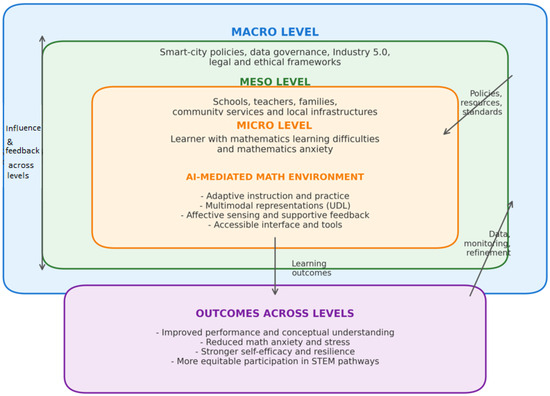
Inclusive AI-mediated mathematics education for students with learning difficulties refers to a human-centered approach to mathematics teaching and learning that uses artificial intelligence (AI), adaptive technologies, and data-rich environments to support learners who experience persistent challenges in mathematics. These challenges may take the form of a formally identified developmental learning disorder with impairment in mathematics, broader learning difficulties, low and unstable achievement, irregular engagement, or heightened mathematics anxiety that places students at risk of disengagement and poor long-term outcomes. This approach integrates early screening, personalized instruction, and affect-aware support to address both cognitive difficulties and the emotional burden associated with mathematics anxiety. Situated within digitally augmented schools, homes, and community spaces typical of smart cities, it seeks to reduce stress and anxiety, prevent the reproduction of educational inequalities, and promote equitable participation in science, technology, engineering, and mathematics (STEM) pathways. It emphasizes Universal Design for Learning (UDL), ethical and transparent use of learner data, and sustained collaboration among teachers, families, technologists, urban planners, and policy-makers across micro (individual), meso (school and community), and macro (urban and policy) levels. Crucially, AI functions as decision support rather than replacement of pedagogical judgment, with teachers maintaining human-in-the-loop oversight and responsibility for inclusive instructional decisions. Where learner data include fine-grained logs or affect-related indicators, data minimization, clear purpose limitation, and child- and family-friendly transparency are essential. Implementation should also consider feasibility and sustainability, including staff capacity and resource constraints, so that inclusive benefits do not depend on high-cost infrastructures.

mathematics education students with learning difficulties low mathematics achievement students at risk specific learning disorder in mathematics artificial intelligence intelligent tutoring systems math anxiety stress inclusive education
The digitalization of contemporary societies has turned learning into a data-rich, ubiquitous activity, as learners leave digital traces through learning management systems, educational apps, social platforms, and smart-city infrastructures; these traces increasingly inform decisions about access to resources, support services, and opportunities across the life course [1][2][3]. When designed with human well-being in mind, such ecosystems can enable personalized and equitable learning. When poorly governed, they risk amplifying existing inequalities and creating new forms of exclusion. In education, this makes governance, transparency, and proportional data use central conditions for inclusive innovation rather than optional add-ons.
Mathematics sits at the heart of this dynamic. It is foundational for scientific literacy and acts as a gatekeeper to many academic and professional pathways, particularly in science, technology, engineering, and mathematics (STEM). For a substantial minority of students, however, mathematics is associated with persistent difficulty and intense emotional distress. A subgroup of these learners meet criteria for “specific learning disorder with impairment in mathematics” in the International Classification of Diseases, 11th Revision (ICD-11), which provides a standardized framework for diagnosing developmental learning disorders and related conditions [1]. Many other students experience low and unstable achievement, irregular attendance, or repeated failure without a formal diagnosis [1][4]. In both cases, they can be considered students with learning difficulties in mathematics who are at risk of negative educational and life outcomes if appropriate support is not provided. To avoid deficit labeling, this entry treats “risk” as a dynamic indicator used to mobilize support rather than a fixed trait.
These cognitive and academic challenges are frequently accompanied by mathematics anxiety, a negative emotional response characterized by worry, tension, and fear that interferes with performance and undermines self-beliefs [5][6]. A broad body of research has shown robust links between mathematics anxiety, working memory, and achievement: anxiety consumes cognitive resources required for problem solving and can trigger avoidance of mathematical tasks, which in turn limits practice and reinforces low performance [7][8][9]. Students who already face learning difficulties, socio-economic disadvantages, or limited support at home are particularly vulnerable [4][6][10]. Critically, anxiety is also shaped by classroom experience (e.g., evaluative pressure and error-related shame), making emotionally safe instructional design a core inclusion requirement.
In parallel, rapid developments in AI and digital technologies have reshaped mathematics learning environments. Intelligent tutoring systems (ITSs), adaptive practice platforms, digital games, virtual manipulatives, and immersive technologies can provide continuous assessment, immediate feedback, and multiple representations of mathematical concepts. Meta-analytic evidence suggests that well-designed digital interventions can significantly improve mathematical performance for students with persistent difficulties and can, in some cases, also reduce mathematics anxiety [11][12][13]. In the broader Artificial Intelligence in Education (AIED) and intelligent tutoring systems (ITS) tradition, evidence syntheses have also reported learning gains from ITS use, supporting the view that adaptive tutoring can meaningfully complement teacher-led instruction when integrated into classroom practice.
These educational developments intersect with broader shifts towards digital society, smart cities, and Industry 5.0. Smart-city initiatives embed AI, the Internet of Things (IoT), and learning analytics into classrooms, campuses, libraries, and public spaces, aiming to create “smart learning environments” that are context-aware and personalized [14][15][16]. Within an Industry 5.0 perspective, this transformation is explicitly framed as human-centric, sustainable, and resilient: technology should augment human capabilities and well-being rather than replace human agency [2][17]. However, smart learning infrastructures can also increase monitoring pressure and perceived surveillance if progress and affective states are continuously tracked, underscoring the need for privacy-aware, proportionate, and transparent deployment.
For students with learning difficulties in mathematics and elevated mathematics anxiety, this raises a central question: can AI-mediated mathematics education within smart-city learning ecosystems act as a lever for inclusion and emotional safety, or will it intensify surveillance, stress, and exclusion? This entry addresses that question from a conceptual and integrative perspective. From the educator’s standpoint, the answer depends on whether AI is implemented as human-in-the-loop decision support—enhancing differentiation and emotional safety—rather than as automated ranking, tracking, or cost-cutting infrastructure.
This entry adopts a conceptual and narrative review approach rather than reporting original empirical data. Its aim is to integrate existing knowledge from four intersecting domains:
(a)
Mathematics learning difficulties and at-risk profiles in mathematics;
(b)
Mathematics anxiety and its cognitive and affective mechanisms;
(c)
AI-based and technology-mediated interventions in mathematics education; and
(d)
Digital society, smart cities, and smart learning environments within an Industry 5.0 framework.
Literature was identified through searches in databases such as Scopus, Web of Science, ERIC, and Google Scholar, using combinations of keywords including “artificial intelligence”, “mathematics education”, “learning difficulties”, “students at risk”, “math anxiety”, “digital society”, “smart city”, and “Industry 5.0”. Priority was given to peer-reviewed articles, books, and policy documents published between 2010 and 2025, while earlier seminal works were included to clarify concepts or theoretical foundations. In addition, foundational syntheses on intelligent tutoring systems (ITS) and research from the Artificial Intelligence in Education (AIED) field were consulted to strengthen the evidence base on established AI-supported approaches in mathematics learning.
The entry does not claim to provide an exhaustive systematic review. Instead, it offers a thematically organized synthesis that clarifies key concepts, summarizes typical benefits and risks of AI-mediated mathematics learning for students with learning difficulties, and derives design principles for inclusive, anxiety-aware educational practice in digital and smart-city learning ecosystems. Particular attention is given to classroom implementation conditions, including teacher agency, usability of analytics and dashboards, professional learning needs, and feasibility considerations related to resources and sustainability.
As illustrated in Figure 1, the overall perspective rests on the intersection of three core domains: AI in mathematics education, learning difficulties and mathematics anxiety, and digital society/smart-city ecosystems. Figure 1 provides the conceptual framing of the entry.
Figure 1. Intersection of three core domains underpinning inclusive AI-mediated mathematics education for students with learning difficulties in mathematics: AI in mathematics education, learning difficulties and mathematics anxiety, and digital society/smart-city ecosystems. Figure 1 provides the conceptual framing.

References

  1. World Health Organization. ICD-11 Code 6A03.2—Developmental Learning Disorder with Impairment in Mathematics; World Health Organization: Geneva, Switzerland, 2020.
  2. Nielsen, C.; Brix, J. Towards Society 5.0: Enabling the European Commission’s Policy Brief ‘Towards a sustainable, human-centric and resilient European Industry’. J. Behav. Econ. Soc. Syst. 2023, 5, 83–91.
  3. UNDP. Smarter and Inclusive Cities: Course on Inclusive Urban Development; United Nations Development Programme: New York, NY, USA, 2024.
  4. Soares, N.; Evans, T.; Patel, D.R. Specific learning disability in mathematics: A comprehensive review. Transl. Pediatr. 2018, 7, 48–62.
  5. Hembree, R. The nature, effects, and relief of mathematics anxiety. J. Res. Math. Educ. 1990, 21, 33–46.
  6. Eden, C.; Heine, A.; Jacobs, A.M. Mathematics anxiety and its development in the course of formal schooling: A review. Psychology 2013, 4, 27–35.
  7. Ashcraft, M.H.; Kirk, E.P. The relationships among working memory, math anxiety, and performance. J. Exp. Psychol. Gen. 2001, 130, 224–237.
  8. Dowker, A.; Sarkar, A.; Looi, C.Y. Mathematics Anxiety: What Have We Learned in 60 Years? Front. Psychol. 2016, 7, 508.
  9. Sammallahti, E.; Finell, J.; Jonsson, B.; Korhonen, J. A Meta-Analysis of Math Anxiety Interventions. J. Numer. Cogn. 2023, 9, e8401.
  10. Malanchini, M.; Rimfeld, K.; Wang, Z.; Petrill, S.A.; Tucker-Drob, E.M.; Plomin, R.; Kovas, Y. Genetic factors underlie the association between anxiety, attitudes and performance in mathematics. Transl. Psychiatry 2020, 10, 12.
  11. Benavides-Varela, S.; Zandonella Callegher, C.; Fagiolini, B.; Leo, I.; Altoè, G.; Lucangeli, D. Effectiveness of digital-based interventions for children with mathematical learning difficulties: A meta-analysis. Comput. Educ. 2020, 157, 103953.
  12. Ersozlu, Z. The role of technology in reducing mathematics anxiety in primary school students. Contemp. Educ. Technol. 2024, 16, ep517.
  13. Ng, C.T.; Chen, Y.H.; Wu, C.J.; Chang, T.T. Evaluation of math anxiety and its remediation through a digital training program in mathematics for first and second graders. Brain Behav. 2022, 12, e2557.
  14. Nikolov, R.; Shoikova, E.; Krumova, M.; Kovatcheva, E.; Dimitrov, V.; Chikalanov, A. On learning in a smart city environment. Serdica J. Comput. 2015, 9, 223–240.
  15. Yang, J.; Shi, G.; Zhu, W.; Sun, Y. Intelligent technologies in smart education: A comprehensive review of transformative pillars and their impact on teaching and learning methods. Humanit. Soc. Sci. Commun. 2025, 12, 1239.
  16. Zhuang, R.; Fang, H.; Zhang, Y.; Lu, A.; Huang, R. Smart learning environments for a smart city: From the perspective of lifelong and lifewide learning. Smart Learn. Environ. 2017, 4, 6.
  17. Almulhim, A.I.; Aina, Y.A. Achieving Human-Centered Smart City Development in Saudi Arabia. Urban Sci. 2025, 9, 393.

More
Upload a video for this entry
Information
Subjects: Education, Special
Contributors MDPI registered users' name will be linked to their SciProfiles pages. To register with us, please refer to https://encyclopedia.pub/register : Georgios Polydoros , Alexandros-Stamatios Antoniou , Charis Polydoros
View Times: 11
Online Date: 13 Feb 2026
Notice
You are not a member of the advisory board for this topic. If you want to update advisory board member profile, please contact office@encyclopedia.pub.
OK
Confirm
Only members of the Encyclopedia advisory board for this topic are allowed to note entries. Would you like to become an advisory board member of the Encyclopedia?
Yes
No
${ textCharacter }/${ maxCharacter }
Submit
Cancel
There is no comment~
${ textCharacter }/${ maxCharacter }
Submit
Cancel
${ selectedItem.replyTextCharacter }/${ selectedItem.replyMaxCharacter }
Submit
Cancel
Confirm
Are you sure to Delete?
Yes No
Academic Video Service



