

Your browser does not fully support modern features. Please upgrade for a smoother experience.
Submitted Successfully!
Thank you for your contribution! You can also upload a video entry or images related to this topic. For video creation, please contact our Academic Video Service.
Version Summary Created by Modification Content Size Created at Operation
1 Martin George Wynn -- 652 2026-01-07 01:48:51 |
2 Format Correct Abigail Zou Meta information modification 652 2026-01-07 06:46:32 |

Video Upload Options

We provide professional Academic Video Service to translate complex research into visually appealing presentations. Would you like to try it?
Cite
If you have any further questions, please contact Encyclopedia Editorial Office.
Neubauer, A.; Wynn, M.; Bown, R. AI, Authorship, Copyright, and Human Originality. Encyclopedia. Available online: https://encyclopedia.pub/entry/59405 (accessed on 08 January 2026).
Neubauer A, Wynn M, Bown R. AI, Authorship, Copyright, and Human Originality. Encyclopedia. Available at: https://encyclopedia.pub/entry/59405. Accessed January 08, 2026.
Neubauer, Anja, Martin Wynn, Robin Bown. "AI, Authorship, Copyright, and Human Originality" Encyclopedia, https://encyclopedia.pub/entry/59405 (accessed January 08, 2026).
Neubauer, A., Wynn, M., & Bown, R. (2026, January 07). AI, Authorship, Copyright, and Human Originality. In Encyclopedia. https://encyclopedia.pub/entry/59405
Neubauer, Anja, et al. "AI, Authorship, Copyright, and Human Originality." Encyclopedia. Web. 07 January, 2026.
Peer Reviewed
AI, Authorship, Copyright, and Human Originality

This entry explores the implications of generative AI for the underlying foundational premises of copyright law and the potential threat it poses to human creativity. It identifies the gaps and inconsistencies in legal frameworks as regards authorship, training-data use, moral rights, and human originality in the context of AI systems that are capable of imitating human expression at both syntactic and semantic levels. The entry includes: (i) a comparative analysis of the legal frameworks of the United Kingdom, United States, and Germany, using the Berne Convention as a harmonising baseline, (ii) a systematic synthesis of the relevant academic literature, and (iii) insights gained from semi-structured interviews with legal scholars, AI developers, industry stakeholders, and creators. Evidence suggests that existing laws are ill-equipped for semantic and stylistic reproduction; there is no agreement on authorship, no clear licensing model for training data, and inadequate protection for the moral identity of creators—especially posthumously, where explicit protections for likeness, voice, and style are fragmented. The entry puts forward a draft global framework to restore legal certainty and cultural value, incorporating a semantics-aware definition of the term “work”, and encompassing licensing and remuneration of training data, enhanced moral and posthumous rights, as well as enforceable transparency. At the same time, parallel personality-based safeguards, including rights of publicity, image, or likeness, although present in all three jurisdictions studied, are not subject to the same copyright and thus do not offer any coherent or adequate protection against semantic or stylistic imitation, which once again highlights the need for a more unified and robust copyright strategy.
artificial intelligence AI copyright moral rights authorship training data human originality transparency global framework
Generative artificial intelligence (AI) has reached a level of sophistication that allows it to autonomously mimic the syntax and semantics of human expression. This technology challenges the key assumptions of copyright law, which is based on human authorship, originality, and moral integrity. Earlier this year (2025), Sir Elton John expressed his concerns that “wheels are in motion to allow AI companies to ride roughshod over the traditional copyright laws that protect artists’ livelihoods” and that “this will allow global big tech companies to gain free and easy access to artists’ work in order to train their artificial intelligence and create competing music” [1] (p. 2). In this context, the Berne Convention can be used as the yardstick against which the copyright regimes of the United Kingdom, the United States, and Germany are measured. While the Berne Convention continues to be the foundation of international copyright harmonisation, it was designed in a pre-digital era when AI systems capable of replicating style, voice, and creative identity were not envisaged.
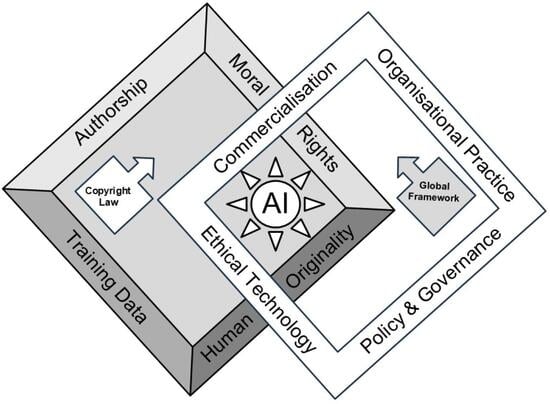
The analysis presented here is organised around the MATH-COPE matrix, a conceptual and methodological framework based on an initial review of the relevant literature, which combines doctrinal and practical perspectives. The framework, discussed in more detail below, offers a coherent cross-cutting prism that allows the identification of the major doctrinal and practical issues and the formulation of reform proposals.
The overall purpose of the entry is to explore the current issues surrounding AI and copyright and put forward a draft global copyright framework to address these issues and related concerns. This entry takes a doctrinal-comparative approach, looking at the legal systems of the three countries noted above. It combines a systematic synthesis of the current academic debates with reports on insights gained from semi-structured interviews with relevant parties [2]. Rather than creating new empirical data, this work is a curation of well-established knowledge and convergent practice indicators to provide an actionable blueprint for a new copyright framework. In addition, the entry puts forward a semantics-aware definition of “work” which does not lose sight of the locus of human originality, yet allows the factoring in of AI-assisted creation. It also presents a pragmatic implementation strategy—including licensing regimes, levels of transparency and enforcement mechanisms—that can be pursued multilaterally without requiring a revision of the Berne Convention.

References

  1. Turvill, W. Elton and Paul in harmony over the dangers of AI. Sunday Times Business and Money. 26 January 2025. Available online: https://www.thetimes.com/business-money (accessed on 27 January 2025).
  2. Neubauer, A. AI and Authorship Redefined—Towards a Global Copyright Framework for Commerce and Human Originality. Ph.D. Thesis, University of Gloucestershire, Cheltenham, UK, 2025.

More
Upload a video for this entry
Information
Subjects: Law
Contributors MDPI registered users' name will be linked to their SciProfiles pages. To register with us, please refer to https://encyclopedia.pub/register : Anja Neubauer , Martin Wynn , Robin Bown
View Times: 8
Online Date: 07 Jan 2026
Notice
You are not a member of the advisory board for this topic. If you want to update advisory board member profile, please contact office@encyclopedia.pub.
OK
Confirm
Only members of the Encyclopedia advisory board for this topic are allowed to note entries. Would you like to become an advisory board member of the Encyclopedia?
Yes
No
${ textCharacter }/${ maxCharacter }
Submit
Cancel
There is no comment~
${ textCharacter }/${ maxCharacter }
Submit
Cancel
${ selectedItem.replyTextCharacter }/${ selectedItem.replyMaxCharacter }
Submit
Cancel
Confirm
Are you sure to Delete?
Yes No
Academic Video Service



