Your browser does not fully support modern features. Please upgrade for a smoother experience.


Submitted Successfully!
 +1 credit
Thank you for your contribution! You can also upload a video entry or images related to this topic.
For video creation, please contact our Academic Video Service.
| Version | Summary | Created by | Modification | Content Size | Created at | Operation |
|---|---|---|---|---|---|---|
| 1 | Sandeep Dhallu | -- | 310 | 2025-10-09 07:09:07 | | | |
| 2 | Arao Fu | Meta information modification | 310 | 2025-10-09 07:15:09 | | |
Video Upload Options
We provide professional Academic Video Service to translate complex research into visually appealing presentations. Would you like to try it?
Cite
If you have any further questions, please contact Encyclopedia Editorial Office.
Dhallu, S.K. The Influence of Diet, Exercise and Lifestyle Factors on Ocular Health. Encyclopedia. Available online: https://encyclopedia.pub/entry/59107 (accessed on 25 September 2026).
Dhallu SK. The Influence of Diet, Exercise and Lifestyle Factors on Ocular Health. Encyclopedia. Available at: https://encyclopedia.pub/entry/59107. Accessed September 25, 2026.
Dhallu, Sandeep Kaur. "The Influence of Diet, Exercise and Lifestyle Factors on Ocular Health" Encyclopedia, https://encyclopedia.pub/entry/59107 (accessed September 25, 2026).
Dhallu, S.K. (2025, October 09). The Influence of Diet, Exercise and Lifestyle Factors on Ocular Health. In Encyclopedia. https://encyclopedia.pub/entry/59107
Dhallu, Sandeep Kaur. "The Influence of Diet, Exercise and Lifestyle Factors on Ocular Health." Encyclopedia. Web. 09 October, 2025.
Copy Citation
The human eye is a complex organ that is prone to visual impairment from both modifiable and non-modifiable risk factors. While some lifestyle choices, such as smoking, can negatively influence the eye’s visual system, others can have a positive impact. For instance, a healthy diet that includes nutrients such as lutein, zeaxanthin and meso-zeaxanthin can have a beneficial effect on macular health. Similarly, exercise can have a beneficial effect not only on general health and wellbeing but also on ocular health. This article will provide an overview of the link between modifiable risk factors such as diet, exercise, psychological stress and others on ocular diseases including dry eye disease, age-related macular degeneration, myopia, glaucoma and diabetic retinopathy. It will also evaluate whether there is a need to raise awareness amongst the general population on how simple lifestyle changes can improve ocular health.
diet
exercise
ocular nutrition
ocular health
modifiable lifestyle factors
mental health
Globally, cataracts, glaucoma and age-related macular degeneration (AMD) are leading causes of visual impairment [1][2]. The development and progression of these conditions is influenced by different external factors, including those which can be modified by the patient themselves such as by improving their diet, leading a less sedentary lifestyle, decreasing exposure to poor air quality environments and so on. These are relatively simple and low-cost changes that a patient can make in order to improve their general as well as ocular wellbeing and could help to reduce the global economic burden of these progressive diseases.
While the general public may have an awareness of the link between these modifiable lifestyle factors and their general health, they may be less aware of the effect on their eye health. This article will explore the influence of nutrition, exercise, smoking, air pollution and psychological stress on ocular health (Figure 1).
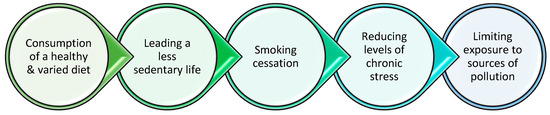
Figure 1. Five key modifiable lifestyle changes that may influence ocular health.
References
- Flaxman, S.R.; Bourne, R.R.; Resnikoff, S.; Ackland, P.; Braithwaite, T.; Cicinelli, M.V.; Das, A.; Jonas, J.B.; Keeffe, J.; Kempen, J.H.; et al. Global causes of blindness and distance vision impairment 1990–2020: A systematic review and meta-analysis. Lancet Glob. Health 2017, 5, e1221–e1234.
- Steinmetz, J.D.; Bourne, R.R.; Briant, P.S.; Flaxman, S.R.; Taylor, H.R.; Jonas, J.B.; Abdoli, A.A.; Abrha, W.A.; Abualhasan, A.; Abu-Gharbieh, E.G.; et al. Causes of blindness and vision impairment in 2020 and trends over 30 years, and prevalence of avoidable blindness in relation to VISION 2020: The Right to Sight: An analysis for the Global Burden of Disease Study. Lancet Glob. Health 2021, 9, e144–e160.
More
Information
Subjects:
Ophthalmology
Contributor
MDPI registered users' name will be linked to their SciProfiles pages. To register with us, please refer to https://encyclopedia.pub/register
:
View Times:
53
Revisions:
2 times
(View History)
Update Date:
09 Oct 2025
Table of Contents





Notice
You are not a member of the advisory board for this topic. If you want to update advisory board member profile, please contact office@encyclopedia.pub.
OK
Confirm
Only members of the Encyclopedia advisory board for this topic are allowed to note entries. Would you like to become an advisory board member of the Encyclopedia?
Yes
No
${ textCharacter }/${ maxCharacter }
Submit
Cancel
Back
Comments
${ item }
|
${ item.createdUser.fullName }
${ item.createdAt }
${ item.vote }
${ item.reply }
Delete
${ reply.createdUser.fullName }
${ reply.createdAt }
${ reply.vote }
Delete
There is no reply to this comment~
${ item.replyTextCharacter }/${ item.replyMaxCharacter }
Submit
Cancel
More
No more~
There is no comment~
${ textCharacter }/${ maxCharacter }
Submit
Cancel
${ selectedItem.replyTextCharacter }/${ selectedItem.replyMaxCharacter }
Submit
Cancel
Confirm
Are you sure to Delete?
Yes
No