

 +1 credit
| Version | Summary | Created by | Modification | Content Size | Created at | Operation |
|---|---|---|---|---|---|---|
| 1 | Encyclopedia Editorial Office | -- | 1091 | 2025-09-15 03:59:47 |
Video Upload Options
The west african lungfish refers to species of freshwater fishes in the genus Protopterus, belonging to the subclass Dipnoi. These fishes are notable for their unique ability to respire using both gills and lungs, a feature that has attracted considerable scientific attention due to its evolutionary significance. Native to various freshwater habitats across Africa, African lungfishes represent a lineage of sarcopterygian fishes with deep evolutionary connections to the origins of tetrapods.
1. Taxonomy and Classification
The African lungfish belongs to the subclass Dipnoi within the class Sarcopterygii, the lobe-finned fishes. Within this group, lungfishes are distinct from coelacanths, the other extant lineage of lobe-finned fishes.
-
Phylum: Chordata
-
Class: Sarcopterygii
-
Subclass: Dipnoi
-
Order: Lepidosireniformes
-
Family: Protopteridae
-
Genus: Protopterus
Currently, four recognized species of African lungfish are widely accepted:
-
Protopterus annectens (West African lungfish)
-
Protopterus aethiopicus (East African lungfish)
-
Protopterus amphibius (East African or Tana lungfish, the smallest species)
-
Protopterus dolloi (Spotted African lungfish)
Molecular studies have confirmed that these species form a monophyletic group distinct from South American (Lepidosiren) and Australian (Neoceratodus) lungfishes [1][2].
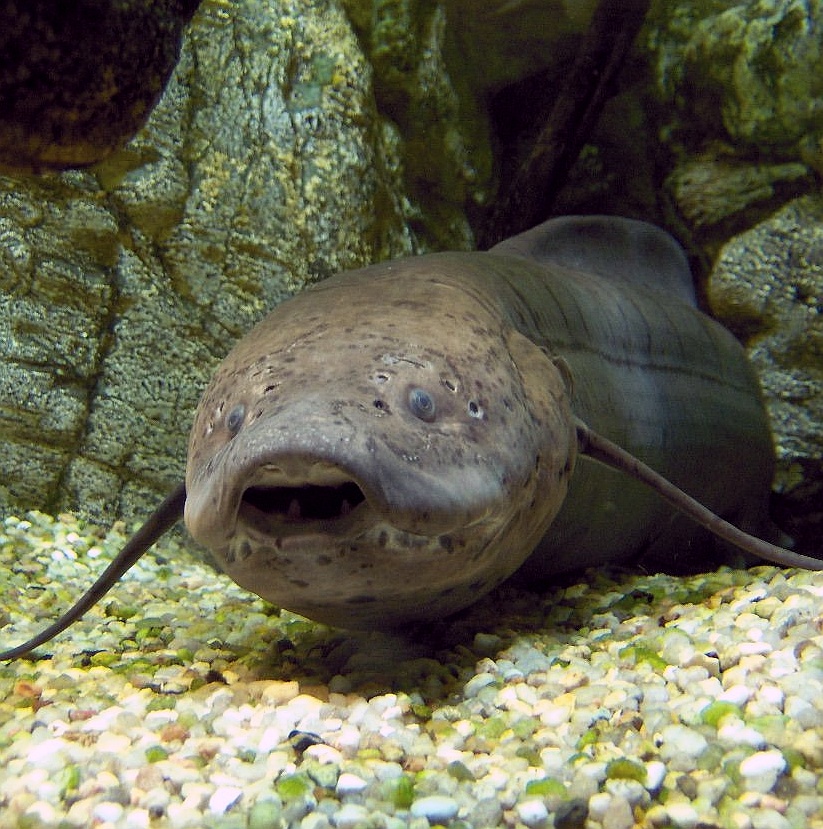
By Gőtehal.jpg: Mathaederivative work: Bff - Gőtehal.jpg, CC BY 2.5, https://commons.wikimedia.org/w/index.php?curid=10700741
2. Morphological Characteristics
African lungfishes exhibit elongated, eel-like bodies with reduced paired fins, adapted for slow movements in muddy waters. The body can range in size from about 44 cm in P. amphibius to over 2 meters in P. aethiopicus, making the latter one of the largest freshwater fishes in Africa [3].
-
Fins: The pectoral and pelvic fins are filamentous, lacking the typical rays seen in actinopterygian fishes.
-
Scales: Covered with thin cycloid scales embedded in the skin.
-
Head and Mouth: They possess tooth plates rather than individual teeth, specialized for crushing and grinding food.
-
Skeleton: The axial skeleton is partly cartilaginous. The notochord persists throughout life, a primitive feature among vertebrates [4].
-
Lungs and Gills: Two elongated lungs run parallel to the body cavity, enabling air-breathing. Gills are present but often reduced in efficiency in adults.
These features reflect both primitive sarcopterygian traits and specialized adaptations to their freshwater environment.
3. Physiology and Adaptations
3.1. Dual Respiration
The most distinctive feature of African lungfish is their capacity for bimodal respiration. Juveniles rely more heavily on gills, while adults depend primarily on lungs for oxygen uptake [5]. This adaptation allows them to survive in oxygen-depleted environments, such as stagnant ponds or seasonal floodplains.
3.2. Estivation
One of the most remarkable physiological adaptations is estivation. During dry seasons, when water bodies evaporate, African lungfish burrow into mud, secrete a mucous cocoon, and enter a state of dormancy that can last several months or even years. Metabolic rates drop significantly, and the fish relies on stored energy reserves [6][7]. This adaptation ensures survival in unpredictable African climates.
3.3. Nitrogen Metabolism
During estivation, nitrogen excretion shifts from ammonia to urea, which is less toxic and can be stored in the body until excretion is possible when water returns [8].
4. Ecology and Habitat
African lungfishes are distributed across tropical Africa in rivers, lakes, floodplains, and swamps. Their habitats are often characterized by seasonal flooding and drying.
-
P. annectens: West and Central Africa, preferring swamps and floodplains.
-
P. aethiopicus: Widely distributed in the Nile, Congo, and East African lakes.
-
P. amphibius: Restricted distribution, primarily the Tana River basin in Kenya.
-
P. dolloi: Central Africa, particularly in the Congo Basin [9].
These species are typically benthic, burrowing in mud and detritus, and exhibit nocturnal feeding patterns.
5. Feeding and Diet
African lungfish are omnivorous, with a preference for mollusks, crustaceans, insects, and plant material. Their crushing tooth plates are particularly adapted for hard-shelled prey [10]. They use a combination of suction and jaw pressure to capture and process food.
6. Reproductive Biology
Reproduction generally occurs during the rainy season, coinciding with flooding. Males excavate nests in muddy substrates, where females deposit eggs. The males guard the nests, and in some species, males develop vascularized extensions on pelvic fins that may help in aerating the developing embryos [11].
Larvae hatch with external gills, resembling amphibian larvae. As they develop, gills regress while lungs take over as the main respiratory organs. This ontogenetic shift has often been cited in discussions of vertebrate evolutionary history [12].
7. Evolutionary Significance
Lungfishes are among the closest living relatives of tetrapods, along with coelacanths. Molecular and morphological evidence suggests that the divergence of lungfishes and tetrapods occurred during the Devonian, more than 400 million years ago [13]. The persistence of lungfishes as “living fossils” provides invaluable insight into the transition from aquatic to terrestrial vertebrates.
The presence of lungs, estivation behavior, and larval developmental stages makes Protopterus a model organism for studying evolutionary physiology and comparative genomics [14].
8. Behavior
African lungfish are generally solitary and sedentary, often remaining motionless in the substrate. They are nocturnal foragers and rely on a combination of chemosensory and mechanosensory cues to locate prey. Their locomotion is slow, using undulations of the body and filamentous fins. However, they are capable of sudden bursts when disturbed [15].
9. Conservation Status
While none of the African lungfish species are currently classified as globally endangered, localized populations are under pressure from habitat loss, overfishing, and pollution. In regions where they are a food source, heavy exploitation can reduce numbers significantly.
-
P. amphibius, due to its restricted range, is considered vulnerable.
-
Other species are more widespread but face threats from agricultural expansion and wetland drainage.
Climate change and alterations in African hydrological cycles may also impact their survival strategies.
10. Human Uses and Cultural Significance
African lungfish are consumed as food in several regions, particularly during times of scarcity when their resilience ensures availability. They are often smoked or dried to preserve them.
In addition, lungfish have a role in traditional medicine in some African cultures, though documentation is limited.
From a scientific perspective, African lungfishes have been central to research in evolutionary biology, respiratory physiology, and developmental biology.
11. Research and Genomics
Recent advances in genomics have revealed that lungfishes possess some of the largest known vertebrate genomes, with sizes exceeding 40 gigabases in some species. These genomes are rich in repetitive elements and provide crucial data on the evolution of vertebrate genes involved in limb development, lung formation, and nitrogen metabolism. Comparative studies with amphibians and mammals highlight the evolutionary continuity of developmental pathways.
12. Conclusion
The African lungfish is a remarkable organism embodying both primitive features of early vertebrates and highly specialized adaptations to its environment. Its dual respiration, estivation ability, and evolutionary placement as a relative of tetrapods make it a keystone species for understanding vertebrate evolution. As pressures on African freshwater ecosystems increase, further conservation and scientific attention are essential to safeguard these living relics of evolutionary history.
References
- Meyer, A., & Zardoya, R. (2003). Recent advances in the (molecular) phylogeny of vertebrates. Annual Review of Ecology, Evolution, and Systematics, 34, 311–338. doi:10.1146/annurev.ecolsys.34.011802.132351.
- Amemiya, C. T., et al. (2013). The African coelacanth genome provides insights into tetrapod evolution. Nature, 496, 311–316. doi:10.1038/nature12027.
- Greenwood, P. H. (1986). The natural history of African lungfishes. Journal of Morphology Supplement, 1, 163–179. doi:10.1002/jmor.1051890409.
- Bemis, W. E. (1984). Structure, function, and evolution of the lungfish skeleton. American Zoologist, 24(1), 37–61. doi:10.1093/icb/24.1.37.
- Graham, J. B. (1997). Air-Breathing Fishes: Evolution, Diversity, and Adaptation. Academic Press.
- Fishman, A. P., Galante, R. J., & Pincus, J. (1990). Estivation in Protopterus: physiology and metabolism. Physiological Zoology, 63(2), 274–294. doi:10.1086/physzool.63.2.30156136.
- Jørgensen, J. M., & Joss, J. (1998). The Biology of Lungfishes. CRC Press.
- Mommsen, T. P., & Walsh, P. J. (1989). Evolution of urea synthesis in vertebrates: The piscine connection. Science, 243(4893), 72–75. doi:10.1126/science.2563170.
- Trewavas, E. (1980). Species of Protopterus (Dipnoi) in Africa. Bulletin of the British Museum (Natural History) Zoology, 39, 59–95.
- Greenwood, P. H. (1958). The feeding mechanism of Protopterus with a discussion of its evolutionary significance. Proceedings of the Zoological Society of London, 131(4), 637–657. doi:10.1111/j.1469-7998.1958.tb00658.x.
- Johnels, A. G. (1957). The mode of reproduction in Protopterus annectens. Arkiv för Zoologi, 10(21), 553–558.
- Carter, G. S., & Beadle, L. C. (1930). The fauna of the swamps of the northern Rhodesia and Katanga. Proceedings of the Zoological Society of London, 100, 57–61. doi:10.1111/j.1469-7998.1930.tb06912.x.
- Cloutier, R. (2010). The fossil record of lungfishes. Biological Reviews, 85(2), 117–168. doi:10.1111/j.1469-185X.2009.00098.x.
- Kuraku, S., et al. (2021). The gigantic genome of the African lungfish sheds light on the vertebrate water-to-land transition. Nature, 590, 284–289. doi:10.1038/s41586-020-03198-8.
- aurent, P., & Perry, S. F. (1995). Environmental effects on gill morphology in fish. Canadian Journal of Zoology, 73(6), 1085–1096. doi:10.1139/z95-128.




