+1 credit
| Version | Summary | Created by | Modification | Content Size | Created at | Operation |
|---|---|---|---|---|---|---|
| 1 | Encyclopedia Editorial Office | -- | 906 | 2025-09-12 05:42:25 |
Video Upload Options
1. Introduction
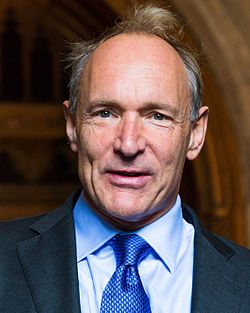
Sir Timothy John Berners-Lee (born June 8, 1955), often known as TimBL or Tim Berners-Lee, is a British computer scientist widely celebrated as the inventor of the World Wide Web. His groundbreaking work in the late 1980s and early 1990s revolutionized how information is shared, accessed, and communicated globally. Unlike many inventors who capitalized on their creations, Berners-Lee chose to gift the Web to the world freely, ensuring it remained an open and accessible platform for humanity. His contributions have earned him numerous accolades, including the Turing Award (2016), knighthood (2004), and a place among Time magazine's "100 Most Important People of the 20th Century".
2. Early Life and Education
2.1. Family Background and Childhood
-
Birth and Family: Born in London, England, Berners-Lee was the eldest of four children to Conway Berners-Lee and Mary Lee Woods, both mathematicians and computer scientists who worked on the Manchester Mark I, one of the earliest commercial computers.
-
Early Influences: His parents' work in computing deeply influenced him. As a child, he was a railway enthusiast, and through building model railways with electronics, he developed a passion for technology and innovation.
-
Education: He attended Sheen Mount Primary School and later Emanuel School in London. During his school years, he excelled in mathematics and sciences.
2.2. University Years
-
Oxford University: From 1973 to 1976, Berners-Lee studied Physics at The Queen's College, Oxford, graduating with a first-class honors degree.
-
Early Computing Projects: While at Oxford, he built his first computer using a Motorola 6800 processor and an old television set, showcasing his early ingenuity in hardware and software integration.
3. Career and the Invention of the World Wide Web
3.1. Early Career
-
Plessey and D.G. Nash: After graduation, he worked as an engineer at Plessey Telecommunications and later at D.G. Nash, where he wrote typesetting software for printers.
-
CERN (First Stint): In 1980, as a software consultant at CERN (European Organization for Nuclear Research) in Geneva, he proposed a project based on hypertext to facilitate information sharing among researchers. This led to the development of ENQUIRE, an early prototype of a hypertext database.
3.2. Development of the World Wide Web
-
Return to CERN: In 1984, Berners-Lee returned to CERN as a permanent researcher. By 1989, he envisioned a global hypertext system that would combine the Internet with hypertext concepts.
-
Key Proposal: In March 1989, he published a seminal paper titled "Information Management: A Proposal," outlining his vision for a decentralized information management system. Initially met with skepticism, the proposal was later approved, and he acquired a NeXT computer to develop the system.
-
Foundational Technologies: By Christmas 1990, he had developed the core components of the Web:
-
HTTP (Hypertext Transfer Protocol): For communication between clients and servers.
-
HTML (Hypertext Markup Language): The standard markup language for creating web pages.
-
URI/URL (Uniform Resource Identifier/Locator): The addressing system for resources on the Web.
-
First Web Browser (called WorldWideWeb): A browser that also functioned as an editor.
-
First Web Server: Running on his NeXT computer at CERN.
-
3.3. Launch and Growth of the Web
-
First Website: On August 6, 1991, the first website (http://info.cern.ch) went live, explaining the World Wide Web project and how to use it.
-
Open and Free Access: In 1993, CERN announced that the Web technology would be royalty-free, ensuring its rapid adoption and growth.
-
Role of Browsers: The Web gained popularity with the release of Mosaic (1993) and later Netscape Navigator, which introduced graphical interfaces. However, Berners-Lee consistently emphasized the importance of open standards over commercial interests.
4. Post-Invention Contributions and Advocacy
4.1. World Wide Web Consortium (W3C)
-
In 1994, Berners-Lee founded the World Wide Web Consortium (W3C) at the Massachusetts Institute of Technology (MIT). The W3C oversees the development of Web standards to ensure long-term growth and interoperability (e.g., HTML, CSS, XML).
4.2. World Wide Web Foundation
-
In 2009, he established the World Wide Web Foundation to advance the Web as a public good and ensure it remains free and accessible to everyone, particularly in underserved communities.
4.3. Academic and Research Roles
-
Professor at MIT and Oxford: He has held professorships at MIT and the University of Oxford, focusing on computer science and the future of the Web.
-
Semantic Web Research: He has advocated for the Semantic Web, an extension of the Web that enables machines to interpret and link data meaningfully.
4.4. Advocacy for Digital Rights
-
Net Neutrality: Berners-Lee is a staunch supporter of net neutrality, arguing that internet service providers should not control or discriminate against online content.
-
Open Data: He has advised governments, including the UK, on open data initiatives, promoting transparency and innovation through public data access.
-
Privacy and Digital Rights: He has expressed concerns about online surveillance, data monopolies, and the concentration of power by tech giants, advocating for decentralized technologies and user control over data.
5. Major Honors and Awards
Berners-Lee's work has been recognized globally with numerous awards and honors, including:
-
Knighthood (2004): Received the Knight Commander of the Order of the British Empire (KBE) from Queen Elizabeth II.
-
Millennium Technology Prize (2004): Awarded the first-ever Millennium Technology Prize by Finland, worth €1 million.
-
Turing Award (2016): Received the ACM Turing Award (often called the "Nobel Prize of Computing") for inventing the World Wide Web, the first web browser, and fundamental protocols.
-
Olympic Recognition: During the 2012 London Olympics opening ceremony, he made a surprise appearance and tweeted, "This is for everyone," symbolizing the Web's universal accessibility.
-
Other Honors: Includes the Order of Merit (2007), IEEE James Clerk Maxwell Medal (2008), and inductions into the Internet Hall of Fame (2012) and Royal Society (2001).
Location: London, England