+1 credit
| Version | Summary | Created by | Modification | Content Size | Created at | Operation |
|---|---|---|---|---|---|---|
| 1 | Encyclopedia Editorial Office | -- | 1307 | 2025-07-24 03:07:58 |
Video Upload Options
Michelangelo Buonarroti, commonly known as Michelangelo, was an Italian sculptor, painter, architect, and poet who is widely considered one of the most influential figures in the history of Western art. Born on March 6, 1475, in Caprese, Italy, he is renowned for his extraordinary contributions to the Renaissance period, particularly for his works in sculpture and fresco painting, which elevated the status of the artist in European society. Michelangelo's works were deeply influenced by classical antiquity, while simultaneously revolutionizing artistic techniques and stylistic trends of his era.
1. Early Life and Education
Michelangelo was born into a family of modest means. His father, Lodovico di Leonardo Buonarroti Simoni, was a local magistrate, while his mother, Francesca Neri, died when he was young. Michelangelo was sent to live with a stonecutter's family, which introduced him to the world of marble and sculpture. His early exposure to these materials would later inform his legendary craftsmanship in stone [1].
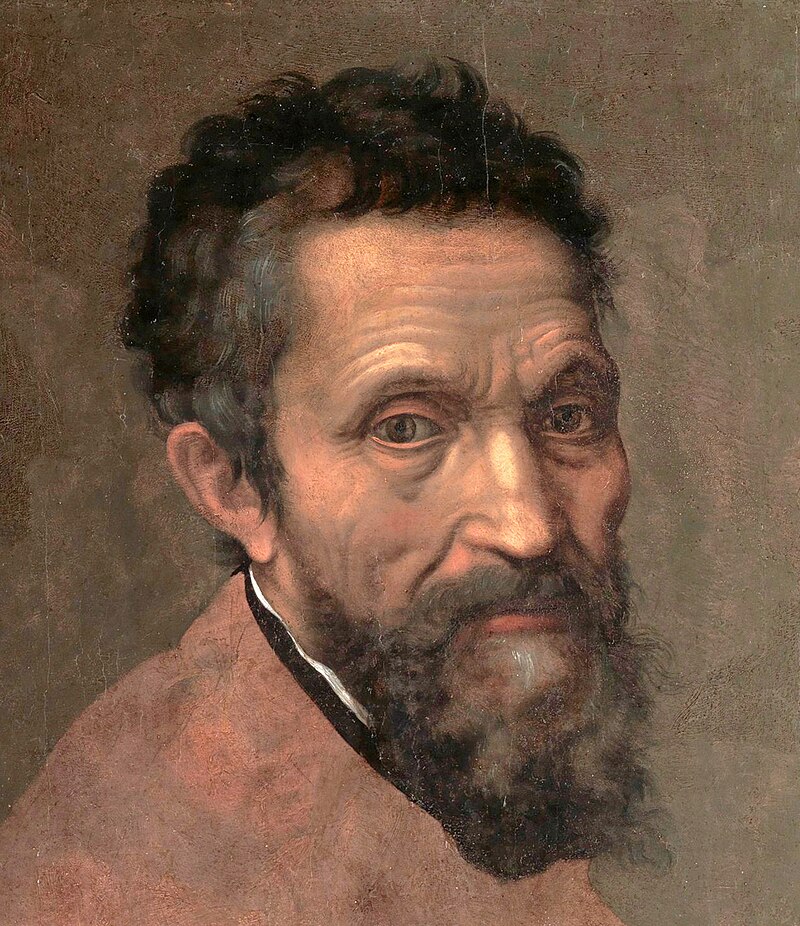
Source: By Attributed to Daniele da Volterra - Metropolitan Museum of Art, online collection (The Met object ID 436771), Public Domain, https://commons.wikimedia.org/w/index.php?curid=93197995
At the age of 13, he was apprenticed to Domenico Ghirlandaio, one of Florence’s leading painters of the time, where he studied fresco painting. His formal education, however, was brief, as his artistic talent soon surpassed the training of his mentors. Michelangelo was also influenced by the work of Donatello, whose sculptures shaped his approach to the human figure, and Lorenzo de' Medici, who took him into the Medici household where he had access to the most prominent artists and scholars of the time [2].
2. Early Works and Rise to Fame
Michelangelo’s first major commission came at the age of 16 when he sculpted The Battle of the Centaurs (1492), a piece that demonstrated his understanding of classical themes and his extraordinary talent in the human form. However, it was his creation of The Pietà (1498–1499), a marble sculpture that depicts the Virgin Mary holding the dead Christ, that catapulted him to international fame. The work, which resides in St. Peter’s Basilica in the Vatican, was lauded for its emotional depth, technical precision, and idealized representation of the human body. The Pietà is a seminal example of his mastery in marble carving and his ability to imbue inanimate stone with life and emotion [3].
In 1501, Michelangelo returned to Florence, where he was commissioned by the Opera del Duomo to create a statue of David. The marble figure of David, measuring 14 feet (4.3 meters) tall, became one of Michelangelo’s defining works and is now considered one of the greatest masterpieces of Western art. Carved from a single block of marble, David represents the Biblical hero moments before his battle with Goliath and is celebrated for its accurate anatomical proportions, dynamic posture, and expression of youthful strength [4].
3. The Sistine Chapel Ceiling
In 1508, Michelangelo was commissioned by Pope Julius II to repaint the ceiling of the Sistine Chapel, which had been left unfinished for several decades. The project, which began in 1508, took him four years to complete. The Sistine Chapel ceiling remains one of the most iconic works in art history, featuring over 300 figures, including scenes from the Book of Genesis, such as the Creation of Adam. Michelangelo’s depiction of God reaching out to touch Adam’s finger remains one of the most recognizable images in Western art. The ceiling is a stunning achievement in fresco painting, displaying Michelangelo’s understanding of perspective, human anatomy, and his ability to convey complex theological themes through visual representation [5].
Despite his initial reluctance to take on the project (he preferred working in sculpture), Michelangelo’s work on the Sistine Chapel transformed the genre of fresco painting. His technical innovation in the use of light and shadow to create depth and drama was revolutionary, and the ceiling is considered one of the greatest artistic achievements of the Renaissance. The Sistine Chapel ceiling is also notable for its depictions of prophets, sibyls, and the ancestors of Christ, which are painted in a complex arrangement of narrative cycles [6].
4. Later Works and Architectural Contributions
Michelangelo's career extended beyond sculpture and painting, and he became involved in architecture during his later years. He was appointed the chief architect of St. Peter’s Basilica in the Vatican in 1546, where he oversaw the completion of the iconic dome of the basilica, which was completed after his death. His work on the basilica transformed the Renaissance approach to church architecture, and his innovations in the design of the dome have had a lasting impact on architecture worldwide. Michelangelo’s design for the basilica’s dome was groundbreaking and influenced subsequent domes in churches, notably the St. Paul’s Cathedral in London.
Michelangelo also designed the Laurentian Library in Florence and worked on the Piazza del Campidoglio in Rome, where he redesigned the entire square. His architectural work is characterized by a deep understanding of classical forms combined with his unique creative vision, which often broke from tradition to explore new solutions to aesthetic and structural problems.
5. Later Paintings and The Last Judgment
In addition to the Sistine Chapel, Michelangelo’s later works included paintings such as the Last Judgment (1536–1541), another monumental fresco covering the altar wall of the Sistine Chapel. Unlike the ceiling, which focused on divine creation, the Last Judgment depicts the second coming of Christ, with angels and demons, as well as saints and sinners, engaging in a dramatic cosmic battle. The painting is noted for its dramatic use of human figures and muscular forms, reminiscent of Michelangelo’s sculpture. The work is also significant for its emotional intensity and the theological implications of divine judgment and salvation.
6. Michelangelo as a Poet
While Michelangelo is best known for his visual art, he was also a talented poet. He wrote over 300 sonnets and other poetic works, many of which reflected his personal feelings about love, beauty, aging, and faith. Michelangelo’s poetry often contained themes of longing and introspection, revealing his inner thoughts about the transitory nature of life and the search for spiritual meaning. His poems were deeply intertwined with his artistic pursuits, as they often dealt with the creative process and the nature of art. In his later years, poetry became an outlet for Michelangelo's frustrations and reflections on his artistic legacy.
7. Legacy and Influence
Michelangelo’s influence on the Renaissance, and Western art in general, cannot be overstated. His approach to realism, anatomical precision, and emotional depth in sculpture and painting set a standard that would inspire generations of artists. His works like the Pietà, David, and the Sistine Chapel ceiling continue to be celebrated for their technical brilliance and artistic innovation.
Michelangelo’s influence also extended to subsequent generations of artists, including Caravaggio, Bernini, and Rodin, who admired his ability to imbue stone and fresco with life. His style, particularly in terms of muscular forms and dramatic tension, influenced the Baroque movement, and his emphasis on personal expression can be seen in later developments such as Romanticism and Modernism.
Today, Michelangelo’s works remain essential to the study of art history, with his masterpieces housed in museums and churches around the world, including the Uffizi Gallery in Florence, the Vatican Museums, and the Accademia Gallery in Florence. His legacy continues to serve as a cornerstone in the study of Renaissance art, and his influence on Western art and culture endures.
8. Conclusion
Michelangelo Buonarroti’s legacy as one of the greatest artists in history is anchored in his transformative contributions to sculpture, painting, architecture, and poetry. His works, including iconic masterpieces such as David, the Pietà, and the Sistine Chapel ceiling, not only define the artistic achievements of the Renaissance but also shape the very essence of Western artistic tradition. His profound impact on the artistic, cultural, and architectural landscape ensures that Michelangelo remains an enduring figure in both historical scholarship and popular imagination.
References
- Hibbard, H. Michelangelo. Harper & Row, 1993.
- Vasari, G. Lives of the Most Excellent Painters, Sculptors, and Architects. 1550, translated by A. de Vere, Penguin Classics, 1996.
- Hartt, F. History of Italian Renaissance Art: Painting, Sculpture, Architecture. 7th edition, Pearson, 2011.
- Wallace, W. E. Michelangelo: The Complete Works. Taschen, 2017.
- Kemp, M. Michelangelo’s Painting: The Sistine Chapel Ceiling. Thames & Hudson, 2003.
- Banister, M. The Poetry of Michelangelo: An Introduction. University of Chicago Press, 1999.