+1 credit
| Version | Summary | Created by | Modification | Content Size | Created at | Operation |
|---|---|---|---|---|---|---|
| 1 | Encyclopedia Editorial Office | -- | 1207 | 2025-05-27 05:42:04 |
Video Upload Options
On May 28, 1937, the German Labour Front (Deutsche Arbeitsfront, DAF) established the company Gesellschaft zur Vorbereitung des Deutschen Volkswagens mbH ("Company for the Preparation of the German People's Car Ltd.") in Berlin. This entity was later renamed Volkswagenwerk GmbH in 1938. The company's founding marked the beginning of what would become Volkswagen, a prominent global automobile manufacturer headquartered in Wolfsburg, Germany .
1. Historical Context and Purpose
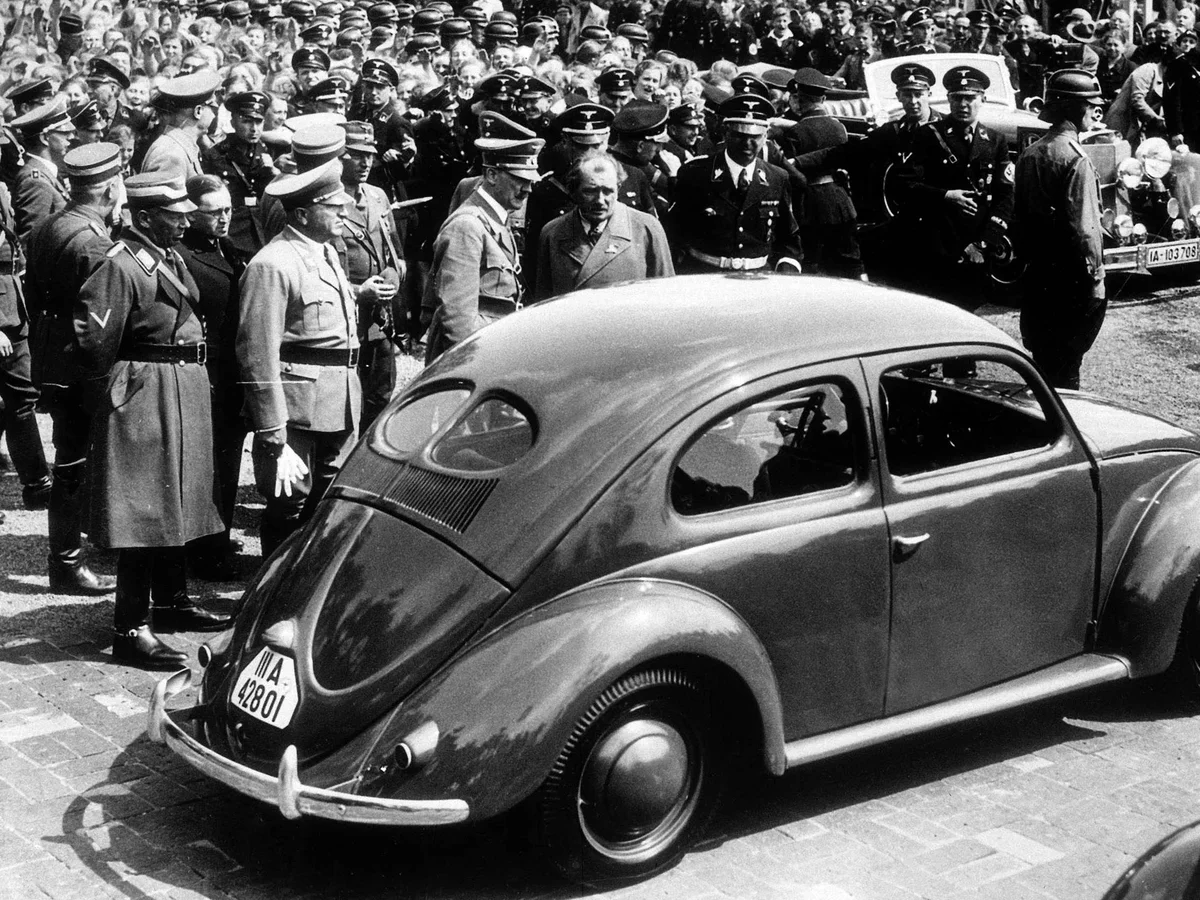
In the early 1930s, Germany faced significant economic challenges, including high unemployment and limited industrial growth. Automobile ownership was a luxury, with most citizens unable to afford a personal vehicle. Recognizing the potential of the automotive industry to stimulate economic development and enhance mobility, the German government initiated a project to produce an affordable and reliable car for the general population [1].
The concept of a "people's car" (Volkswagen in German) aimed to provide every German family with the means to wn a vehicle. This initiative was part of a broader strategy to modernize the country's infrastructure and promote social welfare through increased mobility. The German Labour Front (Deutsche Arbeitsfront, DAF) took the lead in this endeavor, establishing the Gesellschaft zur Vorbereitung des Deutschen Volkswagens mbH ("Company for the Preparation of the German People's Car Ltd.") on May 28, 1937, in Berlin. This entity was later renamed Volkswagenwerk GmbH in 1938 [2].
The project also aligned with plans to expand the autobahn network, facilitating efficient transportation across the country. By integrating automobile production with infrastructure development, the initiative sought to transform Germany into a motorized nation, enhancing both economic productivity and national pride.
Source: Guardian
2. Design and Development
To bring the vision of an affordable car to fruition, the German Labour Front commissioned renowned automotive engineer Ferdinand Porsche to design the vehicle. Porsche was tasked with creating a car that could accommodate two adults and three children, achieve speeds of up to 100 km/h (62 mph), and maintain fuel efficiency of at least 7 liters per 100 kilometers (approximately 33.6 mpg).
Porsche's design, known as the Volkswagen Type 1, featured a rear-mounted, air-cooled engine and a streamlined, aerodynamic body. The vehicle's simplicity and durability made it suitable for mass production and everyday use. The prototype underwent rigorous testing to ensure reliability and performance under various conditions.
The Type 1's distinctive shape and engineering innovations contributed to its eventual popularity. Although initially developed as part of a state-sponsored program, the car's design laid the foundation for what would become the Volkswagen Beetle, one of the most iconic and best-selling automobiles in history.
3. Establishment of Production Facilities
To facilitate mass production of the Volkswagen Type 1, a large manufacturing plant was constructed in 1938 near the town of Fallersleben, which was subsequently renamed Wolfsburg. The site was strategically chosen for its central location in Germany and access to transportation routes, including the Mittelland Canal and major rail lines.
The factory was designed as a vertically integrated facility, capable of producing up to 1.5 million vehicles annually. Its construction involved significant planning and resources, with the aim of creating one of the most advanced automobile production plants of the time. The facility included state-of-the-art machinery and assembly lines to streamline the manufacturing process.
In addition to the factory, a new town was planned and built to house the workers and their families. This comprehensive approach to industrial development reflected the project's significance and the government's commitment to transforming Germany's automotive landscape.
4. Impact of World War II
The outbreak of World War II in 1939 dramatically altered Volkswagen's trajectory. Civilian automobile production was halted, and the company's focus shifted to supporting the war effort. The Wolfsburg plant was repurposed to manufacture military vehicles, including the Kübelwagen and the Schwimmwagen, both based on the original Type 1 design.
The Kübelwagen served as a light military transport vehicle, while the Schwimmwagen was an amphibious version capable of operating on land and water. These vehicles were widely used by German forces during the war, demonstrating the adaptability of Porsche's original design.
Despite the shift in production, the concept of the "people's car" remained a symbol of post-war aspirations. The war's end left the Wolfsburg plant in a state of disrepair, but its potential for civilian automobile manufacturing persisted.
5. Post-War Reconstruction and Growth
Following the end of World War II, the Volkswagen factory came under British control as part of the Allied occupation of Germany. British Army officer Major Ivan Hirst played a pivotal role in reviving the company. Recognizing the plant's potential, Hirst oversaw the repair and retooling of the facility to resume production of the Volkswagen Type 1.
Under Hirst's supervision, the factory began producing vehicles for the British military and, eventually, for civilian use. The car's affordability, reliability, and distinctive design contributed to its growing popularity in post-war Europe.
In 1949, control of Volkswagen was transferred to the West German government and the state of Lower Saxony. The company experienced significant growth during the 1950s and 1960s, with the Beetle becoming an iconic symbol of economic recovery and personal freedom. Its success extended beyond Germany, with exports to the United States and other international markets solidifying Volkswagen's global presence.
6. Global Expansion and Diversification
Volkswagen's success with the Beetle provided the foundation for global expansion. The company established manufacturing plants in various countries, including Brazil, Mexico, South Africa, and China, to meet growing international demand.
To diversify its product lineup and cater to different market segments, Volkswagen acquired several other automotive brands:
-
Audi: Known for luxury and performance vehicles.
-
SEAT: A Spanish automaker offering affordable cars.
-
Škoda: A Czech brand with a reputation for value and reliability.
-
Bentley: A British manufacturer of luxury automobiles.
-
Lamborghini: An Italian brand specializing in high-performance sports cars.
-
Bugatti: A French marque renowned for ultra-luxury and speed.
-
Porsche: A German sports car manufacturer with a storied history.
These acquisitions allowed Volkswagen to expand its reach across various segments of the automotive market, from economy vehicles to luxury and high-performance cars. The company's global footprint and diverse brand portfolio positioned it as one of the world's leading automobile manufacturers.
7. Technological Innovation and Sustainability
In response to evolving environmental standards and consumer preferences, Volkswagen invested heavily in developing electric vehicles (EVs) and sustainable mobility solutions. The company introduced the ID. series, a line of fully electric vehicles built on the Modular Electric Drive Matrix (MEB) platform.
Models in the ID. series include:
-
ID.3: A compact hatchback designed for urban mobility.
-
ID.4: An electric SUV offering versatility and range.
-
ID.5: A coupe-style SUV with advanced features.
-
ID.7: A premium electric sedan.
-
ID. Buzz: A modern reinterpretation of the classic VW Microbus.
These vehicles feature advanced technology, spacious interiors, and zero-emission drivetrains, aligning with global efforts to reduce carbon emissions and promote sustainable transportation.
Volkswagen's commitment to electrification reflects its strategic shift toward innovation and environmental responsibility, ensuring its continued relevance in the rapidly evolving automotive industry.
8. Legacy and Current Status
From its inception on May 28, 1937, Volkswagen has grown into one of the world's leading automobile manufacturers. The company's emphasis on innovation, quality, and global reach has solidified its position in the automotive industry.
Today, Volkswagen continues to develop a wide range of vehicles, embracing new technologies to meet the demands of modern transportation. Its diverse brand portfolio, commitment to sustainability, and focus on customer satisfaction underscore its enduring legacy and ongoing impact on the global automotive landscape.
References
- Mommsen, Hans. The Volkswagen Beetle: A Biography. Columbia University Press, 2010.
- Volkswagen and the Third Reich: A Study in Industrial Responsibility.” German Studies Review, vol. 7, no. 3, 1984, pp. 439–457.