

 +1 credit
| Version | Summary | Created by | Modification | Content Size | Created at | Operation |
|---|---|---|---|---|---|---|
| 1 | Encyclopedia Editorial Office | -- | 892 | 2025-05-20 03:16:04 |
Video Upload Options
Vasco da Gama’s arrival in Calicut, India on May 20, 1498, marked the first time a European reached India by sea, successfully navigating around the Cape of Good Hope and across the Indian Ocean. This event opened a direct maritime trade route between Europe and Asia, breaking the centuries-old overland monopoly held by Middle Eastern and Venetian traders. It initiated an era of European exploration, imperial expansion, and global maritime dominance, especially for Portugal.
1. Introduction
On May 20, 1498, the Portuguese explorer Vasco da Gama landed in the Indian city of Calicut (present-day Kozhikode) on the southwest coast of the Indian subcontinent. This moment marked the first time a European had reached India by sea, successfully sailing around the Cape of Good Hope at the southern tip of Africa and across the Indian Ocean. Da Gama’s arrival would prove to be one of the most consequential events in world history, opening up a new maritime trade route between Europe and Asia and launching an era of European colonial expansion in the East [1][2].
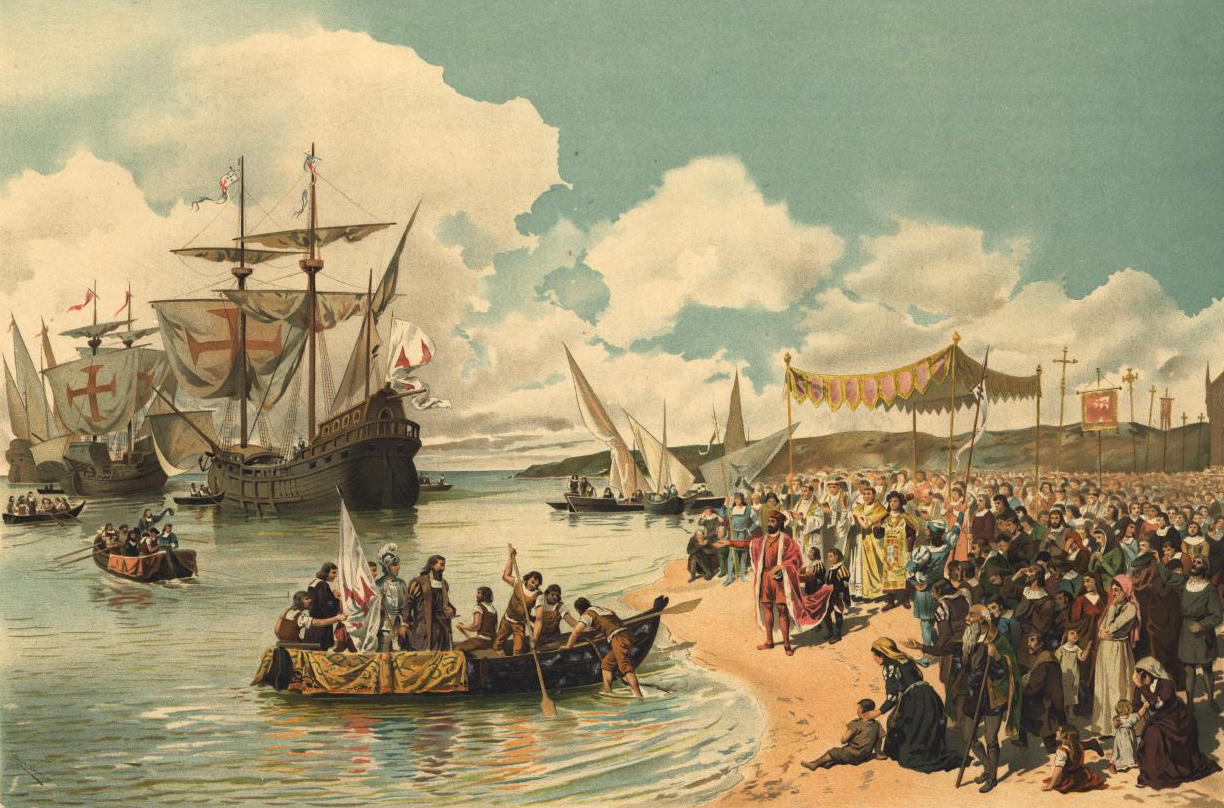
By Roque Gameiro - Biblioteca Nacional de Portugal: http://purl.pt/6855Cota local: E. 294 A., Public Domain, https://commons.wikimedia.org/w/index.php?curid=2632735
2. Background: The European Quest for a Sea Route to India
By the 15th century, spices, silks, and other luxury goods from Asia were in high demand in Europe. However, trade was dominated by Muslim merchants and controlled via overland routes that passed through the Middle East and Venetian ports, making goods expensive and limited. The Portuguese Crown, eager to gain direct access to Eastern markets, invested heavily in maritime exploration. This movement, known as the Age of Discovery, was encouraged by figures like Prince Henry the Navigator and later King Manuel I [2].
Portuguese ships had already made significant progress exploring the western coast of Africa. In 1488, Bartolomeu Dias rounded the Cape of Good Hope, proving that the Indian Ocean could be reached by sea. But it wasn’t until Vasco da Gama’s expedition that a full connection between Europe and India was established [1].
3. The Voyage of Vasco da Gama
Da Gama set sail from Lisbon on July 8, 1497, commanding a fleet of four ships: the São Gabriel, São Rafael, Bérrio, and a supply ship. His journey took him down the western coast of Africa, around the Cape of Good Hope, and along the eastern coast to Mozambique, Mombasa, and Malindi (in modern-day Kenya). There, he secured the services of a skilled Arab pilot, possibly Ahmad ibn Majid, who guided his fleet across the Arabian Sea to the Indian coast [3].
After nearly ten months at sea, the fleet anchored off the port of Calicut on May 20, 1498. Calicut was a major center for the spice trade, known for its bustling markets, cultural diversity, and long-standing trade links with Arab and Persian merchants [4].
4. First Contact with India
Da Gama and his crew were initially received by the local Hindu ruler, the Zamorin of Calicut. However, the Portuguese gifts—which included basic items like cloth, corals, and hats—were considered trivial compared to the valuable goods Calicut's merchants were used to dealing in [1][4]. Furthermore, tensions quickly emerged between the Portuguese newcomers and the established Muslim merchant communities, who viewed them as economic and religious threats.
While da Gama did manage to secure some trade before leaving, the visit did not result in a lasting diplomatic alliance. He returned to Portugal in 1499 with spices and news of the successful voyage. Nevertheless, his journey was hailed as a historic triumph [2].
5. Legacy and Consequences
Vasco da Gama’s arrival in India had profound consequences:
-
New Trade Routes: His success proved that Europe could reach Asia by sea, drastically lowering the cost and increasing the availability of spices and other Eastern goods [1].
-
Portuguese Empire: Portugal quickly capitalized on this new route, establishing trading posts and colonies along the coasts of India, Africa, and later Southeast Asia [2][5].
-
Colonial Conflict: The Portuguese imposed their influence through both diplomacy and military force, disrupting existing trade networks and provoking conflicts with local powers and other European rivals [3][5].
-
Religious and Cultural Impact: The arrival of Europeans in India marked the beginning of complex cultural exchanges, including missionary activities and the spread of Christianity, alongside violence and exploitation [1].
-
Global Power Shift: The voyage shifted the center of global trade from the Mediterranean to the Atlantic Ocean, enhancing the power of emerging European empires and initiating centuries of Western dominance over global commerce [2][3].
6. Historical Importance
Da Gama’s voyage was a turning point in the globalization of trade and the beginning of European colonialism in Asia. It redefined geopolitical boundaries, altered economic systems, and created a new global maritime network. The Portuguese would go on to control key parts of the Indian coast, including Goa, which served as the center of their Indian holdings for centuries [3][5].
Despite the initial diplomatic difficulties, the Portuguese presence in India grew rapidly after da Gama’s second voyage in 1502, during which he returned with a heavily armed fleet and used force to impose trade agreements [2].
7. In Summary
Vasco da Gama’s arrival in Calicut on May 20, 1498, was a landmark in world history. It marked the beginning of direct sea trade between Europe and India, reshaped the global economy, and set the stage for centuries of imperial rivalry and cultural exchange between the East and West [1][3].
References
- Subrahmanyam, S. The Career and Legend of Vasco da Gama. Cambridge University Press, 1997. https://doi.org/10.1017/CBO9780511582246
- Diffie, B. W., & Winius, G. D. Foundations of the Portuguese Empire, 1415–1580. University of Minnesota Press, 1977.
- Russell-Wood, A. J. R. The Portuguese Empire, 1415–1808: A World on the Move. Johns Hopkins University Press, 1998.
- Encyclopaedia Britannica. “Vasco da Gama.” https://www.britannica.com/biography/Vasco-da-Gama
- National Geographic. “Vasco da Gama’s Voyage to India.” https://education.nationalgeographic.org/resource/vasco-da-gama




