+1 credit
| Version | Summary | Created by | Modification | Content Size | Created at | Operation |
|---|---|---|---|---|---|---|
| 1 | Encyclopedia Editorial Office | -- | 677 | 2025-05-09 07:59:55 |
Video Upload Options
The First Academy Awards (later known as the Oscars) was a private awards ceremony held on May 16, 1929, at the Hollywood Roosevelt Hotel in Los Angeles. Organized by the newly formed Academy of Motion Picture Arts and Sciences (AMPAS), it honored outstanding achievements in films released between August 1, 1927, and July 31, 1928. Unlike today’s televised spectacle, the event was a 15-minute dinner banquet attended by 270 industry figures, with winners pre-announced months earlier. Key distinctions included two Best Picture categories (Wings won "Outstanding Picture," while Sunrise took "Unique and Artistic Production") and acting awards based on multiple performances (e.g., Janet Gaynor won Best Actress for three roles). The ceremony established foundational Oscar traditions, though the statuette’s nickname and global prominence would develop later.
1. Introduction
The inaugural Academy Awards ceremony on May 16, 1929 at the Hollywood Roosevelt Hotel established what would become cinema's most prestigious honor. As film historian Robert Osborne notes, "What began as an industry dinner evolved into a global cultural phenomenon through unexpected circumstances" [1]. This transformation from private function to public spectacle reflects Hollywood's own journey from fledgling industry to cultural powerhouse.
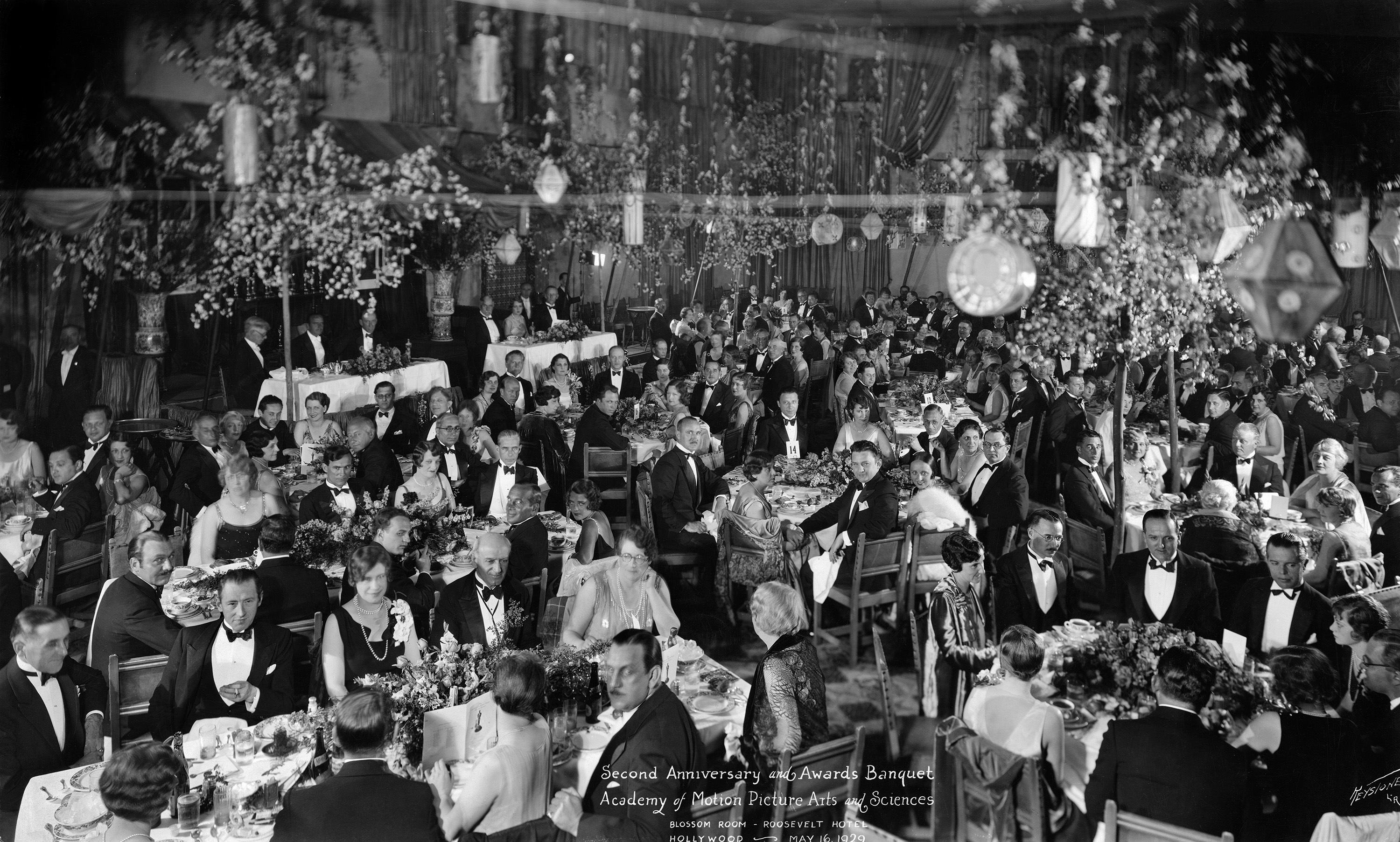
By Academy of Motion Picture Arts and Sciences - https://media.npr.org/assets/img/2023/03/09/banquet2_custom-f20ca080aed9902f80aee627e82f303352386806.jpg, Public Domain, https://commons.wikimedia.org/w/index.php?curid=10277457
2. Historical Context
The Academy of Motion Picture Arts and Sciences (AMPAS) was founded in May 1927, primarily as a labor relations body. According to meeting minutes from the Academy archives, MGM studio head Louis B. Mayer conceived the organization to "mediate disputes without union interference" [2]. The awards component emerged later, with the first eligibility period covering August 1, 1927-July 31, 1928 - coinciding with Hollywood's transition to sound films.
The ceremony's modest scale reflected industry uncertainty. As the Los Angeles Times reported on May 17, 1929: "The banquet was strictly an industry affair...with none of the fanfare associated with major civic events" [3]. Tickets cost 5(approximately85 today when adjusted for inflation), deliberately priced to exclude the general public [4].
3. The Ceremony
Contemporary accounts describe a 15-minute awards presentation during a larger dinner program. AMPAS President Douglas Fairbanks presided over what the Hollywood Reporter called "more a celebration than competition" [5]. The absence of suspense - winners were announced February 18, 1929 in the Academy Bulletin - created a relaxed atmosphere unlike modern ceremonies.
Notable program elements included:
-
Dual Best Picture awards (later consolidated after 1929)
-
Acting honors recognizing multiple performances
-
Technical awards for cinematography and engineering
4. Award Winners Analysis
The selection of Wings as Outstanding Picture reflected both its technical achievements (groundbreaking aerial sequences) and box office success ($2 million gross). As film historian Jeanine Basinger observes, "Wings demonstrated sound film techniques while remaining silent - a bridge between eras" [6].
Sunrise's Unique and Artistic Production award honored F.W. Murnau's German Expressionist influences. Murnau biographer Lotte Eisner notes the film's "visual poetry stood in stark contrast to Hollywood's commercial products" [7]. This category's discontinuation after 1929 signaled Hollywood's prioritization of mainstream appeal.
Janet Gaynor's Best Actress win for three roles established an acting award precedent. As she recalled in a 1977 interview: "They simply told me I'd won for my year's work - no one imagined it would become so important" [8].
5. Cultural Impact
The ceremony's immediate effects were modest but significant:
-
Established AMPAS as an industry authority
-
Created standards for technical excellence
-
Provided positive publicity during scandal-plagued years
As scholar Emily Carman demonstrates, "The Awards became a key tool in Hollywood's self-reinvention as respectable entertainment" [9]. This proved crucial during subsequent Production Code implementation.
6. Preservation Status
Tragically, many honored works are now lost. According to the Library of Congress:
-
Only 5 of 12 Best Picture nominees survive complete
-
Emil Jannings' The Way of All Flesh is among the most significant losses
-
Wings exists only through a 1992 restoration using six partial prints [10]
7. Legacy
The ceremony's innovations endured:
-
Dual award categories foreshadowed modern specialty honors
-
Technical recognition established standards still used today
-
Janet Gaynor remained the youngest Best Actress winner until 1986
As critic David Thomson reflects: "That first dinner contained all the Oscars' future contradictions - art versus commerce, private celebration versus public spectacle" [11].
References
- Osborne, R. (2013). 85 Years of the Oscar. Abbeville Press.
- Academy of Motion Picture Arts and Sciences. (1927). Board meeting minutes [Unpublished archival records]. Margaret Herrick Library, Los Angeles, CA.
- "Film Folk Honor Own at Academy Fete." (1929, May 17). Los Angeles Times, p. 12.
- U.S. Bureau of Labor Statistics. (2023). CPI Inflation Calculator. https://www.bls.gov/data/inflation_calculator.htm
- First Academy Awards Presented." (1929, May 17). The Hollywood Reporter, pp. 1-2.
- Basinger, J. (2020). The Movie Musical!. Knopf.
- Eisner, L. (1973). Murnau. University of California Press.
- Gaynor, J. (1977). Interview [Oral history recording]. Academy Oral History Project.
- Carman, E. (2016). Independent Stardom: Freelance Women in the Hollywood Studio System. University of Texas Press.
- Library of Congress. (2015). National Film Preservation Plan. U.S. Government Printing Office.
- Thomson, D. (2012). The Big Screen: The Story of the Movies. Farrar, Straus and Giroux.