

 +1 credit
| Version | Summary | Created by | Modification | Content Size | Created at | Operation |
|---|---|---|---|---|---|---|
| 1 | Mathias Stricker | -- | 607 | 2025-04-23 15:22:15 | | | |
| 2 | Catherine Yang | Meta information modification | 607 | 2025-04-24 02:52:16 | | |
Video Upload Options
A molecular cloud is an accumulation of interstellar gas and dust. These clouds have very low temperatures of just 10 to 30 kelvin and therefore the hydrogen is primarily composed of molecular hydrogen or H2. Compared to the mainly ionized hydrogen in other areas of the interstellar medium, less than 1% of all hydrogen in the Milky Way is bound in molecular clouds. The rest is in the form of atomic hydrogen which can become a molecular cloud at a later point in time.
The size of these molecular clouds can be from a few light years up to 600 light years and their total mass can reach several million solar masses. Molecular clouds with dimensions of more than about 15 light years are also called giant molecular clouds.
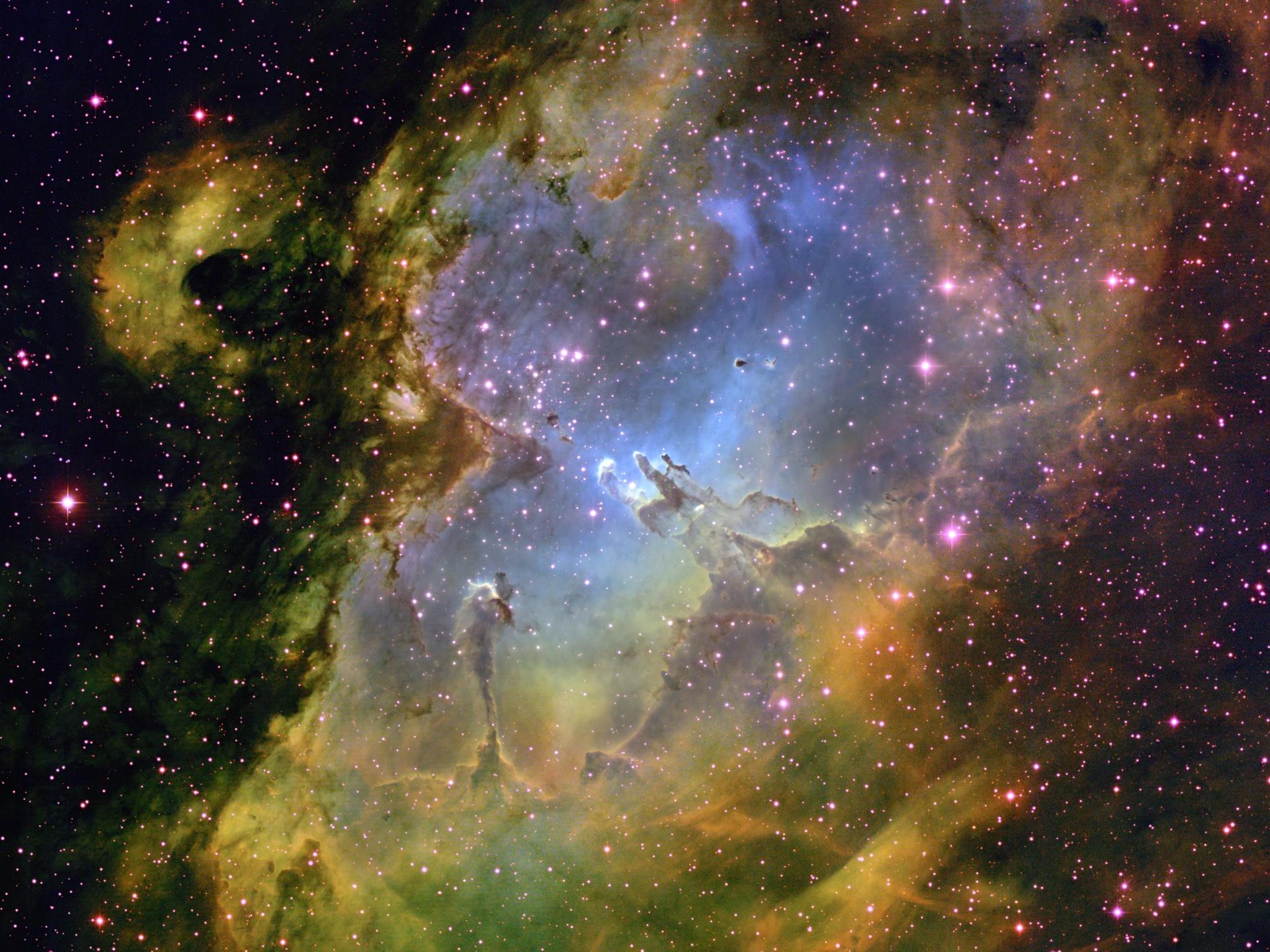
The Eagle Nebula is part of a molecular cloud with a diameter of about 20 light years. Credit: T. A. Rector & B. A. Wolpa, NOAO, AURA
Molecular clouds are so important because they are the raw material of stars and planets. A dark nebula (or dark cloud) is a very dense part of a bigger molecular cloud; the light extinction is caused by the high density and the presence of interstellar dust in these clouds. These are the regions where new stars are forming. Such a density can only occur if the temperatures are very low, otherwise the thermal pressure of the gas would lead to an expansion of the dark nebula and no new stars would be able to form. They mainly consist of hydrogen and dust particles which are all you need to form new star systems with stars and planets. Indeed, these clouds often contain newly formed stars; we just cannot see them due to the extinction of visible light caused by the dust of the clouds. Nevertheless, we are able to look into the core of the cloud using radio or infrared wavelengths. This way we can detect the very young stars.
Hundreds of different types of molecules have been detected in these clouds, among them water (H2O), ammonia (NH3), ethyl alcohol (C2H5OH) and even sugar and amino acids like glycine (C2H5NO2), the basic modules of life. We can trace more than 70 amino acids in meteorites and even 5 bases of DNA. Meteorites represent the original composition of the molecular cloud that our solar system was formed out of, since in many cases their basic structure has not changed much since the very first days of our solar system more than 4.5 billion years ago. All the rocks on earth are much younger in age and have completely lost this information. They have been melted and recrystallized with a very different chemical composition.
These clouds do not last for a very long time. After the new stars are born their solar winds blow away the remaining gas and dust. Only a fraction, about 10%, of the original material of the molecular cloud gets locked up in stars and planets. The rest of the material will be blown away into the interstellar medium and one day will be "recycled" in other molecular clouds - its next chance to become a star or a planet. If you further consider that for sun-like stars approximately 50% of the hydrogen of which the star is composed will be returned to the interstellar medium in the form of planetary nebula, we reach a recycling rate of almost 95%. Well, the universe is quite efficient in this sense and there will be many more generations of stars to come!
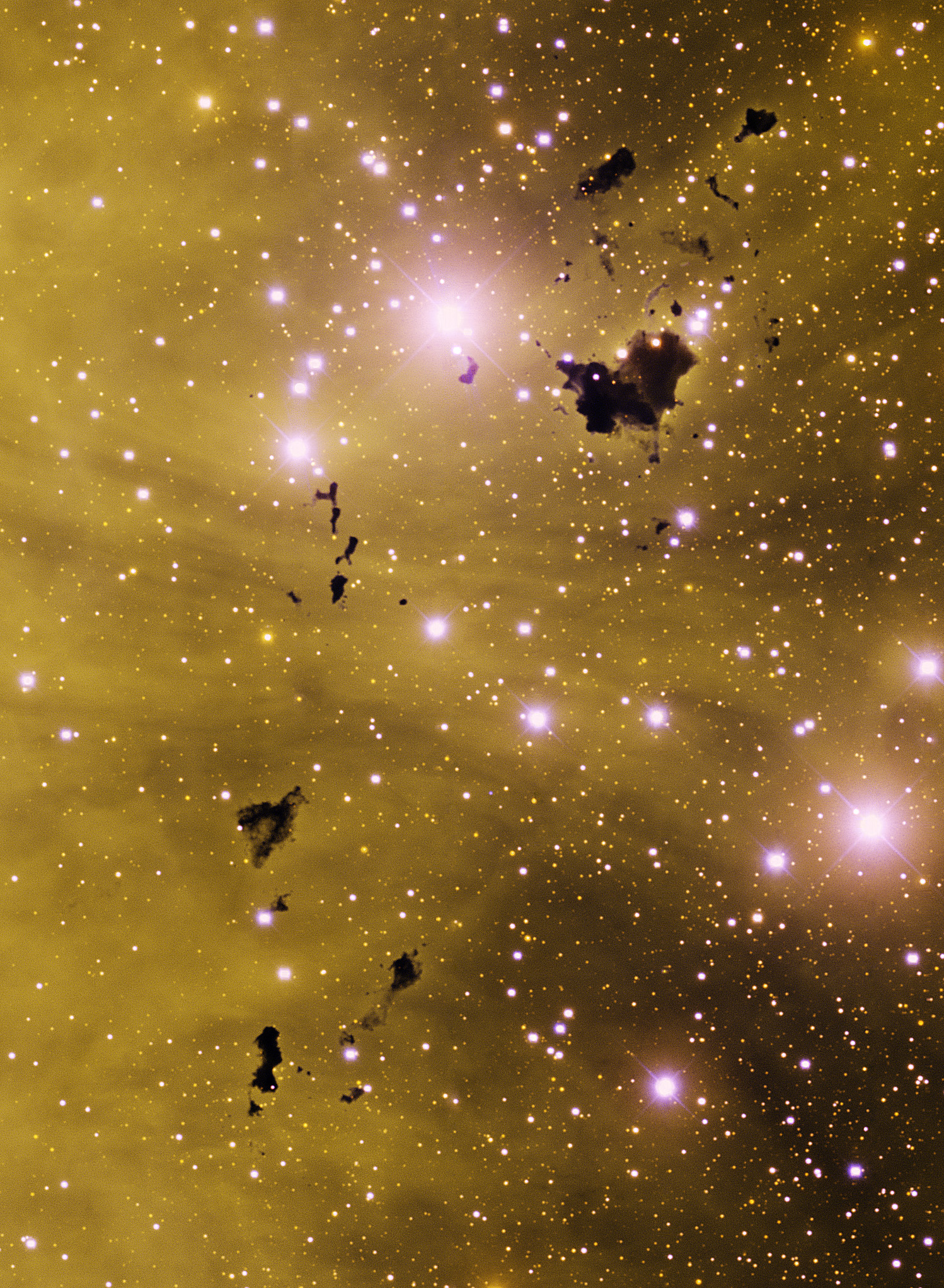
A dark nebula in IC 2944. Credit & Copyright: T. Rector (U. Alaska Anchorage), & N.S. van der Bliek (NOAO/AURA/NSF)




