

 +1 credit
| Version | Summary | Created by | Modification | Content Size | Created at | Operation |
|---|---|---|---|---|---|---|
| 1 | Orchidea Maria Lecian | -- | 2144 | 2025-03-07 04:46:35 |
Video Upload Options
Transient Phenomena in Exotic Astrophysical Objects
EditSelected topics from particular exotic Astrophysical sources are surveyed. In particular, the studies of the X-ray emissions are recapitulated.
1. Introduction
Selected Astrophysical sources classified as ’exotic objects’ are scrutinized according to the emissions. The open interrogations and the recent analyses are recapitulated- the attention being devoted to the accretion models and on the jet-collimation paradigms.
1.1 An example of transient relativistic radio jet
An example of transient Relativistic radio jet is taken from [1]. The first observations of ’transient Relativistic jet’ are inferred from the experimental evidence of the Blackhole candidate Cygnus X-1 after interferometer techniques. The jet is corresponding to ’softest’ X-ray spectrum. The velocity of the jet could not be extracted from the analysis of the experimental data. The jet was not associated with any heated radio emission. The jet is analysed within the framework of the ’unified model’ of a disc-jet coupling in blackhole X binaries. The jet line was attempted to be identified. The consistency of the source is studied as the jet time duree is consistent with the X ray softening, and as the radio emission undergoes suppression after completion of the spectral softening and as the transient/ejecta shock are observed.
Nevertheless, further paradigms should be investigated, as the studied jet is not judged as consistent in [1] with the ’unified model after the ejection.
1.2 Disc as X-ray source
From [2], the mass rates ˙ M ∼ 10−9 − 3 · 10−8M⊙/year are investigated. The disc is considered as an X-ray source with hν ∼ 0 − 10keV and luminosity L ∼1037 −1038.
When the flux of the accreting matter decreases, the temperature of the radiation is descended. The optical luminosity acquires its main contribution from ’reradiation’ of the part of the X ray. The matter arriving form the ’central high temperature’ of the disc is absorbed in the outer regions with lower temperature.
1.3 Transient radio jet from erupting Dwarf Nova
From [3], Astrophysical jets are described to happen around all types of accreting objects. A ’unified’ scenario has been pictured f ’disc-jet’ coupling from many phenomena, which range within accreting objects. Radio observation of a Dwarf Nova in ’outburst flat spectrum radio emission’ is explained ibidem as from synchrotron emission form a ’transient jet’. Analogies with X-ray binaries are studied. The disc jet protocol is suggested to be extendable. Similarities with the radio luminosities are outlined.
The relation between the radio emission with the accretion stages is envisaged.
The observed phenomenon is a jet form a non-magnetic Dwarf Nova (DN): common features between the launching in cataclysmic variables and XRB’s are delineated.
White Dwarfs (WD’s) are hypothsized to be connecting the paradigms proper of Young Stellar Objects (YSO’s) [4] and XRB’s. The classification of YSO’s and the role of dust in the emission is explained in [4][5].
An exception is considered as far as soft states of XRB’s and related phenomena are concerned.
All the accretion powered jets exhibit a ’launching efficiency’ common to YSO’s, AGN’s and γRB’s. The launching efficiency is studied as the ratio of the jet power with the power transmitted to the accretion flow (10%).
Common aspects of disc-jet coupling from YSO’s to γRB’s via AGN’s are stressed.
In Fig. 1 of [3], the ’hardness efficiency intensity diagrams’ (experimental) reveal the time evolution of an outburst.
Jet lines are observed in BH’s and Neutron-Star’s XrB’s. Power-law component in the ’hard’ X-ray emission with respect to the boundary layer/accretion disc luminosity are studied [6][7].
1.4 Formation of the disc around a BH
From [2], the formation of the disc around a BH is ascribed to the ’outward transfer’ of the angular momentum of the matter involved in the formation of the accretion.
The structure of the spectrum and the radiation of the spectrum are understood as depending on the ’rate’ of the matter inflow into the disc calculated at the
extreme boundary of the disc.
The magnetic field and the aspects of the turbulence affect the phenomenon in a weaker way with respect to the transport of angular momentum.
An ’autoregulation of the accretion’ is hypothesized to depend on ’counterpart mechanisms’ between the matter inflow and the evaporation of the gas ascribed
to ’hard radiation’.
Only a small fraction of the accreting matter is described as falling under the gravitational radius; unaccordingly, the majority of the matter is ’flowing out’ of the central region of the disc.
1.5 The role of plasma in ultraluminous X-ray sources
Ultraluminous x-ray sources (ULX’s) are ’off-nuclear point sources’ situated in nearby galaxies determined after an X-ray luminosity which is higher than the theoretical prescriptions of the Eddington limit of ’spherical infall’ [8]; because the masses do not overlap with the range of the isotropic Eddington limit, the
models were molded for BH’s.
The study of the broad-band X-ray observation was performed of the nuclear region of the galaxy M82. Two sources are focused about, to which the correspond BH masses M of M > 50M⊙ plus a important difference with respect with the usual ’thin disc accretion’ protocol.
The conserved pulsation is in correspondence with the rotation of a magnetised neutron star.
As a result, the the neutron stars are discovered to be not rare in the ULX population. The further studies must be focused on the accretion of the matter onto magnetised compact objects. Two sources are focused about.
The role of plasma is here outlined.
Spectral analysis is performed with two spectral models: one ’absorbed power law’ and on ’absorbed accretion disc’. The effect of ’strong diffuse plasma emission’ out of the M82 galaxy is calculated. For source 15, the presence of ’low temperature (thermal) plasma’ is comprehend.
Flux measurements are performed with spectroscopy technique.
The diffuse plasma emission of the M82 galaxy is included.
Other point sources are modellised as consisting of low-temperature plasma as from the framework of [9] and an ’accretion-disc-continuum’; the former is understood to comprise the diffuse emission.
1.6 A study about jets and accretion discs
From [8][9][10], the study of the binary system SS433 is achieved.
The relativistic start is understood most likely as a BH which is characterised as undergoing a constant ’supercritical regime’ as far as the accretion gas on the celestial body is concerned; as an observational evidence, a ’supercritical accretion disc’ and collimated relativistic jets are presented.
The disc and the jets undergo precession.
The scenario is embraced as useful for the study of the microquasars.
The orientation of the accretion disc is attributed a relevant role. observational evidences are presented of wind, of gas flows, and of the properties of the material on the equatorial plane.
The jets are understood as surrounded of hot gas which ’reradiates’ from the inner region of the disc.
The phenomenon is ibidem considered as apt for comparison with other extremely ’bright’ X-ray sources form other galaxies.
One of the peculiarities of SS433 is the presence of ’heavy jets’. The jets are made of e+e− plasma and their velocities of propagation is slow if compared with those of other microquasars. The presence of the dense clouds of gas is important, as the clouds of gas do not undergo relevant deceleration within the considered lengthscales.
The Relativistic particles are thought of as accelerating and as taking part in’shock waves: these aspects qualify the interaction between the jets and the gas outgoing from the accretion disc.
More in detail, the clouds of gas are observed to propagate within considerable distances without an ’appreciable’ deceleration. Due to this important property, the jets are apt to be observed spectrally in the optical, in the X-ray, and in images in the radio and in the X-ray.
The relativistic particles are interpreted as undergoing acceleration during during the phenomena of interaction between the ’heavy jets’, the slow velocity of the disc wind is taken to account as well for the explanation of the long time duree of the optical radiation of the jets, as well as in the (∼ days) variations of the radio flux of SS433. The study of the relativistic particles is understood as the Relativistic particles are ’prepared’ for the blackhole spacetime from the initial conditions on the gravitational radius as from [11] Eq. (20) ibidem.
The jet radio emission is analysed to be polarised in a crucial manner at 10%−20% [12][13].
The polarization is ’variable’: the orientation is revealed along the ’instantaneous’ directions of the jets.
The circular polarization is 0.3%−0.6%: it is apprehended to be due as a direct result of the synchrotron radiation of the relativistic electrons in the jets.
From [12], the magnetic field is compatible with the low-frequency ’turnover’ of the spectrum. From [14], the interpretation is proposed that a conversion form the linear polarization to the circular one is due to the radiation propagating in a plasma with the appropriate qualities; within this framework, the degree of circular polarization is calculated to be allowed to arrive at 10%.
The cause of the linear polarization has not been proposed a unique explanation yet with the phenomenon of jets. In the case there is a circumstance, the polarization happens at a distance form the source which is still within the binary system; it is most likely to occur at the appearance of the jets above the ’wind photosphere’.
The slaved disc model is reported in [15]. The behaviour is inferred that the lares should take place twice per orbital period, i.e. when the reference frame is taken as one rotating with the equatorial plane of the relativistic star; this phenomenon is ascribed to the variation of the volume within the ’critical Roche surface’.
Furthermore, at the same sequence of twice each orbital period from [16], a perturbation of the disc is caused after the gravitational torque exerted at the
outer boundary of the disc.
The main transfer of SS433 at the activity of its jets should be ’molded’ after both the paradigms.
A further example for comparison of sources of luminosity which exceed the Eddington limit is presented in [17], in which the role of the jets is considered
as well.
2. Studies
Some new features about the analytical models of the time-dependent properties of the accretion phenomenon in absence of magnetic field is reported in Appendix A. The relevance of the phenomenon of blackhole accretion disc is outlined in [18]; the theoretical models are classified. In [19], the phenomenon of jets are hypothesized to be independent of the nature of the celestial body involved; the role of anomalous viscosity and that of the diffusivity are suggested to be taken into account. The presence of a large-scale magnetic filed under peculiar conditions is demonstrated as needed.
The prospective studies are to be oriented according to the new findings. In [20], accreting blackholes are considered. The X-ray radiation in the neighbourhood of the blackhole objects is examined. In [21], the phenomenon of hot accretion flow is studied; lower-mass accretion rates are taken into account, from which two aspects are investigated, i.e. the advection-dominated accretion flow and the luminous hot accretion flow: the radiative efficiency is investigated. The related phenomenon of is explored in [22], for which an r-dependent mass accretion law is found: the presence of a magnetic field is comprehended.
In [23], the role of the magnetic field in the accretion flow is analysed, and the time-dependent properties are outlined as far as the spectra are concerned. The role of gas has to be taken into account as follows.
In [24], the X-ray source M101 ULX-1 is analysed; its tantalizing properties are compared with the known paradigms. In [25], the properties of the infalling matter are considered, when the infalling matter is forming a spinning disc around the central object. In [26], the importance of the model of the slim disc is described within the
analysis of the variability in soft X-ray emission. In [27], the mechanisms of X-ray emission in compact objects is further explained. The further phenomena can be investigated. In [28], Ultraluminous X-ray sources (ULX’s) are reviewed to consist of an ex treme class of accreting compact objects which undergo highly super-Eddington accretion. In [29], some aspects of the numerical-simulation methods about collimation effects are recapitulated.
A. Selected time-dependent phenomena in accretion objects
The equations of motion of a perturbed inviscid fluid is followed from [30]. The equations of motions of an inviscid fluid are written in the General-Relativistic form with implementing the gradients to their covariant expressions as from [31].

The equations of motion of the adiabatic perturbations of the velocities are here specified as

The perturbations are taken
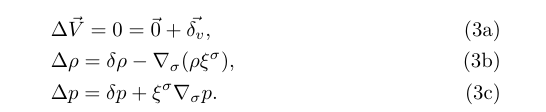
From Eq. (3a), Eq. (refeqy1) is specified for adiabatic perturbations of the velocities as

After implementing Eq. (3b) and Eq. (3c), Eq. (4) is written as containing the different orders as


After considering the different orders in Eq. (5), the different equations are obtained
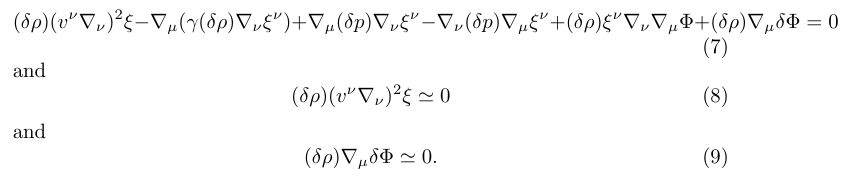
In particular, the new (non-Newtonian) condition Eq (9) is found for any (also, non-Newtonian) potentials.
The time behaviours of thin polytropic accretion discs under particular axisym metric perturbations are discussed in [32]. More in detail, both time independent perturbations and time-dependent perturbations are considered. Numerical methods due to J. von Neumann are recapitulated in [33].
References
- R. P. Fender, A. M. Stirling, R. E. Spencer, I. Brown, G. G. Pooley, T. W. B. Muxlow and J. C. A. Miller-Jones, A transient relativistic radio jet from cygnus x-1, Mon. Not. Roy. Astron. Soc. 369, 603-607 (2006). doi:10.1111/j.1365-2966.2006.10193.x [arXiv:astro-ph/0602307 [astro-ph]].
- N.I.Shakura, R.A. Sunyaev, Black holes in binary systems. Observational appearance, Astronomy and Astrophysics 24, 337 (1973).
- E. Kooerding, M. Rupen, C. Knigge, R. Fender, V. Dhawan, M. Templeton, T. Muxlow, A Transient Radio Jet in an Erupting Dwarf Nova, Science 320 (5881), 1318-1320 (2008).
- R. J. White, L. A. Hillenbrand, On the Evolutionary Status of Class I Stars and Herbig-Haro Energy Sources in Taurus-Auriga, ApJ 616, 998 (2004).
- F.C. Adams, C. Fred, C.J. Lada, J. Charles et al., Spectral Evolution of Young Stellar Objects, Astrophysical Journal 312,788 (1987).
- P. J. Wheatley, C. W. Mauche, J. A. Mattei, The X-ray and extremeultraviolet flux evolution of SS Cygni throughout outburst, MNRAS 345, 49 (2003).
- D. Maitra, C. D. Bailyn, Evolution of Spectral States of Aquila X-1 during the 2000 Outburst, ApJ 608, 444 (2004).
- M. Bachetti, F.A. Harrison, D.J. Walton et al., An ultraluminous X-ray source powered by an accreting neutron star, Nature 514 (7521), 202-204 (2014).
- R. Mewe, E.H.B.M. Gronenschild, G.H.J. van den Oord, Calculated Xradiation from optically thin plasmas. V, Astron. Astrophys. Supplement Series 62, 197-254 (1985).
- S. Fabrika, The jets and supercritical accretion disk in SS433, Astrophysics and Space Physics Reviews 12, 1-152 (2004).
- I. Bogush, K. Kobialko, D. Gal’tsov, Constructing massive particles surfaces in static spacetimes, e-print arXiv:2402.03266
- E.R. Seaquist, P.C. Gregory, P.C. Crane, Nonthermal radio emission from H-alpha-emission object, IAU Circ. N3256, 2 (1978).
- A.E. Niell, R.A. Preston, T.G. Lockhart, Periodic and Secular Changes in SS 433, Astrophys. J. 250, 248 (1981).
- R.P. Fender, M.A. Hendry, The radio luminosity of persistent X-ray binaries, Mon. Not. R. Astron. Soc. 317, 1 (2000).
- D.L. Band, J.E. Grindlay, On the origin of X-ray variability of SS 433, Astrophys. J. 285, 702 (1984).
- J.I. Katz, S.F. Anderson, S.A. Grandi, B. Margon, Nodding motions of accretion rings and disks : a short-term period in SS 433, Astrophys. J. 260, 780 (1982).
- K. Okada, T. Dotani, K. Makishima, K. Mitsuda, T. Mihara, Observation of Bright X-Ray Sources in the Nearby Spiral Galaxy IC 342, Publ. Astr. Soc. Japan 50, 25 (1998).
- Q. Ju, W. Wang, Prospect of the Theory of Black Hole Accretion Disks, 9th Pacific Rim Conference on Stellar Astrophysics, Proceedings of a conference held at Lijiang, China in 14-20 April 2011, ASP Conference Series, Vol. 451. Edited by S. Qain, K. Leung, L. Zhu, and S. Kwok, San Francisco: Astronomical Society of the Pacific, pag. 279 (2011).
- J. Ferreira, P. O. Petrucci, Jet launching and field advection in quasiKeplerian discs, IAU Symp. 275, 260 (2011).
- M. Gilfanov, X-Ray Emission from Black-Hole Binaries, in: T. Belloni (eds) The Jet Paradigm. Lecture Notes in Physics, vol 794. Springer, Berlin, Heidelberg (2010).
- F. Yuan, R. Narayan, Hot Accretion Flows Around Black Holes, Annual Review of Astronomy and Astrophysics 52, 529 (2014).
- S.-L. Li, X. Cao, Global dynamics of advection-dominated accretion flows with magnetically driven outflow, Monthly Notices of the Royal Astronomical Society 400, 1734 (2009).
- S. Mineshige, Time-Dependent Properties of Black-Hole Accretion Flow, 289, The Proceedings of the IAU 8th Asian-Pacific Regional Meeting I, 301 (1988).
- J.-F.Liu, J.N. Bregman, Y. Bai et al., Puzzling accretion onto a black hole in the ultraluminous X-ray source M 101 ULX-1, Nature 503 (7477), 500503 (2013).
- J.E. Pringle, M.J. Rees, Accretion Disc Models for Compact X-Ray Sources, Astronomy and Astrophysics 21, 1 (1972).
- M. Takeuchi, S. Mineshige, T. Kawaguchi et al., Slim-Disk Model for Soft X-Ray Excess and Variability of Narrow-Line Seyfert 1 Galaxies, Publications of the Astronomical Society of Japan 52, 499-508 (2000).
- V.M. Vasyliunas, Theories of Magnetospheres around Accreting Compact Objects, Space Science Reviews, Volume 24, Issue 4, pp.609-634 (1979).
- M. Bachetti, The high energy X-ray probe (HEX-P): studying extreme accretion with ultraluminous X-ray sources, Frontiers in Astronomy and Space Sciences 10 (2023).
- X. Hou, Monte-Carlo simulations on possible collimation effects of outflows to fan-beamed emission of ultraluminous accreting X-ray pulsars, The Astronomy Journal 941, 126 (2022).
- J.L. Friedman, B.F. Schutz, Lagrangian Perturbation Theory of Nonrelativistic Fluids, The Astrophysical Journal 221, 937-957 (1978).
- OML, Transient phenomena of inviscid accretion gas-radiation slim disc in a gravitational potential after adiabatic perturbations of the velocities, International Journal of Mathematics and Computer Research 12, 4562 (2024).
- O.M. Umurhan, A. Nemirovsky, O. Regev, G. Shaviv, Hydrodynamical stability of thin accretion discs: transient growth of global axisymmetric perturbations, Mon. Not. R. Astron. Soc. 000, 1-20 (2005).
- Z. Shen, W. Yan, G. Lv, Behavior of viscous solutions in Lagrangian formulation, Journal of Computational Physics 229, 4522 (2010).




