+1 credit
| Version | Summary | Created by | Modification | Content Size | Created at | Operation |
|---|---|---|---|---|---|---|
| 1 | Mekhla Sarkar | -- | 604 | 2024-06-13 13:01:03 | | | |
| 2 | Mekhla Sarkar | + 5 word(s) | 609 | 2024-06-13 13:43:19 | | | | |
| 3 | Jason Zhu | + 1 word(s) | 610 | 2024-06-19 05:01:06 | | |
Video Upload Options
Imagine technology that is perceptive, adaptable, and perfectly in tune with human needs. This is the promise of Ambient Intelligence (AMI), a groundbreaking advancement in IT with transformative potential across various domains, especially healthcare. By merging the power of Artificial Intelligence (AI) with the Internet of Medical Things (IoMT), AMI creates a dynamic and responsive medical environment. The survey dives deep into the integration of AMI techniques in IoMT, providing essential insights for both researchers and practitioners eager to innovate in the healthcare sector.
1. Introduction
In recent years, healthcare management systems have faced increasing strain, with chronic diseases and pandemics like COVID-19 stretching resources to their limits. Cardiovascular diseases, colorectal cancer, strokes, highlight the ongoing challenge. Post-surgery patients often need continuous monitoring, but frequent hospital visits are costly, inefficient, and inconvenient. Despite technological advances, many industrialized nations struggle with the quality and affordability of healthcare, raising concerns about the sector's sustainability and prompting the use of makeshift facilities and telehealth technologies.
The limitations of contemporary healthcare systems have spurred interest in alternative approaches aimed at promoting effective personalized care. Among these approaches, Ambient Intelligence (AMI) and the Internet of Medical Things (IoMT) represent a paradigm shift towards intelligent healthcare. AMI, known for creating adaptable and contextually aware environments, can transform healthcare facilities into intelligent ecosystems tailored to individual patient needs. Simultaneously, IoMT technologies facilitate interconnected medical devices and sensors, enabling real-time monitoring, data collection, and remote patient management. Integrating AI algorithms in AMI and IoMT systems enhances their capabilities with advanced data analytics, predictive modeling, and decision support functionalities.
The benefits of this integration include:
- Automated home monitoring services
- Reduced hospital and hospice occupancy
- Lower healthcare costs
- Personalized healthcare services
- Predictive analysis for early disease detection
These AI-powered technologies promise a new era of intelligent healthcare, prioritizing patient-centered care while optimizing operational efficiency. The integration of AMI and AI in healthcare through IoMT requires an exhaustive review of relevant literature, knowledge of different sensors, actuators, communication protocols, and AI-based approaches, as well as case studies to highlight the benefits, potential hurdles, and future trajectories of utilizing AMI and AI in healthcare via the IoMT. The detailed information can be read from the survey paper at https://www.mdpi.com/2079-9292/13/12/2309.
-
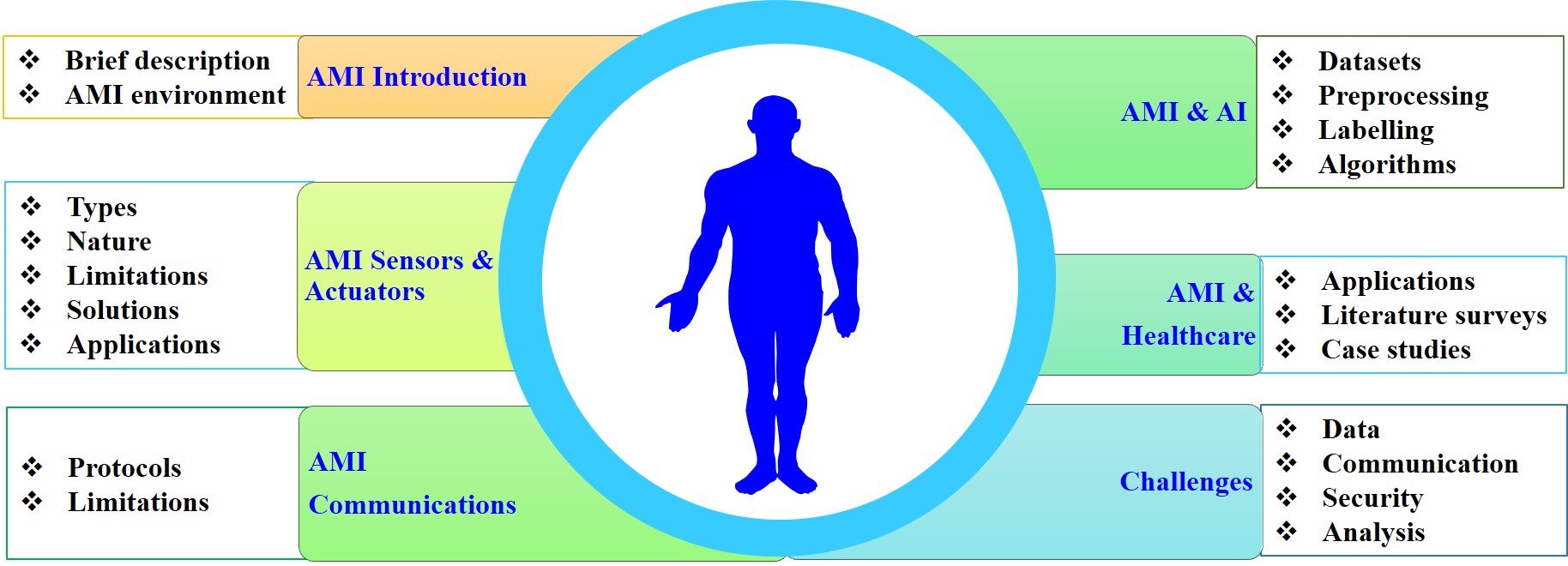
A comprehensive explanation of the AMI environment is provided, highlighting its key components, functionalities, and capabilities in healthcare settings.
-
Various IoMT sensors, including body-centric and ambient sensors, are explored while discussing their invasive or non-invasive nature, usage, benefits, and applications in facilitating intelligent healthcare solutions.
-
Various types of actuators are discussed based on their relationship to the body and environment, providing insights into their functions, challenges, and examples in healthcare contexts.
-
The communication protocols and technologies used in IoMT systems are delved into, examining their role in facilitating seamless data exchange and interaction among sensors, actuators, and other components in healthcare environments.
-
The integration of the IoMT with AI algorithms is analyzed, specifically focusing on image and video data as well as sensor data processing techniques.
-
A comprehensive literature survey is presented in order to explore the diverse applications of AMI in healthcare, covering areas such as remote patient monitoring, personalized healthcare delivery, smart medical devices, and telemedicine.
-
The challenges and limitations associated with the implementation of AMI in healthcare are analyzed, including issues related to data privacy, security, interoperability, scalability, and user acceptance.The overview of the work can be diagrammatically explained in Figure 1 for easy understanding and visualization.