You're using an outdated browser. Please upgrade to a modern browser for the best experience.
Submitted Successfully!
Thank you for your contribution! You can also upload a video entry or images related to this topic. For video creation, please contact our Academic Video Service.
Version Summary Created by Modification Content Size Created at Operation
1 Jinsol Han -- 1291 2023-01-12 04:13:11 |
2 layout Camila Xu Meta information modification 1291 2023-01-12 04:19:38 |

Video Upload Options

We provide professional Academic Video Service to translate complex research into visually appealing presentations. Would you like to try it?
Cite
If you have any further questions, please contact Encyclopedia Editorial Office.
Han, J.;  Lee, C.;  Hur, J.;  Jung, Y. Pathogenesis of Alcoholic Liver Disease. Encyclopedia. Available online: https://encyclopedia.pub/entry/40086 (accessed on 11 December 2025).
Han J,  Lee C,  Hur J,  Jung Y. Pathogenesis of Alcoholic Liver Disease. Encyclopedia. Available at: https://encyclopedia.pub/entry/40086. Accessed December 11, 2025.
Han, Jinsol, Chanbin Lee, Jin Hur, Youngmi Jung. "Pathogenesis of Alcoholic Liver Disease" Encyclopedia, https://encyclopedia.pub/entry/40086 (accessed December 11, 2025).
Han, J.,  Lee, C.,  Hur, J., & Jung, Y. (2023, January 12). Pathogenesis of Alcoholic Liver Disease. In Encyclopedia. https://encyclopedia.pub/entry/40086
Han, Jinsol, et al. "Pathogenesis of Alcoholic Liver Disease." Encyclopedia. Web. 12 January, 2023.
Pathogenesis of Alcoholic Liver Disease
Edit

Alcoholic liver disease (ALD) is a globally prevalent chronic liver disease caused by chronic or binge consumption of alcohol. The liver is highly susceptible to alcohol because it is the first organ where alcohol is metabolized, and it has a high level of alcohol-metabolizing enzymes. Metabolization of alcohol in the liver produces various hepatotoxic byproducts and significant oxidative stress on the liver, leading to the large-scale death of hepatocytes . Oxidative stress and excessive cell death exacerbate inflammation in the liver. Prolonged cell damage and inflammation activate hepatic stellate cells (HSCs), which are key players in the development of fibrosis in the liver. ALD encompasses a diverse spectrum, from mild to severe pathologies, including steatosis, steatohepatitis, cirrhosis, and hepatocellular carcinoma (HCC). 

alcoholic liver disease therapeutics pathogenesis

1. Introduction

Alcohol has long been recognized as a critical risk factor for many diseases [1][2]. However, alcohol consumption is not well controlled because of its addictive properties and social or cultural needs [3][4]. Uncontrolled, chronic and binge alcohol consumption result in an increase in alcohol-related diseases worldwide and account for 5.1% of the global burden of diseases [5]. Alcoholic liver disease (ALD) is responsible for the majority of alcohol-related deaths [6][7]. The liver is highly susceptible to alcohol because it is the first organ where alcohol is metabolized, and it has a high level of alcohol-metabolizing enzymes [8][9]. Metabolization of alcohol in the liver produces various hepatotoxic byproducts and significant oxidative stress on the liver, leading to the large-scale death of hepatocytes [8][10]. Oxidative stress and excessive cell death exacerbate inflammation in the liver [8][11]. Prolonged cell damage and inflammation activate hepatic stellate cells (HSCs), which are key players in the development of fibrosis in the liver [8][12]. ALD encompasses a diverse spectrum, from mild to severe pathologies, including steatosis, steatohepatitis, cirrhosis, and hepatocellular carcinoma (HCC) [13]. Given the prevalence of ALD worldwide, concerted efforts have been made to control alcohol consumption [11][14]. However, the trend in alcohol consumption is steadily increasing [13]. The COVID-19 pandemic has accelerated the prevalence of ALD [15]. There are no Food and Drug Administration (FDA)-approved drugs specifically targeting ALD, and the only treatments for ALD are abstinence and liver transplantation [16]. Thus, there is an urgent need for the development of ALD therapeutics. Several drugs are currently prescribed to patients with ALD as a supportive measure to delay death or to maintain health until liver transplantation is possible [17][18][19]. However, these available options are insufficient and/or ineffective for the patients [17][18][19].
In the absence of effective drug treatments, researchers are focusing on therapeutic strategies, targeting ALD pathogenesis and oxidative stress, regeneration, and inflammation [18][20][21]. Stem cell therapy has emerged as a promising therapy for ALD based on the immunomodulatory and regenerative capacities of stem cells in liver diseases, including ALD [22][23][24]. Among various types of stem cells, mesenchymal stem cells (MSCs) are considered a strong candidate for stem cell therapies because they are multipotent and can be obtained relatively easily from various sources, such as bone marrow (BM), adipose tissue, placenta, and umbilical cord (UC) [25][26][27]. In addition, MSCs do not give rise to the same ethical controversy that embryonic stem cells do [27][28][29]. MSCs have been widely studied and tested in clinical trials of liver diseases [22][23][24]. The therapeutic potential of MSC-derived secretory factors for liver diseases has been proven [27][30].

2. Pathogenesis of ALD

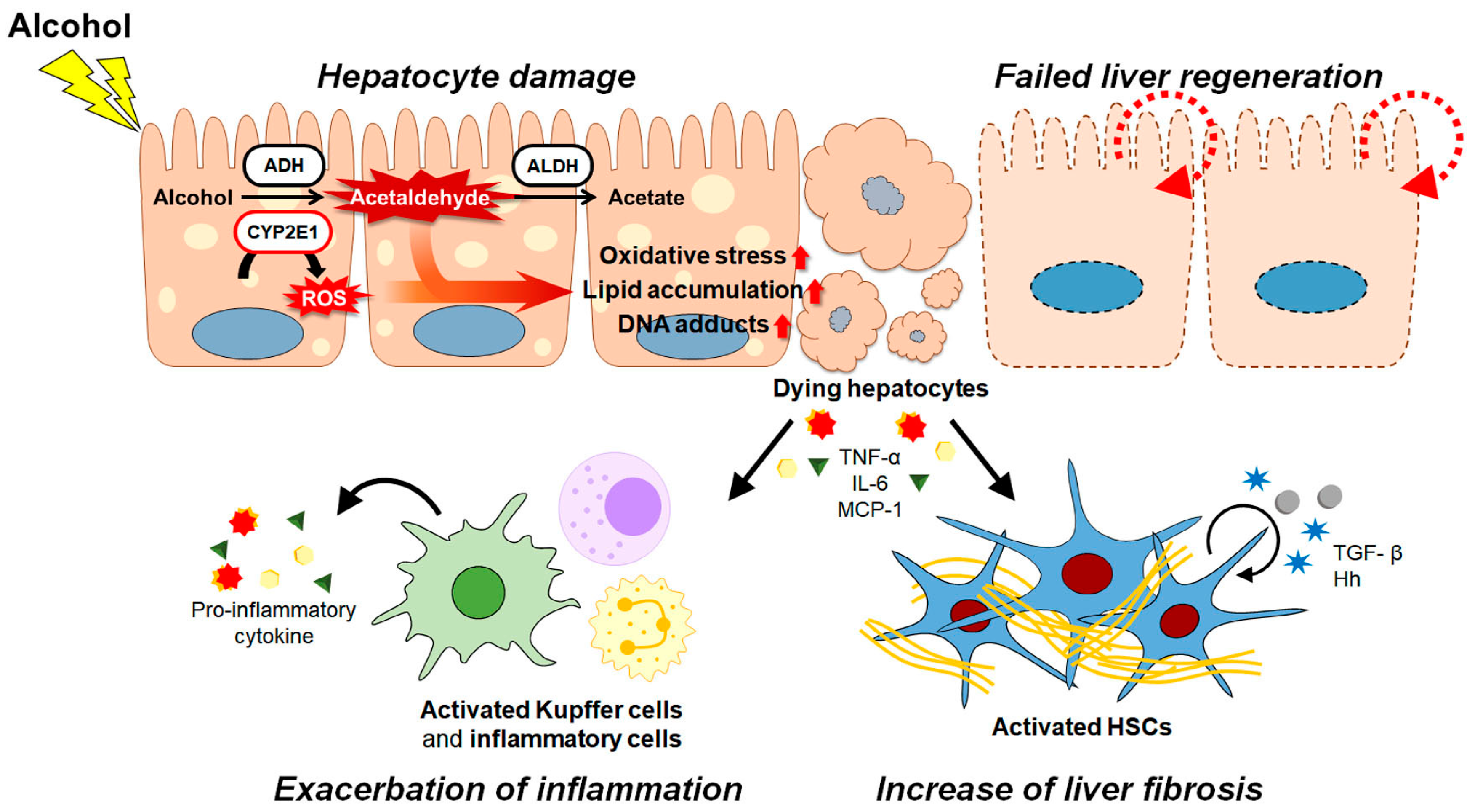
After alcohol is transferred through the bloodstream into the liver, hepatic enzymes convert the alcohol into acetaldehyde [8][9][31][32]. Among hepatic enzymes, alcohol dehydrogenase (ADH) and cytochrome P450 2E1 (CYP2E1) are the two main enzymes that oxidize alcohol to acetaldehyde, which plays a major role in alcohol-induced hepatotoxicity [8][9]. Acetaldehyde is then further metabolized to acetate by aldehyde dehydrogenase (ALDH) [8][9]. Most acetate leaves the liver and is metabolized into carbon dioxide, fatty acids, and water in peripheral tissues [8][9][10]. When an excessive amount of alcohol is ingested, the expression and activity of CYP2E1 rather than ADH is enhanced, and CYP2E1 converts alcohol to acetaldehyde, resulting in the production of reactive oxygen species (ROS) such as superoxide, peroxynitrite, hydrogen peroxide, and hydroxyl radicals [8][9][10][33][34]. The role of ROS in promoting oxidative stress is well known [35][36][37]. Prolonged alcohol consumption impairs liver lipid metabolism and leads to excessive hepatic fat accumulation by increasing fatty acid uptake and de novo lipogenesis and decreasing β-oxidation and secretion of very low-density lipoproteins [8][38][39]. This results in the accumulation of massive hepatic lipids in hepatocytes producing ROS [40][41]. Excessive ROS promotes lipid peroxidation and generates malondialdehyde (MDA) and 4-hydroxynonenal, which form toxic proteins or DNA adducts with acetaldehyde [42][43]. Alcohol also disrupts the antioxidant defense system by lowering the levels of antioxidants, including glutathione (GSH) and S-adenosyl-L-methionine (SAMe), provoking oxidative stress [44]. Oxidative stress impairs mitochondrial function by inducing abnormal enlargement of mitochondria and mitochondrial DNA damage and reducing hepatic ATP levels and mitochondrial protein synthesis [42][45][46][47]. In addition, excessive alcohol injures the successful repair process by hepatocytes and progenitors [48][49]. Hepatocytes are known to possess regenerative capacity to refill the loss of liver mass in response to liver damage [50][51]. Hepatic injury induces the upregulation of DNA synthesis in remaining mature hepatocytes and/or triggers expansion of the progenitor cell population, with these cells differentiating into hepatocytes [50][51]. As alcohol significantly inhibits the proliferation of both mature hepatocytes and liver progenitor cells and interrupts the differentiation of liver progenitors, immature and nonfunctional hepatocytes accumulate in the liver [49][52][53].
Dying hepatocytes damaged by alcohol release various cytokines and chemokines, such as tumor necrosis factor-α (TNF-α), interleukin (IL)-6, and monocyte chemoattractant protein-1 (MCP-1) [54][55]. These activate liver-resident macrophages known as Kupffer cells to recruit neutrophils and monocytes into the liver [54][55][56]. These inflammatory cells produce a wide variety of cytokines, which activate multiple signaling pathways in the liver. Among these pathways, the roles of nuclear factor-κB (NF-κB) and signal transducer and the activator of transcription 3 (STAT3) in the pathogenesis of liver diseases have been extensively studied [54][56][57][58]. NF-κB activated by alcohol metabolites induces the expression of various genes encoding pro-inflammatory cytokines and chemokines and participates in inflammasome regulation [58]. In response to alcohol injury, IL-6 is released from Kupffer cells and activates STAT3 in hepatocytes. Activated STAT3 promotes the production of pro-inflammatory cytokines and chemokines in these cells and increases monocyte/macrophage infiltration into the liver, exacerbating inflammation [57]. Hepatic inflammation is accompanied by fibrosis [59][60]. Liver fibrosis impairs hepatic function and architecture, leading to death from liver failure [61][62]. HSCs are a key contributor to fibrogenesis [63][64]. In damaged liver, HSCs gradually lose their distinctive features and undergo trans-differentiation into myofibroblast-like HSCs in a process called activation [63][64]. Profibrotic factors stimulating HSC activation, such as transforming growth factor-β (TGF-β), Hedgehog, and platelet-derived growth factor, are reported to be upregulated in patients with ALD and in animal models of ALD [65][66][67] (Figure 1).
Figure 1. Alcohol metabolism and pathophysiological process in ALD progression. In the liver, alcohol is metabolized to acetaldehyde by alcohol dehydrogenase (ADH) and cytochrome P450 2E1 (CYP2E1). Acetaldehyde is metabolized to acetate by aldehyde dehydrogenase (ALDH). When an excessive amount of alcohol is ingested, CYP2E1 is activated and elevates the levels of acetaldehyde and reactive oxygen species (ROS). Both acetaldehyde and ROS damage the hepatocytes by increasing oxidative stress, lipid accumulation and DNA adducts, leading to hepatocyte death. In addition, alcohol disrupts liver regeneration and aggravates hepatocyte damage. Dying hepatocytes release various cytokines and chemokines, such as tumor necrosis factor-α (TNF-α), interleukin-6 (IL-6), and monocyte chemoattractant protein-1 (MCP-1), which induce activation of inflammatory cells. Activated inflammatory cells produce pro-inflammatory cytokines to exacerbate inflammation. Hepatic stellate cells (HSCs), a major contributor to liver fibrosis, are also activated by cytokines released from dying hepatocytes, and produce extracellular matrix proteins. Activated HSCs release pro-fibrotic factors such as transforming growth factor-β (TGF-β) and Hedgehog (Hh), and maintain their activation status in an autocrine manner or promote activation of inactivated HSCs in a paracrine manner. Eventually, alcohol and its metabolites collectively contribute to the ALD pathogenesis by various pathways and/or mechanisms.

References

  1. Rehm, J. The risks associated with alcohol use and alcoholism. Alcohol Res. Health 2011, 34, 135–143.
  2. Shield, K.D.; Parry, C.; Rehm, J. Chronic diseases and conditions related to alcohol use. Alcohol Res. 2013, 35, 155–173.
  3. Rehm, J.; Shield, K.D. Global Burden of Disease and the Impact of Mental and Addictive Disorders. Curr. Psychiatry Rep. 2019, 21, 10.
  4. Carvalho, A.F.; Heilig, M.; Perez, A.; Probst, C.; Rehm, J. Alcohol use disorders. Lancet 2019, 394, 781–792.
  5. Rehm, J.; Shield, K.D. Global Burden of Alcohol Use Disorders and Alcohol Liver Disease. Biomedicines 2019, 7, 99.
  6. Rehm, J.; Samokhvalov, A.V.; Shield, K.D. Global burden of alcoholic liver diseases. J. Hepatol. 2013, 59, 160–168.
  7. Ramkissoon, R.; Shah, V.H. Alcohol Use Disorder and Alcohol-Associated Liver Disease. Alcohol Res. 2022, 42, 13.
  8. Hyun, J.; Han, J.; Lee, C.; Yoon, M.; Jung, Y. Pathophysiological Aspects of Alcohol Metabolism in the Liver. Int. J. Mol. Sci. 2021, 22, 5717.
  9. Cederbaum, A.I. Alcohol metabolism. Clin. Liver Dis. 2012, 16, 667–685.
  10. Lieber, C.S. Ethanol metabolism, cirrhosis and alcoholism. Clin. Chim. Acta 1997, 257, 59–84.
  11. Osna, N.A.; Donohue, T.M., Jr.; Kharbanda, K.K. Alcoholic Liver Disease: Pathogenesis and Current Management. Alcohol Res. 2017, 38, 147–161.
  12. Byun, J.S.; Jeong, W.I. Involvement of hepatic innate immunity in alcoholic liver disease. Immune Netw. 2010, 10, 181–187.
  13. Chacko, K.R.; Reinus, J. Spectrum of Alcoholic Liver Disease. Clin. Liver Dis. 2016, 20, 419–427.
  14. Witkiewitz, K.; Litten, R.Z.; Leggio, L. Advances in the science and treatment of alcohol use disorder. Sci. Adv. 2019, 5, eaax4043.
  15. Deutsch-Link, S.; Curtis, B.; Singal, A.K. COVID-19 and alcohol associated liver disease. Dig. Liver Dis. 2022, 54, 1459–1468.
  16. Vuittonet, C.L.; Halse, M.; Leggio, L.; Fricchione, S.B.; Brickley, M.; Haass-Koffler, C.L.; Tavares, T.; Swift, R.M.; Kenna, G.A. Pharmacotherapy for alcoholic patients with alcoholic liver disease. Am. J. Health Syst. Pharm. 2014, 71, 1265–1276.
  17. Xu, M.; Chang, B.; Mathews, S.; Gao, B. New drug targets for alcoholic liver disease. Hepatol. Int. 2014, 8, 475–480.
  18. Mitchell, M.C.; Kerr, T.; Herlong, H.F. Current Management and Future Treatment of Alcoholic Hepatitis. Gastroenterol. Hepatol. 2020, 16, 178–189.
  19. Singal, A.K.; Mathurin, P. Diagnosis and Treatment of Alcohol-Associated Liver Disease: A Review. JAMA 2021, 326, 165–176.
  20. Gao, B.; Bataller, R. Alcoholic liver disease: Pathogenesis and new therapeutic targets. Gastroenterology 2011, 141, 1572–1585.
  21. Kong, L.Z.; Chandimali, N.; Han, Y.H.; Lee, D.H.; Kim, J.S.; Kim, S.U.; Kim, T.D.; Jeong, D.K.; Sun, H.N.; Lee, D.S.; et al. Pathogenesis, Early Diagnosis, and Therapeutic Management of Alcoholic Liver Disease. Int. J. Mol. Sci. 2019, 20, 2712.
  22. Yang, X.; Meng, Y.; Han, Z.; Ye, F.; Wei, L.; Zong, C. Mesenchymal stem cell therapy for liver disease: Full of chances and challenges. Cell Biosci. 2020, 10, 123.
  23. Nicolas, C.; Wang, Y.; Luebke-Wheeler, J.; Nyberg, S.L. Stem Cell Therapies for Treatment of Liver Disease. Biomedicines 2016, 4, 2.
  24. Wang, J.; Sun, M.; Liu, W.; Li, Y.; Li, M. Stem Cell-Based Therapies for Liver Diseases: An Overview and Update. Tissue Eng. Regen. Med. 2019, 16, 107–118.
  25. Kang, S.H.; Kim, M.Y.; Eom, Y.W.; Baik, S.K. Mesenchymal Stem Cells for the Treatment of Liver Disease: Present and Perspectives. Gut Liver 2020, 14, 306–315.
  26. Yang, Y.; Zhao, Y.; Zhang, L.; Zhang, F.; Li, L. The Application of Mesenchymal Stem Cells in the Treatment of Liver Diseases: Mechanism, Efficacy, and Safety Issues. Front. Med. 2021, 8, 655268.
  27. Hu, C.; Zhao, L.; Zhang, L.; Bao, Q.; Li, L. Mesenchymal stem cell-based cell-free strategies: Safe and effective treatments for liver injury. Stem Cell Res. Ther. 2020, 11, 377.
  28. Ding, D.C.; Shyu, W.C.; Lin, S.Z. Mesenchymal stem cells. Cell Transplant. 2011, 20, 5–14.
  29. Volarevic, V.; Markovic, B.S.; Gazdic, M.; Volarevic, A.; Jovicic, N.; Arsenijevic, N.; Armstrong, L.; Djonov, V.; Lako, M.; Stojkovic, M. Ethical and Safety Issues of Stem Cell-Based Therapy. Int. J. Med. Sci. 2018, 15, 36–45.
  30. Lee, C.; Kim, M.; Han, J.; Yoon, M.; Jung, Y. Mesenchymal Stem Cells Influence Activation of Hepatic Stellate Cells, and Constitute a Promising Therapy for Liver Fibrosis. Biomedicines 2021, 9, 1598.
  31. Holford, N.H. Clinical pharmacokinetics of ethanol. Clin. Pharmacokinet. 1987, 13, 273–292.
  32. Louvet, A.; Mathurin, P. Alcoholic liver disease: Mechanisms of injury and targeted treatment. Nat. Rev. Gastroenterol. Hepatol. 2015, 12, 231–242.
  33. Lu, Y.; Cederbaum, A.I. CYP2E1 and oxidative liver injury by alcohol. Free Radic. Biol. Med. 2008, 44, 723–738.
  34. Leung, T.M.; Nieto, N. CYP2E1 and oxidant stress in alcoholic and non-alcoholic fatty liver disease. J. Hepatol. 2013, 58, 395–398.
  35. Schieber, M.; Chandel, N.S. ROS function in redox signaling and oxidative stress. Curr. Biol. 2014, 24, R453–R462.
  36. Migdal, C.; Serres, M. Reactive oxygen species and oxidative stress. Med. Sci. 2011, 27, 405–412.
  37. Cichoż-Lach, H.; Michalak, A. Oxidative stress as a crucial factor in liver diseases. World J. Gastroenterol. 2014, 20, 8082–8091.
  38. Jeon, S.; Carr, R. Alcohol effects on hepatic lipid metabolism. J. Lipid Res. 2020, 61, 470–479.
  39. Baraona, E.; Lieber, C.S. Effects of ethanol on lipid metabolism. J. Lipid Res. 1979, 20, 289–315.
  40. Tan, H.K.; Yates, E.; Lilly, K.; Dhanda, A.D. Oxidative stress in alcohol-related liver disease. World J. Hepatol. 2020, 12, 332–349.
  41. Dey, A.; Cederbaum, A.I. Alcohol and oxidative liver injury. Hepatology 2006, 43, S63–S74.
  42. Wu, D.; Cederbaum, A.I. Alcohol, oxidative stress, and free radical damage. Alcohol Res. Health 2003, 27, 277–284.
  43. Wu, D.; Zhai, Q.; Shi, X. Alcohol-induced oxidative stress and cell responses. J. Gastroenterol. Hepatol. 2006, 21, S26–S29.
  44. Tsermpini, E.E.; Plemenitaš Ilješ, A.; Dolžan, V. Alcohol-Induced Oxidative Stress and the Role of Antioxidants in Alcohol Use Disorder: A Systematic Review. Antioxidants 2022, 11, 1374.
  45. Hoek, J.B.; Cahill, A.; Pastorino, J.G. Alcohol and mitochondria: A dysfunctional relationship. Gastroenterology 2002, 122, 2049–2063.
  46. Mantena, S.K.; King, A.L.; Andringa, K.K.; Eccleston, H.B.; Bailey, S.M. Mitochondrial dysfunction and oxidative stress in the pathogenesis of alcohol- and obesity-induced fatty liver diseases. Free Radic. Biol. Med. 2008, 44, 1259–1272.
  47. Abdallah, M.A.; Singal, A.K. Mitochondrial dysfunction and alcohol-associated liver disease: A novel pathway and therapeutic target. Signal Transduct. Target. Ther. 2020, 5, 26.
  48. Lv, Y.; So, K.F.; Xiao, J. Liver regeneration and alcoholic liver disease. Ann. Transl. Med. 2020, 8, 567.
  49. Diehl, A.M. Recent events in alcoholic liver disease V. effects of ethanol on liver regeneration. Am. J. Physiol. Gastrointest. Liver Physiol. 2005, 288, G1–G6.
  50. Michalopoulos, G.K.; Bhushan, B. Liver regeneration: Biological and pathological mechanisms and implications. Nat. Rev. Gastroenterol. Hepatol. 2021, 18, 40–55.
  51. Kiseleva, Y.V.; Antonyan, S.Z.; Zharikova, T.S.; Tupikin, K.A.; Kalinin, D.V.; Zharikov, Y.O. Molecular pathways of liver regeneration: A comprehensive review. World J. Hepatol. 2021, 13, 270–290.
  52. Horiguchi, N.; Ishac, E.J.; Gao, B. Liver regeneration is suppressed in alcoholic cirrhosis: Correlation with decreased STAT3 activation. Alcohol 2007, 41, 271–280.
  53. Duguay, L.; Coutu, D.; Hetu, C.; Joly, J.G. Inhibition of liver regeneration by chronic alcohol administration. Gut 1982, 23, 8–13.
  54. Kawaratani, H.; Tsujimoto, T.; Douhara, A.; Takaya, H.; Moriya, K.; Namisaki, T.; Noguchi, R.; Yoshiji, H.; Fujimoto, M.; Fukui, H. The effect of inflammatory cytokines in alcoholic liver disease. Mediat. Inflamm. 2013, 2013, 495156.
  55. Neuman, M.G. Cytokines—Central factors in alcoholic liver disease. Alcohol Res. Health 2003, 27, 307–316.
  56. Zeng, T.; Zhang, C.L.; Xiao, M.; Yang, R.; Xie, K.Q. Critical Roles of Kupffer Cells in the Pathogenesis of Alcoholic Liver Disease: From Basic Science to Clinical Trials. Front. Immunol. 2016, 7, 538.
  57. Horiguchi, N.; Wang, L.; Mukhopadhyay, P.; Park, O.; Jeong, W.I.; Lafdil, F.; Osei-Hyiaman, D.; Moh, A.; Fu, X.Y.; Pacher, P.; et al. Cell type-dependent pro- and anti-inflammatory role of signal transducer and activator of transcription 3 in alcoholic liver injury. Gastroenterology 2008, 134, 1148–1158.
  58. Nowak, A.J.; Relja, B. The Impact of Acute or Chronic Alcohol Intake on the NF-κB Signaling Pathway in Alcohol-Related Liver Disease. Int. J. Mol. Sci. 2020, 21, 9407.
  59. Koyama, Y.; Brenner, D.A. Liver inflammation and fibrosis. J. Clin. Investig. 2017, 127, 55–64.
  60. Seki, E.; Schwabe, R.F. Hepatic inflammation and fibrosis: Functional links and key pathways. Hepatology 2015, 61, 1066–1079.
  61. Brenner, D.A. Molecular pathogenesis of liver fibrosis. Trans. Am. Clin. Climatol. Assoc. 2009, 120, 361–368.
  62. Dhar, D.; Baglieri, J.; Kisseleva, T.; Brenner, D.A. Mechanisms of liver fibrosis and its role in liver cancer. Exp. Biol. Med. 2020, 245, 96–108.
  63. Lee, U.E.; Friedman, S.L. Mechanisms of hepatic fibrogenesis. Best Pract. Res. Clin. Gastroenterol. 2011, 25, 195–206.
  64. Higashi, T.; Friedman, S.L.; Hoshida, Y. Hepatic stellate cells as key target in liver fibrosis. Adv. Drug. Deliv. Rev. 2017, 121, 27–42.
  65. Jung, Y.; Brown, K.D.; Witek, R.P.; Omenetti, A.; Yang, L.; Vandongen, M.; Milton, R.J.; Hines, I.N.; Rippe, R.A.; Spahr, L.; et al. Accumulation of hedgehog-responsive progenitors parallels alcoholic liver disease severity in mice and humans. Gastroenterology 2008, 134, 1532–1543.
  66. Kurys-Denis, E.; Prystupa, A.; Luchowska-Kocot, D.; Krupski, W.; Bis-Wencel, H.; Panasiuk, L. PDGF-BB homodimer serum level—A good indicator of the severity of alcoholic liver cirrhosis. Ann. Agric. Environ. Med. 2020, 27, 80–85.
  67. Flisiak, R.; Pytel-Krolczuk, B.; Prokopowicz, D. Circulating transforming growth factor β1 as an indicator of hepatic function impairment in liver cirrhosis. Cytokine 2000, 12, 677–681.

More
Upload a video for this entry
Information
Subjects: Pathology
Contributors MDPI registered users' name will be linked to their SciProfiles pages. To register with us, please refer to https://encyclopedia.pub/register : Jinsol Han , , Jin Hur , Youngmi Jung
View Times: 624
Revisions: 2 times (View History)
Update Date: 12 Jan 2023
Notice
You are not a member of the advisory board for this topic. If you want to update advisory board member profile, please contact office@encyclopedia.pub.
OK
Confirm
Only members of the Encyclopedia advisory board for this topic are allowed to note entries. Would you like to become an advisory board member of the Encyclopedia?
Yes
No
${ textCharacter }/${ maxCharacter }
Submit
Cancel
There is no comment~
${ textCharacter }/${ maxCharacter }
Submit
Cancel
${ selectedItem.replyTextCharacter }/${ selectedItem.replyMaxCharacter }
Submit
Cancel
Confirm
Are you sure to Delete?
Yes No
Academic Video Service