Your browser does not fully support modern features. Please upgrade for a smoother experience.


Submitted Successfully!
 +1 credit
Thank you for your contribution! You can also upload a video entry or images related to this topic.
For video creation, please contact our Academic Video Service.
| Version | Summary | Created by | Modification | Content Size | Created at | Operation |
|---|---|---|---|---|---|---|
| 1 | Catherine Yang | -- | 4545 | 2022-11-30 01:48:14 |
Video Upload Options
We provide professional Academic Video Service to translate complex research into visually appealing presentations. Would you like to try it?
Cite
If you have any further questions, please contact Encyclopedia Editorial Office.
HandWiki. Gerard K. O'Neill. Encyclopedia. Available online: https://encyclopedia.pub/entry/37227 (accessed on 21 September 2026).
HandWiki. Gerard K. O'Neill. Encyclopedia. Available at: https://encyclopedia.pub/entry/37227. Accessed September 21, 2026.
HandWiki. "Gerard K. O'Neill" Encyclopedia, https://encyclopedia.pub/entry/37227 (accessed September 21, 2026).
HandWiki. (2022, November 30). Gerard K. O'Neill. In Encyclopedia. https://encyclopedia.pub/entry/37227
HandWiki. "Gerard K. O'Neill." Encyclopedia. Web. 30 November, 2022.
Copy Citation
space exploration
high-energy physics
particle physics
Further Reading
In this part, we encourage you to list the link of papers wrote by the character, or published reviews/articles about his/her academic contributions.
Edit
References
- O'Neill, G. (1956). "Storage-Ring Synchrotron: Device for High-Energy Physics Research". Physical Review 102 (5): 1418–1419. doi:10.1103/PhysRev.102.1418. Bibcode: 1956PhRv..102.1418O. Archived from the original on March 6, 2012. https://web.archive.org/web/20120306163409/http://www.feynman.princeton.edu/mumu/physics/oneill_pr_102_1418_56.pdf.
- Dyson 1993, pp. 97–98
- Dyson 1993, p. 98
- "Gerard K. O'Neill" Notable Scientists: From 1900 to the Present
- "Gerard K(itchen) O'Neill" Contemporary Authors Online
- Rein 1977
- Daniels 1992
- Dyson 1993, p. 97
- Henson 1977, p. 8
- "Sylvia Turlington Wed at Her Home" New York Times
- O'Neill The High Frontier 1977, back matter
- Town Topics, Princeton local newspaper http://www.towntopics.com/may2808/obits.html
- Hoddeson 1997, p. 265 O'Neill visited HEPL in 1957 to discuss colliding beams with Wolfgang K. H. Panofsky, then the director of that laboratory, and to seek collaborators.
- Richter 2002 This facility, first proposed by Gerard K. O’Neill of Princeton, and built at the High-Energy Physics Lab by a Princeton-Stanford collaboration, is the grandfather of all electron colliding-beam machines.
- Hoddeson 1997, p. 267 The Office of Naval Research, a very imaginative organization that was then the principal supporter of fundamental research in physics, funded the project to the tune of $800,000, thanks to the persuasive powers of Panofsky.
- Richter 2002 The construction of the first serious colliding-beam system began there in 1958 ...
- Dyson 1993, pp. 97–98 He solved the tough technical problems of injecting a beam from an accelerator into the ring and keeping the betatron oscillations of the particles in the ring small, so that a substantial fraction of the injected particles were stably captured.
- "Gerard K. O'Neill" Notable Scientists: From 1900 to the Present Finally obtaining financial support in 1959 from the Office of Naval Research and the Atomic Energy Commission, O'Neill and his colleagues built two particle storage rings at Stanford University that used his high-vacuum technique and successfully demonstrated his colliding-beam theory.
- O'Neill The High Frontier 1977, p. 243
- Astronaut Biographies: Former Astronauts
- Brand 1977
- O'Neill The High Frontier 1977, p. 233
- Overend 1977
- Brand 1977 O'Neill: So then it went through a period of-let's see, that was 1970, and it was not until four more years that I was able to get an article published.
- Brand 1977 O'Neill: ... I used to talk about it to my children. I'd take them on walks in the woods, and speculate about what life in a space colony would be like....
- O'Neill 1974 “ As an enthusiastic glider pilot, I have checked the question of thermal scales: the soaring pilots of the colonial age should find sufficient atmospheric instability to provide them with lift. ”
- O'Neill 1974 the ultimate size limit for the human race on the newly available frontier is at least 20,000 times its present value.
- O'Neill 1974 For the first colony it is probably best to choose a particular point on that sphere, within easy range of both Earth and Moon, not so close as to be eclipsed often, and preferably stable against displacements in all three coordinates. The L4 and L5 Lagrange libration points satisfy all these conditions.
- O'Neill The High Frontier 1977, p. 253
- O'Neill The High Frontier 1977, p. 249
- Henson 1977, p. 10
- Sullivan 1974
- O'Neill The High Frontier 1977, pp. 250–252
- O'Neill The High Frontier 1977, p. 252
- O'Neill The High Frontier 1977, p. 255
- O'Neill The High Frontier 1977, p. 256
- Erichsen 1994
- Space Manufacturing Facilities 1977
- Udall 1975
- O'Neill The High Frontier 1977, p. 282
- O'Neill The High Frontier 1977, p. 264
- SSI History
- O'Neill Summer Study Notes 1977
- "Gerard K. O'Neill" Notable Scientists: From 1900 to the Present Therefore, in 1977, he sought and obtained private support for a new, non-profit corporation called the Space Studies Institute. Located at Princeton University, the Space Studies Institute supports technical research on the science and engineering of living and working in space with grants made possible by members' contributions.
- SSI History At the end of the year and with legal matters attended to, SSI was given a strong head-start by two gifts from private donors, totaling nearly $100,000.
- About SSI
- Kolm 1992, p. 123 An offshoot of this maglev research resulted in the concept of the mass driver by Professor Gerard K. O'Neill of Princeton University in 1974.
- Meinel 2007 Someone in NASA apparently agreed, because in 1976 the space agency awarded a $50 000 contract to O'Neill and MIT professor Henry Kolm, part of which they used to build a coilgun. Called the Mass Driver I, the 8-meter-long device had its public debut at Princeton, in the lobby of Chadwin Hall, where a conference on space colonies was taking place.
- Weintraub 1984, p. 304
- Bateman 1984
- Kolm 1992, p. 123
- Lovell 1977 "It's the best argument yet for chopping NASA's funding to the bone. As Chairman of the Senate Subcommittee responsible for NASA's appropriations, I say not a penny for this nutty fantasy..."
- Proxmire 1978
- Werbos 1978, p. 15
- Davis 2006
- O'Neill The High Frontier 1977, p. 134
- Hanushek 1985, p. 2
- Hanushek 1985, p. 6 (in 1982 dollars)
- Paine 1986
- Phi Beta Kappa Award in Science Winners
- Ferris 1981
- Weil 1984
- "Gerard K. O'Neill" Notable Scientists: From 1900 to the Present In 1983, he founded the Geostar Corporation which, based on O'Neill's own patent, developed the first private satellite navigational system to guide travel on earth.
- Martin 2000, pp. 263–264 In 1987 ... the Geostar Corporation began providing limited one-way position determination service (Geostar System 1.0) from mobile subscribers, primarily in the long-distance trucking industry, using the French Argos transponders on U.S. meteorological satellites. The second was on GStar 2, launched in 1986; the subsystem operated properly in initial testing but failed less than two months after launch.
- Geostar Corporation Records 1983–1991
- Satellite News 1991 Satellite News has learned that Iridium Inc., a Motorola affiliate, and Comsat Corp. have purchased the assets of ill-fated, Washington, D.C.-based Geostar Corp. at a bankruptcy auction proceeding late last week.
- Sexton 1989
- Honan 1990
- Keystone press release 2006, p. 4
- "Patent US5433155: High speed transport system". https://www.google.com/patents/US5433155. Retrieved 1 June 2017.
- "O'Neill, Dr. Roger A." 2008
- Simons 1997
- Quarterly Launch Report 3Q 1997
- "Pegasus HAPS Rocket Body Reentry Prediction" 2002
- SSI History At the last board meeting that he attended, one month before he succumbed to a seven-year bout with leukemia, Dr. Gerard O'Neill firmly stated, "Our mission is not complete until people are living and working in space."
- Hoyt 2006, p. 20 The conference was held again at Princeton the following year in cooperation with the American Institute of Aeronautics and Astronautics, and took place every other year from 1975 to 2001.
- Chang, Kenneth (May 9, 2019). "Jeff Bezos Unveils Blue Origin's Vision for Space, and a Moon Lander". The New York Times. https://www.nytimes.com/2019/05/09/science/jeff-bezos-moon.html.
- Dickson 2007 The Magplane Pipeline Technology was demonstrated in Florida at IMC Global Inc., which has merged with Cargill Crop Nutrition to form The Mosaic Company [NOS-NY]—the world's leading producer of potash and phosphate crop nutrients. In the demonstration, phosphate ore was successfully transported at speeds up to 65 kilometers/hour using the pipeline system that utilized rare earth (neodymium-iron-boron) permanent magnets on the capsules over a 275-metre long pipeline containing a linear synchronous motor winding.
- MTI Principals
- Tumlinson 2006
- Grierson 2004
- NSS Gerard K. O'Neill Memorial Award
More
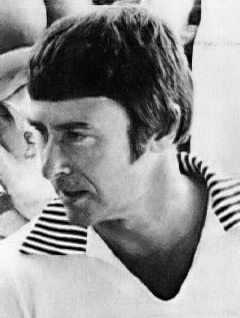
Name:
Gerard K. O'Neill
Born:
Feb 1927
Died:
Apr 1992
Birth
Location: New York, U.S.
Location: New York, U.S.
Titles:
Physicist
Space activist
Affiliation:
Unknown
Honor:
Unknown
Information
Subjects:
Others
Contributor
MDPI registered users' name will be linked to their SciProfiles pages. To register with us, please refer to https://encyclopedia.pub/register
:
View Times:
2.6K
Entry Collection:
HandWiki
Revision:
1 time
(View History)
Update Date:
30 Nov 2022
Table of Contents





Notice
You are not a member of the advisory board for this topic. If you want to update advisory board member profile, please contact office@encyclopedia.pub.
OK
Confirm
Only members of the Encyclopedia advisory board for this topic are allowed to note entries. Would you like to become an advisory board member of the Encyclopedia?
Yes
No
${ textCharacter }/${ maxCharacter }
Submit
Cancel
Back
Comments
${ item }
|
${ item.createdUser.fullName }
${ item.createdAt }
${ item.vote }
${ item.reply }
Delete
${ reply.createdUser.fullName }
${ reply.createdAt }
${ reply.vote }
Delete
There is no reply to this comment~
${ item.replyTextCharacter }/${ item.replyMaxCharacter }
Submit
Cancel
More
No more~
There is no comment~
${ textCharacter }/${ maxCharacter }
Submit
Cancel
${ selectedItem.replyTextCharacter }/${ selectedItem.replyMaxCharacter }
Submit
Cancel
Confirm
Are you sure to Delete?
Yes
No