You're using an outdated browser. Please upgrade to a modern browser for the best experience.
Submitted Successfully!
Thank you for your contribution! You can also upload a video entry or images related to this topic. For video creation, please contact our Academic Video Service.
Version Summary Created by Modification Content Size Created at Operation
1 Yousef Yari Kamrani -- 3397 2022-04-14 15:15:33 |
2 update references and layout Amina Yu -1 word(s) 3396 2022-04-15 04:55:53 |

Video Upload Options

We provide professional Academic Video Service to translate complex research into visually appealing presentations. Would you like to try it?
Cite
If you have any further questions, please contact Encyclopedia Editorial Office.
Yari Kamrani, Y.; , .; Aliniaeifard, S.; Lastochkina, O.; Moosavi-Nezhad, M.; Hajinajaf, N.; Talar, U. Regulatory Role of Circadian Clocks under Water-Deficit Conditions. Encyclopedia. Available online: https://encyclopedia.pub/entry/21775 (accessed on 16 December 2025).
Yari Kamrani Y,  , Aliniaeifard S, Lastochkina O, Moosavi-Nezhad M, Hajinajaf N, et al. Regulatory Role of Circadian Clocks under Water-Deficit Conditions. Encyclopedia. Available at: https://encyclopedia.pub/entry/21775. Accessed December 16, 2025.
Yari Kamrani, Yousef, , Sasan Aliniaeifard, Oksana Lastochkina, Moein Moosavi-Nezhad, Nima Hajinajaf, Urszula Talar. "Regulatory Role of Circadian Clocks under Water-Deficit Conditions" Encyclopedia, https://encyclopedia.pub/entry/21775 (accessed December 16, 2025).
Yari Kamrani, Y., , ., Aliniaeifard, S., Lastochkina, O., Moosavi-Nezhad, M., Hajinajaf, N., & Talar, U. (2022, April 14). Regulatory Role of Circadian Clocks under Water-Deficit Conditions. In Encyclopedia. https://encyclopedia.pub/entry/21775
Yari Kamrani, Yousef, et al. "Regulatory Role of Circadian Clocks under Water-Deficit Conditions." Encyclopedia. Web. 14 April, 2022.
Regulatory Role of Circadian Clocks under Water-Deficit Conditions
Edit

Plants undergo diurnal oscillations that are generated and maintained by an endogenous system known as the circadian clock. The circadian system is a complex, inter-connected, and reciprocally regulated network. The core oscillator consists of many coupled feedback loops in plants. Circadian rhythms are governed by a molecular clock system that synchronizes plant function with daily light and temperature cycles to maintain homeostasis, and the efficient functioning of plants depends on the proper operation of the circadian clock system. In fact, many plant processes follow a rhythmic sinusoidal pattern over the course of a 24 h period, in perfect sync with the diurnal cycle. These oscillations persist in the absence of environmental stimuli (under continuous light and constant temperature), and can be sustained for several weeks.

ABA signaling abiotic stress central oscillator circadian clock

1. Circadian Clock Plays a Central Role in Plant Fitness

The endogenous clock conferring plants a fitness advantage enables them to anticipate periodic environmental changes and adapt correspondingly, thus contributing to the physiological and developmental homeostasis of plants [1]. This happens initially through communicating an estimate of the time of day to circadian-regulated features of the cell and later to transcriptional regulation [2][3]. Previous one was contradicted that this hypothesis as they concluded that the endogenous clock may indirectly be involved in adaption as part of correlation with other adaptive traits and are unemployed for adaption in new generations compared to their ancestors [4]. Moreover, despite several documents supporting the regulatory role of the circadian clock in plants’ fitness, there are some reports challenging the evolutionary role of molecular regulation based on the circadian clock. For instance, comparative transcriptome analysis showed that clock-based regulation of transcriptomes is manifested more in unicellular organisms than in modern plants [5]. Regarding this, recent molecular studies revealed that, during the evolution, clock-regulation of transcriptome is reduced from 90% of the transcriptome in unicellular organisms such as algae [6] to 50% of the transcriptome in evolved and flexible species such as modern plants [7][8]. However, studying a variant population of Arabidopsis presenting a range of circadian rhythm periods, it was revealed that plants whose internal clock more closely matched the environmental T-cycle (light⁄dark cycle lengths) were properly adapted and produced more viable offspring in subsequent generations [1]. This discrepancy invites a more in-depth investigation of the underlying mechanisms of direct or indirect involvement of the circadian clock in plants’ fitness. Therefore, it will be presented that the involvement of the circadian clock in plants’ resilience to drought stress via triggering photoprotection, stomatal movements, drought stress, and water-use efficiency (WUE) through the involvement of ABA.

2. Circadian Clock Enhances Fitness by Controlling Photoprotection via the Xanthophyll Cycle
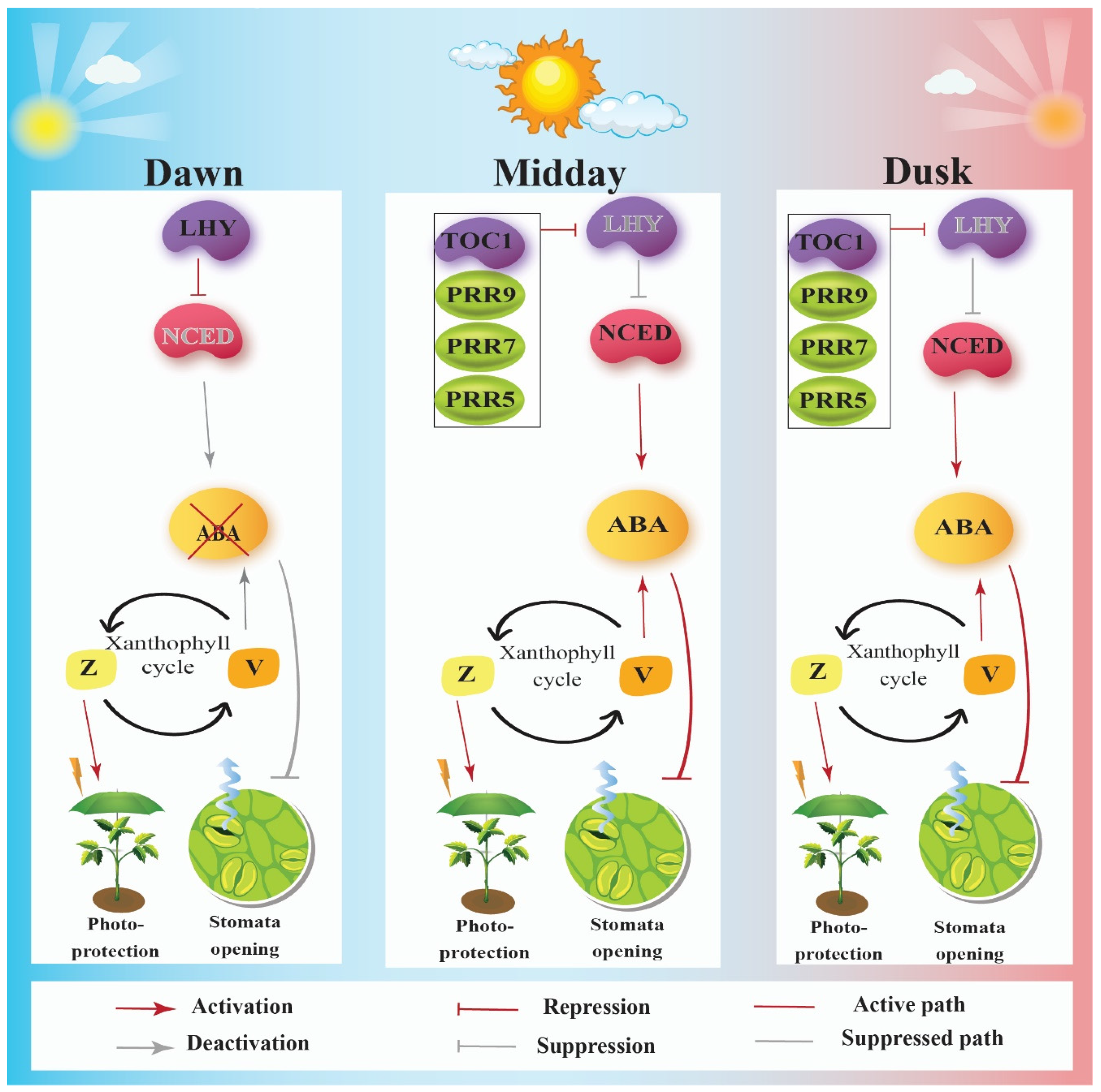
Although light exposure is vital for plant growth and development, excess photoabsorption damages the photosynthetic apparatus and frequently imposes an inhibitory effect on photosynthesis, a process known as photoinhibition [9]. Plant photosynthetic machinery under excessive light generates toxic by-products of oxygen (O2), ROS, which leads to oxidative damage to the photosynthetic apparatus of the plants [10][11]. To cope with light stress, plants have developed several photoprotective mechanisms to avoid the absorption of excess light energy, thereby reducing photodamage. Plants are able to acclimate to different environmental conditions to alleviate the detrimental effects of excess light on growth and viability [12]. Under excess light conditions, plants may acquire a balanced state of photomorphogenesis (chloroplast avoidance movements and leaf anatomical modifications) to avoid the absorption of excess light energy and reduce photodamage through a feedback mechanism. Furthermore, it has already been demonstrated that xanthophyll cycles protect plants against oxidative stress generated by exposure to high light intensity. It is demonstrated that the xanthophyll cycle shields against oxidative stress generated by high light irradiation. At the molecular level, some carotenoids take part in quenching chlorophyll triplets and prevent the formation of ROS [13]. More precisely, a low pH in the luminal side of the thylakoid membrane activates the violaxanthin de-epoxidase (VDE) that converts violaxanthin (V) into zeaxanthin (Z), which facilitates light-regulated switching of PSII from a light-harvesting state to an energy-dissipating state under excessive light. Therefore, these cycles assist photo-acclimation of plants under varying light conditions [14].
Circadian regulation of physiological traits has been documented in a large number of studies concerning both species and photosynthetic syndromes [15][16]. However, clock responses to high light stress in plants are not yet clearly understood. Yarkhunova et al. (2018) showed that the disruption of clock function via mutations leads to shifts in Fv′/Fm′ (the chlorophyll fluorescence parameter reflecting the efficiency of photosystem II (PSII) photochemistry) and non-photochemical quenching (NPQ), such that wild-type plants have both higher Fv′/Fm′ and lower total NPQ, representing more efficient photosynthetic functionality [17]. NPQ consists of responses that occur over longer periods, allowing for acclimation to high light exposure, as well as short-term responses to rapid fluctuations in light. There are three types of NPQ categorized based on the time scales of their induction and relaxation: energy-dependent feedback de-excitation quenching (qE) [10], state transition-dependent quenching (qT), and photoinhibitory quenching (qI).
A high NPQ value indicates the absorption of excessive photons and shows the efficiency of the dissipation of excessive excitation energy into harmless heat. Transcriptomic studies have revealed that some genes coding the enzymes required for state transitions (for example, STN7 protein kinase, AT1G68830, AT5G01920, and AT4G27800) are circadian-regulated [17][18], suggesting that the clock plays an important role in the synchronization of state transitions. It is worth noting here that quenching excess energy in a non-photochemical way, either by state transition (qT) or photoinhibition (qI), shows correlations with the circadian period, and neither the genes responsible for qE sites such as LHCII, CP29, and CP26 (for example, AT1G19150, AT3G53460, AT4G10340) nor the genes associated with photoinhibition (for example, AT1G77510, AT2G30950, AT3G19570) are under circadian control.
Galvez-Valdivieso et al. (2009) showed that abscisic acid (ABA) signaling is associated with extracellular ROS production and the expression of high light-responsive genes including RD20, HSP17.6B-C1, and HSP17.6C-C1 [19]. ABA content of Arabidopsis leaves increases following 15 min exposure to high light and low humidity in either attached and desiccated leaves, however, no significant differences between NPQ of the nced3 mutant with low ABA content and wild-type cells have been reported [20].
In contrast, using a new transcriptomics approach, Huang et al. (2019) highlighted three important findings: first, the ABA biosynthetic genes, including 9-cis-epoxycarotenoid dioxygenase (NCED) 3, NCED5, and NCED9, are upregulated after 0.5 h of high light exposure. Second, the ABA levels increased slightly after 0.5 h of high light, increased sharply after 6 h of high light exposure, then reached a plateau for the subsequent exposure. Third, the most important finding with respect to the discussion was indicative of severe hypersensitivity to 24 h high light exposure in ABA biosynthesis-defective double mutant nced3 nced5 [21]. The mutant plants had bleached cotyledons with larger bleached areas compared to their wild-type counterparts. In brief, these results not only suggested that ABA might be a signal for triggering response to high light [19][22] in the short term, but it may also be a signaling component in the continuous high level of ABA content during different durations of high light exposure (Figure 1). The high light-hypersensitive phenotype of nced3 nced5 double mutants is indicative of the important role of ABA in middle- and long-term high light-stress responses. However, the mechanism linking ABA accumulation to photosensitivity remains to be investigated in the future. One possible scenario could be the dissipation of light energy due to either a defect in Z or PSBS accumulation, which leads to photosensitivity; therefore, further investigation by quantifying Z content or PSBS accumulation under high light in nced3 nced5 mutant could shed light on the photoprotection mechanism.
Cells 11 01154 g002 550
Figure 1. Regulatory role of circadian clocks on the biosynthesis of abscisic acid (ABA) and regulation of photo-protection, or on the PIF4 expression for regulation of thermo-morphogenesis, during different times of the day.

3. Circadian Clock Enhances Fitness by Assisting Adaptive Stomatal Movements
Stomata are the gas exchange gates of plants. Considering the diverse roles of stomata in plant responses to environmental cues, they enable plants to cope with changing environments despite the sessile nature of plants [23]. The guard cells have the ability to integrate a wide variety of signals to regulate stomatal movements in order to establish a balance between CO2 uptake and water loss [24]. The clock endogenous oscillator regulates the sensitivity of the guard cells in response to exogenous stimuli that are reflected by stomatal movements [25]. The response of stomata to exogenous cues depends on the phase of the circadian clock at the time of stimulation. In other words, circadian-regulated processes discriminate between signaling pathways according to the time of day, which guarantees the phase-appropriate response of the guard cells to exogenous stimuli. Thereby, the clock provides a mechanism for signal processing and transduction in response to stimuli, which is known as the ‘gating’ mechanism [25]. Several experiments revealed that the gating mechanism is not only affected by the influence of the clock on the sensitivity of output pathways, but also determines the sensitivity of the feedback pathways back into the clock’s internal oscillator. For instance, the clock regulates ABA biosynthesis, and gates downstream responses [26]; in turn, ABA induces TOC1 expression 5–10 h after dawn, suggesting a role for TOC1 as both the regulator of the internal oscillator’s pace and the modulator of downstream process kinetics [27][28].
An increasing number of reports are evidencing the circadian gating of responses to various stimuli, including ABA [29], auxins [30], light [31], and pathogens [32]. The clock was also shown to play specific roles in the regulation of ABA signaling at numerous points of the network, including ABA biosynthesis, activation, transport, and metabolism [26][33][34].
This adaptive role of circadian clocks to improve growth and survival can be related to the regulation of carbon metabolism [35]. Here, it was focused on the role of the circadian clock and light/dark cycles on the ABA metabolism as the main phytohormone involved in the regulation of stomatal aperture influencing carbon metabolism through photosynthesis. Although it is indicated that vapor pressure deficit (VPD) is the driving force to induce stomata to open/close, light is considered as a signal that promotes stomatal opening, and conversely, darkness causes its closure [36].
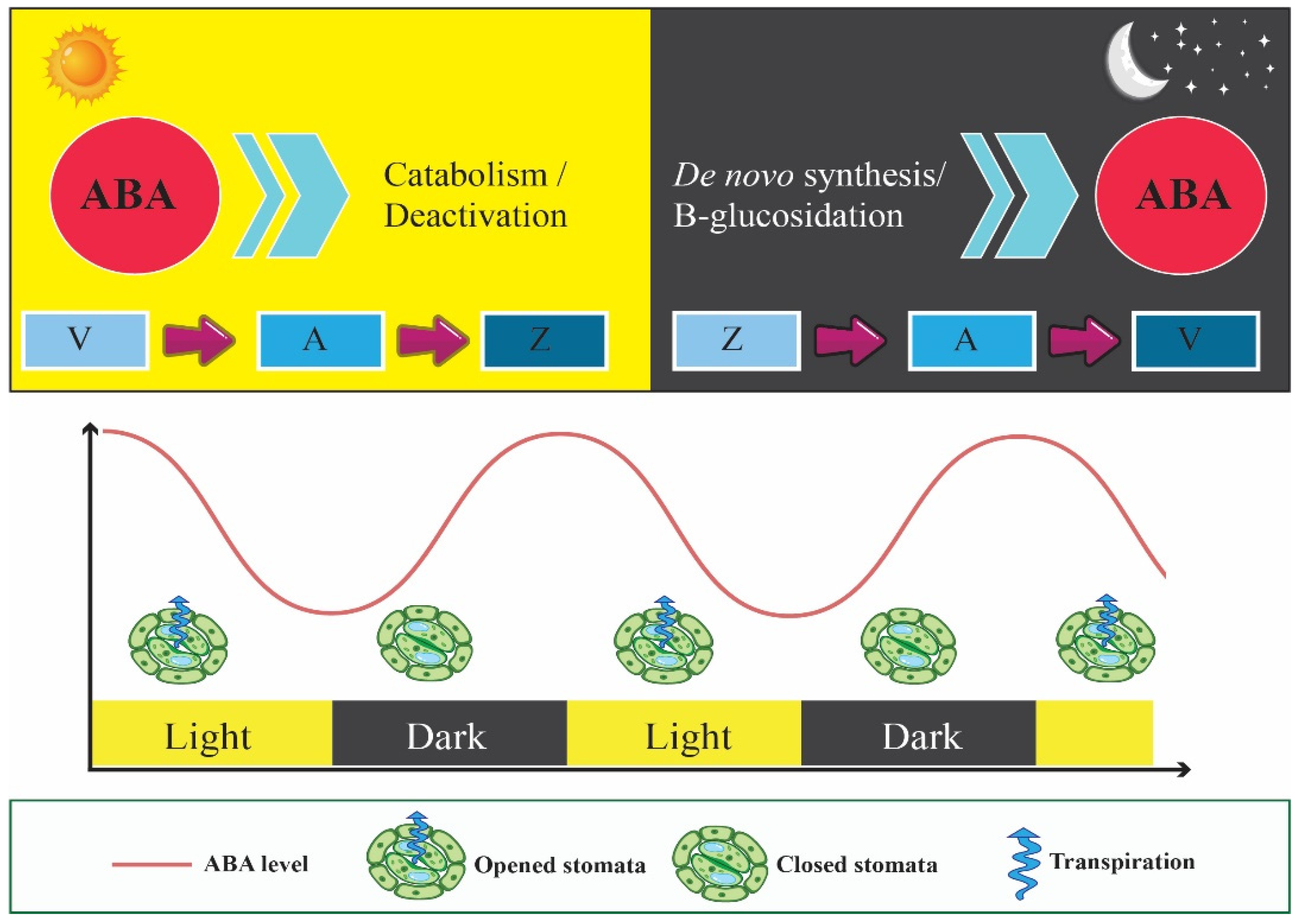
During exposure to light and under normal conditions, ABA levels decrease as the result of three mechanisms: (i) excitation of chlorophyll molecules in the photosystems and activation of the photosynthesis-triggered conversion of violaxanthin (V) to antheraxanthin (A), and then zeaxanthin (Z), in the xanthophyll cycle. Since V and other cis-epoxycarotenoids are derived as the precursor for ABA biosynthesis, the pool of ABA precursors would be restricted during the day; (ii) glucose conjugates to ABA during the light period, which results in de-activation of ABA; and (iii) activation of ABA 8′-hydroxylases, which are activated by elevated O2 and reduced CO2 levels due to mesophyll photosynthesis [37][38]. ABA 8′-hydroxylases degrade ABA to phaseic acid [39]. Consequently, ABA reaches its minimum levels during the daytime. This regulating mechanism is based on favoring phototropin-mediated activation of guard cell H+-pump leading to stomatal opening, acceleration of the photosynthesis process, and the production of carbohydrates. In the dark phase, the ABA 8′-hydroxylase activity would be restricted as the result of low O2 and high CO2 concentrations due to the cessation of photosynthesis and decreased NADPH pool, while the xanthophyll cycle is directed towards the production of V, which promotes ABA biosynthesis. Consequently, ABA levels increased during the dark period, leading to the closure of stomata (Figure 2) [38].
Cells 11 01154 g003 550
Figure 2. Circadian rhythms in ABA levels and stomatal opening/closure under non-stressful conditions. Light period promotes the conversion of violaxanthin (V) into antheraxanthin (A) and then zeaxanthin (Z) in the xanthophyll cycle, leading to ABA catabolism/deactivation and stomatal opening, while darkness favors the production of V as the ABA biosynthesis precursor, and stomatal closure.

4. Circadian Clock Enhances Fitness by Controlling WUE through Affecting Stomatal Movements

The circadian clock’s oscillator bears adaptive advantages by providing plants a cellular measure of the daytime to improve water-use efficiency (WUE) [3]. In plants, WUE is a complex trait that is derived through integrative molecular and physiological networks. The central component of this network is the stomatal movements. An increasing number of studies have demonstrated that the endogenous circadian oscillator modulates the circadian rhythm of stomatal movement [2][40][41] and modulates the responses of stomatal guard cells to environmental cues [42][43]. Calcium (Ca+) signaling is one of the primary regulators of the osmotic stress response [44][45]. The circadian regulation of stomatal movement underlies clock-regulated Ca+ signaling. Coincidence of cytosolic Ca+ pick accumulation with high stomatal responsiveness to ABA in the afternoon provides a clock-regulated framework for the stomatal movement to maximize WUE in plants [46].
The abundance of transcripts encoding CCA1, LHY, TOC1, and GI showed circadian oscillations in the guard cells [1]. Previous research demonstrated that the short-period mutant toc1-1 shortens circadian waves of stomatal conductance [47], while the long-period mutant ztl-1 prolongs the rhythms of stomatal conductance [47][48], and the constitutive overexpression of CCA1 alters the daily regulations of stomatal movement under continuous light, which increases the stomatal conductance throughout the photoperiod [31]. Accordingly, the clock endogenous oscillator within guard cells makes an important contribution to the daily regulation of stomatal opening [49].
The fact that the circadian oscillator contributes to both stomatal movement [31] and biomass accumulation [50], as well as the finding that mutations or over-expression of clock components (for example, CCA1, TOC1, ELF3, GI, GRP7, PRR9, TEJ, TIC, and ZTL) resulted in altered WUE, allows the postulation that the clock might take part in long-term WUE and consequent plant fitness [49]. The circadian clock, through the mediation of stomatal movement, may also affect the daily pattern of net exchange of CO2 [51]. Nocturnal opening of stomata may be an adaptive behavior providing high value of stomatal conductance for the time when it is accompanied with low temperature and low VPD, which maximize the potential of plants for photosynthesis. On the other hand, the diurnal closure of stomata reduces photosynthesis at the expense of preventing water loss in hot hours of the day [52]. The circadian dependence on stomatal aperture is also influenced by the response of stomatal aperture to ABA, VPD, and time of the day, showing a peak in the afternoon [29][53]. This clock-gated response to ABA was shown to be a conserved behavior that evolved through evolution [54].
Interestingly, the stomatal aperture is affected by several key genes that are involved in circadian-controlled pathways that mediate photoperiodic flowering [55][56] including FLOWERING LOCUS T (FT), GIGANTEA (GI), CO, and ELF3. FT induces stomatal opening in response to blue light. The upregulation of FT by GI and CO results in stomatal opening and its repression by ELF3 leads to stomatal closure [56][57]. The level of FT transcript shows a circadian rhythm parallel with an oscillating pattern of stomatal aperture under constant light conditions. Moreover, loss-of-function mutants of FT have shown no circadian rhythm under constant light and insensitive to blue-light activation of the H+-ATPase with reduced stomatal aperture [56]. Wide-open stomata and high H+-ATPase activity has been observed in all elf3 loss-of-function alleles and also the elf3 phot1 phot2 triple mutant under either darkness or blue-light exposure. Moreover, the level of FT mRNA was also increased in guard cells, which confirms that ELF3 is a negative regulator of stomatal aperture in response to light [58]. Accordingly, Chen et al. (2012) proposed that the associated role of ELF3 and FT with the circadian oscillator in the regulation of stomatal aperture may underlie signal conveyance from the circadian clock or its downstream and photoperiod-dependence of stomatal sensitivity to blue light [59].

5. Circadian Clock Enhances Fitness by Improving Plant Drought-Stress Responses

The circadian clock is tightly linked with abiotic-stress responses. It regulates the transcription of stress-involving genes, which facilitates adaptive responses. Additionally, metabolic and homeostasis balances are synchronized with the plant circadian clock (Sanchez et al., 2011). The interrelation between drought-stress signaling and the circadian rhythm has been depicted in different plant species [60][61]. The majority of drought-stress-responsive elements follow a rhythmic expression pattern which synchronizes the physiological response of plants with circadian regulation [61][62][63]. It was demonstrated that the transcription of a number of genes contributes to drought- and osmotic-stress responses in a diurnal pattern, including EARLY RESPONSE TO DEHYDRATION 10 (ERD10) and 7 (ERD7), COLD-REGULATED 15 B (COR15B) and A (COR15A), RESPONSE TO DESSICATION 29 A (RD29A), DEHYDRATION-RESPONSIVE ELEMENT-BINDING (DREB), and BASIC LEUCINE ZIPPER (bZIP) [61][64].
Genome-wide analysis of gene expression in Populus simonii under drought stress revealed that the abundance of LHY that is a central component of the clock is decreased under water-deficit stress [65]. Moreover, an interrelation between drought-responsive genes and the circadian clock has been proposed in soybean since several stress-responsive genes exhibited a clock-gated expression. In this plant, circadian rhythm is disturbed due to the downregulation of evening-specific components of the clock (TOC1, LUX, and ELF4 genes) [61]. Differential expression of clock genes under drought stress has been reported in soybean and the amplitude of PRR7 and TOC1 gene expressions was found to deviate from normal conditions. In addition, a drought-specific splicing pattern has been detected for PRR3, which may act cooperatively with PRR7 and TOC1 to provide energy homeostasis during drought-stress conditions [66].
During drought conditions, TOC1 binds to the promotor of ABA-related genes, ABAR/CHLH/GUN5, and regulates its clock-gated expression. Sequentially, the expression of ABAR is advanced through the induction of TOC1 by ABA. In addition, ABAR and TOC1 RNAi/overexpression lines were characterized with impairment in the induction of TOC1 by ABA, suggesting that reciprocal regulation between TOC1 and circadian expression of ABAR is crucial for ABA-dependent response to drought [27]. Besides, TOC1 is introduced as a molecular switch that links the clock with the plant drought-stress-response pathway [27]. Studying TOC1 as the main component of the clock in roots and shoots revealed that participation of the clock in drought fitness was tissue-specific, TOC1 expression in the root did not contribute to TOC1-dependent fitness responses, and TOC1-deficient lines failed to convert biomass to seed capsule [67]. Nevertheless, a TOC1-dependent manner was found in R/FR-related drought responses in Nicotiana attenuate shoots via transcriptomic analysis and screening of transgenic lines [67]. Mutation in GI, an evening component of the clock, showed hypersensitivity to drought due to defected stomatal closure and uncontrolled water loss in Arabidopsis, which is due to reduction in expression of NCED3 [68].
The obvious rhythmic expression trend with PEG treatment as well as qRT-PCR verification of PEG-induced expression of several members of the PRR gene family uncovered the involvement of GhPRR in drought-stress response in Gossypium hirsutum [69]. In Arabidopsis, expression of drought-stress-response genes including DREB1/CBF (DEHYDRATION-RESPONSIVE ELEMENT B1/C-REPEAT-BINDING FACTOR) was conferred in prr9 prr7 prr5 mutants [70]. Nakamichi et al. (2016) studied Arabidopsis transgenic lines constitutively expressing PRR5 fused to a construct of two tandem VP16 stringent transcriptional activation domains (PRR5-VP), which is a negative regulator of endogenous PRR function. Using genome-wide gene expression profiling, they revealed that in transgenic lines, genes related to water-deprivation responses and cold stress were up-regulated [42].
Plants respond to drought stress through complex networks including ABA-dependent and ABA-independent pathways [71]. A close overlap between the circadian clock-regulated transcripts and ABA has been reported [64]. This issue has attracted the attention of many scientists because ABA regulates many abiotic-stress responses, including drought, water stress, and frost [72]. Interestingly, microarray comparative transcriptome analysis revealed an extensive overlap between circadian datasets and ABA, suggesting that many of the key genes that are involved in ABA biosynthesis and signal transduction are under the control of the circadian clock [64][73].
The regulatory role of circadian clocks in drought-stress signaling was first revealed through the transcriptome analysis in Arabidopsis. This confirmed the ABA-induced TOC1 expression through a clock-gated process, which is indicative of the coincidence of ABA-dependent stress response pathway with circadian rhythm [27].
Emerging evidence has indicated the involvement of the main component of the clock-TOC1 in ABA-induced stomatal movement. Defects in ABA-dependent stomatal closure in TOC1 miss-expressing plants are another potential clue for the circadian-regulated nature of drought-induced stomatal closure [27]. It was also shown that in wild-type plants, ABA-induced TOC1 expression occurs during the day whereas, the same response is absent at night. ABA-induced TOC1 expression acts as a molecular switch that bears adaptive advantages through attuning the physiological response of plants under drought stress, in such a way that relative amounts of ABA make a balance between the mechanisms involved in preventing water loss and relieving the mechanisms at the expense of proceeding photosynthesis [27]. This results in preventing water loss during hot hours of the day under water-deficit conditions [74]. Therefore, to confirm the involvement of the circadian clock in response to drought stress, the reciprocal relation between the ABA-dependent pathway of stress response and the circadian clock is hypothesized.

References

  1. Yerushalmi, S.; Yakir, E.; Green, R.M. Circadian clocks and adaptation in Arabidopsis. Mol. Ecol. 2011, 20, 1155–1165.
  2. Chen, P.; Liu, P.; Zhang, Q.; Zhao, L.; Hao, X.; Liu, L.; Bu, C.; Pan, Y.; Zhang, D.; Song, Y. Dynamic physiological and transcriptome changes reveal a potential relationship between the circadian clock and salt stress response in Ulmus pumila. Mol. Genet. Genom. 2022, 297, 303–317.
  3. Harmer, S.L.; Hogenesch, J.B.; Straume, M.; Chang, H.-S.; Han, B.; Zhu, T.; Wang, X.; Kreps, J.A.; Kay, S.A. Orchestrated Transcription of Key Pathways in Arabidopsis by the Circadian Clock. Science 2000, 290, 2110–2113.
  4. Gendron, J.M.; Pruneda-Paz, J.L.; Doherty, C.J.; Gross, A.M.; Kang, S.E.; Kay, S.A. Arabidopsis circadian clock protein, TOC1, is a DNA-binding transcription factor. Proc. Natl. Acad. Sci. USA 2012, 109, 3167–3172.
  5. Ferrari, C.; Proost, S.; Janowski, M.; Becker, J.; Nikoloski, Z.; Bhattacharya, D.; Price, D.; Tohge, T.; Bar-Even, A.; Fernie, A.; et al. Kingdom-wide comparison reveals the evolution of diurnal gene expression in Archaeplastida. Nat. Commun. 2019, 10, 737.
  6. Monnier, A.; Liverani, S.; Bouvet, R.; Jesson, B.; Smith, J.Q.; Mosser, J.; Corellou, F.; Bouget, F.Y. Orchestrated transcription of biological processes in the marine picoeukaryote Ostreococcus exposed to light/dark cycles. BMC Genom. 2010, 11, 192.
  7. Michael, T.P.; Mockler, T.C.; Breton, G.; McEntee, C.; Byer, A.; Trout, J.D.; Hazen, S.P.; Shen, R.; Priest, H.D.; Sullivan, C.M.; et al. Network discovery pipeline elucidates conserved time-of-day-specific cis-regulatory modules. PLoS Genet. 2008, 4, e14.
  8. Serrano-Bueno, G.; Romero-Campero, F.J.; Lucas-Reina, E.; Romero, J.M.; Valverde, F. Evolution of photoperiod sensing in plants and algae. Curr. Opin. Plant Biol. 2017, 37, 10–17.
  9. Huner, N.P.A.; Oquist, G.; Hurry, V.M.; Krol, M.; Falk, S.; Griffith, M. Photosynthesis, photoinhibition and low temperature acclimation in cold tolerant plants. Photosynth. Res. 1993, 37, 19–39.
  10. Müller, P.; Li, X.P.; Niyogi, K.K. Non-photochemical quenching. A response to excess light energy. Plant Physiol. 2001, 125, 1558–1566.
  11. Niyogi, K.K. Photoprotection revisited: Genetic and molecular approaches. Annu. Rev. Plant Biol. 1999, 50, 333–359.
  12. Walters, R.G. Towards an understanding of photosynthetic acclimation. J. Exp. Bot. 2005, 56, 435–447.
  13. Davison, P.A.; Hunter, C.N.; Horton, P. Overexpression of β-carotene hydroxylase enhances stress tolerance in Arabidopsis. Nature 2002, 418, 203–206.
  14. Hager, A.; Holocher, K. Localization of the xanthophyll-cycle enzyme violaxanthin de-epoxidase within the thylakoid lumen and abolition of its mobility by a (light-dependent) pH decrease. Planta 1994, 192, 581–589.
  15. Faure, S.; Turner, A.S.; Gruszka, D.; Christodoulou, V.; Davis, S.J.; Von Korff, M.; Laurie, D.A. Mutation at the circadian clock gene EARLY MATURITY 8 adapts domesticated barley (Hordeum vulgare) to short growing seasons. Proc. Natl. Acad. Sci. USA 2012, 109, 8328–8333.
  16. McClung, C.R. Beyond Arabidopsis: The circadian clock in non-model plant species. Semin. Cell Dev. Biol. 2013, 24, 430–436.
  17. Yarkhunova, Y.; Guadagno, C.R.; Rubin, M.J.; Davis, S.J.; Ewers, B.E.; Weinig, C. Circadian rhythms are associated with variation in photosystem II function and photoprotective mechanisms. Plant Cell Environ. 2018, 41, 2518–2529.
  18. Litthauer, S.; Battle, M.W.; Lawson, T.; Jones, M.A. Phototropins maintain robust circadian oscillation of PSII operating efficiency under blue light. Plant J. 2015, 83, 1034–1045.
  19. Galvez-Valdivieso, G.; Fryer, M.J.; Lawson, T.; Slattery, K.; Truman, W.; Smirnoff, N.; Asami, T.; Davies, W.J.; Jones, A.M.; Baker, N.R.; et al. The high light response in arabidopsis involves ABA signaling between vascular and bundle sheath cells W. Plant Cell 2009, 21, 2143–2162.
  20. Teng, K.; Li, J.; Liu, L.; Han, Y.; Du, Y.; Zhang, J.; Sun, H.; Zhao, Q. Exogenous ABA induces drought tolerance in upland rice: The role of chloroplast and ABA biosynthesis-related gene expression on photosystem II during PEG stress. Acta Physiol. Plant. 2014, 36, 2219–2227.
  21. Huang, J.; Zhao, X.; Chory, J. The Arabidopsis Transcriptome Responds Specifically and Dynamically to High Light Stress. Cell Rep. 2019, 29, 4186–4199.e3.
  22. Suzuki, N.; Miller, G.; Salazar, C.; Mondal, H.A.; Shulaev, E.; Cortes, D.F.; Shuman, J.L.; Luo, X.; Shah, J.; Schlauch, K.; et al. Temporal-spatial interaction between reactive oxygen species and abscisic acid regulates rapid systemic acclimation in plants. Plant Cell 2013, 25, 3553–3569.
  23. van Meeteren, U.; Aliniaeifard, S. Stomata and postharvest physiology. Postharvest Ripening Physiol. Crop. 2016, 1, 157–216.
  24. Hetherington, A.M.; Woodward, F.I. The role of stomata in sensing and driving environmental change. Nature 2003, 424, 901–908.
  25. Hubbard, K.E.; Webb, A.A.R. Circadian Rhythms in Stomata: Physiological and Molecular Aspects. In Rhythms in Plants; Springer International Publishing: Cham, Switzerland, 2015; pp. 231–255. ISBN 9783319205175.
  26. Adams, S.; Grundy, J.; Veflingstad, S.R.; Dyer, N.P.; Hannah, M.A.; Ott, S.; Carré, I.A. Circadian control of abscisic acid biosynthesis and signalling pathways revealed by genome-wide analysis of LHY binding targets. New Phytol. 2018, 220, 893–907.
  27. Legnaioli, T.; Cuevas, J.; Mas, P. TOC1 functions as a molecular switch connecting the circadian clock with plant responses to drought. EMBO J. 2009, 28, 3745–3757.
  28. Pokhilko, A.; Mas, P.; Millar, A.J. Modelling the widespread effects of TOC1 signalling on the plant circadian clock and its outputs. BMC Syst. Biol. 2013, 7, 23.
  29. Correia, M.J.; Pereira, J.S.; Chaves, M.M.; Rodrigues, M.L.; Pacheco, C.A. ABA xylem concentrations determine maximum daily leaf conductance of field-grown Vitis vinifera L. plants. Plant Cell Environ. 1995, 18, 511–521.
  30. Snaith, P.J.; Mansfield, T.A. The circadian rhythm of stomatal opening: Evidence for the involvement of potassium and chloride fluxes. J. Exp. Bot. 1986, 37, 188–199.
  31. Dodd, A.N.; Salathia, N.; Hall, A.; Kévei, E.; Tóth, R.; Nagy, F.; Hibberd, J.M.; Millar, A.J.; Webb, A.A.R. Plant circadian clocks increase photosynthesis, growth, survival, and competitive advantage. Science 2005, 309, 630–633.
  32. Zhang, C.; Xie, Q.; Anderson, R.G.; Ng, G.; Seitz, N.C.; Peterson, T.; McClung, C.R.; McDowell, J.M.; Kong, D.; Kwak, J.M.; et al. Crosstalk between the Circadian Clock and Innate Immunity in Arabidopsis. PLoS Pathog. 2013, 9, e1003370.
  33. Yang, M.; Han, X.; Yang, J.; Jiang, Y.; Hu, Y. The Arabidopsis circadian clock protein PRR5 interacts with and stimulates ABI5 to modulate abscisic acid signaling during seed germination. Plant Cell 2021, 33, 3022–3041.
  34. Lee, H.G.; Mas, P.; Seo, P.J. MYB96 shapes the circadian gating of ABA signaling in Arabidopsis. Sci. Rep. 2016, 6, 17754.
  35. Webb, A.A.R.; Satake, A. Understanding Circadian Regulation of Carbohydrate Metabolism in Arabidopsis Using Mathematical Models. Plant Cell Physiol. 2015, 56, 586–593.
  36. Göring, H.; Koshuchowa, S.; Deckert, C. Influence of Gibberellic Acid on Stomatal Movement. Biochem. Physiol. Pflanz. 1990, 186, 367–374.
  37. Aliniaeifard, S.; van Meeteren, U. Can prolonged exposure to low VPD disturb the ABA signalling in stomatal guard cells? J. Exp. Bot. 2013, 64, 3551–3566.
  38. Tallman, G. Are diurnal patterns of stomatal movement the result of alternating metabolism of endogenous guard cell ABA and accumulation of ABA delivered to the apoplast around guard cells by transpiration? J. Exp. Bot. 2004, 55, 1963–1976.
  39. Kushiro, T.; Okamoto, M.; Nakabayashi, K.; Yamagishi, K.; Kitamura, S.; Asami, T.; Hirai, N.; Koshiba, T.; Kamiya, Y.; Nambara, E. The Arabidopsis cytochrome P450 CYP707A encodes ABA 8′-hydroxylases: Key enzymes in ABA catabolism. EMBO J. 2004, 23, 1647–1656.
  40. Hassidim, M.; Dakhiya, Y.; Turjeman, A.; Hussien, D.; Shor, E.; Anidjar, A.; Goldberg, K.; Green, R.M. CIRCADIAN CLOCK ASSOCIATED1 (CCA1) and the Circadian Control of Stomatal Aperture. Plant Physiol. 2017, 175, 1864–1877.
  41. Chowdhury, F.I.; Arteaga, C.; Alam, M.S.; Alam, I.; Resco de Dios, V. Drivers of nocturnal stomatal conductance in C3 and C4 plants. Sci. Total Environ. 2022, 814, 151952.
  42. Nakamichi, N.; Takao, S.; Kudo, T.; Kiba, T.; Wang, Y.; Kinoshita, T.; Sakakibara, H. Improvement of Arabidopsis Biomass and Cold, Drought and Salinity Stress Tolerance by Modified Circadian Clock-Associated PSEUDO-RESPONSE REGULATORs. Plant Cell Physiol. 2016, 57, 1085–1097.
  43. Panchal, S.; Melotto, M. Stomate-based defense and environmental cues. Plant Signal. Behav. 2017, 12, e1362517.
  44. Shomali, A.; Aliniaeifard, S. Overview of Signal Transduction in Plants under Salt and Drought Stresses. In Salt and Drought Stress Tolerance in Plants; Springer: Berlin/Heidelberg, Germany, 2020; pp. 231–258.
  45. Aliniaeifard, S.; Shomali, A.; Seifikalhor, M.; Lastochkina, O. Calcium Signaling in Plants under Drought. In Salt and Drought Stress Tolerance in Plants; Springer: Berlin/Heidelberg, Germany, 2020; pp. 259–298.
  46. Zhang, S.; Wu, Q.R.; Liu, L.L.; Zhang, H.M.; Gao, J.W.; Pei, Z.M. Osmotic stress alters circadian cytosolic Ca2+ oscillations and OSCA1 is required in circadian gated stress adaptation. Plant Signal. Behav. 2020, 15, 1836883.
  47. Somers, D.E.; Webb, A.A.R.; Pearson, M.; Kay, S.A. The short-period mutant, toc1-1, alters circadian clock regulation of multiple outputs throughout development in Arabidopsis thaliana. Development 1998, 125, 485–494.
  48. Dodd, A.N.; Parkinson, K.; Webb, A.A.R. Independent circadian regulation of assimilation and stomatal conductance in the ztl-1 mutant of Arabidopsis. New Phytol. 2004, 162, 63–70.
  49. Simon, N.M.L.; Graham, C.A.; Comben, N.E.; Hetherington, A.M.; Dodd, A.N. The circadian clock influences the long-term water use efficiency of Arabidopsis. Plant Physiol. 2020, 183, 317–330.
  50. Graf, A.; Schlereth, A.; Stitt, M.; Smith, A.M. Circadian control of carbohydrate availability for growth in Arabidopsis plants at night. Proc. Natl. Acad. Sci. USA 2010, 107, 9458–9463.
  51. Resco de Dios, V.; Gessler, A.; Ferrio, J.P.; Alday, J.G.; Bahn, M.; del Castillo, J.; Devidal, S.; García-Muñoz, S.; Kayler, Z.; Landais, D.; et al. Circadian rhythms have significant effects on leaf-to-canopy scale gas exchange under field conditions. Gigascience 2016, 5, 43.
  52. Chaves, M.M.; Costa, J.M.; Zarrouk, O.; Pinheiro, C.; Lopes, C.M.; Pereira, J.S. Controlling stomatal aperture in semi-arid regions—The dilemma of saving water or being cool? Plant Sci. 2016, 251, 54–64.
  53. Resco de Dios, V. Circadian regulation and diurnal variation in gas exchange. Plant Physiol. 2017, 175, 3–4.
  54. Hauser, F.; Waadt, R.; Schroeder, J.I. Evolution of Abscisic Acid Synthesis and Signaling Mechanisms. Curr. Biol. 2011, 21, R346–R355.
  55. Kimura, Y.; Aoki, S.; Ando, E.; Kitatsuji, A.; Watanabe, A.; Ohnishi, M.; Takahashi, K.; Inoue, S.; Nakamichi, N.; Tamada, Y.; et al. A flowering integrator, SOC1, affects stomatal opening in Arabidopsis thaliana. Plant Cell Physiol. 2015, 56, 640–649.
  56. Kinoshita, T.; Ono, N.; Hayashi, Y.; Morimoto, S.; Nakamura, S.; Soda, M.; Kato, Y.; Ohnishi, M.; Nakano, T.; Inoue, S.; et al. FLOWERING LOCUS T Regulates Stomatal Opening. Curr. Biol. 2011, 21, 1232–1238.
  57. Ando, E.; Ohnishi, M.; Wang, Y.; Matsushita, T.; Watanabe, A.; Hayashi, Y.; Fujii, M.; Ma, J.F.; Inoue, S.; Kinoshita, T. TWIN SISTER OF FT, GIGANTEA, and CONSTANS Have a Positive But Indirect Effect on Blue Light-Induced Stomatal Opening in Arabidopsis. Plant Physiol. 2013, 162, 1529–1538.
  58. Liu, X.L. ELF3 Encodes a Circadian Clock-Regulated Nuclear Protein That Functions in an Arabidopsis PHYB Signal Transduction Pathway. Plant Cell 2001, 13, 1293–1304.
  59. Chen, C.; Xiao, Y.-G.; Li, X.; Ni, M. Light-Regulated Stomatal Aperture in Arabidopsis. Mol. Plant 2012, 5, 566–572.
  60. Kie bowicz-Matuk, A.; Rey, P.; Rorat, T. Interplay between circadian rhythm, time of the day and osmotic stress constraints in the regulation of the expression of a Solanum Double B-box gene. Ann. Bot. 2014, 113, 831–842.
  61. Marcolino-Gomes, J.; Rodrigues, F.A.; Fuganti-Pagliarini, R.; Bendix, C.; Nakayama, T.J.; Celaya, B.; Molinari, H.B.C.; de Oliveira, M.C.N.; Harmon, F.G.; Nepomuceno, A. Diurnal oscillations of soybean circadian clock and drought responsive genes. PLoS ONE 2014, 9, e86402.
  62. Wilkins, O.; Bräutigam, K.; Campbell, M.M. Time of day shapes Arabidopsis drought transcriptomes. Plant J. 2010, 63, 715–727.
  63. Li, J.; Liu, Y.-H.; Zhang, Y.; Chen, C.; Yu, X.; Yu, S.-W. Drought stress modulates diurnal oscillations of circadian clock and drought-responsive genes in Oryza sativa L. Yi Chuan = Hereditas 2017, 39, 837–846.
  64. Mizuno, T.; Yamashino, T. Comparative transcriptome of diurnally oscillating genes and hormone-responsive genes in Arabidopsis thaliana: Insight into circadian clock-controlled daily responses to common ambient stresses in plants. Plant Cell Physiol. 2008, 49, 481–487.
  65. Chen, J.; Song, Y.; Zhang, H.; Zhang, D. Genome-Wide Analysis of Gene Expression in Response to Drought Stress in Populus simonii. Plant Mol. Biol. Rep. 2013, 31, 946–962.
  66. Syed, N.H.; Prince, S.J.; Mutava, R.N.; Patil, G.; Li, S.; Chen, W.; Babu, V.; Joshi, T.; Khan, S.; Nguyen, H.T. Core clock, SUB1, and ABAR genes mediate flooding and drought responses via alternative splicing in soybean. J. Exp. Bot. 2015, 66, 7129–7149.
  67. Valim, H.F.; McGale, E.; Yon, F.; Halitschke, R.; Fragoso, V.; Schuman, M.C.; Baldwin, I.T. The Clock Gene TOC1 in Shoots, Not Roots, Determines Fitness of Nicotiana attenuata under Drought. Plant Physiol. 2019, 181, 305–318.
  68. Baek, D.; Kim, W.-Y.; Cha, J.-Y.; Park, H.J.; Shin, G.; Park, J.; Lim, C.J.; Chun, H.J.; Li, N.; Kim, D.H.; et al. The GIGANTEA-ENHANCED EM LEVEL Complex Enhances Drought Tolerance via Regulation of Abscisic Acid Synthesis. Plant Physiol. 2020, 184, 443–458.
  69. Wang, J.; Du, Z.; Huo, X.; Zhou, J.; Chen, Y.; Zhang, J.; Pan, A.; Wang, X.; Wang, F.; Zhang, J. Genome-wide analysis of PRR gene family uncovers their roles in circadian rhythmic changes and response to drought stress in Gossypium hirsutum L. PeerJ 2020, 8, e9936.
  70. Nakamichi, N.; Kudo, T.; Makita, N.; Kiba, T.; Kinoshita, T.; Sakakibara, H. Flowering time control in rice by introducing Arabidopsis clock-associated PSEUDO-RESPONSE REGULATOR 5. Biosci. Biotechnol. Biochem. 2020, 84, 970–979.
  71. Shinozaki, K.; Yamaguchi-Shinozaki, K. Gene networks involved in drought stress response and tolerance. J. Exp. Bot. 2007, 58, 221–227.
  72. Sanchez, A.; Shin, J.; Davis, S.J. Abiotic stress and the plant circadian clock. Plant Signal. Behav. 2011, 6, 223–231.
  73. Matsui, A.; Ishida, J.; Morosawa, T.; Mochizuki, Y.; Kaminuma, E.; Endo, T.A.; Okamoto, M.; Nambara, E.; Nakajima, M.; Kawashima, M.; et al. Arabidopsis transcriptome analysis under drought, cold, high-salinity and ABA treatment conditions using a tiling array. Plant Cell Physiol. 2008, 49, 1135–1149.
  74. Robertson, F.C.; Skeffington, A.W.; Gardner, M.J.; Webb, A.A.R. Interactions between circadian and hormonal signalling in plants. Plant Mol. Biol. 2009, 69, 419–427.

More
Upload a video for this entry
Information
Subjects: Plant Sciences
Contributors MDPI registered users' name will be linked to their SciProfiles pages. To register with us, please refer to https://encyclopedia.pub/register : Yousef Yari Kamrani , , Sasan Aliniaeifard , Oksana Lastochkina , Moein Moosavi-Nezhad , Nima Hajinajaf , Urszula Talar
View Times: 1.1K
Revisions: 2 times (View History)
Update Date: 15 Apr 2022
Notice
You are not a member of the advisory board for this topic. If you want to update advisory board member profile, please contact office@encyclopedia.pub.
OK
Confirm
Only members of the Encyclopedia advisory board for this topic are allowed to note entries. Would you like to become an advisory board member of the Encyclopedia?
Yes
No
${ textCharacter }/${ maxCharacter }
Submit
Cancel
There is no comment~
${ textCharacter }/${ maxCharacter }
Submit
Cancel
${ selectedItem.replyTextCharacter }/${ selectedItem.replyMaxCharacter }
Submit
Cancel
Confirm
Are you sure to Delete?
Yes No
Academic Video Service