Your browser does not fully support modern features. Please upgrade for a smoother experience.
Submitted Successfully!
Thank you for your contribution! You can also upload a video entry or images related to this topic. For video creation, please contact our Academic Video Service.
Version Summary Created by Modification Content Size Created at Operation
1 Juan Carlos Roa + 3644 word(s) 3644 2021-09-26 04:14:07 |
2 format correct Conner Chen Meta information modification 3644 2022-01-20 03:38:04 |

Video Upload Options

We provide professional Academic Video Service to translate complex research into visually appealing presentations. Would you like to try it?
Cite
If you have any further questions, please contact Encyclopedia Editorial Office.
Roa, J.C. LncRNAs in Gallbladder Cancer. Encyclopedia. Available online: https://encyclopedia.pub/entry/18523 (accessed on 15 January 2026).
Roa JC. LncRNAs in Gallbladder Cancer. Encyclopedia. Available at: https://encyclopedia.pub/entry/18523. Accessed January 15, 2026.
Roa, Juan Carlos. "LncRNAs in Gallbladder Cancer" Encyclopedia, https://encyclopedia.pub/entry/18523 (accessed January 15, 2026).
Roa, J.C. (2022, January 19). LncRNAs in Gallbladder Cancer. In Encyclopedia. https://encyclopedia.pub/entry/18523
Roa, Juan Carlos. "LncRNAs in Gallbladder Cancer." Encyclopedia. Web. 19 January, 2022.
LncRNAs in Gallbladder Cancer
Edit

Gallbladder cancer has a mortality of 85,000 deaths worldwide and an incidence rate of 0.9 cases per 100,000 individuals. The incidence of GBC varies among the different geographical areas of the world, showing a higher incidence among descendants of North and South American natives, and in several Asian countries. The highest GBC incidence rate is found in Chile between individuals who descend from the Mapuche people, with 12.3 cases per 100,000 in men and 27.3 cases per 100,000 in women.
Unfortunately, as symptomatology is unspecific and routine biochemical assays are not accurate, GBC is usually diagnosed late, sometimes as an accidental finding in patients with cholelithiasis. Due to this late diagnosis, GBC is generally found in an advanced stage, which causes that these patients have a poor prognosis and short life expectancy. For instance, the 5-year survival rate of GBC in advanced stages (T3 and T4 stages) is less than 5%, while if this cancer were detected in the initial stages (T1 stage) there would be an increase up to 75% in this 5-year survival rate.
The research about lncRNAs and their participation in the acquisition of a malignant tumor phenotype has evidenced a dramatic increase because a large number of them have been demonstrated to actively participate in several mechanisms that contribute to the progression of cancer. Regarding this, the development of metastatic and tumorigenic characteristics is closely related to a more aggressive phenotype in cancer because these features provide cancer cells the capacity of expanding to other tissues and form new tumors, indicating a worse prognosis in cancer patients.

long non-coding RNAs lncRNA prognosis gallbladder cancer

1. Upregulated lncRNAs in GBC

Since the discovery of the first lncRNA in 1990 [1], many other lncRNAs have been described to date, using the latest technologies in molecular biology and due to large databases that have been able to provide a large amount of information on their molecular characteristics and biological functions in cancer [2]. Regarding the GBC, AFAP1-AS1, is a lncRNA that is overexpressed in GBC tissues and its expression levels are significantly associated with tumor size. The long-rank Kaplan—Meier analysis suggests that higher expression of AFAP1-AS1 is a poor prognosis factor in these patients. Functionally, the knockdown of AFAP1-AS1 may inhibit proliferation and invasion, and decrease Twist1 and Vimentin expression in GBC cell lines, indicating that AFAP1-AS1 may participate in cancer progression [3]. Similarly, ANRIL has been found upregulated in GBC tissues compared to adjacent normal tissues and has been also shown to increase proliferation and tumor size in a murine model, which is consistent with the correlation of its expression with overall survival in these patients [4].
CCAT1 has been described in different cancers, including gastric and colorectal cancer [5]. This lncRNA has been shown to be upregulated in GBC tissues compared with adjacent normal tissues. Furthermore, CCAT1 is more highly expressed in tumors in advanced stages than (T3 + T4) early stages (T1 + T2), and more highly expressed in tumors spread to lymph nodes (N1/2) compared with tumors localized only in the gallbladder (N0). CCAT1 expression is significantly correlated with tumor status, lymph node invasion and advanced tumor node metastasis (TNM) stage, suggesting that CCAT1 expression is related to poor prognosis in GBC. In addition, in vitro experiments show that the knockdown of CCAT1 decreases S-phase, invasion and tumor growth in vivo. Mechanistically, the authors propose that CCAT1 increases the expression of Bmi1 through competitively sponging miRNA-218-5p [6].
Along with this, current evidence has shown that those tumor tissues with a higher expression of cancer stem cell (CSCs) markers are prone to developing a greater tumorigenic and metastatic capacity and are directly associated with a worse life expectancy of patients [7][8][9][10][11]. Only one overexpressed lncRNA has been described in GBC patient tissues that promote the expression of markers associated with the stem-like cell population. DILC is overexpressed in gallbladder CSCs and GBC tissues and its knockdown decreased stem-like CD44+/CD133+ cell population and diminished sphere-forming capacity in GBC cells. Consistently, the expression of stemness-associated transcription factors and CSC markers (ABCG2, MDR-1, Oct4 and CD34) were also inhibited by DILC knockdown in GBC spheroids. Moreover, DILC knockdown decreased proliferation, migration and invasion in vitro, as well as tumor growth and CSC number in NOD/SCID xenograft model. In addition, the knockdown of DILC reduced metastasis capacity in vivo by activating Wnt/β-catenin pathway. This suggests that DILC promotes stem-like properties in GBC and can subsequently induce a pro-metastatic and pro-tumorigenic phenotype in this neoplasm [12].
Another lncRNA implicated in the development of aggressive features in cancer is DGCR5 [13][14][15][16][17]. This lncRNA is upregulated in GBC tissues and cell lines and has been associated with proliferation migration, invasion, colony formation, and tumor growth in vivo in GBC. Mechanistically, when DGCR5 is upregulated, a lower expression of ZO-1 and E-cadherin can be induced, whereas the expression levels of N-cadherin, vimentin, MMP-2, and MMP-9 are upregulated. Moreover, the MEK/ERK1/2 and JNK/p38 MAPK pathways may also be involved in the function performed by DGCR5 to induce invasion and EMT processes [18].
FOXD2-AS1 is another lncRNA that has been shown to induce proliferation, tumor growth, migration and invasion due to its effect on recruiting DNMT1, a methyltransferase that subsequently produces promoter methylation in the MLH1 gene, and consequently the inhibition of MLH1 transcription [19]. A study by Cai et al. identified around 457 overexpressed and 266 downregulated lncRNAs in doxorubicin (DOX)-resistant GBC cells. Among the overexpressed lncRNAs, GBCDRlnc1 seemed to be interesting because it was also found highly expressed in GBC tissues compared to adjacent noncancerous tissues. Kaplan—Meier analysis demonstrated that patients with GBCDRlnc1 overexpression have a significantly shorter overall survival than those with lower expression of this lncRNA, which was also correlated with histological grade and TNM stage [20]. In DOX-resistant GBC cell lines, the GBCDRlnc1 overexpression showed to be involved in an increased autophagy activity within the cells by enhancing the conversion from LC3-I into LC3-II and by inhibiting the ubiquitination of phosphoglycerate kinase 1 (PGK1). High GBCDRlnc1 levels were found in DOX-resistant GBC cells inducing a significantly greater resistance to doxorubicin, gemcitabine, and 5-fluorouracil in these cells. Therefore, this study suggests that chemoresistance observed in GBC cells may be related to the increased autophagic activity induced by GBCDRlnc1 [20].
Another lncRNA is HOTAIR, which has been shown to be overexpressed in different cancers and to promote malignant tumor characteristics [21]. HOTAIR is overexpressed in gallbladder cancer tissues compared with adjacent non-tumoral tissues, indicating that HOTAIR is frequently upregulated on GBC. In addition, HOTAIR is more expressed in gallbladder tumors (T3 + T4) compared with tumors (T1 + T2). HOTAIR expression is more expressed in tumors spread to regional lymph nodes (N1) compared to primary tumors, suggesting that HOTAIR expression may be a progression and prognosis marker in GBC patients. Functionally, HOTAIR promotes proliferation and migration in GBC cell lines, correlating positively with the expression of c-Myc and negatively with miRNA-130a, which suggests that this mechanism may participate in cancer progression in GBC patients [21].
H19 is a lncRNA that has been expressed in different cancers in which it has been shown to participate in the acquisition of different oncogenic characteristics [22]. In GBC, H19 expression has been shown to be overexpressed in tumor tissue than in adjacent non-tumor tissue. Its expression is correlated with tumor size, lymphatic metastasis, and a worse prognosis in patients with GBC. Furthermore, H19 knockdown has been shown to decrease proliferation, tumorigenesis, migration, invasion, and EMT, by reducing Twist expression. Mechanistically, it was observed that overexpression of H19 in GBC cells downregulated miR-194-5p and markedly increased AKT2 expression, as well as enhanced the expression of miR-342-3p targeting FOXM1 through competitively sponging miR-342-3p, which suggests that the oncogenic function of H19 will be through both H19/miR-194-5p/AKT2 and H19/miR-342-3p/FOXM1 axes [23][24][25].
LINC01694 levels were also found remarkably elevated in GBC tissues, cell lines, and sera of patients with GBC. Patients with high LINC01694 values were more likely to develop stage III + IV and poorly differentiated GBC. Moreover, patients with higher LINC01694 levels had shorter total survival rates, being this transcript subsequently considered an independent factor in the prognosis of GBC patients. In vitro experiments evidenced that the LINC01694 knockdown effectively decreased proliferation and invasion compared to controls. In vivo analyses showed that the overexpression of LINC01694 significantly increased tumor growth in nude mice. Mechanistically, the higher expression of LINC01694 induced a reduction of miR-340-5p expression and, in consequence, a higher expression of SOX4. This result was confirmed in GBC tissues, which showed a positive correlation between LINC01694 y SOX4 expression but an inverse correlation with miR-340-5p expression. These data suggest that the aggressiveness induced by LINC01694 is via the LINC01694/miR-340-5p/SOX4 axis [26]. In a similar way, Loc344887 was found overexpressed in GBC tissues and cell lines compared to controls, and higher levels of Loc344887 were associated with larger tumor size. The Loc344887 knockdown was able to reduce the proliferative, migratory, and invasive features of GBC cells by decreasing the levels of Vimentin, N-Cadherin and Twist, and increasing the levels of E-cadherin, which suggests that Loc344887 promotes EMT and tumor progression in GBC [27].
LINC00152 has been widely described as an inductor of a tumorigenic phenotype in cells of several cancer types [28][29]. LINC00152 levels were found significantly higher in GBC tissues and in four human GBC cell lines compared to controls. The high LINC00152 levels were significantly associated with increased Ki-67-positive staining, a cell proliferation marker in tumors. In addition, the expression of LINC00152 was significantly higher in T3 + T4 compared to T1 + T2 tumors. Overexpression of LINC00152 significantly enhanced cell proliferation and the number of cancer cells in the S-phase in in vitro assays. This feature was confirmed in animal models where the high LINC00152 levels produced a greater tumor growth rate. Regarding the metastatic phenotype, LINC00152 expression levels were higher in metastatic lymph nodes than in primary tumors correlating positively with tumor status progression, lymph node invasion, TNM stage advancement and overall survival [30][31]. Moreover, the ectopic expression of LINC0052 promoted higher migration and invasion in vitro, as well as an increment in the number of peritoneal metastatic nodes in a murine model, accompanied by increased levels of Vimentin protein and decreased levels of E-cadherin protein. Mechanistically, LINC00152 can activate the PI3K pathway in GBC cells and can also act as a molecular sponge for miR-138, which directly suppresses the expression of hypoxia-inducible factor-1a (HIF-1a), suggesting that both the LINC00152/miR-138/HIF-1a axis and the activation of PI3K pathway by LINC00152 might be inducing GBC progression [30][31].
MALAT1 is one of the most studied lncRNAs in cancer [32][33][34] and has several oncogenic functions as modulates multiple signaling pathways involved in the enhancement of cell proliferation, metastasis, and invasion that commonly results in poor prognosis in cancer patients [35][36][37][38][39][40][41]. MALAT1 was found overexpressed in GBC tissue samples versus controls and its upregulation correlated positively with tumor size and lymph node metastasis, while also correlating negatively with overall survival [33][42][43][44][45]. The tumorigenic features developed by MALAT1 expression were evidenced by lower proliferation rate, lower colony formation and decreased tumor growth in in vivo models once GBC cells were treated with siRNAs against MALAT1 (siMALAT1) [33]. The metastatic features produced by MALAT1 are demonstrated in the fact that siMALAT1 significantly reduced the migration and invasion in GBC cell lines and produced a diminished expression of matrix metalloproteinase 9 (MMP-9), an enzyme involved in invasion by digesting the extracellular matrix. The confirmation of these results was performed in mice injected with siMALAT1 NOZ cells, which exhibited few metastatic peritoneal nodules at 8 weeks after inoculation, as well as a significant reduction in the levels of phosphorylated MEK1/2, ERK 1/2, MAPK, and JNK 1/2/3. These results suggest that the ERK/MAPK pathway participates in the MALAT1-induced metastasis of GBC cells [33]. Another probable mechanism by which MALAT1 may promote aggressive characteristics in GBC is regulating MCL-1 expression as a competing endogenous RNA for miR-363-3p [45].
MINCR expression is significantly elevated in GBC tissues, being associated with larger tumor size, lymph node metastasis, and shorter overall survival time, which suggests that MINCR is related to poor prognosis in GBC patients. Functionally, the knockdown of MINCR can reduce cell proliferation, migration, invasion, and EMT in vitro. As expected, tumor volume in vivo also significantly decreased in mice injected subcutaneously with GBC si-MINCR cells. This result can be explained because MINCR may be interacting with miRNA ribonucleoprotein complexes (miRNP) that also contain Ago2, and this interplay may modify the ability of miR-26a-5p to bind to EZH2, influencing its expression [46]. Similarly, NEAT1 is another lncRNA that has been found highly expressed in GBC tissues compared to controls. In addition, its knockdown decreases colony formation, migration, invasion in vitro, and tumor growth in vivo. The NEAT1 action mechanism probably involves serving as a sponge of miR-335 to subsequently provoke the increase of Survivin expression [47].
Another lncRNA is ROR, which has been involved in the acquisition of a more aggressive phenotype in GBC cases. ROR is upregulated in GBC tissues compared to matched normal tissues. The high expression of ROR has been found significantly associated with tumor size, lymph node metastasis and poorer overall survival time in GBC patients [48]. Also, ROR has been demonstrated to play an important role in cell proliferation, migration, and invasion in GBC cell lines. Silencing of ROR due to a siRNA against this lncRNA (siROR) induced a significant reduction in the number of cells in the S-phase and a decrease in the migration and invasion capacity of GBC cells [48]. To determine whether these aggressive characteristics are related to an EMT process, an siRNA against ROR was perform. The results showed that the mRNA expression of E-cadherin was significantly increased but Twist1 and Vimentin were markedly decreased in GBC cell lines, suggesting that ROR induces EMT in GBC cells [48].
SPRY4-IT1 is another non-coding RNA that is overexpressed in GBC cell lines and tissues versus controls. Its overexpression in GBC cell lines increases migration, proliferation, colony formation and invasion [49]. In a similar way, SNHG6 has been shown to be upregulated in serum from GBC patients and GBC cell lines compared to controls. This transcript has been closely related to poor prognosis because GBC has a correlation with grade of differentiation, TNM stage, tumor invasion, and location. The knockdown of SNHG6 may also decrease proliferation and invasion abilities in vitro, and reduced tumor growth in nude mice. Furthermore, these assays showed a significantly lower expression of N-cadherin, Vimentin and Snail while E-cadherin was significantly upregulated after transfection with siSNHG6, also indicating that SNHG6 can play a role in the development of EMT in GBC cells. This EMT process in GBC tumors may be triggered by SNHG6 via its downregulating effect on miR-26b-5p and the subsequent activation of the Hedgehog signaling pathway [50]. Another lncRNA is SSTR5-AS1 that has been involved in chemoresistance. SSTR5-AS1 has been found highly expressed in gemcitabine-resistant GBC cell lines. Results showed that upregulation of SSTR5-AS1 produced a decrease in apoptosis, specifically because the NONO/SSTR5-AS1 interaction prevents the degradation of NONO by the proteasome, thus suggesting that the apoptosis inhibition caused by SSTR5-AS1 is a signal of the development of drug resistance in GBC cell lines [51]. Moreover, SSTR5-AS1 was also found significantly upregulated in GBC tissues and cell lines compared to adjacent non-tumoral tissues, being associated with a worse overall survival rate in this cohort. Therefore, SSTR5-AS1 may be useful as a marker of prognosis marker in GBC patients [51]. Similarly, TUG1 has been found significantly overexpressed in GBC tissues and cell lines. Functionally, knockdown of TUG1 was able to significantly reduce proliferation and invasion in vitro, as well as inhibiting the Vimentin expression and upregulating the E-cadherin levels through a decrease in the miR-300 expression [52].
Another lncRNA involved in GBC progression is UCA1, whose upregulation has been observed in GBC tissues and GBC cell lines compared to controls. The UCA1 upregulation has been directly and significantly associated with certain clinicopathological characteristics of GBC patients including tumor size, lymph node metastasis, TNM stage, and poor overall survival time compared to patients with lower levels of UCA1 [53]. In tumor tissue injected subcutaneously in mice, the UCA1 overexpression also correlated with immunohistochemical expression of Ki-67, indicating that UCA1 may participate actively in proliferation and tumor growth processes [53]. In addition, UCA1 overexpression significantly promoted the cell migration and invasion of GBC cell lines by inducing the reduced expression of E-cadherin, and the increased Vimentin expression by Western blot. UCA1 expression was observed to be significantly upregulated after GBC cell lines were treated with TGF-β1, an activator o EMT process, which prompts that UCA1 can promote EMT in GBC through the recruitment of enhancer of zeste homolog 2 (EZH2) that subsequently induces the repression of p21 and E-cadherin in this malignancy [53].
TTN-AS and FENDRR are also found highly expressed in GBC tissues compared to controls. The knockdown of TTN-AS1 induced a decrease in migration and invasion capabilities by acting as a sponge to miR-107 and provoking the subsequent upregulation of HMGA1 [54][55]. Finally, CRNDE is a lncRNA that has not been described if its expression increases or decreases in patients with GBC. However, it has been observed that when a DMBT1 knockdown (CRNDE target as scaffold) is performed, the CRNDE expression increases. Furthermore, it has been observed that the expression of DMBT1 decreases in GBC tissues. Thus, these data suggest that CRNDE expression may be increased in GBC patients. Mechanistically, CRNDE acts as a scaffold for DMBT1, promoting migration and invasion through increased activity of the PI3K/AKT pathway [56].

2. Downregulated lncRNAs in GBC

As shown above, most of the lncRNAs described in GBC are overexpressed in these patients. However, there are lncRNAs that are also downregulated. An example of this is LET and GATA6-AS, which have been found downregulated in GBC tissues compared to non-tumor tissues. The low LET expression was correlated with less differentiated histology, greater invasion of lymph nodes, and advanced tumor stages. Moreover, multivariate analysis showed that LET expression was an independent prognostic indicator for metastasis and death, suggesting that the low levels of LET can serve as a prognostic indicator. Functionally, LET knockdown was able to increase the invasiveness and proliferative capacities under hypoxic conditions in GBC cells. On the contrary, LET overexpression increased apoptosis and suppressed proliferation and tumor growth in vivo. These results suggest that the lower expression of LET can participate in the progression of GBC [57]. Conversely, GATA6-AS expression was shown to progressively decrease as the gallbladder tumors proceeded to advanced stages, suggesting that GATA6-AS can serve as a marker of tumor progression. Furthermore, the overexpression of GATA6-AS was shown to significantly decrease the proliferative and invasive features in GBC cell lines. This effect can be explained by a decrease in the expression of miR-421 through TMP-2 [58].
Another lncRNA is MEG3 that it has been demonstrated that its expression is downregulated in GBC tissues compared with adjacent non-tumoral tissue. The low expression is related to poor prognosis, lymph node metastasis, and histological grade, suggesting that the low expression of MEG3 is related to poor prognosis in GBC patients. In vitro experiments showed that MEG3 overexpression significantly attenuated cell proliferation, colony formation and induce apoptosis in GBC cell lines. These results are reproduced in vivo since MEG3 overexpression decreases tumorigenesis and Ki-67 marker in the Balb/c nude mice model. In addition, MEG3 overexpression inhibited the invasion of NOZ cells with a significant upregulation of E-cadherin, accompanied by downregulation of N-cadherin and Vimentin. These data indicated that MEG3 inhibited cell invasion and EMT progression in GBC. Mechanistically, MEG3 promotes EZH2 degradation through its ubiquitination, regulating large tumor suppressor 2 (LATS2) as well as NF-κb pathway [4][59][60]. Similarly, GCASPC is a non-coding RNA that is downregulated in GBC tissues, being correlated with tumor size, advanced stage of disease, reduced overall survival (OS) and disease-free survival (DFS) rates. The ectopic expression of GCASPC decreased proliferation and induced significant G1-S arrest in GBC cell lines, while cell lines overexpressing GCASPC developed smaller tumors in nude mice, indicating that high expression of GCASPC reduces tumorigenesis in GBC. The authors mention that the probable mechanism will be via the inhibition of pyruvate carboxylase by the GCASP/miR-17-3p interaction proposing a new mechanism for the acquisition of a malignant phenotype in GBC [61].
In this review, the molecular and clinicopathological findings of lncRNAs described to date in GBC are summarized. Most of the lncRNAs studied in GBC have been selected due to being found overexpressed in GBC tissues and associated with malignant features that explain a worsening survival in GBC patients. Regarding this, a meta-analysis by Zhong et al., [29] describes similar findings to those reviewed in this work. The authors showed that overexpression of certain lncRNAs (e.g., MALAT1, MINCR, ROR, LINC00152, and AFAP1-AS1) can be used as potential predictors of worse survival or can be involved in the regulation of tumor size (e.g., AFAP1-AS1, MALAT1 and ROR). In addition, the overexpression of certain lncRNAs (e.g., LINC00152, HEGBC, MALAT1, and ROR and HEGBC) were found to be positively correlated with lymph node metastases, meanwhile, other lncRNAs such as PVT1 were correlated with a higher TNM stage. In contrast, Zhong et al. also described that the expression of LET and MEG3 was associated with a lower histological grade, lower TNM stage and absence of lymph node metastases, which is consistent with what has been described about the tumor suppressor role of these lncRNAs in other cancers [62][63]. Therefore, the inferences concluded in Zhong et al., corroborate the features described in this review.
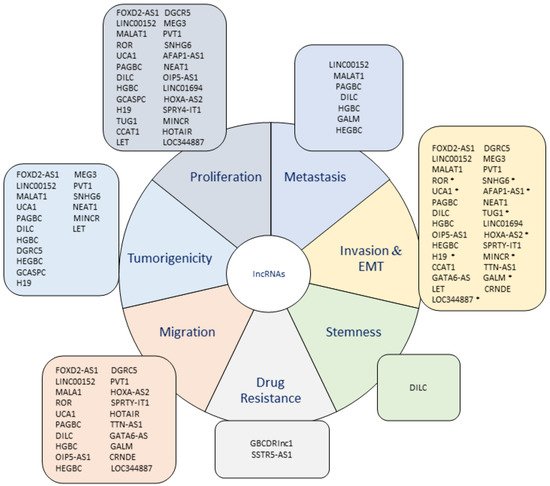
Finally, Figure 1 summarizes all the features associated with an aggressive phenotype and its relationship with the different lncRNAs described to date in GBC.
Figure 1. Role of lncRNAs in the aggressive phenotype in gallbladder cancer. LncRNAs associated with aggressive characteristics described in GBC. *: involved in invasion and EMT. lncRNAs without * are involved only in invasion.

References

  1. Brannan, C.I.; Dees, E.C.; Ingram, R.S.; Tilghman, S.M. The product of the H19 gene may function as an RNA. Mol. Cell Biol. 1990, 10, 28–36.
  2. Isin, M.; Dalay, N. LncRNAs and neoplasia. Clin. Chim. Acta 2015, 444, 280–288.
  3. Ma, F.; Wang, S.H.; Cai, Q.; Zhang, M.D.; Yang, Y.; Ding, J. Overexpression of LncRNA AFAP1-AS1 predicts poor prognosis and promotes cells proliferation and invasion in gallbladder cancer. Biomed. Pharm. 2016, 84, 1249–1255.
  4. Liu, B.; Shen, E.D.; Liao, M.M.; Hu, Y.B.; Wu, K.; Yang, P.; Zhou, L.; Chen, W.D. Expression and mechanisms of long non-coding RNA genes MEG3 and ANRIL in gallbladder cancer. Tumor Biol. 2016, 37, 9875–9886.
  5. Liu, Z.; Chen, Q.; Hann, S.S. The functions and oncogenic roles of CCAT1 in human cancer. Biomed. Pharm. 2019, 115, 108943.
  6. Ma, M.Z.; Chu, B.F.; Zhang, Y.; Weng, M.Z.; Qin, Y.Y.; Gong, W.; Quan, Z.W. Long non-coding RNA CCAT1 promotes gallbladder cancer development via negative modulation of miRNA-218-5p. Cell Death Dis. 2015, 6, e1583.
  7. Ma, Y.C.; Yang, J.Y.; Yan, L.N. Relevant markers of cancer stem cells indicate a poor prognosis in hepatocellular carcinoma patients: A meta-analysis. Eur. J. Gastroenterol. Hepatol. 2013, 25, 1007–1016.
  8. Joseph, C.; Arshad, M.; Kurozomi, S.; Althobiti, M.; Miligy, I.M.; Al-Izzi, S.; Toss, M.S.; Goh, F.Q.; Johnston, S.J.; Martin, S.G.; et al. Overexpression of the cancer stem cell marker CD133 confers a poor prognosis in invasive breast cancer. Breast Cancer Res. Treat. 2019, 174, 387–399.
  9. Han, Y.; Xue, X.; Jiang, M.; Guo, X.; Li, P.; Liu, F.; Yuan, B.; Shen, Y.; Zhi, Q.; Zhao, H. LGR5, a relevant marker of cancer stem cells, indicates a poor prognosis in colorectal cancer patients: A meta-analysis. Clin. Res. Hepatol. Gastroenterol. 2015, 39, 267–273.
  10. Liu, B.; Zhang, Y.; Liao, M.; Deng, Z.; Gong, L.; Jiang, J.; Lynn, L.; Wu, K.; Miao, X. Clinicopathologic and prognostic significance of CD24 in gallbladder carcinoma. Pathol. Oncol. Res. 2011, 17, 45–50.
  11. Nguyen, L.V.; Vanner, R.; Dirks, P.; Eaves, C.J. Cancer stem cells: An evolving concept. Nat. Rev. Cancer 2012, 12, 133–143.
  12. Liang, C.; Yang, P.; Han, T.; Wang, R.Y.; Xing, X.L.; Si, A.F.; Ma, Q.Y.; Chen, Z.; Li, H.Y.; Zhang, B. Long non-coding RNA DILC promotes the progression of gallbladder carcinoma. Gene 2019, 694, 102–110.
  13. Xue, C.; Chen, C.; Gu, X.; Li, L. Progress and assessment of lncRNA DGCR5 in malignant phenotype and immune infiltration of human cancers. Am. J. Cancer Res. 2021, 11, 1–13.
  14. Wang, R.; Dong, H.X.; Zeng, J.; Pan, J.; Jin, X.Y. LncRNA DGCR5 contributes to CSC-like properties via modulating miR-330-5p/CD44 in NSCLC. J. Cell Physiol. 2018, 233, 7447–7456.
  15. Dong, H.X.; Wang, R.; Jin, X.Y.; Zeng, J.; Pan, J. LncRNA DGCR5 promotes lung adenocarcinoma (LUAD) progression via inhibiting hsa-mir-22-3p. J. Cell Physiol. 2018, 233, 4126–4136.
  16. Wang, X.L.; Shi, M.; Xiang, T.; Bu, Y.Z. Long noncoding RNA DGCR5 represses hepatocellular carcinoma progression by inactivating Wnt signaling pathway. J. Cell Biochem. 2019, 120, 275–282.
  17. Jiang, D.; Wang, C.; He, J. Long non-coding RNA DGCR5 incudes tumorigenesis of triple-negative breast cancer by affecting Wnt/β-catenin signaling pathway. J. BUON 2020, 25, 702–708.
  18. Liu, S.; Chu, B.; Cai, C.; Wu, X.; Yao, W.; Wu, Z.; Yang, Z.; Li, F.; Liu, Y.; Dong, P.; et al. DGCR5 Promotes Gallbladder Cancer by Sponging MiR-3619-5p via MEK/ERK1/2 and JNK/p38 MAPK Pathways. J. Cancer 2020, 11, 5466–5477.
  19. Gao, J.; Dai, C.; Yu, C.; Yin, X.B.; Liao, W.-y.; Huang, Y.; Zhou, F. Silencing of long non-coding RNA FOXD2-AS1 inhibits the progression of gallbladder cancer by mediating methylation of MLH1. Gene Ther. 2020, 28, 306–318.
  20. Cai, Q.; Wang, S.; Jin, L.; Weng, M.; Zhou, D.; Wang, J.; Tang, Z.; Quan, Z. Long non-coding RNA GBCDRlnc1 induces chemoresistance of gallbladder cancer cells by activating autophagy. Mol. Cancer 2019, 18, 82.
  21. Ma, M.Z.; Li, C.X.; Zhang, Y.; Weng, M.Z.; Zhang, M.D.; Qin, Y.Y.; Gong, W.; Quan, Z.W. Long non-coding RNA HOTAIR, a c-Myc activated driver of malignancy, negatively regulates miRNA-130a in gallbladder cancer. Mol. Cancer 2014, 13, 156.
  22. Ghafouri-Fard, S.; Esmaeili, M.; Taheri, M. H19 lncRNA: Roles in tumorigenesis. Biomed. Pharm. 2020, 123, 109774.
  23. Wang, S.H.; Wu, X.C.; Zhang, M.D.; Weng, M.Z.; Zhou, D.; Quan, Z.W. Long noncoding RNA H19 contributes to gallbladder cancer cell proliferation by modulated miR-194-5p targeting AKT2. Tumor Biol. 2016, 37, 9721–9730.
  24. Wang, S.H.; Ma, F.; Tang, Z.H.; Wu, X.C.; Cai, Q.; Zhang, M.D.; Weng, M.Z.; Zhou, D.; Wang, J.D.; Quan, Z.W. Long non-coding RNA H19 regulates FOXM1 expression by competitively binding endogenous miR-342-3p in gallbladder cancer. J. Exp. Clin. Cancer Res. 2016, 35, 160.
  25. Wang, S.H.; Wu, X.C.; Zhang, M.D.; Weng, M.Z.; Zhou, D.; Quan, Z.W. Upregulation of H19 indicates a poor prognosis in gallbladder carcinoma and promotes epithelial-mesenchymal transition. Am. J. Cancer Res. 2016, 6, 15–26.
  26. Liu, L.; Yan, Y.; Zhang, G.; Chen, C.; Shen, W.; Xing, P. Knockdown of LINC01694 inhibits growth of gallbladder cancer cells via miR-340-5p/Sox4. Biosci. Rep. 2020, 40.
  27. Wu, X.C.; Wang, S.H.; Ou, H.H.; Zhu, B.; Zhu, Y.; Zhang, Q.; Yang, Y.; Li, H. The NmrA-like family domain containing 1 pseudogene Loc344887 is amplified in gallbladder cancer and promotes epithelial-mesenchymal transition. Chem. Biol. Drug Des. 2017, 90, 456–463.
  28. Seo, D.; Kim, D.; Kim, W. Long non-coding RNA linc00152 acting as a promising oncogene in cancer progression. Genom. Inf. 2019, 17, e36.
  29. Zhong, Y.; Wu, X.; Li, Q.; Ge, X.; Wang, F.; Wu, P.; Deng, X.; Miao, L. Long noncoding RNAs as potential biomarkers and therapeutic targets in gallbladder cancer: A systematic review and meta-analysis. Cancer Cell Int. 2019, 19, 169.
  30. Cai, Q.; Wang, Z.Q.; Wang, S.H.; Li, C.; Zhu, Z.G.; Quan, Z.W.; Zhang, W.J. Upregulation of long non-coding RNA LINC00152 by SP1 contributes to gallbladder cancer cell growth and tumor metastasis via PI3K/AKT pathway. Am. J. Transl. Res. 2016, 8, 4068–4081.
  31. Cai, Q.; Wang, Z.; Wang, S.; Weng, M.; Zhou, D.; Li, C.; Wang, J.; Chen, E.; Quan, Z. Long non-coding RNA LINC00152 promotes gallbladder cancer metastasis and epithelial-mesenchymal transition by regulating HIF-1α via miR-138. Open Biol. 2017, 7.
  32. Li, Z.X.; Zhu, Q.N.; Zhang, H.B.; Hu, Y.; Wang, G.; Zhu, Y.S. MALAT1: A potential biomarker in cancer. Cancer Manag. Res. 2018, 10, 6757–6768.
  33. Wu, X.S.; Wang, X.A.; Wu, W.G.; Hu, Y.P.; Li, M.L.; Ding, Q.; Weng, H.; Shu, Y.J.; Liu, T.Y.; Jiang, L.; et al. MALAT1 promotes the proliferation and metastasis of gallbladder cancer cells by activating the ERK/MAPK pathway. Cancer Biol. Ther. 2014, 15, 806–814.
  34. Sun, Y.; Ma, L. New Insights into Long Non-Coding RNA MALAT1 in Cancer and Metastasis. Cancers 2019, 11, 216.
  35. Huo, Y.; Li, Q.; Wang, X.; Jiao, X.; Zheng, J.; Li, Z.; Pan, X. MALAT1 predicts poor survival in osteosarcoma patients and promotes cell metastasis through associating with EZH2. Oncotarget 2017, 8, 46993–47006.
  36. Chen, Q.; Su, Y.; He, X.; Zhao, W.; Wu, C.; Zhang, W.; Si, X.; Dong, B.; Zhao, L.; Gao, Y.; et al. Plasma long non-coding RNA MALAT1 is associated with distant metastasis in patients with epithelial ovarian cancer. Oncol. Lett. 2016, 12, 1361–1366.
  37. Luan, C.; Li, Y.; Liu, Z.; Zhao, C. Long Noncoding RNA MALAT1 Promotes the Development of Colon Cancer by Regulating. OncoTargets Ther. 2020, 13, 3653–3665.
  38. Jen, J.; Tang, Y.A.; Lu, Y.H.; Lin, C.C.; Lai, W.W.; Wang, Y.C. Oct4 transcriptionally regulates the expression of long non-coding RNAs NEAT1 and MALAT1 to promote lung cancer progression. Mol. Cancer 2017, 16, 104.
  39. Schmidt, L.H.; Spieker, T.; Koschmieder, S.; Schäffers, S.; Humberg, J.; Jungen, D.; Bulk, E.; Hascher, A.; Wittmer, D.; Marra, A.; et al. The long noncoding MALAT-1 RNA indicates a poor prognosis in non-small cell lung cancer and induces migration and tumor growth. J. Thorac. Oncol. 2011, 6, 1984–1992.
  40. Jadaliha, M.; Zong, X.; Malakar, P.; Ray, T.; Singh, D.K.; Freier, S.M.; Jensen, T.; Prasanth, S.G.; Karni, R.; Ray, P.S.; et al. Functional and prognostic significance of long non-coding RNA MALAT1 as a metastasis driver in ER negative lymph node negative breast cancer. Oncotarget 2016, 7, 40418–40436.
  41. Huang, N.S.; Chi, Y.Y.; Xue, J.Y.; Liu, M.Y.; Huang, S.; Mo, M.; Zhou, S.L.; Wu, J. Long non-coding RNA metastasis associated in lung adenocarcinoma transcript 1 (MALAT1) interacts with estrogen receptor and predicted poor survival in breast cancer. Oncotarget 2016, 7, 37957–37965.
  42. Lin, N.; Yao, Z.; Xu, M.; Chen, J.; Lu, Y.; Yuan, L.; Zhou, S.; Zou, X.; Xu, R. Long noncoding RNA MALAT1 potentiates growth and inhibits senescence by antagonizing ABI3BP in gallbladder cancer cells. J. Exp. Clin. Cancer Res. 2019, 38, 244.
  43. Wang, S.H.; Zhang, W.J.; Wu, X.C.; Zhang, M.D.; Weng, M.Z.; Zhou, D.; Wang, J.D.; Quan, Z.W. Long non-coding RNA Malat1 promotes gallbladder cancer development by acting as a molecular sponge to regulate miR-206. Oncotarget 2016, 7, 37857–37867.
  44. Zhang, T.; Chen, L.; Xu, X.; Shen, C. Knockdown of Long Noncoding RNA. Cancer Biother. Radiopharm. 2020.
  45. Wang, S.H.; Zhang, W.J.; Wu, X.C.; Weng, M.Z.; Zhang, M.D.; Cai, Q.; Zhou, D.; Wang, J.D.; Quan, Z.W. The lncRNA MALAT1 functions as a competing endogenous RNA to regulate MCL-1 expression by sponging miR-363-3p in gallbladder cancer. J. Cell Mol. Med. 2016, 20, 2299–2308.
  46. Wang, S.H.; Yang, Y.; Wu, X.C.; Zhang, M.D.; Weng, M.Z.; Zhou, D.; Wang, J.D.; Quan, Z.W. Long non-coding RNA MINCR promotes gallbladder cancer progression through stimulating EZH2 expression. Cancer Lett. 2016, 380, 122–133.
  47. Yang, F.; Tang, Z.; Duan, A.; Yi, B.; Shen, N.; Bo, Z.; Yin, L.; Zhu, B.; Qiu, Y.; Li, J. Long Noncoding RNA. OncoTargets Ther. 2020, 13, 2357–2367.
  48. Wang, S.H.; Zhang, M.D.; Wu, X.C.; Weng, M.Z.; Zhou, D.; Quan, Z.W. Overexpression of LncRNA-ROR predicts a poor outcome in gallbladder cancer patients and promotes the tumor cells proliferation, migration, and invasion. Tumor Biol. 2016, 37, 12867–12875.
  49. Yang, L.; Cheng, X.; Ge, N.; Guo, W.; Feng, F.; Wan, F. Long non-coding RNA SPRY4-IT1 promotes gallbladder carcinoma progression. Oncotarget 2017, 8, 3104–3110.
  50. Liu, X.F.; Wang, K.; Du, H.C. LncRNA SNHG6 regulating Hedgehog signaling pathway and affecting the biological function of gallbladder carcinoma cells through targeting miR-26b-5p. Eur. Rev. Med. Pharm. Sci. 2020, 24, 7598–7611.
  51. Xue, Z.; Yang, B.; Xu, Q.; Zhu, X.; Qin, G. Long non-coding RNA SSTR5-AS1 facilitates gemcitabine resistance via stabilizing NONO in gallbladder carcinoma. Biochem. Biophys. Res. Commun. 2020, 522, 952–959.
  52. Ma, F.; Wang, S.H.; Cai, Q.; Jin, L.Y.; Zhou, D.; Ding, J.; Quan, Z.W. Long non-coding RNA TUG1 promotes cell proliferation and metastasis by negatively regulating miR-300 in gallbladder carcinoma. Biomed. Pharm. 2017, 88, 863–869.
  53. Cai, Q.; Jin, L.; Wang, S.; Zhou, D.; Wang, J.; Tang, Z.; Quan, Z. Long non-coding RNA UCA1 promotes gallbladder cancer progression by epigenetically repressing p21 and E-cadherin expression. Oncotarget 2017, 8, 47957–47968.
  54. Lin, Z.; Li, Y.; Shao, R.; Hu, Y.; Gao, H. LncRNA TTN-AS1 acts as a tumor promoter in gallbladder carcinoma by regulating miR-107/HMGA1 axis. World J. Surg. Oncol. 2021, 19, 163.
  55. Zhang, L.; Geng, Z.; Meng, X.; Meng, F.; Wang, L. Screening for key lncRNAs in the progression of gallbladder cancer using bioinformatics analyses. Mol. Med. Rep. 2018, 17, 6449–6455.
  56. Shen, S.; Liu, H.; Wang, Y.; Wang, J.; Ni, X.; Ai, Z.; Pan, H.; Shao, Y. Long non-coding RNA CRNDE promotes gallbladder carcinoma carcinogenesis and as a scaffold of DMBT1 and C-IAP1 complexes to activating PI3K-AKT pathway. Oncotarget 2016, 7, 72833–72844.
  57. Ma, M.Z.; Kong, X.; Weng, M.Z.; Zhang, M.D.; Qin, Y.Y.; Gong, W.; Zhang, W.J.; Quan, Z.W. Long non-coding RNA-LET is a positive prognostic factor and exhibits tumor-suppressive activity in gallbladder cancer. Mol. Carcinog. 2015, 54, 1397–1406.
  58. Li, K.; Tang, J.; Hou, Y. LncRNA GATA6-AS inhibits cancer cell migration and invasion in gallbladder cancer by downregulating miR-421. OncoTargets Ther. 2019, 12, 8047–8053.
  59. Bao, D.; Yuan, R.X.; Zhang, Y. Effects of lncRNA MEG3 on proliferation and apoptosis of gallbladder cancer cells through regulating NF-κB signaling pathway. Eur. Rev. Med. Pharm. Sci. 2020, 24, 6632–6638.
  60. Jin, L.; Cai, Q.; Wang, S.; Mondal, T.; Wang, J.; Quan, Z. Long noncoding RNA MEG3 regulates LATS2 by promoting the ubiquitination of EZH2 and inhibits proliferation and invasion in gallbladder cancer. Cell Death Dis. 2018, 9, 1017.
  61. Ma, M.Z.; Zhang, Y.; Weng, M.Z.; Wang, S.H.; Hu, Y.; Hou, Z.Y.; Qin, Y.Y.; Gong, W.; Zhang, Y.J.; Kong, X.; et al. Long Noncoding RNA GCASPC, a Target of miR-17-3p, Negatively Regulates Pyruvate Carboxylase-Dependent Cell Proliferation in Gallbladder Cancer. Cancer Res. 2016, 76, 5361–5371.
  62. Tian, J.; Hu, X.; Gao, W.; Zhang, J.; Chen, M.; Zhang, X.; Ma, J.; Yuan, H. Identification of the long non-coding RNA LET as a novel tumor suppressor in gastric cancer. Mol. Med. Rep. 2017, 15, 2229–2234.
  63. Gu, L.; Zhang, J.; Shi, M.; Zhan, Q.; Shen, B.; Peng, C. lncRNA MEG3 had anti-cancer effects to suppress pancreatic cancer activity. Biomed. Pharm. 2017, 89, 1269–1276.

More
Upload a video for this entry
Information
Contributor MDPI registered users' name will be linked to their SciProfiles pages. To register with us, please refer to https://encyclopedia.pub/register : Juan Carlos Roa
View Times: 465
Revisions: 2 times (View History)
Update Date: 20 Jan 2022
Notice
You are not a member of the advisory board for this topic. If you want to update advisory board member profile, please contact office@encyclopedia.pub.
OK
Confirm
Only members of the Encyclopedia advisory board for this topic are allowed to note entries. Would you like to become an advisory board member of the Encyclopedia?
Yes
No
${ textCharacter }/${ maxCharacter }
Submit
Cancel
There is no comment~
${ textCharacter }/${ maxCharacter }
Submit
Cancel
${ selectedItem.replyTextCharacter }/${ selectedItem.replyMaxCharacter }
Submit
Cancel
Confirm
Are you sure to Delete?
Yes No
Academic Video Service