
In southern Morocco, architecture does more than provide shelter; it encodes centuries of adaptation to climate, culture, and landscape. The earthen Kasbahs and Ksour of Ouarzazate Province—long recognized for their historical and architectural value—offer a particularly compelling case.
A study published in MDPI Sustainability, titled “Characterizing Sustainability and Assessing Biophilic Design in Vernacular Architecture: Case of Kasbahs and Ksour in South of Morocco,” argues that these fortified vernacular structures hold important insights for contemporary discussions on biophilic and sustainable architecture. Using a Biophilic Interior Design Matrix composed of 54 attributes, the authors systematically evaluated eleven representative buildings and demonstrate that these historic forms incorporate environmental responsiveness, human–nature connection, and material intelligence in ways that resonate strongly with modern sustainability frameworks.
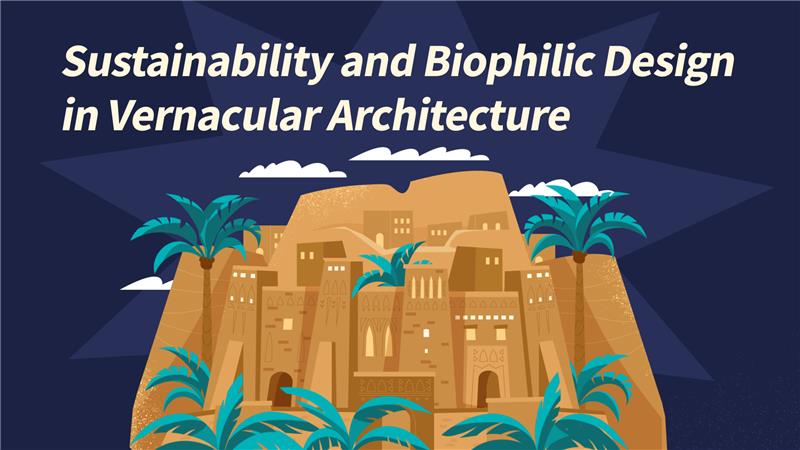
Source: Encyclopedia Video abstract (https://encyclopedia.pub/video/1742).
1. Biophilic Design as an Analytical Lens
Biophilic design, grounded in the biophilia hypothesis, emphasizes the integration of natural elements, processes, and patterns into built environments in order to enhance psychological well-being, physical comfort, and cognitive performance. In contemporary practice, biophilic strategies often rely on engineered systems—such as advanced daylighting solutions, vegetated surfaces, or controlled ventilation—to restore connections with natural processes that are frequently diminished in dense urban settings.
The case study from Ouarzazate applies this framework to eleven heritage buildings, examining how their material composition, spatial organization, and environmental behavior correspond to biophilic attributes. By translating vernacular characteristics into measurable indicators, the authors show that traditional structures can provide relevant insights for present-day design challenges, particularly in arid and semi-arid contexts.
2. Materiality and Environmental Integration
A central finding of the study concerns the predominance of earth-based construction, including rammed earth, adobe, and stone. These locally sourced materials, characterized by low embodied energy, perform strongly across several biophilic categories, especially those related to tactile richness, natural analogues, and integration with the surrounding landscape. Their thermal mass helps maintain interior comfort by moderating diurnal temperature fluctuations, thereby reducing dependence on mechanical systems.
The resultant interiors exhibit a high degree of environmental coherence: surfaces, textures, and colors reflect the desert ecology from which the buildings arise. This material continuity aligns closely with core biophilic attributes focused on sensory connection and place-based identity.
3. Spatial Configuration and Climatic Responsiveness
Vernacular spatial strategies further reinforce biophilic qualities. The compact urban fabric of Ksour, narrow passageways, shaded transitional zones, and internal courtyards collectively produce environments responsive to strong solar exposure, seasonal climatic variability, and local circulation patterns.
According to the study’s findings, these spatial typologies correspond to biophilic attributes involving:
-
dynamic natural lighting
-
shade and thermal refuge
-
coherent spatial order
-
human scale and enclosure
-
perceptible environmental processes
Rather than relying on modern technologies, these buildings achieve environmental regulation through form, orientation, and passive strategies refined over generations.
4. Sustainability Embedded in Vernacular Practice
Although traditional builders of Kasbahs and Ksour did not articulate sustainability as a conscious design agenda, the study shows that sustainable practices are embedded throughout their construction and use. Local materials minimize environmental impact; passive thermal strategies reduce energy demands; and building forms are finely tuned to climatic and ecological conditions.
This integration of cultural, material, and environmental knowledge contrasts with many contemporary approaches that attempt to retrofit sustainability into existing design systems. The authors argue that vernacular Moroccan architecture exemplifies a holistic approach in which human comfort, resource efficiency, and environmental responsiveness operate in mutually reinforcing ways.
5. Implications for Contemporary Architecture
The study's findings carry broader implications for architectural practice, particularly in regions confronting climate stress or resource limitations. Several insights emerge:
-
Vernacular architecture can serve as a repository of environmental intelligence, offering precedents for low-energy, context-appropriate strategies.
-
Biophilic qualities may already be embedded in traditional structures, even if not defined as such, providing instructive examples for contemporary application.
-
Sustainability may be strengthened by cultural continuity, linking material practice to identity, place, and ecological understanding.
The Kasbahs and Ksour therefore encourage architects to consider how traditional building knowledge can inform modern biophilic and sustainable design frameworks rather than exist apart from them.
6. Conclusion: Learning from Vernacular Ecologies
The study concludes that the Kasbahs and Ksour of the Ouarzazate Province are significant not only for their cultural heritage but also for their environmental adaptability and human-centered design logic. By applying the Biophilic Interior Design Matrix, the authors demonstrate that many features of these vernacular structures naturally align with the objectives of biophilic and sustainable design.
As societies confront climate change, increasing energy pressures, and a growing disconnect from natural environments, the lessons embedded in Morocco’s vernacular landscapes gain renewed relevance. These buildings illustrate how environmental adaptation, material stewardship, and human well-being can reinforce one another within integrated architectural systems.
In this way, the study of Kasbahs and Ksour extends beyond historical inquiry; it offers a forward-looking model for sustainable design. Re-engaging with vernacular knowledge may help the built environment evolve toward approaches that are both technically resilient and culturally grounded.
For more information about topic, you can view the online video entitled "Sustainability and Biophilic Design in Vernacular Architecture: Morocco".