
Cows communicate a great deal through their behavior. Subtle changes in standing, lying, feeding, or social interactions often provide early indicators of health status, stress levels, or reproductive activity. In modern dairy systems, where herd sizes continue to increase, continuous manual observation is neither efficient nor reliable. Consequently, automated behavior monitoring has become a key component of precision livestock farming.
Vision-based behavior recognition offers a non-invasive and scalable solution; however, its practical implementation remains challenging. Variability in posture, lighting conditions, background complexity, and animal density can significantly affect detection performance. A recent study published in MDPI Animals entitled "CAMLLA-YOLOv8n: Cow Behavior Recognition Based on Improved YOLOv8n" addresses these challenges by proposing an improved YOLOv8-based framework for recognizing Holstein cow behaviors in real farm environments. By refining feature representation, attention mechanisms, and localization strategies, the study aims to enhance robustness under practical on-farm conditions.
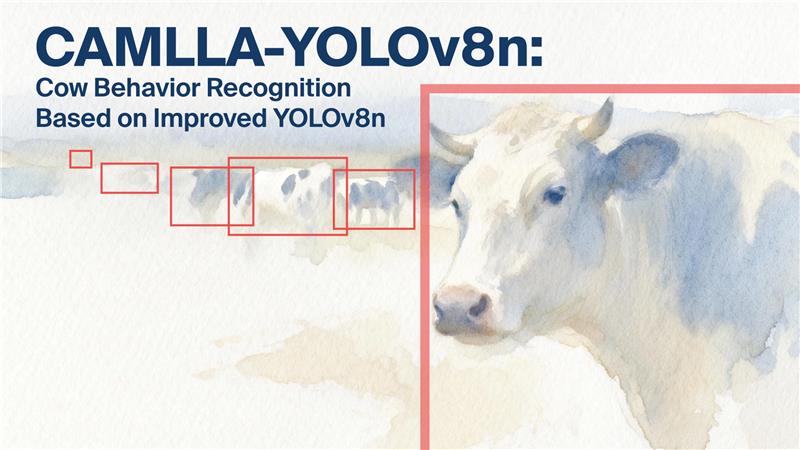
1. Visual Challenges in On-Farm Cow Behavior Recognition
Recognizing cow behavior from visual data in real farm environments is inherently complex. Multiple cows frequently appear within the same field of view, leading to overlap and occlusion that obscure key anatomical features. In addition, behaviors are associated with distinct postural patterns, yet substantial variability exists within each behavior category due to individual differences and environmental influences.
Detection is further complicated by changes in apparent cow size caused by varying camera distances, as well as fluctuations in lighting and background elements throughout the day. In many cases, behavior-related visual cues are small, subtle, or only partially visible, particularly during brief interactions or transitional movements. Together, these factors limit the effectiveness of standard object detection architectures when applied directly to farm imagery.
2. Model Design and Methodological Improvements
To address these challenges, the study introduces a series of targeted architectural and methodological refinements to the YOLOv8n model. Rather than increasing model complexity, the proposed approach focuses on enhancing feature discrimination, strengthening multi-scale representation, and improving bounding box regression. This design strategy maintains computational efficiency while improving suitability for real-world deployment.
3. Data Augmentation Strategy
A hybrid data augmentation strategy was applied to increase the diversity of training samples. Variations in posture, scale, orientation, and environmental conditions were introduced to better reflect the visual complexity of real farm scenes. This approach improves generalization and reduces sensitivity to changes in camera placement, barn layout, and herd composition.
4. C2f-CA Module with Coordinate Attention
Within the backbone network, a Coordinate Attention mechanism was integrated into the C2f module, forming the C2f-CA structure. This mechanism encodes spatial position information alongside channel-wise dependencies, allowing the model to retain location awareness while emphasizing behavior-relevant features.
As a result, the model more effectively distinguishes individual cows in crowded scenes and suppresses background interference. This is particularly beneficial in multi-cow environments where visual overlap is common.
5. MLLAttention in the Neck for Multi-Scale Feature Fusion
To address scale variation among detected targets, the MLLAttention mechanism was introduced into the P3, P4, and P5 layers of the Neck component. These layers integrate features across multiple spatial resolutions.
By improving attention-driven feature fusion, the model maintains consistent recognition performance for cows appearing at different distances from the camera, which is a common scenario in open or semi-open farm settings.
6. SPPF-GPE Module for Small Target Enhancement
The standard SPPF module was further refined into the SPPF-GPE module by combining global average pooling and global maximum pooling. This modification enhances the extraction of both global context and localized salient features.
Improved sensitivity to small or partially occluded targets supports more reliable detection of subtle behavioral cues, which are often critical for early behavioral assessment.
7. Shape-IoU Loss for Improved Localization Accuracy
For bounding box regression, the study replaces CIoU loss with Shape-IoU loss, placing greater emphasis on matching the shape and scale of predicted and ground-truth bounding boxes.
This adjustment improves localization accuracy in crowded scenes and reduces errors caused by overlapping targets, thereby supporting more reliable behavior recognition.
8. Experimental Validation
The proposed CAMLLA-YOLOv8n model was evaluated using a self-constructed dataset comprising 23,073 annotated instances of Holstein cow behaviors. Experimental results show that the improved model achieves higher Precision than earlier YOLO-based approaches.
These findings demonstrate that the combined use of attention mechanisms, improved feature fusion, and optimized loss design can enhance detection performance under realistic farm conditions without substantially increasing computational cost.
9. Implications for Precision Livestock Farming
The study highlights the practical value of advanced vision-based behavior recognition systems in dairy farming. Improved detection accuracy enables earlier identification of health-related behavioral changes, more reliable monitoring of estrus and reproductive activity, and reduced reliance on manual observation.
Such systems support data-driven herd management, contribute to improved animal welfare, and promote more efficient and sustainable farming practices.
10. Conclusion
Accurate recognition of cow behavior is essential for modern precision livestock farming. By introducing targeted structural improvements to the YOLOv8n framework, this study provides an effective and application-oriented solution for behavior detection in complex agricultural environments.
As visual monitoring technologies continue to evolve, approaches that balance methodological rigor, robustness, and practical deployability will play an increasingly important role in the digital transformation of animal husbandry.
For more information about topic, you can view the online video entitled "CAMLLA-YOLOv8n: Cow Behavior Recognition Based on Improved YOLOv8n".