Randomised trials establish whether a treatment can work under ideal conditions; real-world evidence establishes whether it does work in the patients clinicians actually see. Eligibility criteria exclude the majority of everyday patients from cardiovascular outcome trials, and the effectiveness observed in practice is shaped as much by titration and treatment persistence as by pharmacology. Observational data can extend trial findings to broader populations, but only when they are designed to emulate the trial they are meant to complement. This blog sets out what each source of evidence can and cannot answer and offers three questions for appraising a real-world study at the point of clinical decision.
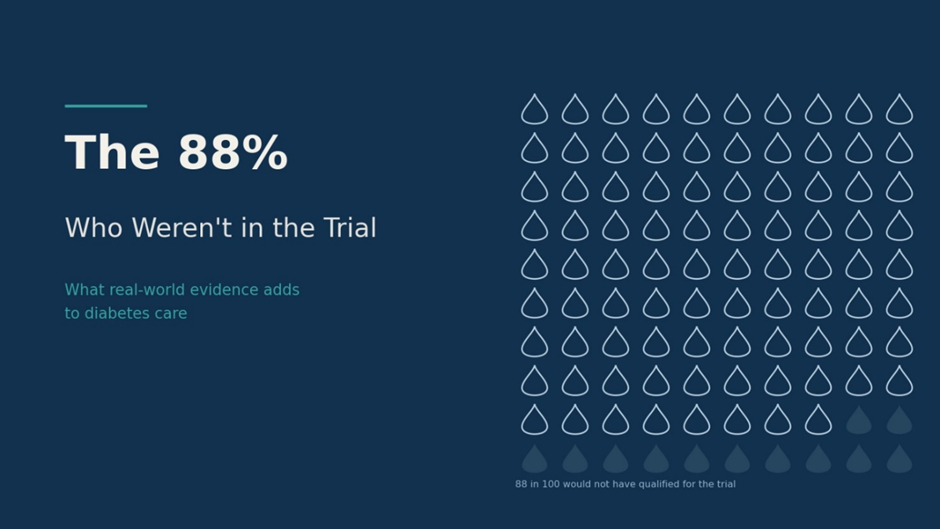
On Monday, you read a cardiovascular outcome trial destined to change practice. On Tuesday morning, in your clinic, an 82-year-old man sits down: estimated glomerular filtration rate 38 mL/min/1.73 m², eleven medications, and at least three criteria that would have excluded him from that trial. The trial did nothing wrong. It was simply not built to answer the question he is putting to you.
1. Trial Populations and Clinical Populations
Randomised controlled trials are designed for internal validity: eligibility criteria, run-in periods, and protocol-driven follow-up all serve to isolate the causal effect of a molecule from everything else in a person’s life. That engineering has a price, and the price is representativeness.
How high that price is becomes clear when the criteria of four SGLT2 inhibitor outcome trials are applied to 455,662 adults with type 2 diabetes attending 222 Italian diabetes clinics: 11.7% would have qualified for EMPA-REG OUTCOME, 55.9% for DECLARE-TIMI 58 (Figure 1B) [1]. Those who did qualify were older and had a longer disease duration, with lower HbA1c and BMI and more microvascular complications than the participants actually enrolled in those trials. Your Tuesday patient almost certainly belonged to the 88% that the most restrictive of the four would have excluded. This does not make the trial useless to him; it makes a second type of evidence necessary.
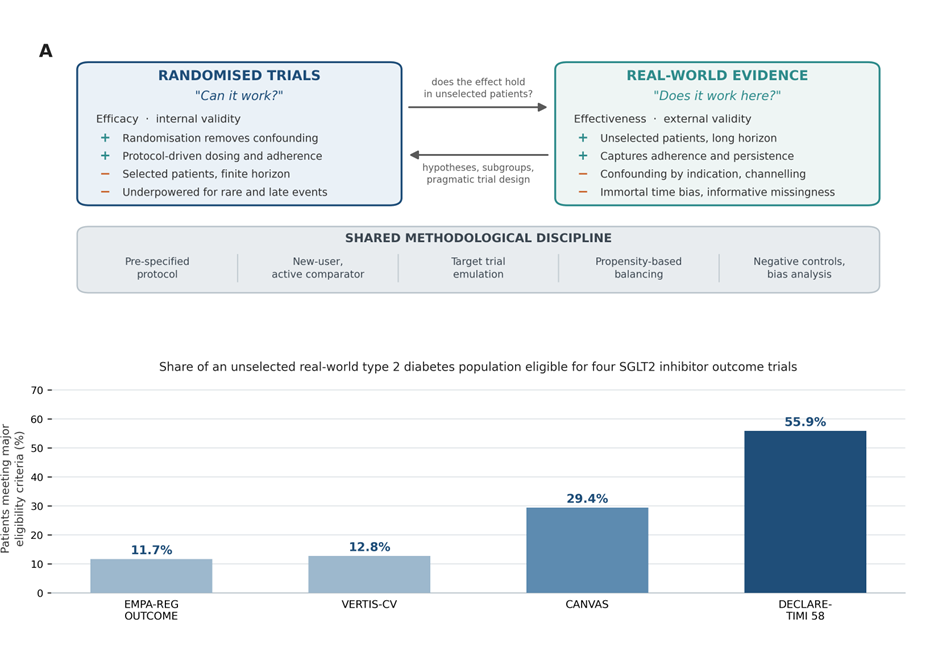
Figure 1. Two complementary sources of clinical evidence. (A) Randomised trials and real-world studies answer sequential rather than competing questions, and both depend on the same methodological discipline. (B) Proportion of an unselected real-world type 2 diabetes population meeting the major eligibility criteria of four SGLT2 inhibitor outcome trials, drawn from data reported in reference 1. Original figure prepared by the author.
2. What Real-World Evidence Contributes
The first contribution concerns the gap between what a drug can do and what it does. In a cohort of 7,881 adults treated with injectable semaglutide or tirzepatide for obesity in routine practice, mean weight reduction at one year was 8.7%, compared with 14.9% at 68 weeks in STEP 1 and 20.9% at 72 weeks in SURMOUNT-1 [2–4]—little more than half of the semaglutide trial result and closer to two-fifths of the tirzepatide one.
That gap is explained almost entirely by how the drugs are actually used. In all, 80.8% of the cohort remained on low maintenance doses, whereas those who reached and maintained the full dose without interruption achieved weight loss approaching that observed in the clinical trials. The difference does not lie in the molecule; it lies in titration and in continuing treatment. Discontinuation at one year was 17.1% in STEP 1 and 14.3–16.4% across tirzepatide doses in SURMOUNT-1; here, 20.4% discontinued treatment within three months and a further 32.0% before twelve months [2]. And here real-world data do what no registration trial can: explain why people stop. Among patients discontinuing treatment within the first year in the same health system, the reported reasons for discontinuation were cost or insurance barriers in 47.6% of cases, intolerable side effects in 14.6%, and supply shortages in 11.8% [5]. Adherence thus stops being a nuisance variable to be adjusted for and becomes a determinant of outcome that can, in part, be addressed in the consultation itself.
The relationship is not only one of deflation: sometimes real-world data widen the benefit rather than narrow it. CVD-REAL compared more than 150,000 patients initiating an SGLT2 inhibitor with an equal number initiating other glucose-lowering drugs (309,056 in total), and 87% had no established cardiovascular disease at baseline [6]; even in this lower-risk population, fewer hospitalisations for heart failure and fewer deaths were observed, extending to a lower-risk population a signal the trials had shown primarily in high-risk secondary prevention. The finding arrived years ahead of the dedicated trials—and precisely for that reason it deserves suspicion: that comparison was not randomised.
3. The Limits of Observational Data
Observational research cannot randomise treatment, and much of what follows stems from that limitation. Patients receive one drug rather than another for reasons that are often also the reasons they fare better or worse; this is confounding by indication; prescribing follows formulary, fashion, and phenotype, and that is channelling; the interval between cohort entry and first exposure is misassigned with surprising ease, and immortal time bias is manufactured; and data absent from an electronic record are rarely missing at random.
The textbook case is instructive precisely because it closed well. For years, observational cohorts suggested that postmenopausal hormone therapy protected against coronary heart disease, until the Women’s Health Initiative found the opposite; when the Nurses’ Health Study was re-analysed by explicitly emulating the design and analysis of the randomised trial, the discrepancy largely disappeared [7]. It was never the data that had lied, but the way they had been questioned.
From that lesson came the toolkit we now expect to find in rigorous observational research: new-user, active-comparator designs, explicit target trial emulation [8], propensity-based balancing, negative control outcomes, and quantitative bias analysis (Figure 1A). For the reader who rarely has time to reconstruct a study design from scratch, that toolkit condenses into three questions.
4. Three Questions for Appraising a Real-World Study
What trial is this study emulating?
Eligibility, treatment strategies, time zero, outcome, and follow-up should be prespecified before the data are examined, as they would be in a well-designed protocol.
Is the comparison fair in time as well as in patients?
Comparing new users with an active comparator, while properly aligning time zero, reduces most of the classic biases; comparing prevalent users with never-users almost never does.
How much unmeasured confounding would it take to make this result disappear?
An E-value, a negative control outcome, a falsification endpoint. A paper that cannot answer it is asking you to take the estimate on faith.
If the answers hold, that study earns a place in clinical reasoning alongside the trial—not instead of it.
5. Reading the Two Sources Together
The two sources answer questions in sequence rather than in competition: whether a treatment can work under ideal conditions, and whether it works here, in these patients, at the doses actually prescribed, for as long as they are actually taken. Regulators have already made that move, admitting real-world data into decisions that were once the exclusive territory of trials.
For the clinician, the gain is more modest and more immediate. Return to the man from Tuesday morning: Monday’s trial describes a population he was never part of, while a well-designed real-world study describes one he might actually belong to. That is where the decision begins, and it will take both to see it through.
References
1. Nicolucci, A.; Candido, R.; Cucinotta, D.; Graziano, G.; Rocca, A.; Rossi, M.C.; Tuccinardi, F.; Manicardi, V. Generalizability of cardiovascular safety trials on SGLT2 inhibitors to the real world: implications for clinical practice. Adv. Ther. 2019, 36, 2895–2909.
2. Gasoyan, H.; Butsch, W.S.; Schulte, R.; Casacchia, N.J.; Le, P.; Boyer, C.B.; Griebeler, M.L.; Burguera, B.; et al. Changes in weight and glycemic control following obesity treatment with semaglutide or tirzepatide by discontinuation status. Obesity (Silver Spring) 2025, 33, 1657–1667.
3. Wilding, J.P.H.; Batterham, R.L.; Calanna, S.; Davies, M.; Van Gaal, L.F.; Lingvay, I.; McGowan, B.M.; Rosenstock, J.; et al. Once-weekly semaglutide in adults with overweight or obesity. N. Engl. J. Med. 2021, 384, 989–1002.
4. Jastreboff, A.M.; Aronne, L.J.; Ahmad, N.N.; Wharton, S.; Connery, L.; Alves, B.; Kiyosue, A.; Zhang, S.; et al. Tirzepatide once weekly for the treatment of obesity. N. Engl. J. Med. 2022, 387, 205–216.
5. Gasoyan, H.; Butsch, W.S.; Casacchia, N.J.; Schulte, R.; Criswell, V.; Fox, J.; Renner, H.; Le, P.; et al. Reasons for discontinuation of obesity pharmacotherapy with semaglutide or tirzepatide in clinical practice. Obesity (Silver Spring) 2025, 33, 2296–2303.
6. Kosiborod, M.; Cavender, M.A.; Fu, A.Z.; Wilding, J.P.; Khunti, K.; Holl, R.W.; Norhammar, A.; Birkeland, K.I.; et al. Lower risk of heart failure and death in patients initiated on sodium-glucose cotransporter-2 inhibitors versus other glucose-lowering drugs: the CVD-REAL study. Circulation 2017, 136, 249–259.
7. Hernán, M.A.; Alonso, A.; Logan, R.; Grodstein, F.; Michels, K.B.; Willett, W.C.; Manson, J.E.; Robins, J.M. Observational studies analyzed like randomized experiments: an application to postmenopausal hormone therapy and coronary heart disease. Epidemiology 2008, 19, 766–779.
8. Hernán, M.A.; Robins, J.M. Using big data to emulate a target trial when a randomized trial is not available. Am. J. Epidemiol. 2016, 183, 758–764.
Biography
Antonio Maria Labate, MD, is a specialist in Internal Medicine working as an outpatient diabetology and internal medicine specialist at ASST Franciacorta and ASST Mantova, in Lombardy, Italy. He trained in Internal Medicine at the University of Messina and has broad clinical experience spanning internal medicine, emergency medicine, and diabetology. His work focuses on clinical diabetology, cardiovascular and cardiometabolic risk in type 2 diabetes, real-world evidence, and the clinical use of newer glucose-lowering therapies such as GLP-1 receptor agonists and SGLT2 inhibitors. He has authored peer-reviewed articles and congress communications on the cardiovascular, renal, and metabolic effects of these agents and serves as a reviewer for several international journals.