Publishing a peer-reviewed article was once widely regarded as the final stage of the research process. A manuscript accepted by a reputable journal was expected to reach its audience through established channels such as library collections, conference proceedings, and citation networks. Today, that expectation is increasingly unrealistic. The rapid growth of scholarly publishing has created an environment in which researchers must compete for attention within an immense and continuously expanding body of literature. As a result, discoverability has become a major challenge, often standing between research and its intended audience. Publication remains an essential milestone, but it is no longer sufficient on its own to ensure scholarly impact. Whether a study is read, cited, applied in practice, or used as a foundation for further research increasingly depends on factors beyond publication itself. Visibility, accessibility, and purposeful dissemination have become critical components of the research communication process.

1. The Discoverability Problem
The volume of scientific literature has grown exponentially over the past two decades, doubling roughly every nine years according to bibliometric estimates drawn from the Web of Science and Scopus databases. This growth means that any single article competes not only with contemporaries in its narrow subfield but with an ever-expanding archive of prior work indexed by the same search engines. Google Scholar appears to rank articles using factors that include citation counts, recency, and metadata completeness. The result is a visibility gradient: research quality and research reach are correlated, but imperfectly, and the gap between the two is where deliberate visibility strategy operates.
Taherdoost's treatment of this problem frames visibility not as a passive outcome of publication but as an active, multi-stage process encompassing indexing, metadata optimization, author identification, and platform-level dissemination. This reframing is significant because it shifts responsibility from the publisher alone to the researcher, who must now treat academic search optimization, ORCID registration, and repository deposit as integral components of the research workflow rather than administrative afterthoughts.
2. Open Access and the Citation Advantage
Empirical evidence on the relationship between accessibility and citation impact is substantial and consistent. A large-scale bibliometric study analyzing 1.4 million articles found that open access papers received a citation advantage of approximately 18 percent on average when compared with subscription-access articles published in the same journal and year, with the effect strongest in the first two years after publication [1]. The mechanism is plausible: articles behind a paywall are read by a smaller population of institutionally affiliated researchers, while open access articles are accessible to independent scholars, practitioners, policymakers, and researchers in lower-income countries whose institutions cannot afford comprehensive subscription bundles. Piwowar et al. [1] further estimated that by 2025, a majority of journal articles viewed online would be available through some form of open access, whether via gold, green, or hybrid routes, reflecting a structural shift in how scholarly content circulates.
Researchers who fail to deposit in an institutional or subject repository within the mandated embargo window risk not only reduced visibility but also non-compliance penalties that can affect future funding eligibility. The practical implication for individual researchers is that accessibility decisions made at the point of submission, choice of journal, licensing terms, and repository deposit have measurable downstream consequences for how widely their work travels.
3. Altmetrics and the Expansion of Impact Measurement
Citation counts, while historically the dominant proxy for research impact, capture only a narrow slice of how research is actually used. A study is often read, downloaded, discussed on social media, cited in policy documents, or referenced in clinical guidelines long before it accumulates a meaningful citation count, and in many cases these forms of engagement never translate into formal citations at all. Altmetrics, a term encompassing mentions on Twitter/X, Mendeley reader counts, news coverage, and policy citations, have emerged as a complementary measurement framework capable of capturing this broader engagement in near real time [2]. Tennant et al. [2], in a comprehensive review of open scholarship practices, argue that altmetric indicators are particularly valuable for capturing societal and practitioner-facing impact that traditional citation metrics systematically underrepresent, including impact in fields such as public health, education, and applied engineering where practitioner audiences rarely cite author publications themselves.
The adoption of altmetric tracking has grown accordingly. Altmetric.com, one of the leading providers, now tracks attention data for over millions research outputs, and its Attention Score has become a standard feature on the landing pages of major publishers including Elsevier, Springer Nature, and Wiley. For early-career researchers in particular, altmetric visibility can serve as an early signal of research relevance well before formal citations accrue, which typically takes two to three years to reach a measurable baseline. This lag matters practically: some tenure and promotion committees, grant panels, and hiring committees increasingly request altmetric data alongside traditional citation counts precisely because the former offers a more immediate signal of research uptake.
4. Researcher Identity and Metadata Infrastructure
A frequently underestimated barrier to research visibility is the problem of author disambiguation. Common surnames, name changes, institutional affiliation changes, and inconsistent name formatting across databases mean that a single researcher's output can be fragmented across multiple non-linked author profiles, diluting apparent productivity and citation impact when viewed through any single database. The Open Researcher and Contributor ID (ORCID) system was developed specifically to resolve this problem by assigning researchers a persistent, unique digital identifier that travels with them across institutions, publishers, and funding bodies. As of recent registry figures, ORCID has issued millions of persistent researcher identifiers, and an increasing number of journals now require ORCID registration as a condition of submission, reflecting its consolidation as infrastructure rather than an optional convenience [3].
More broadly, metadata quality, including accurate keywords, structured abstracts, standardized author affiliations, and complete funding acknowledgment, directly affects how well an article is indexed by discovery systems. Taherdoost (2025) [3] emphasizes that metadata optimization functions analogously to academic search optimization in commercial contexts: articles with keyword-rich titles and abstracts aligned to common search terminology are retrieved more reliably and rank higher in results than semantically equivalent articles using idiosyncratic or overly technical phrasing. This is not a matter of gaming search algorithms but of ensuring that indexing systems, which rely heavily on textual pattern matching rather than deep semantic understanding, can correctly categorize and surface the work to the audiences most likely to find it relevant (Figure 1).
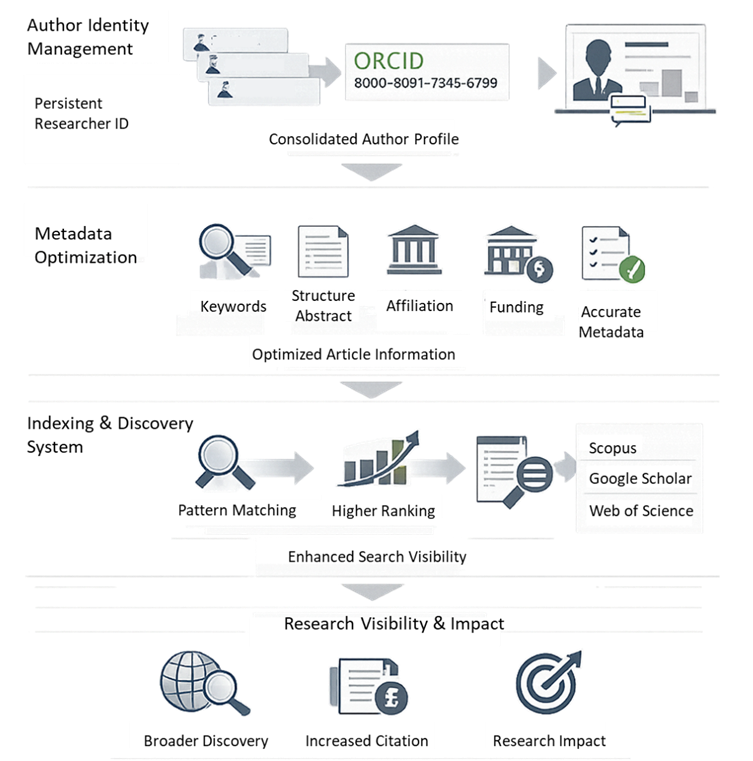
Figure 1. Enhancing research visibility: an integrated approach.
5. Institutional Repositories and Preprint Culture
Beyond journal-level accessibility, institutional and disciplinary repositories have become a significant secondary channel for research dissemination. Green open access, the practice of depositing a manuscript version in a repository such as arXiv, SSRN, or an institutional archive, allows researchers to comply with funder mandates even when publishing in subscription journals with restrictive licensing. The preprint server arXiv alone has hosted over two million papers since its founding, and disciplines such as physics and computer science now treat preprint deposit as a near-universal norm preceding formal peer review. The COVID-19 pandemic accelerated preprint adoption across biomedical fields as well, with medRxiv and bioRxiv collectively hosting tens of thousands of pandemic-related preprints that informed public health responses months before formal publication, illustrating how accessibility infrastructure can materially compress the time between research completion and societal use [2].
6. Toward an Integrated Visibility Strategy
The evidence surveyed here converges on a single conclusion: research impact in the digital age is not an automatic consequence of rigorous methodology and journal acceptance but the product of deliberate, sustained visibility practice operating across multiple layers of the scholarly communication system. Accessibility choices at the point of publication, disciplined use of persistent identifiers, attentive metadata construction, and engagement with both citation-based and attention-based impact metrics together determine whether a piece of research reaches its potential audience. Taherdoost's [3] framing of visibility as an active, ongoing researcher competency rather than a passive outcome captures this shift accurately, and the citation and altmetric evidence reviewed above substantiates the practical stakes involved. As the volume of scholarly output continues to grow, researchers who treat dissemination strategy as integral to the research process, rather than incidental to it, are likely to see a disproportionate return on both the resources invested in their research and the influence that research ultimately exerts on their field.
References
[1] Piwowar, H.; Priem, J.; Larivière, V.; Alperin, J. P.; Matthias, L.; Norlander, B.; Farley, A.; West, J.; Haustein, S. The state of OA: A large-scale analysis of the prevalence and impact of Open Access articles. PeerJ. 2018, 6, e4375.
[2] Tennant, J. P.; Waldner, F.; Jacques, D. C.; Masuzzo, P.; Collister, L. B.; Hartgerink, C. H. J. The academic, economic and societal impacts of Open Access: An evidence-based review. F1000Res. 2016, 5, 632.
[3] Taherdoost, H. Maximizing Research Impact: Practical Strategies for Enhancing Research Visibility (1st ed.) Routledge. https://doi.org/10.4324/9781003604785.
Biography
Dr. Hamed Taherdoost is an award-winning researcher, educator, and R&D leader with over two decades of international experience across academia and industry. He is a Professor at University Canada West and holds academic affiliations with Westcliff University (USA), GISMA University of Applied Sciences (Germany), and Victorian Institute of Technology (Australia). He is a GUS Institute Fellow (UK), a Westcliff Faculty Fellow, and a Fellow at the National Kaohsiung University of Science and Technology, Taiwan. His work spans digital transformation, cybersecurity, AI, and technology innovation, with hundreds of high-impact publications. Dr. Taherdoost serves as Book Series Editor for Routledge’s Mastering Academic Excellence and holds editorial roles with leading international journals.