
In many regions worldwide, sanitation systems play a decisive yet often overlooked role in public health, environmental protection, and social well-being. Selecting an appropriate sanitation solution is therefore not only a technical challenge but also a social and economic one.
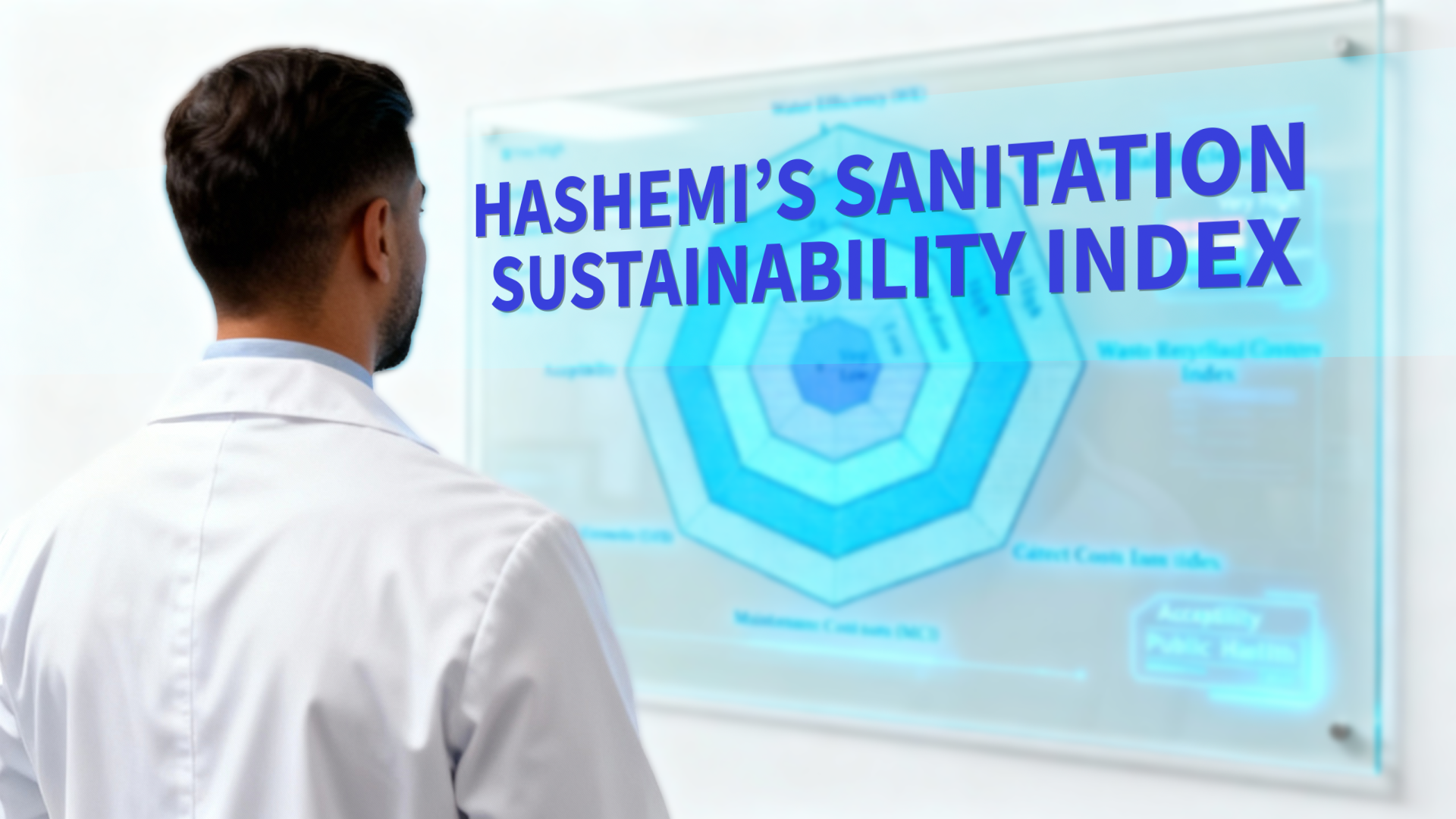
A study published in MDPI Sustainability, entitled "Sanitation Sustainability Index: A Pilot Approach to Develop a Community-Based Indicator for Evaluating Sustainability of Sanitation Systems" introduces a community-based framework for evaluating sanitation options prior to implementation. By integrating technical, economic, and social dimensions into a single composite indicator, the Hashemi’s Sanitation Sustainability Index (HSSI) offers a structured and context-sensitive approach to supporting informed sanitation planning in alignment with Sustainable Development Goal 6.
1. The Rationale for a Sustainability-Based Assessment Framework
Sanitation interventions frequently encounter challenges not solely due to technical limitations but because economic feasibility and social acceptance are insufficiently considered during the planning stage. Systems that perform well from an engineering perspective may impose unsustainable financial burdens or conflict with local cultural practices. Conversely, low-cost solutions may fail to adequately protect public health or the environment.
The HSSI was developed to address these limitations by providing a pre-implementation evaluation framework that integrates technical, economic, and social dimensions of sustainability. By enabling direct comparison among alternative sanitation technologies, the index supports informed decision-making and reduces the risk of system failure following deployment.
2. Structure of Hashemi's Sanitation Sustainability Index
The HSSI comprises three sub-indices—technical, economic, and social—each consisting of normalized, dimensionless variables. This normalization ensures that the index is adaptable to local conditions and applicable across diverse geographic and socio-economic contexts.
Technical Sustainability
The technical sub-index evaluates the efficiency with which sanitation systems utilize resources and manage waste streams. It includes three primary indicators:
-
Water Efficiency, which assesses water consumption per sanitation event relative to community standards;
-
Energy Efficiency, which evaluates the energy requirements for wastewater treatment processes;
-
Waste Recycling Efficiency, which measures the proportion of waste that is safely recovered and reused.
These indicators are calculated using straightforward comparative equations that benchmark proposed systems against existing local practices, thereby facilitating transparent and meaningful comparisons among different sanitation technologies.
3. Economic Sustainability
Economic viability is a critical determinant of the long-term success of sanitation systems, particularly in low-income and resource-constrained settings. The economic sub-index includes:
-
Capital Cost Index, reflecting initial investment requirements;
-
Maintenance Cost Index, capturing long-term operational and maintenance expenses;
-
Direct Economic Benefits, accounting for potential revenue generation, such as the recovery of nutrients or energy.
Sanitation systems that demonstrate cost-effectiveness or generate tangible economic benefits receive higher scores, highlighting options that are more likely to be financially sustainable over time.
4. Social Sustainability
The social sub-index addresses human and behavioral dimensions that strongly influence sanitation system performance. It incorporates two key variables:
-
Acceptability, which evaluates alignment with cultural norms, user preferences, and community perceptions;
-
Public Health Impact, which assesses the system’s effectiveness in improving hygiene and reducing disease transmission.
Although these indicators are qualitative in nature, they are quantified through structured surveys, pilot studies, and standardized scoring methods, ensuring consistency and comparability across assessments.
5. Application and Validation: A Case Study from South Korea
The applicability of the HSSI was demonstrated through a comparative assessment of two sanitation systems implemented in a suburban area of Seoul, South Korea: a conventional septic tank system and a resource-oriented sanitation (ROS) system.
The findings indicate that the ROS system achieved a substantially higher overall HSSI score (0.71) than the septic tank system (0.42). This outcome was primarily attributable to the ROS system’s superior performance in waste recycling and its potential to generate economic benefits, despite exhibiting lower levels of social acceptability.
To assess the robustness of the index, the authors employed Monte Carlo simulations to estimate the statistical distribution of HSSI scores. The results confirmed that the calculated values fell within a 95 percent confidence interval, supporting the reliability and stability of the index.
6. Implications for Policy and Practice
A key strength of the HSSI lies in its adaptability. The index can be applied across a wide range of spatial and institutional scales, including rural communities, urban informal settlements, and regional or national sanitation planning initiatives, provided that context-specific data are available.
By emphasizing simplicity, flexibility, and pre-implementation assessment, the HSSI serves as a practical decision-support tool for policymakers, engineers, and development organizations seeking to identify sanitation systems that are not only technically sound but also economically viable and socially acceptable.
7. Concluding Remarks
Hashemi’s Sanitation Sustainability Index provides a structured and integrative framework for evaluating sanitation systems through a sustainability lens. By systematically incorporating technical, economic, and social dimensions, the index facilitates transparent and evidence-based decision-making.
As global efforts continue toward achieving universal access to safe and sustainable sanitation under SDG 6, tools such as the HSSI are expected to play an increasingly important role in guiding investments and ensuring that sanitation solutions are resilient, context-appropriate, and sustainable in the long term.
For more information about topic, you can view the online video entitled "Hashemi's Sanitation Sustainability Index (HSSI)".