
In recent years, when browsing major academic journal websites, one may notice that many articles are accompanied by a playable video. This is not merely a superficial enrichment of format, but rather signals a shift in scholarly communication from static text to dynamic, interactive visual presentation.
As a key medium in this transformation, video abstracts expand the communicative dimension of traditional text through visual storytelling. They not only present research innovations but also reshape how academic outputs connect with readers, the public, and future scholars. Understanding video abstracts has therefore become an essential part of grasping contemporary scholarly communication practices.
1. Why Video Abstracts Are Taking Off in Academic Communication
The evolution of scholarly communication has always been closely aligned with the development of digital media ecosystems. Today, there are over 5.3 billion internet users worldwide, with more than 5 billion active social media users [1]. Video platforms such as YouTube and Instagram attract billions of monthly users. Cisco’s Visual Networking Index predicted that video would account for over 82% of global internet traffic [2]. Against this backdrop, traditional text-based formats alone can no longer fully meet the needs of research dissemination.
With the widespread adoption of social media and video platforms, academic communication relying solely on text is no longer sufficient to reach broader audiences, including researchers, policymakers, and the general public. The popularity of official video channels such as Nature Video and Science Magazine, which have hundreds of thousands of subscribers, demonstrates the strong public engagement potential of video-based scientific communication [3].
Video abstracts have emerged in response to this trend. They transform structured research findings into shareable visual narratives, acting as an interface between academia and the broader digital space. The International Association of Scientific, Technical and Medical Publishers (STM), in its outlook on 2024 publishing technology trends, emphasizes the importance of user-centered innovation and the need to provide “digital natives” with more mobile, visual, and multimedia-rich forms of scholarly communication. This highlights a clear direction at the industry level.
2. Evidence Matters: Do Video Abstracts Really Enhance Research Impact?
The core value of video abstracts lies in their ability to significantly improve visibility, reader engagement, and citation impact. A growing body of empirical research supports this claim.
2.1. The Metrics That Prove It
In terms of increasing article attention, early studies have demonstrated a strong positive correlation between video abstracts and visibility. Spicer’s analysis found that among the top 25 and top 100 most-read articles, those with video abstracts were significantly overrepresented [4].
Regarding communication effectiveness, experimental research by Bredbenner et al. showed that, compared with graphical and traditional text abstracts, video abstracts ranked highest in terms of comprehension, user enjoyment, and willingness to follow future research updates. This indicates their effectiveness in improving both understanding and engagement [5].
In terms of measurable academic impact, a study by Zong et al. published in Scientometrics found that articles with video abstracts had an expected citation count 1.206 times higher than those without, representing an increase of approximately 20.6% [6]. Another cross-sectional study by Bonnevie et al. reported that articles with video abstracts showed an average increase of about 15% in citations, 35% in views, and 25% in Altmetric scores [7].
Publishing practice data further supports these findings. Wiley reports that articles with video abstracts achieve an 80% increase in full-text views on Wiley Online Library and a 10% higher Altmetric score.
MDPI’s video service impact report also indicates that articles with video abstracts show increased views, downloads, and citations compared with those without. For example, Remote Sensing experienced the highest increase in views (up to 112.25%), while Journal of Clinical Medicine (JCM) showed the highest growth in downloads (47.19%) and citations (201.2%).
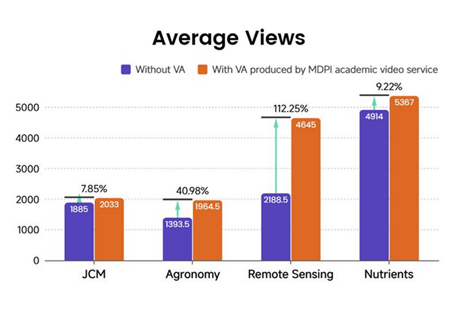
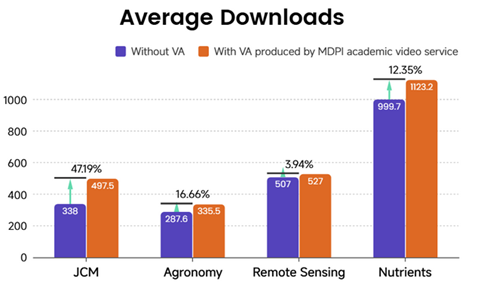
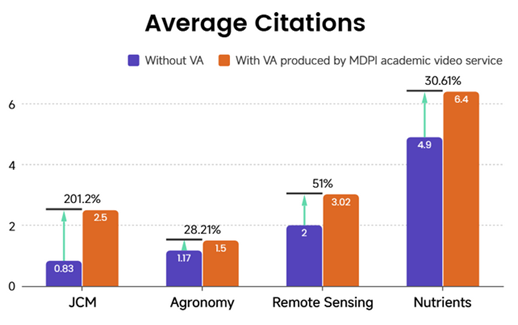
Figure 1. MDPI video abstract impact report. Comparison of the effects of video abstracts on article views, downloads, and citations across four journals: JCM, Agronomy, Remote Sensing, and Nutrients. The analysis covers all articles published between 1 January 2023 and 31 October 2025. In this study, 30 articles accompanied by video abstracts produced by the MDPI Academic Video Service were included as the video abstract group, while the remaining 24,906 articles published during the same period without video abstracts were used as the control group [8].
These findings collectively demonstrate that video abstracts enhance both the academic depth and societal reach of research, achieving a dual impact on influence.
2.2. From Journals to Social Platforms
Compared with traditional academic papers, video abstracts are more easily integrated into the dissemination mechanisms of social media and video platforms. This advantage is driven by both algorithmic preferences for video content and human cognitive processes.
According to Mayer’s multimedia learning theory, combining text with images or video improves comprehension and memory retention. Research by Guo et al. further shows that shorter videos, especially those under six minutes, achieve significantly higher completion rates [9].
Video abstracts, typically 3–5 minutes in length, effectively present core research findings within a limited timeframe while avoiding cognitive overload. This format aligns well with contemporary patterns of fragmented information consumption, enabling broader dissemination of research outcomes.
Moreover, a study in the European Journal of Sport Science found that professionally produced animated video abstracts significantly outperform text-based or author-produced videos in terms of attention, reach, and engagement on the X platform [10].
Leading institutions such as the University of Cambridge, Duke University, and the University of Hong Kong also recommend the use of video abstracts to enhance research visibility and impact, providing clear guidance for researchers, particularly early-career scholars.
3. Where Video Abstracts Make the Biggest Difference
With increasing adoption, video abstracts are now applied across multiple stages of academic activities, all aimed at improving communication efficiency:
- Journal and database platforms: As supplementary materials, video abstracts help users quickly assess relevant information during literature searches.
- Academic conferences and seminars: They enable audiences to grasp key findings rapidly, allowing discussions to focus on substantive issues.
- Grant applications and research reporting: They provide intuitive presentations of innovation and methodology within limited evaluation time.
- Interdisciplinary collaboration: They offer a more accessible communication tool, reducing barriers between researchers from different fields.
- Teaching and science communication: They help non-specialist audiences understand complex research topics.
The practical value of video abstracts is becoming increasingly evident. Through diverse application scenarios, they promote academic exchange and collaboration while demonstrating unique advantages across multiple domains.
4. What’s Next for Video in Research Communication
The rise in video abstracts is not accidental but reflects the combined evolution of open science, digital publishing, and diversified communication formats. As research dissemination expands across platforms and multimedia environments, text-centered formats alone are no longer sufficient.
Major academic publishers—including MDPI, Springer Nature, Elsevier, Wiley, and Taylor & Francis—have already incorporated video abstracts into journal platforms and author guidelines, recognizing them as an important tool for enhancing visibility and dissemination.
In this context, MDPI’s Academic Video Service provides comprehensive support centered on video abstracts, including scriptwriting, animation design, professional voiceover, and multi-platform promotion. These videos can be directly embedded into article pages, improving dissemination efficiency while enhancing the traceability and long-term visibility of academic outputs.
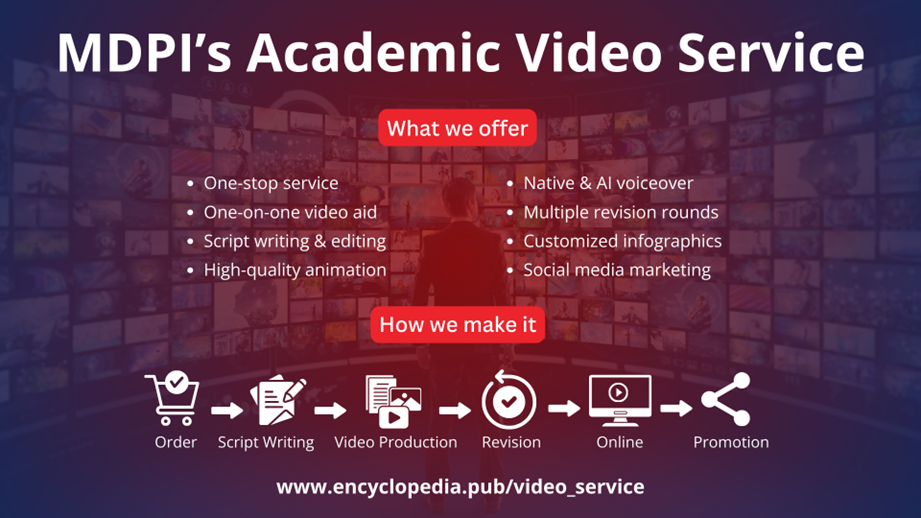
Figure 2. MDPI academic video service.
References
[1] Digital 2024: Global Overview Report. Available online: https://datareportal.com/reports/digital-2024-global-overview-report (accessed on 15 January 2026)
[2] Cisco Predicts More IP Traffic in the Next Five Years Than in the History of the Internet. Available online: https://newsroom.cisco.com/c/r/newsroom/en/us/a/y2018/m11/cisco-predicts-more-ip-traffic-in-the-next-five-years-than-in-the-history-of-the-internet.html?utm_source.com (accessed on 15 January 2026)
[3] Huang, S.; Weng, Y.; Yang, Q. Current Status and Development Strategies of Science Journal Video Channels on WeChat: A Case Study of Chinese Academy of Sciences Journals. Chin. J. Sci. Tech. Period. Res. 2023, 34, 1392–1398.
[4] Spicer, S. Exploring Video Abstracts in Science Journals: An Overview and Case Study. J. Librariansh. Sch. Commun. 2014, 2, eP1110.
[5] Bredbenner K.; Simon S.M. Video abstracts and plain language summaries are more effective than graphical abstracts and published abstracts. PLOS ONE 2019, 14, e0224697.
[6] Zong, Q.; Xie, Y.; Tuo, R.; Huang, J.; Yang, Y. The impact of video abstract on citation counts: evidence from a retrospective cohort study of New Journal of Physics. Scientometrics 2019, 119, 1715–1727.
[7] Bonnevie, T.; Repel, A.; Gravier, F.E.; Ladner, J.; Sibert, L.; Muir, J.F.; Cuvelier, A.; Fischer, M.O. Video abstracts are associated with an increase in research reports citations, views and social attention: a cross-sectional study. Scientometrics 2023, 128, 3001–3015.
[8] MDPI Video Abstract Impact Report 2025. Available online: https://encyclopedia.pub/insights/impact-report-2025-how-mdpi-video-abstracts-enhance-research-visibility(accessed on 15 January 2026)
[9] Guo, P.J.; Kim, J.; Robin, R. How video production affects student engagement: an empirical study of MOOC videos. Proceedings of the first ACM conference on Learning @ scale conference; Association for Computing Machinery: New York, USA. 2014, 41–50. 10.1145/2556325.2566239.
[10] Erskine, N.; Hendricks, S. What is the effect of posting video abstracts on journal article impact? J. Vis. Commun. Med. 2024, 47, 47-55. doi: 10.1080/17453054.2024.2423087.