For years, cybersecurity has been a game of asymmetric warfare. Human defenders, outnumbered and outpaced, have fought against an endless tide of malware, phishing, and brute-force attacks. But the rules are changing. The rise of generative and autonomous artificial intelligence has turned this silent war into a lightning-fast duel of algorithms. Welcome to the next cybersecurity battlefield: AI versus AI.
Attackers no longer need to write painstaking lines of exploit code. They now deploy Large Language Models (LLMs) to craft spear-phishing emails that perfectly mimic a boss’s tone, generate polymorphic malware that rewrites itself each time it infects a machine, and automate the discovery of zero-day vulnerabilities in hours instead of weeks. On the other side, defenders counter with AI-driven security orchestration, real-time anomaly detection, and adversarial training. The battlefield is no longer human versus machine; it is machine versus machine, with milliseconds determining the victor (Figure 1).
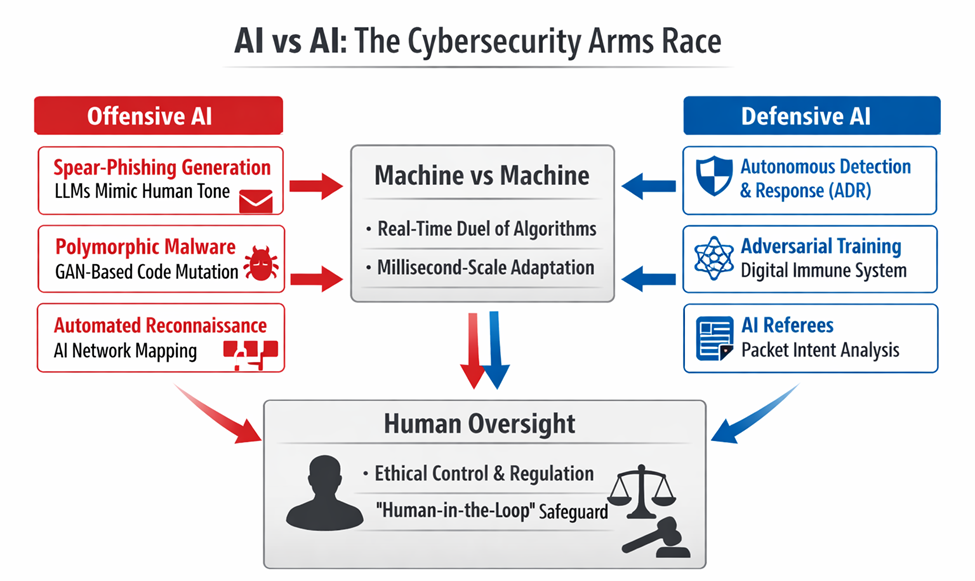
Figure 1. Flowchart illustrating the evolving cybersecurity arms race between offensive and defensive AI systems.
1. The Rise of Offensive AI
The democratization of AI models has lowered the barrier to cybercrime. Malicious actors now use AI to scale attacks that were once too labor-intensive. Consider the traditional phishing email: usually riddled with grammatical errors and suspicious links. Offensive AI changes that. By ingesting a target’s public social media data, an AI can generate a highly personalized message, referencing recent projects or inside jokes. According to a recent industry analysis, AI-generated phishing emails have click-through rates comparable to legitimate internal communications, making them nearly impossible for humans to spot [1].
Beyond deception, AI enables adaptive malware. Traditional signature-based antivirus fails against code that rewrites its own logic on every execution. Using generative adversarial networks (GANs), attackers can create malware variants that evade even behavior-based detection systems. A 2025 report noted that AI-driven ransomware can now identify high-value files, encrypt them, and negotiate ransom amounts dynamically based on the victim’s financial data scraped from compromised systems [2].
Worst of all is the automation of reconnaissance. AI agents can sweep through networks silently, learning patterns of legitimate traffic, mapping user behaviors, and waiting for the perfect moment to strike. This is not a future threat; it is already happening.
2. The Defensive Counter-Revolution
In response, defenders are weaponizing AI as well. Modern Security Operations Centers (SOCs) are drowning in alerts, thousands per day, most of them false positives. AI-powered Security Information and Event Management (SIEM) systems now filter this noise, correlating events across endpoints, clouds, and identities. But the real game-changer is Autonomous Detection and Response (ADR). Unlike rule-based systems, ADR platforms use unsupervised learning to establish a baseline of “normal” activity across a network. When an offensive AI begins its reconnaissance, ADR spots the subtle statistical anomalies, a user account logging in from two continents within seconds, or a process writing encrypted data at an unusual speed, and triggers countermeasures before any damage is done.
One of the most promising defensive techniques is adversarial machine learning. Here, defenders train their models on attacks generated by rival AIs. In effect, they create a "digital immune system" that has already seen millions of variations in AI-driven malware. These models can then predict and block mutations in real time [3]. Leading tech firms have deployed so-called “AI referees” that sit between networks and external traffic, analyzing every packet’s intent rather than just its signature.
3. The Cat-and-Mouse Game Accelerates
What makes AI vs AI unique is the speed of the arms race. Human hackers need days or weeks to reverse-engineer a defense and craft a new exploit. An offensive AI can do it in seconds. For example, a defensive AI might learn to block a certain pattern of SQL injection attempts. Within minutes, an offensive AI can generate thousands of novel injection strings, test which one bypasses the filter, and launch a refined attack. This forces defenders to adopt real-time model updating, a practice known as "continuous learning" in cybersecurity.
Yet this speed comes with a dangerous side effect: model poisoning. Attackers have learned to feed defensive AIs deliberately crafted false data, causing them to mislabel malicious activity as benign. Thus, the battle is not just about who has the smarter AI, but who can better protect the integrity of their AI’s training data.
4. The Human Element Remains
Despite the machine-versus-machine frenzy, cybersecurity professionals are far from obsolete. Their role is shifting from front-line warrior to strategic commander. Humans now design the reward functions that guide defensive AI, investigate edge cases that confuse models, and make ethical judgments, like whether an automated counterattack is legal or proportionate. In fact, the most effective teams operate as "centaurs": humans and AI collaborating, each covering the other’s blind spots. AI provides speed and scale; humans provide context and creativity.
Regulation is also entering the fray. Governments are debating rules for offensive AI use, especially for nation-state actors. The emerging consensus is that any AI used in active defense must have a "human-in-the-loop" for actions like isolating critical infrastructure or deploying counter-hacking measures. Without such safeguards, an autonomous AI war could spiral into chaos, two machine learning models recursively attacking each other, consuming bandwidth and compute, while real assets are left exposed.
5. The Future Battlefield
Looking ahead three to five years, several scenarios are plausible. The first is a stalemate where offensive and defensive AI evolve in lockstep, forcing attackers to return to low-tech methods like social engineering. The second, more alarming scenario is the "AI breakout", when a single offensive AI discovers a novel exploit that renders all current defenses useless, leading to a wave of catastrophic breaches before a patch is developed. The third is a regulated equilibrium, where governments mandate AI safety standards for cybersecurity tools, much like they do for automobiles and medical devices.
What is certain is that the era of purely human-led defense is over. Every enterprise, from local hospitals to global banks, must now invest in AI-driven security or be annihilated by AI-driven crime. The next great cybersecurity battlefield is not a place. It is a neural network versus another neural network, fighting silently in the cloud, with our digital lives as the prize.
6. Conclusion
AI vs AI is not a Hollywood fantasy; it is the new reality of cyber conflict. Offensive AI lowers the skill floor for attackers while raising the speed ceiling for everyone. Defensive AI offers the only hope of keeping pace. As we have seen, this cat-and-mouse game has become instantaneous, relentless, and unforgiving. For security professionals, the message is clear: learn to harness, trust, and verify your AI defenders, because on the other side of the firewall, another AI is already learning how to beat them.
References
- Heiding, F.; Lermen, S.; Kao, A.; Schneier, B.; Vishwanath, A. Evaluating Large Language Models' Capability to Launch Fully Automated Spear Phishing Campaigns: Validated on Human Subjects. 2024, arXiv preprint arXiv:2412.00586.
- Faddom. AI and Ransomware: The Double-Edged Sword. Faddom Inc. 2025, Available online: https://faddom.com/ai-and-ransomware-the-double-edged-sword/ (Accessed on 29 April 2026).
- Huang, W.; Chu, D.-T.; Bai, L.-Y.; Kang, W.; Zhang, H.-T.; Li, B.; Han, Z.-M.; Ge, J.; et al. EvoMail: Self-Evolving Cognitive Agents for Adaptive Spam and Phishing Email Defense. 2025, arXiv preprint arXiv:2509.21129.
Biography
Dr. Hamed Taherdoost is an award-winning researcher, educator, and R&D leader with over two decades of international experience across academia and industry. He is a Professor at University Canada West and holds academic affiliations with Westcliff University (USA), GISMA University of Applied Sciences (Germany), and Victorian Institute of Technology (Australia). He is a GUS Institute Fellow (UK), a Westcliff Faculty Fellow, and a Fellow at the National Kaohsiung University of Science and Technology, Taiwan. His work spans digital transformation, cybersecurity, AI, and technology innovation, with hundreds of high-impact publications. Dr. Taherdoost serves as Book Series Editor for Routledge’s Mastering Academic Excellence and holds editorial roles with leading international journals.