
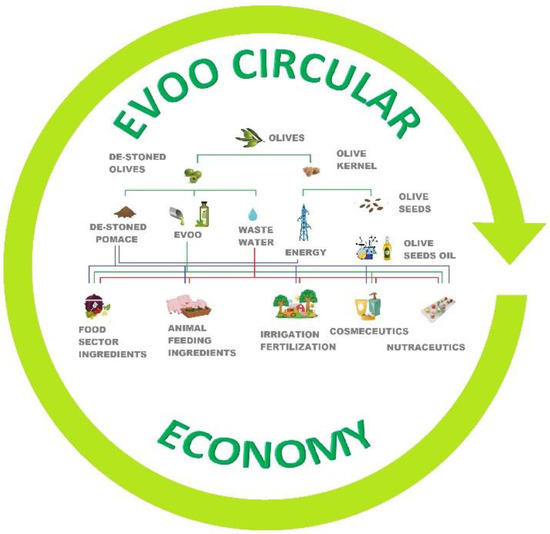
Extra-virgin olive oil (EVOO) contains many bioactive compounds with multiple biological activities that make it one of the most important functional foods. Both the constituents of the lipid fraction and that of the unsaponifiable fraction show a clear action in reducing oxidative stress by acting on various body components, at concentrations established by the European Food Safety Authority’s claims. In addition to the main product obtained by the mechanical pressing of the fruit, i.e., the EVOO, the residual by-products of the process also contain significant amounts of antioxidant molecules, thus potentially making the Olea europea L. an excellent example of the circular economy. In fact, the olive mill wastewaters, the leaves, the pomace, and the pits discharged from the EVOO production process are partially recycled in the nutraceutical and cosmeceutical fields also because of their antioxidant effect.
- Olea europea L.
- olive oil
1. Introduction
2. Olea europea L.: Overview on Its Chemical Compounds
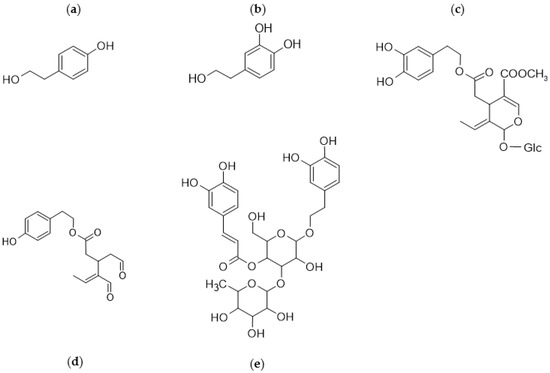
| Seed Oil | Virgin Olive Oil | Skin | Pulp | Wood | Leaves |
|---|---|---|---|---|---|
| Phenolic acid/aldehydes | Phenolic acid/aldehydes | Phenolic acid/aldehydes | Phenolic acid/aldehydes | Phenolic acid/aldehydes | Phenolic acid/aldehydes |
| Tocopherols | Tocopherols | Tocopherols | |||
| Sterols | Sterols | Organic acid and coumarins | Organic acid and coumarins | Organic acid and coumarins | Organic acid and coumarins |
| Flavonoids | Simple phenols and derivatives | Simple phenols and derivatives | Simple phenols and derivatives | ||
| Lignans | Secoiridoids and derivatives | Secoiridoids and derivatives | Secoiridoids and derivatives | ||
| Fatty acids and derivatives | Flavonoids | Flavonoids | |||
| Pentacyclic triterpenes |
Tocopherols |
This entry is adapted from the peer-reviewed paper 10.3390/molecules26041072