Abstract
Barriers to entry are structural and strategic obstacles that restrict new firms from entering a market and competing effectively against established firms. These barriers are central to understanding market power because they explain how dominant firms sustain control and prevent competitive disruption. Within the Market Power Hierarchy Framework, barriers to entry serve as the mechanisms through which temporary competitive advantage becomes long-term dominance. They may arise naturally from industry structure or be intentionally reinforced through strategic actions by dominant firms. This entry identifies ten major barriers to entry that shape market control and explains how these barriers influence competition, innovation, and long-term market concentration.
- Introduction
Market power plays a central role in shaping competition, pricing behavior, and long-term economic outcomes. Traditional economic models often classify markets into fixed categories such as perfect competition, oligopoly, and monopoly. While these classifications provide useful theoretical foundations, they do not fully explain how firms gradually move from competitive participation to increasing levels of dominance.
The Market Power Hierarchy Framework provides a structured way to understand this progression by organizing market dominance into measurable levels of control. Rather than treating competition and monopoly as separate market states, the framework recognizes that market power develops through stages. As firms gain market share, competitive constraints weaken, strategic independence increases, and the ability to shape market conditions becomes more significant.
A critical feature of The Market Power Hierarchy Framework is the recognition that dominance is sustained through structural barriers that restrict competition. Among the most significant mechanisms are the 10 Barriers to Entry and Market Control, which determine whether new firms can successfully enter a market and challenge established competitors.
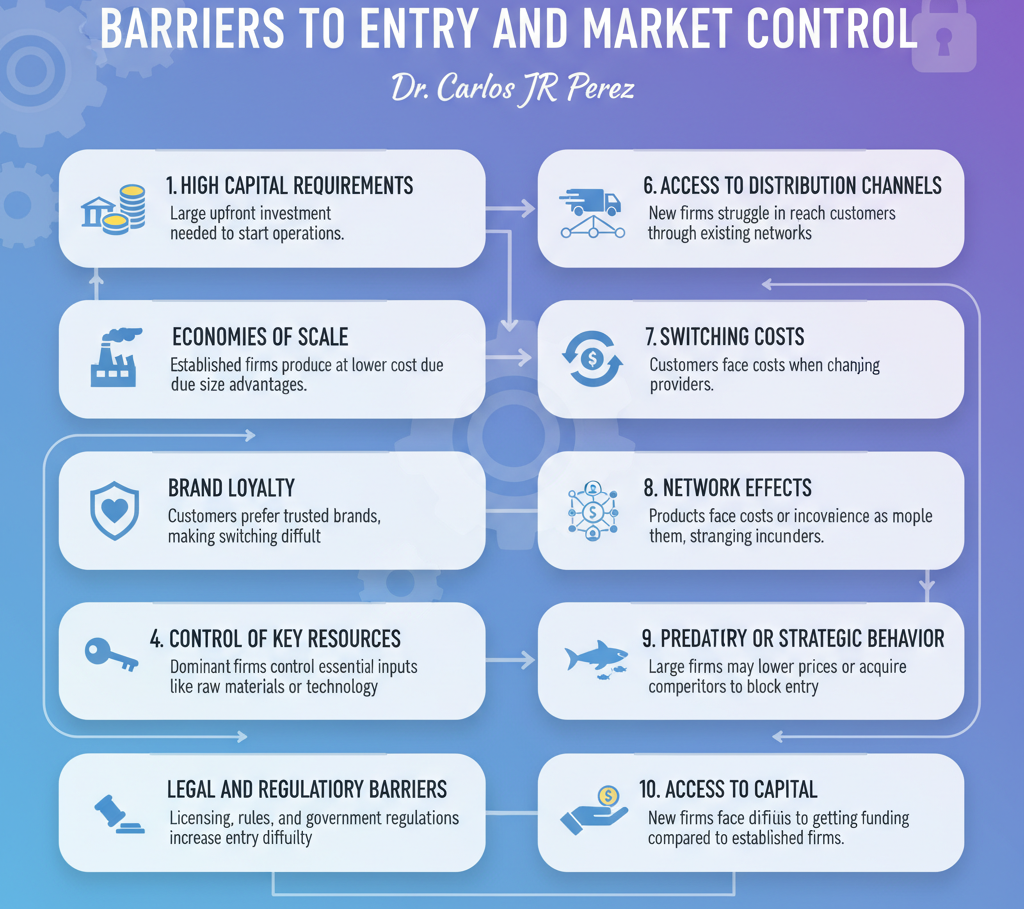
The 10 Barriers to Entry and Market Control include high capital requirements, economies of scale, brand loyalty and customer trust, control of key resources, legal and regulatory barriers, access to distribution channels, switching costs, network effects, predatory and strategic behavior, and access to capital and financing. Each barrier contributes to limiting competitive access while strengthening the position of dominant firms.
These barriers rarely operate in isolation. In concentrated markets, they often reinforce one another to create layered systems of protection that preserve market control over time. A firm benefiting from multiple barriers gains stronger pricing power, greater operational stability, and increased freedom to shape competitive conditions.
Within The Market Power Hierarchy Framework, the interaction of these barriers explains how temporary competitive advantages evolve into durable dominance. Understanding the 10 Barriers to Entry and Market Control is therefore essential for analyzing market concentration, evaluating competition, and explaining how modern industries move toward long-term structural control.
The following ten barriers represent the most significant mechanisms through which firms maintain market power.
- High Capital Requirements
High capital requirements represent one of the most visible and restrictive barriers to market entry. Certain industries require firms to commit substantial financial resources before they can begin operations. These costs may include physical infrastructure, advanced equipment, research and development systems, production facilities, software architecture, compliance systems, and workforce training.
The significance of this barrier lies in timing and risk. A new entrant must often invest heavily long before generating revenue, creating substantial uncertainty. If the business fails to gain sufficient market share, these sunk costs cannot easily be recovered. This discourages many potential entrants from attempting entry in the first place.
Industries such as telecommunications, commercial aviation, energy generation, semiconductor manufacturing, and pharmaceutical development frequently exhibit this barrier. For example, establishing a nationwide telecommunications network requires extensive infrastructure construction, licensing, maintenance systems, and technological integration. Because only large organizations can absorb such financial risk, existing firms face limited competitive pressure.
High capital requirements therefore concentrate participation among well-funded firms and create structural protection for dominant incumbents.
Some industries require substantial financial investment before a firm can begin operations. This includes infrastructure, equipment, facilities, research systems, and operational networks.
High capital requirements create immediate financial risk and prevent smaller firms from entering the market.
For example, entering the telecommunications industry requires billions of dollars to build towers, fiber-optic systems, software infrastructure, and service coverage. Few firms possess sufficient financial capacity, allowing existing providers to maintain concentrated control.
- Economies of Scale
Economies of scale occur when larger firms reduce average production costs by increasing operational output. As production expands, fixed costs such as facilities, administration, logistics, and technology systems are distributed across more units, lowering the cost per unit.
This creates a strong competitive advantage for established firms. Large-scale firms often negotiate lower supplier prices, optimize production efficiency, and utilize sophisticated distribution systems that smaller firms cannot match.
For new entrants, this creates immediate structural disadvantage. Because they begin at smaller scale, their average costs are higher, often forcing them to charge higher prices or accept lower profit margins.
For example, a multinational retailer can distribute goods across global supply chains at significantly lower cost than a regional startup. Even if product quality is identical, the cost advantage of scale allows the larger firm to compete more aggressively.
This barrier reinforces concentration by making sustained competition financially difficult for smaller entrants.
Economies of scale occur when larger firms reduce average production costs by increasing output.
Large firms benefit from bulk purchasing, production efficiency, specialized labor systems, and optimized logistics. These advantages lower operational costs and improve profitability.
For example, a global retailer can purchase inventory at lower wholesale prices than a local competitor. This allows lower consumer pricing that smaller firms cannot match, limiting competitive entry.
- Brand Loyalty and Customer Trust
Brand loyalty is built through long-term consumer experience, consistent product quality, effective marketing, and emotional familiarity. Over time, consumers develop trust in established brands, reducing uncertainty in purchasing decisions.
This creates a significant barrier because customers often prefer familiar brands even when alternatives offer lower prices or superior features. Consumer decisions are not purely rational; they are shaped by habit, perception, social recognition, and psychological comfort.
For new firms, overcoming this barrier requires substantial investment in marketing, reputation-building, customer service, and promotional incentives.
A practical example can be seen in consumer electronics. New smartphone brands may introduce innovative products, yet many consumers remain committed to established brands because of ecosystem familiarity and long-term trust.
This psychological barrier slows market penetration and protects established firms from competitive displacement.
Brand loyalty develops when consumers consistently associate a company with quality, reliability, or familiarity.
Consumers often remain with trusted brands even when alternatives offer lower prices or improved features.
For example, a new smartphone manufacturer may offer stronger technical performance, but many consumers continue purchasing established brands because of trust, familiarity, and ecosystem comfort.
This psychological resistance creates a significant barrier for new competitors.
- Control of Key Resources
Control over critical resources provides firms with direct structural advantage. These resources may include proprietary technology, patents, exclusive supplier contracts, scarce raw materials, specialized expertise, or critical infrastructure systems.
When dominant firms control these assets, competitors face serious operational disadvantages. Without access to essential inputs, new entrants may be unable to produce comparable products or may incur significantly higher costs.
This barrier is especially powerful because it affects competition at the production level rather than consumer preference alone.
For example, a pharmaceutical company with exclusive patent rights can legally prevent other firms from manufacturing identical treatments for a fixed period. Similarly, control over rare mineral supply chains may restrict manufacturing access for competing technology producers.
Control of key resources therefore creates direct exclusionary power.
Dominant firms often control essential resources needed for production or distribution.
These resources may include patents, specialized technology, supplier relationships, raw materials, proprietary systems, or industry expertise.
For example, a pharmaceutical company holding exclusive patent rights can prevent competitors from producing equivalent medicine for years, securing strong market control.
This barrier directly limits competitive access.
- Legal and Regulatory Barriers
Governments establish legal and regulatory systems to ensure safety, reliability, environmental protection, and public welfare. While these rules serve important public purposes, they often increase the complexity and cost of entering a market.
Regulatory barriers may include licensing procedures, product certification, environmental reviews, legal approvals, safety inspections, and ongoing reporting obligations.
Established firms usually possess greater institutional knowledge and legal capacity to navigate these systems. New entrants often face delays, uncertainty, and significant compliance costs.
For example, launching a new airline requires extensive regulatory approval involving aircraft certification, pilot training compliance, insurance requirements, airport access agreements, and operational safety audits.
These legal hurdles protect market integrity but also reduce entry accessibility, often reinforcing existing market concentration.
Governments impose regulations to ensure safety, reliability, and public protection.
However, these regulations often create costly compliance requirements that discourage new market entry.
For example, new airline companies must satisfy extensive licensing, aircraft certification, insurance, and safety standards before operating commercially.
Large established airlines can absorb these costs more easily than startups, reinforcing dominance.
- Access to Distribution Channels
Distribution determines whether products reach consumers effectively.
Established firms frequently control key retail relationships, logistics systems, warehouse networks, online visibility, and platform positioning. These advantages ensure consistent market access.
New entrants may struggle to secure shelf placement, digital discoverability, transportation infrastructure, or retailer cooperation.
A small food manufacturer, for example, may produce superior products but fail commercially because major supermarkets prioritize established supplier agreements.
Digital markets display similar barriers. Dominant platforms often control search visibility and recommendation algorithms, limiting exposure for new entrants.
Without effective distribution access, competitive viability becomes severely constrained.
A product must reach consumers effectively to compete.
Established firms often control retail relationships, logistics systems, shelf placement, and digital platform visibility.
For example, major beverage companies secure premium supermarket shelf placement through long-term agreements. Smaller competitors struggle for visibility even when product quality is comparable.
Without distribution access, effective competition becomes nearly impossible.
- Switching Costs
Switching costs refer to obstacles consumers face when changing from one provider to another.
These costs may be financial, technical, operational, or psychological. Examples include cancellation fees, retraining requirements, compatibility loss, data transfer difficulty, workflow disruption, and consumer uncertainty.
Even modest switching inconvenience can strongly discourage movement.
For example, businesses using enterprise software systems often remain with existing providers because switching requires staff retraining, system integration changes, and temporary productivity disruption.
This creates customer lock-in, reducing competitive pressure even when superior alternatives exist.
Switching costs therefore stabilize dominant market positions by limiting consumer mobility.
Switching costs are obstacles consumers face when changing providers.
These costs may involve financial penalties, technical retraining, lost compatibility, data migration difficulties, or inconvenience.
For example, businesses using enterprise software often remain with established providers because changing systems requires retraining staff, transferring data, and disrupting operations.
This customer lock-in protects dominant firms from competition.
- Network Effects
Network effects occur when a product’s value increases as more users adopt it.
This barrier is especially powerful in digital markets such as communication platforms, marketplaces, operating systems, and social networks.
The larger the user base, the greater the product’s usefulness. This attracts additional users, reinforcing growth.
New entrants face immediate disadvantage because they begin with limited user participation, reducing perceived value.
For example, a new messaging platform may offer superior features but struggle because users remain where their existing contacts are already active.
This self-reinforcing dynamic often produces rapid concentration and durable digital dominance.
Network effects occur when product value increases as more users adopt it.
The larger the network, the greater its attractiveness to new users.
For example, social media platforms become more valuable as more users join. A new platform may offer better features but struggle because users prefer established networks where their contacts already exist.
This self-reinforcing effect accelerates concentration.
- Predatory and Strategic Behavior
Dominant firms sometimes use deliberate strategies to discourage competition.
These actions may include temporary below-cost pricing, rapid product imitation, exclusive supplier agreements, aggressive acquisitions, or market saturation through product expansion.
The purpose is not necessarily immediate profit, but deterrence.
For example, a dominant retailer may sharply reduce prices in markets where new competitors emerge, making competition financially unsustainable until rivals exit.
Potential entrants observing this behavior may avoid entering entirely.
This strategic deterrence strengthens dominance by increasing perceived competitive risk.
Dominant firms may use deliberate strategies to discourage competition. These include temporary price reductions, acquisitions of emerging competitors, rapid product imitation, and exclusive agreements.
For example, a dominant online retailer may lower prices aggressively in response to new entrants, making market entry financially unsustainable.
These actions increase uncertainty and discourage competitive investment.
- Access to Capital and Financing
Financial access determines whether firms can launch, survive, and scale.
Established firms benefit from strong credit histories, investor confidence, market reputation, and institutional financing relationships.
New firms often face limited funding opportunities, higher borrowing costs, and greater investor skepticism.
This restricts investment capacity for infrastructure, marketing, staffing, technology development, and expansion.
For example, a multinational technology firm can secure billions in capital for platform development, while startups may struggle to raise sufficient seed funding.
This financial imbalance reinforces dominance by enabling incumbents to outspend and outlast emerging competitors.
Financial resources determine whether firms can enter, survive, and expand.
Established firms usually possess stronger credit ratings, investor trust, and easier financing access.
For example, a multinational technology company can raise billions through capital markets, while a startup may struggle to secure even limited venture funding.
This imbalance restricts competitive growth and reinforces market concentration.
- Conclusion
The ten barriers to entry represent the primary mechanisms through which firms sustain market control and preserve dominance over time. These barriers rarely operate independently. Instead, they reinforce one another to create layered systems of protection that make competition increasingly difficult.
A dominant firm may simultaneously benefit from scale efficiency, customer loyalty, regulatory familiarity, distribution control, switching resistance, network effects, and superior financing access.
This interconnected structure transforms temporary advantage into lasting dominance. Within the Market Power Hierarchy Framework, understanding these barriers is essential for explaining how concentrated markets evolve and why competition often fails to emerge even in dynamic industries.
References
Bain, J. S. Barriers to New Competition. Harvard University Press, 1956.
Porter, M. E. Competitive Strategy: Techniques for Analyzing Industries and Competitors. Free Press, 1980.
Stigler, G. J. “Barriers to Entry, Economies of Scale, and Firm Size.” Journal of Political Economy, 1968.
Tirole, J. The Theory of Industrial Organization. MIT Press, 1988.
Schmalensee, R. “Industrial Economics: An Overview.” Economic Journal, 1989.
