Your browser does not fully support modern features. Please upgrade for a smoother experience.

Please note this is an old version of this entry, which may differ significantly from the current revision.
It is my aim to investigate the conditions under which a manifold with conic singularity is made to correspond to the GR spacetimes, i.e., to one endowed with the complete fundamental group, after the base point of the conic singularity is removed. The crepant resolution of conical singularities is discussed within this context. For these purposes, the meterization conditions of Zariski topologies are recalled after the Troyanov theorems are scrutinized. The preparation of the General-Relativistic spacetimes originated after the exposed methodologies from the pertinent Calabi-Yau manifolds is described. In particular, the tangent flows on meterized Ricci gradient solitons is proven to be unique after the Einstein Field Equations are imposed; the details of the preparation are discussed for shrinkers. The Einsteinian spacetimes with vanishing volume growth of the meterized solitons are then prepared.
- General-Relativity
- Calabi-Yau varieties
- Meterized weighted manifolds
- Crepant cone resolution
- experimental validations in String Theory
1. The Removal of the Base of the Cone
What is the crepant resolution of a conical singularity?
The topological coverings spaces of the complements obtained after the removal of the base of the cone (forming the conical singularity) correspond directly to the subgroups of the fundamental group when the space is path connected, locally path connected, and semilocally simply connected.
One here comments that the the complement is geodesically-path connected, then the complement is unique and separable.
There is a one-to-one correspondence between connected covering spaces P :Y → X/S and conjugacy classes of subgroups π1(X/S), as from [1] chapter 1.3. From [1] chapter 1.2, the Van Kampen theorems is utilised to prove that forall group G there exists a space XG whose fundamental group is isometric to G: the case of Riemannian manifolds is analysed; the results are extended to pseudo-Riemannian spaces with topology of connectedness at infinity.
2. Meterization Tools of Noncompact Spacetimes
How are noncompact spacetimes resulting from topological spaces meterized?
The study of the curvature on a meterized Riemann surface, i.e. one with a conformal class of Riemannian metrics is afforded in citetroy1; ibidem, the result is newly proven that ’on any connected noncompact Riemann surface of finite type, it is possible to construct complete metrics, the complete metric being unique. Te asymptotic geometries for these problems were considered in [2][3], while the present purpose is to investigate spacetimes which obey the Birkhoff theorem.
It is remarked from [4] that new statement of the Gauss-Bonnet operator after the definitions of a pertinent invariant (of a 4-spcedimensional Riemannian manifold with cones) and a new linear second-order operator are built. From [5], the local formulation of the Gauss-Bonnet theorem is proposed, which is extended after the geodesics curvature and after the sum of the angles external to the vertices on the frontier (boundary of the manifold) which is requested to be piecewise regular.
The existence of a conformal metric is proven after the Troyanov theorem; conformal equivalence is proven from ibidem under conformal transformations of the metric tensor, which are those compatible with the Ricci flow reconciled with the Einstein Field Equations: from [4], the curvature is apt fro the topology to be unchanged after the Laplace-Beltrami operator with respect to the metric is applied to the regular function defining the conformal factor of the meterization- the Zariski topology is in these cases metrized the analysis of [6] notwithstanding, i.e., in particular after the final remark form ibidem. Isoperimetric estimates in this case are provided from [7].
3. Geodesics-Path Connected Complements
Are the geodesic paths complete from complements?
Completeness of pseudo-Riemannian manifolds is here discussed as follows.
Is it proven straightforward newly that, given X a Riemannian manifold, then the complement X/S is geodesically connected as S is in this case b0 the point of the base of the cone, which has codimension 4 in four-spacetime-dimensional Einsteinian spacetimes. The lifting of geodesics is discussed in Section 4.
3.1. Removing a Point form a Projective Variety
It is my aim to prove that removing one point ’at infinity’ from a projective variety allows one to obtain the remaining part which is isomorphic to an affine space.
The conditions are then imposed for the obtention of the Einsteinian spacetimes, where weighted manifolds can be constructed.
The topological covering of the complement space is discussed about completeness.
The topological covering of the complement space corresponds to the complete fundamental group when the universal covering space is taken as the covering.
3.2. Separable Complements
The cover of the complement X/S of a separable space X corresponds to the fundamental group
- if and only if X/S is locally-path connected; and
- if and only if X/S is semilocally simply connected.
For the complement X/S to be geodesically path connected, X/S must be separable.
Separability is proven of complete connected pseudo-Riemannian manifolds. The removed point b0 is requested not to discard the path-connectedness.
3.3. Complete, Separable Metric Space Complements
The necessary conditions of regularity for the existence of the covering spaces are gotten when the complement is a separable completely metrizable topological (Polish) space.
The definition of conical manifolds as being asymptotic to a unique metric cone in taken from the recent analysis [8].
4. Methodology to Obtain the Complete Fundamental GR Diffeomorphisms Group
How is the complete fundamental GR diffeomorphisms group obtained?
It is my aim to prove how to obtain the GR diffeomorphisms group when the topological covering of the complement of the affine space from an algebraic variety after the removal of the conical singularity.
The topological covering of the complement of a space is defined as the subgroups of the fundamental group πi(X − C, b0). Here, (X − C, b) can be, in general, path connected, locally-path connected, or semi-locally path connected.
The condition of the full correspondence are as follows.
1. The fundamental groups and subgroups forall subgroup H ⊂ πi(X − C, b) there exists a the covering space Π such that E → X − C; after words, the induced map Π ∗ (C, lo) is induced as isomorphic to H0: the universal covering has to be studied.
2. If the complement X − c is semilocally simply connected, then there exists X ≃ Γ the universal cover; this way,
2a: it corresponds to the trivial subgroup, and
2b: it is simply connected.
3. Regularity is proven in the cases X − C should be
3a: locally-path connected; or
3c: semilocally simply connected.
This implementation hold for complements of algebraic curves/ hypersurfaces in complex/projective affine spaces: the dimension of the affine complement is taken, for the moment, as generic.
4. Galois correspondence is analyzed. For these purposes, the isomorphisms of the coverings are such that the deck transformations are proven to be the Perelman diffeomorphisms when the normal covering is isomorphic to the quotient of the fundamental group by the corresponding normal subgroup. Differently stated, this is the action of the complete fundamental group of the covering.
The methodology is applied also to Calabi-Yau crepant cones
5. Methodology to Obtain the Perelman Diffeomorphism Group on Weighted Manifolds
How is the Perelman diffeomorphism written?
It is my aim to prove the the Perelman diffeomorphism is obtained from weighted manifold as the fundamental groups of the manifold which is the topological covering of the complement of an algebraic manifold, from which one conical singularity is removed.
The topological coverings of the complements correspond to the fundamental group(s).
The link of a conical singularity is here the case of the cone.
Is the link of a singularity is removed, a space connected at infinity is obtained if and only if the link is a connected variety, the base of the cone being a topologically-connected space of dimension zero.
The removal of a zero-dimensional space from a connected variety of space dimensions n ≥ 2 allows one to
3.1: obtain a space connected at infinity;
3.2: invoke the Hartogs extension theorems.
As a result, when n ≥ 2 the fundamental group is unchanged.
It is my purpose to apply the methodological tools when n = 3 and then to add one time dimension.
6. Methodology to Obtain Geodesics-Path-Connected Complements
Which complements are geodesics-path-connected?
It is my purpose to obtain geodesics-path connected complements when the cover is unique and it is the fundamental cover.
The topological covering spaces of the complement of a subspace corresponds to the full (i.e., complete) fundamental group of the complement if and only if the covering space is the universal cover.
For the complements to be geodesics-path connected the following conditions have to be respected.
4a: The covering space corresponds to the entire fundamental group if and only if the universal covering space is characterize after having a trivial fundamental group.
4b: The complements of a knot (i.e., a simply closed curve) in S3 of R3 are always path connected.
4c: The the generalized path-connectedness of a complement is obtained if and only if the space is endowed with Riemannian metric; the complement must be connected.
4d: The covering space correspondence can now be investigated.
According to the new reappraisal [9], theorem 4 from ibidem, of the fundamental theorem of covering spaces, there exists a one-to-one correspondence between connected covering spaces E of a space X and the conjugacy classes of sub- groups πi(X, x0)
Result The full group corresponds to the universal cover; the subgroup corresponds to the intermediate cover.
7. Experimental Validations
How are the experimental settings prepared?
It is my aim to describe the needed experimental settings after defining which topologies are to be experimentally looked for.
According to these purposes, it is necessary to define the Physical spacetimes obtained after investigation of the smooth metric spaces.
The instances are here discussed of recently-presented scenarios descending from Calabi-Yau varieties.
7.1. The Cone Structure at Infinity
What is the new description of the Einsteinian cone structure at infinity?
The cone structure at infinity is studied in the work of Cheeger et al. [10] in the Ricci flat case when the volume growth is Euclidean.
In the case I am studying, th geodesics completeness in the noncompact pseudo- Riemannian case is considered; the coverings are proven to be equivalent if and only if the geodesics can be lifted (i.e., projected from the manifold to its covering space) in a coherent manner. The removal of the point makes the cover classify the diverse possible topologies which preserve the structure of the lightcones around the singularity point because the correspondence is biunivocal. This way, to form a cover Π : C → M, one considers a geodesics γ(t) ∈ Mstarting frm the point x; for a point x˜ ∈ Π the behaviour is requested π(x˜) = x, according to which there eists and is unique the curve γ˜(t) ∈ C such that it starts from x˜ and πγ˜(t) ≡ γ(t).
As proven in [11], the volume growth of the obtained solitons is vanishing, i.e. so is the pointed-Hausdorff-Gromov measure distance (because the distances are evaluated as issued from a nonnull set of initial conditions). This way, the scenario recently envisaged in [12] is now to be newly revised and upgraded.
It is a prospective investigation to upgrade also, after [12], the investigation about complete Calabi-Yau manifolds which are asymptotic to Riemannian cones at infinity as well;within the same scheme, the description of the Kaehler solitons is framed after [13][14].
7.2. Construction of Einsteinian Manifolds and the Solitons
How are Einsteinian weighted meterized solitons constructed according to the uniqueness of the tangent flow?
In the work of Goto [15], the affine variety X0 is considered, with only one isolated singularity at p.
Ibidem, the complement X0/p is considered; it is strictly defined as Zariski open subset of X. In the following, the complement X0/p is studied as a smooth affine variety. newly obtain a pseudo-Riemannian manifold after equipping the smooth affine manifold with a metric tensor g, and let the torsion and the non-metricity object vanish, i.e., such that the transport is parallel ∇g = 0 and the
Levi-Civita connections become the Christoffel symbols, which are recalled to be unique in GR: the study of the complement X0/P is now performed, with P ≡ { p} in general. Accordingly, the link to the singularity is described as a smooth manifold Sn −1, with here n2 ≡ 2n.
I here remark that the S2n−1 is visualized as the intersection of X with a small sphere around p; for the definition of the link to the singularity, I let the torsion and the nonmetricity object vanish.
Theorem 5.1 from [15] is now newly revised; given X0 an affine variety with only one normal isolated singularity at p, the complement X0/p is assumed to be bi-holomorphic to a cone C(S) of an Einstein-Sasakian manifold S of dimension 2n−1. If thrre is a resolution of singularity pi : X→X0 endowed with trivial line bundle Kx then there exists a Ricci-flat complete Kaehler metric forall Kaehler class of X.
The resolutions are now taken; it is straightforward proven that it is unique. I here comment that, after [16], the sphere S2n−1 can be biholomorphic with a cone; nevertheless, they are not topologically equivalent: the complex holospheres are made to correspond with the ’space of complex lines’. I further newly comment that, as a sphere is not biholomoorphic with a cone, it cannot be mapped to the cone after an invertible holomorphic map to a cone. Nonetheless, I here recall that conic metrics can exist on spheres; the sphere is unique.
The conformal equivalence after meterization is now newly proven after the Troyanov theorem; the conic metric is explained on a sphere as with a unique singularity in one point p, being the conical singularity of 2πα; therefore, it exists in in the point P one has that g− | z | (α−1) =| z | 2.
After the Gauss-Bonnet theorem, the number of points is counted; one needs at least a cigar soliton for the Gauss-Bonnet theorem to be obeyed.
7.3. Topology of the Metrized Solitons in the Einsteinian Spacetimes
The unqiueness of the tangent flow in Einsteinian spacetimes
In the work of Colding et al [17], the tangent flow of the Ricci flow is considered. Ibidem, the possible Ricci flows are investigated.
I recall that the Ricci flow which admits tangent flow is analyzed in the work of Chan et al. [18] after the problem is introduced in the work of Bamler [19]. In [18], a tangent flow at a singular point is proven to be unique. This way, the spacetime prepared in [17] which consists of non-unique tangent flow is not Physical.
Furthermore, in[18], the conditions are prepared to solve the interrogation posed in the work of Chow et al. [20] according to which the ’singularity model is the tangent flow at the singular point’.
In theorem 0.3 from [17], the picture is proposed, that, given a Ricci flow of a meterized manifold, if the tangent flow is a cylinder at a point of the space- time, then all the (further) would-be tangent flows are further -in the sense to be specified, diverse- would-be cylinders at the same point considered; the techniques of gauge or coordinate diffeomorphisms are invoked ibidem. The tangent flow at infinity was considered in [19]. It is straightforward proven after [21] and [11], that forall points of the Ricci flow the corresponding meterized manifold is the weighted pseudo-spherical cylinder in GR, where the instances of the Generalized-Schwarzschild spacetimes are taken, whose ’bases’ are one point at the fictitious singularity and one point at spatial infinity after the Birkhoff theorem. As a result, the tangent flow of the meterized manifold of the pseudo-spherical cylinder in GR is unique up to rescalings of the weights, which are appended at the metric tensor.
The result is straightforward proven forall noncompact pseudo-Riemannian gradient shrinkers.
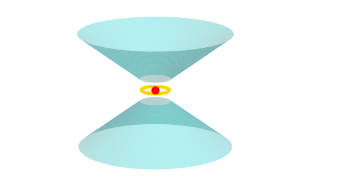
In the diagram, the singularity is represented after the red point of the cone (the base of the cone), i.e., here the geometry is not smooth. The golden line at the middle demonstrates how a crepant resolution replaces the point with a new smooth space (where the divisor is exceptional) where the singularity is modified, but the fundamental properties of the pencil of lines are not requested to be modified though the case is here simplified when the space dimensional model I have reduced, i.e. the aspects of nontriviality if Killing vectors should be considered.
When the Killing vectors are considered, the pertinent holomorphic forms have to be considered.
References
- A. Hatcher, Algebraic Topology, (2001), avalaibale online at https://algebraic-topology.readthedocs.io/en/latest/index.html.
- D. Hulin, M. Troyanov, Prescribing curvature on open surfaces, Math. Ann. 293, 277-315 (1992).
- D. Hulin, M. Troyanov, Sur la courbure des surfaces ouvertes, C.R. Acad. Sci., Paris 310 (S´er. 1), 203-206 (1990).
- S.E. Mc Keown, Extrinsic curvature and conformal Gauss-Bonnet for four- manifolds with corner, Pacific J. Math. 314, 411-424 (2021).
- M. Abate, Lecture Notes, Chapter 4, The Gauss-Bonnet Theorem, University of Pisa.
- University of California Riverside, Lecture Notes, Comparing the metric and Zariski Topologies.
- M. Troyanov, Riemannian Surfaces with Simple Singularities, e-print arXiv:2201.03359.
- M. Li, S. Sun, On Conical Asymptotically Flat Manifolds, Journal of Math- ematical Study 58(2), 188-210 (2025).
- T. Tao, Trying to understand the Galois correspondence, 28 August 2018.
- J. Cheeger, G. Tian, On the cone structure at infinity of Ricci flat manifolds with Euclidean volume growth and quadratic curvature decay, Invent. Math. 118 (1994), 493-571.
- O.M. Lecian, The Yamabe Flow Under the Rotational Ansatz of Noncompact (Pseudo-Riemannian) Solitons: Schwarzschild Solitons and Generalized-Schwarzschild Ones, Axioms 15(4), 267 (2026).
- Z. Yan, X. Zhu, Uniqueness of the asymptotic limits for Ricci-flat manifolds with linear volume growth II, e-print arXiv:2601.01623v1 (2026).
- R.J. Conlon, H.-J. Hein, Asymptotically conical Calabi-Yau manifolds I, e-print arXiv:1205.6347 (2012).
- R.J. Conlon, A. Deruelle, Steady gradient Kaehler-Ricci solitons on crepant resolutions of Calabi-Yau cones, available online at https://perso.imj-prg.fr/alix-deruelle/wp-content/uploads/deruelle- pub/steadies/master2.pdf
- R. Goto, Calabi-Yau structures and Einstein-Sasakian structures on crepant resolutions of isolated singularities, e-print arXiv:0906.5191 (2009).
- S. Gindikin, Holomorphic horospherical duality ”sphere-cone”, Indagationes Mathematicae 16(3-4), 487-497 (2005). Indagationes Mathematicae.
- T.H. Colding, W.P. Minicozzi, Singularities of Ricci flow and diffeomor- phisms, Publ. math. IHES 142, 75-152 (2025).
- P.-Y. Chan, Z. Ma, Y. Zhang, On Ricci flows with closed and smooth tangent flows, eprint arXiv:2109.14763 (2021).
- R.H: Bamler, Structure theory of non-collapsed limits of Ricci flows, e-rpint arXiv 2009.03243 (2020).
- B. Chow, S. Chu, D. Glickenstein et al., The Ricci flow: techniques and applications- Part III- Geometric-Analytic Aspects, Mathematical Surveys and Monographs 163, AMS, Providence, RI (USA), 2010.
- O.M. Lecian, Geodesics Completeness and Cauchy Hypersurfaces of Ricci Solitons on Pseudo-Riemannian Hypersurfaces at the Fictitious Singularity: Schwarzschild-Soliton Geometries and Generalized-Schwarzschild-Soliton Ones, Axioms 14(12), 896 (2025).
- M. Feldman, T. Ilmanen, D. Knopf, Rotationally symmetric shrinking and expanding gradient Kaehler-Ricci solitons, J. Differential Geom. 65 (2), 169-209 (2003).
- B. Kotschwar, L. Wang, A uniqueness theorem for asymptotically cylindrical shrinking Ricci solitons, J. Differential Geom., 126(1), 215-295 (2024).
- T.H. Colding, W.P. Minicozzi II, Singularities and diffeomorphisms, ICCM Not. 10(1), 112-116 (2022).
This entry is offline, you can click here to edit this entry!