
Performance-enhancing drugs (PEDs) are substances used to improve athletic ability, endurance, strength, or recovery beyond the body’s natural limits. While some PEDs have legitimate medical applications, their use in competitive sports is controversial due to ethical concerns, health risks, and violations of fair play principles. Anti-doping agencies and sports governing bodies have established strict regulations and testing protocols to detect and deter PED use in both amateur and professional athletics.
- performance-enhancing drugs
- drugs
- health risks
1. Introduction
Performance-enhancing drugs (PEDs) are substances or methods used to improve athletic performance, endurance, strength, or recovery beyond what can be achieved through training and nutrition alone. PEDs include a wide range of pharmacological agents, hormones, and physiological techniques, such as anabolic steroids, erythropoietin, stimulants, and blood transfusions [1][2]. While some PEDs have legitimate medical uses, their non-therapeutic use in competitive sports has raised ethical, health, and regulatory concerns.
The issue of PEDs extends beyond athletics, as misuse has also been reported in military contexts, academic performance, and even cosmetic applications. This has led to significant debate regarding the balance between human enhancement, health risks, and the principles of fair competition.
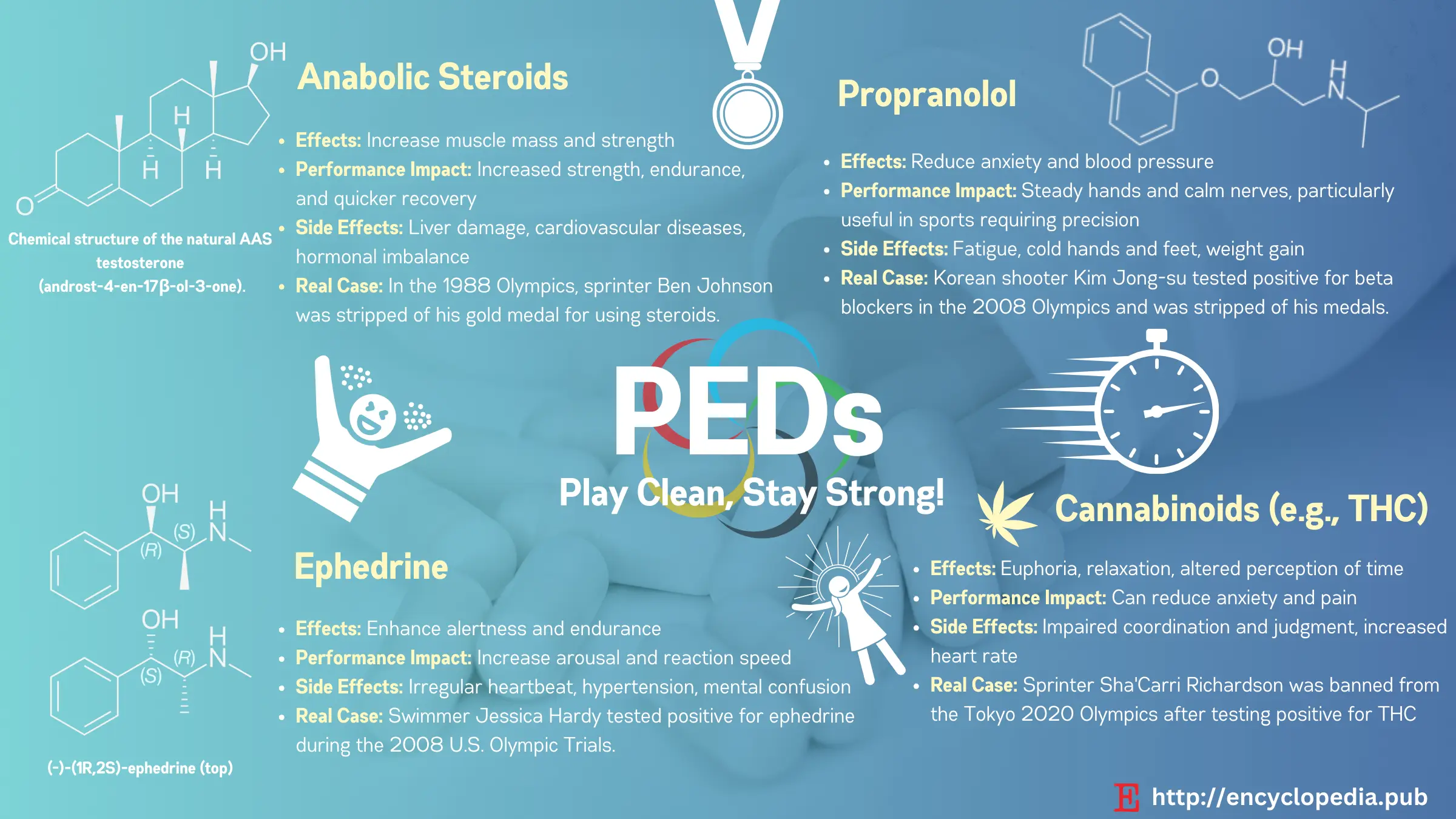
Source: Scientific Infographics (https://encyclopedia.pub/image/1692)
2. Historical Background
The use of performance-enhancing substances can be traced back to ancient civilizations. Greek athletes consumed herbal concoctions and special diets before competitions, while Roman gladiators were reported to use stimulants and tonics [3]. In the late 19th and early 20th centuries, athletes experimented with caffeine, alcohol, strychnine, and amphetamines to improve stamina [4].
By the mid-20th century, the discovery of anabolic steroids and synthetic hormones revolutionized PED use. Reports of widespread steroid use emerged during the 1954 World Weightlifting Championships and the 1960s Olympic Games [5]. The tragic death of Danish cyclist Knud Enemark Jensen during the 1960 Rome Olympics, attributed to amphetamine use, catalyzed the formation of formal anti-doping regulations.
The International Olympic Committee (IOC) introduced drug testing in 1968, followed by the establishment of the World Anti-Doping Agency (WADA) in 1999, which continues to oversee global anti-doping efforts.
3. Categories of Performance-Enhancing Drugs
3.1. Anabolic Agents
Anabolic-androgenic steroids (AAS) are synthetic derivatives of testosterone. They promote muscle growth (anabolic effects) and secondary male sexual characteristics (androgenic effects). Widely misused in strength sports, AAS enhance protein synthesis, accelerate recovery, and increase lean body mass. However, misuse is associated with cardiovascular complications, liver toxicity, hormonal imbalances, and psychiatric disorders.
3.2. Peptide Hormones and Growth Factors
-
Erythropoietin (EPO): Increases red blood cell production, improving oxygen delivery to muscles and endurance.
-
Human Growth Hormone (hGH): Stimulates tissue growth, muscle repair, and recovery.
-
Insulin-like Growth Factor-1 (IGF-1): Promotes anabolic effects in muscle tissues.
Although effective in enhancing performance, these substances pose risks such as blood clotting, hypertension, acromegaly, and metabolic disturbances.
3.3. Stimulants
Drugs such as amphetamines, ephedrine, and caffeine reduce fatigue, increase alertness, and improve reaction times. While some stimulants are socially accepted (e.g., caffeine), their excessive use in competitive sports may result in dependence, arrhythmias, and sudden cardiac events.
3.4. Narcotics and Analgesics
Used to mask pain, opioids and other analgesics allow athletes to train and compete beyond natural pain threshold. Their misuse can lead to addiction, respiratory depression, and masking of injuries that may worsen over time.
3.5. Beta-2 Agonists
Initially developed to treat asthma, agents such as salbutamol and clenbuterol enhance oxygen uptake and promote lean muscle mass. Overuse may cause tremors, tachycardia, and metabolic imbalance.
3.6. Diuretics and Masking Agents
Diuretics are employed to reduce body weight rapidly or to dilute urine samples in drug testing. They pose risks such as electrolyte imbalances, dehydration, and kidney damage.
3.7. Blood Doping and Oxygen-Enhancing Techniques
Blood transfusions and artificial oxygen carriers increase hemoglobin concentration and endurance capacity. Risks include infection, embolism, and stroke.
3.8. Gene Doping
Emerging strategies involve modifying genetic material to enhance muscle growth, endurance, or recovery. Although still experimental, gene doping raises profound ethical, safety, and detection challenges.
4. Health Implications of PED Use
4.1. Physical Risks
-
Cardiovascular: Hypertension, arrhythmias, thrombosis, and myocardial infarction.
-
Hepatic: Liver toxicity, particularly from oral anabolic steroids.
-
Endocrine: Hormonal imbalances, infertility, and gynecomastia in men.
-
Neurological: Psychiatric symptoms including aggression, mood swings, and dependence.
4.2. Psychological and Behavioral Effects
PED use has been linked to body image disorders, compulsive training, and addiction. Anabolic steroid dependence is increasingly recognized as a clinical condition requiring medical and psychological intervention.
4.3. Social and Ethical Concerns
The use of PEDs undermines principles of fairness, sportsmanship, and equal opportunity in competition. It also places pressure on athletes to conform, risking a cycle of widespread misuse.
5. Detection and Anti-Doping Measures
PED detection has advanced significantly, combining biochemical, hematological, and genetic methods.
-
Urine and blood testing: The most common methods, identifying metabolites of banned substances.
-
Biological Passport: A longitudinal monitoring approach, tracking changes in blood and steroid profiles to detect abnormal patterns.
-
Mass spectrometry and isotope ratio analysis: Highly sensitive techniques for identifying synthetic steroids.
-
Emerging technologies: Include omics-based profiling, biomarkers of gene doping, and artificial intelligence in detection.
WADA maintains an annually updated list of prohibited substances and methods, guiding global anti-doping efforts.
6. Legal and Regulatory Framework
-
World Anti-Doping Code: Provides a harmonized framework for anti-doping rules across international federations.
-
National Anti-Doping Organizations (NADOs): Enforce regulations within individual countries.
-
Legal implications: Athletes testing positive may face suspensions, fines, annulment of results, and reputational damage. In some jurisdictions, trafficking and possession of PEDs may result in criminal penalties.
7. Notable Cases in Sports
-
Ben Johnson (1988 Seoul Olympics): Stripped of his gold medal in the 100 m sprint after testing positive for stanozolol.
-
Lance Armstrong: Banned for life and stripped of seven Tour de France titles due to long-term use of EPO, steroids, and blood transfusions .
-
Russian Doping Scandal: Systematic state-sponsored doping program revealed before the 2016 Rio Olympics, leading to widespread suspensions.
These high-profile cases highlight the scale and complexity of doping in elite sports.
8. Cultural and Ethical Perspectives
The debate on PEDs raises questions of human limits, fairness, and the nature of competition. While some argue for strict prohibition to preserve integrity, others advocate for controlled legalization, citing individual autonomy and inevitable technological progress. Transhumanist perspectives even frame PED use as part of broader human enhancement.
9. Future Directions
-
Advances in biotechnology: Gene editing tools such as CRISPR may introduce new forms of undetectable doping.
-
Personalized medicine: Understanding individual genetics could improve PED detection and preventive strategies.
-
Ethical governance: Greater dialogue between athletes, regulators, and scientists is needed to balance innovation, health, and fairness.
10. Conclusion
Performance-enhancing drugs represent a multifaceted issue at the intersection of sports science, medicine, ethics, and law. While they can enhance physical capacity, the associated health risks and ethical dilemmas underscore the need for robust regulation and continued vigilance. As scientific advances open new possibilities for enhancement, society faces ongoing challenges in defining the boundaries of fair play, safety, and human performance.
References
- Mottram, D. R. Drugs in Sport. 6th ed.; Routledge: London, 2010.
- Yesalis, C. E.; Bahrke, M. S. History of doping in sport. Int. Sports Stud. 2002, 24(2), 42–76.
- Todd, T. The myth of anabolic steroids: A history. J. Sport Hist. 1987, 14(1), 87–107.
- Yesalis, C. E.; Bahrke, M. S. Performance-enhancing substances in sport and exercise. Hum. Kinet. 2002, 3, 285–313.
- Franke, W. W.; Berendonk, B. Sports, genes, and doping—an international science perspective. Mol. Cell. Endocrinol. 1997, 131(1), 1–11.