
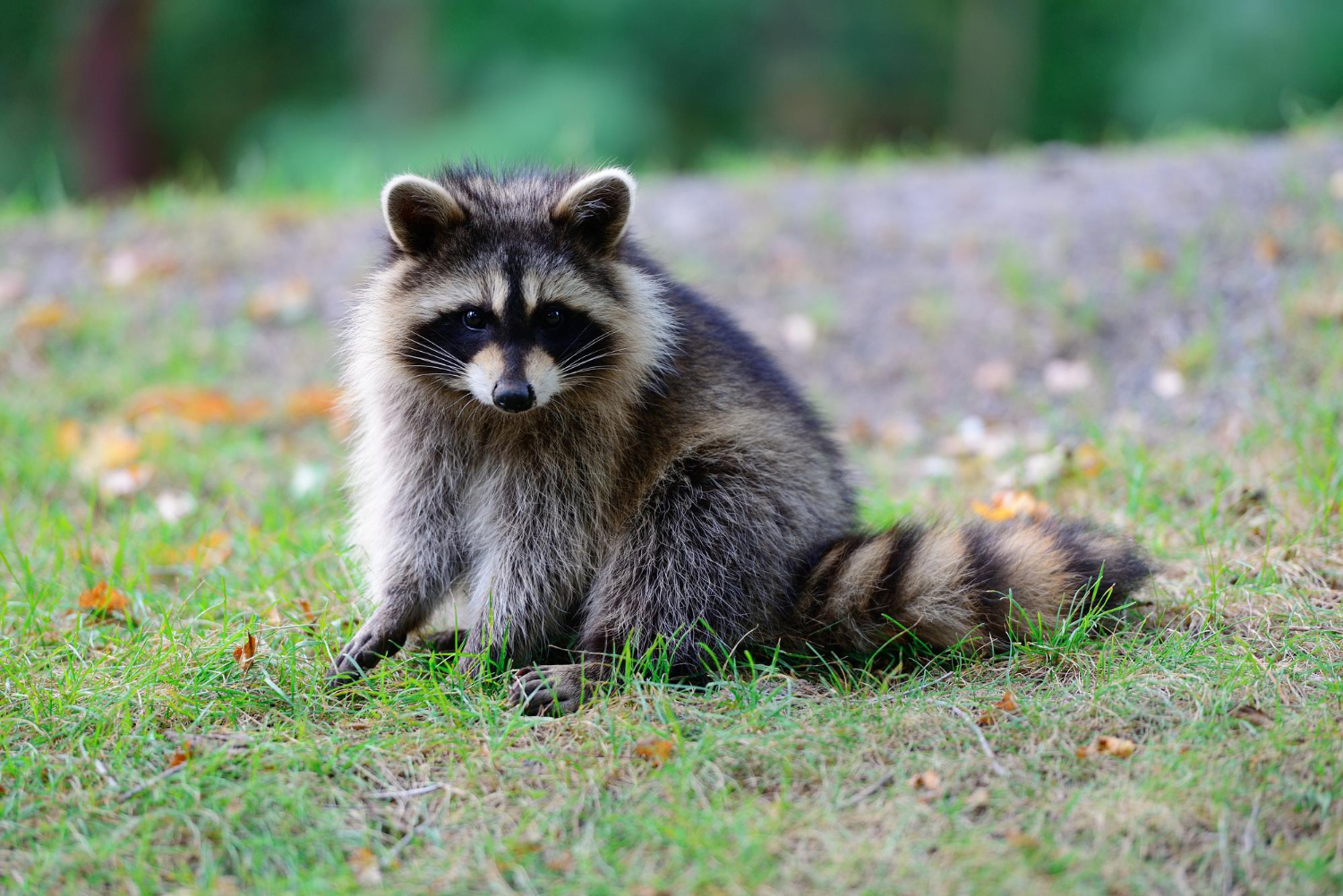
The raccoon (Procyon lotor) is a medium-sized, omnivorous mammal native to North America. Recognizable by its characteristic black facial mask and ringed tail, it belongs to the family Procyonidae. Raccoons exhibit notable adaptability and intelligence, allowing them to thrive in a wide range of environments, from forests to urban areas. They are primarily nocturnal and possess dexterous forepaws, which aid in manipulating objects and food.
- Raccoon
- Procyon lotor
- urban wildlife
- North American mammals
- zoonotic disease
- behavioral ecology
- animal cognition
- invasive species
1. Taxonomy and Classification
The raccoon is a member of the order Carnivora and the family Procyonidae, which also includes coatis and kinkajous. The genus Procyon comprises several species, though Procyon lotor is the most widespread and studied. Carl Linnaeus first described the species in his Systema Naturae in 1758. Subspecies differentiation has been debated due to high genetic variability and adaptability, with up to 22 subspecies previously described, though many are now considered synonymous due to overlapping traits [1].
Phylogenetic studies suggest that raccoons diverged from a common ancestor shared with bears and mustelids around 30 million years ago, with the Procyonidae family itself originating in Central America before dispersing into North America [2].
2. Morphology and Physical Characteristics
Adult raccoons typically measure between 40 and 70 cm in body length, with tails ranging from 20 to 40 cm. They weigh between 5 and 15 kg, with northern individuals generally larger due to Bergmann’s rule [3]. Their fur is grayish-brown, dense, and water-resistant, with a distinctive black “mask” of fur around the eyes and alternating black and white rings on the tail.
One of the raccoon’s most remarkable physical features is its highly sensitive and prehensile forepaws. These allow for fine manipulation and are essential for foraging. Each paw has five digits with nails adapted for climbing and grasping. Studies have shown raccoons possess tactile discrimination comparable to primates [4].
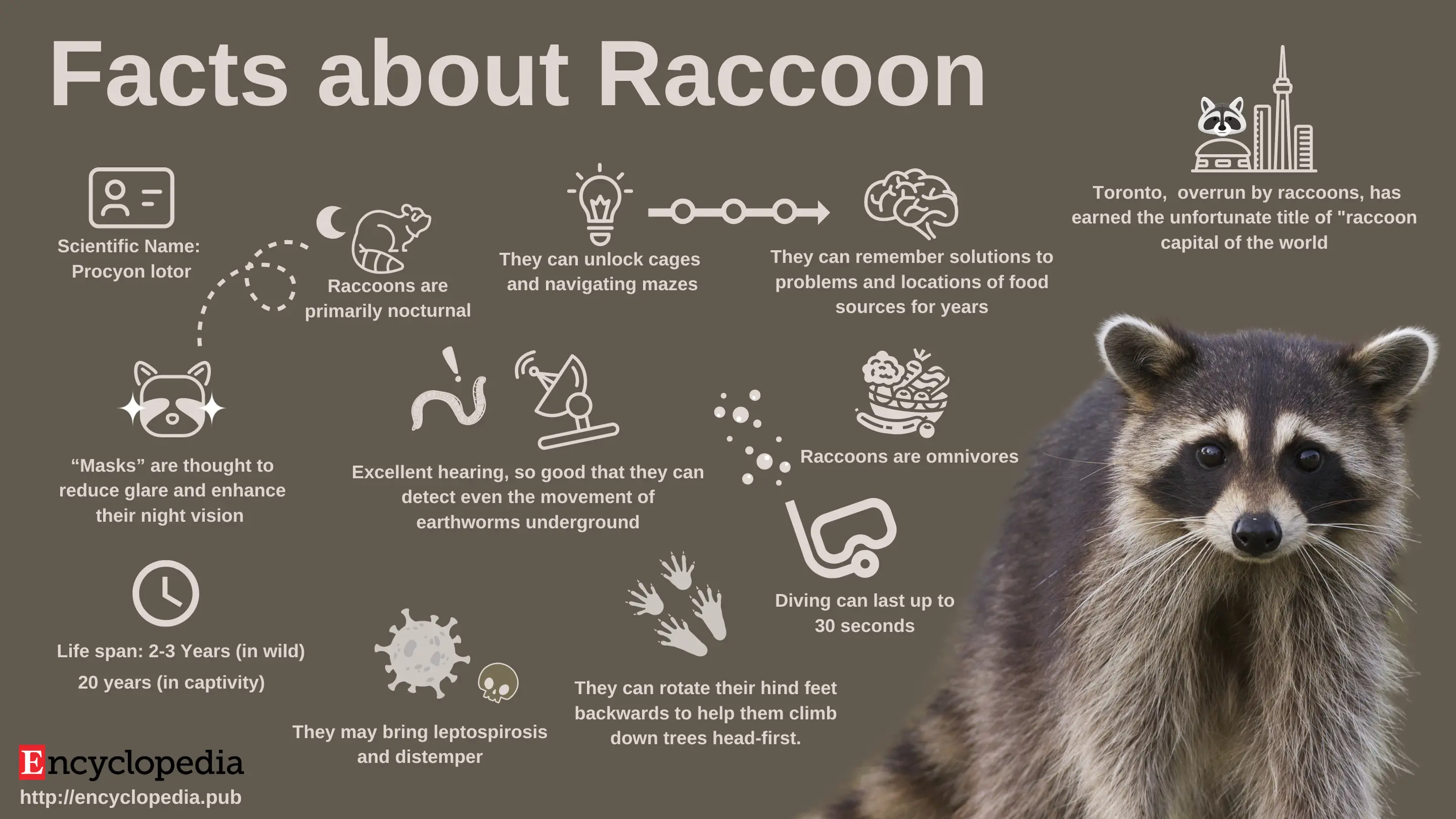
Source: Encyclopedia Scientific Infographic (https://encyclopedia.pub/image/1125)
3. Behavior and Social Organization
Raccoons are nocturnal and exhibit crepuscular activity patterns. They are generally solitary, although overlapping home ranges and temporary aggregations occur, especially during mating seasons and in urban environments where food is abundant [5]. While not territorial, they maintain home ranges that can vary between 0.5 and 20 square kilometers depending on habitat productivity.
Communication occurs through vocalizations (such as growls, whimpers, and screams), scent marking, and body language. Males may become aggressive during the mating season but otherwise tend to avoid confrontation.
Raccoons are also known for their problem-solving abilities and memory. Laboratory studies show they can remember solutions to tasks for over three years and learn from observational cues.
4. Reproduction and Life Cycle
Raccoon mating occurs from January to June, with peak breeding between February and March in most regions. Males are polygynous, often competing for access to females. After mating, males do not participate in rearing offspring.
Gestation lasts approximately 63 to 65 days. Females give birth in tree hollows, burrows, or abandoned buildings to litters ranging from 2 to 7 kits. Kits are altricial, born blind and hairless, and dependent on maternal care for up to 10 weeks [6]. They begin foraging with their mother at around 8 to 12 weeks and are weaned by four months.
Juveniles remain near their natal range until the following spring, at which point males typically disperse while females may remain near their mother’s territory [7]. The average lifespan in the wild is 2 to 3 years due to predation and disease, although individuals may live over a decade in captivity [8].
5. Diet and Foraging Strategies
Raccoons are generalist omnivores with seasonal variation in diet. They consume fruits, nuts, insects, small mammals, amphibians, fish, and bird eggs. In urban areas, they also scavenge human refuse, pet food, and crops.
Foraging behavior demonstrates their intelligence. Raccoons often "wash" food items, though this behavior is more accurately interpreted as exploratory manipulation rather than true cleaning. Their foraging is facilitated by acute tactile sensitivity in their forepaws, particularly under moist conditions which enhance tactile perception.
In autumn, raccoons increase food intake to build fat reserves for winter, especially in colder regions. While not true hibernators, they enter torpor during extreme cold, relying on body fat reserves.
6. Habitat and Distribution
Originally confined to forests and wetlands in North America, raccoons have expanded their range considerably. Their current distribution includes almost all of the United States, southern Canada, Central America, parts of South America, and introduced populations in Europe and Japan.
Raccoons show high habitat plasticity, occupying deciduous and mixed forests, coastal marshes, farmlands, and increasingly, urban environments. In cities, raccoons utilize buildings, sewers, and garbage as nesting and feeding sites, often resulting in human-wildlife conflict.
Introduced raccoon populations, such as those in Germany and Japan, have sparked ecological concern due to predation on native species and competition with local fauna.
7. Disease and Public Health Implications
Raccoons are vectors of several zoonotic diseases. The most significant is rabies, especially in the eastern United States, where raccoons are the primary terrestrial reservoir host. They may also carry raccoon roundworm (Baylisascaris procyonis), which poses serious neurological risks to humans and pets if ingested.
Other diseases include leptospirosis, salmonellosis, and canine distemper. In urban settings, close contact with humans raises concerns about transmission. Public health campaigns often focus on minimizing raccoon access to waste and promoting vaccination programs for pets.
8. Raccoons in Culture and Conservation
Raccoons have long held symbolic and cultural significance. Indigenous North American tribes regarded raccoons as symbols of curiosity, dexterity, and adaptability. In modern times, raccoons are often anthropomorphized in literature, film, and media—sometimes glamorized as clever tricksters or mischievous thieves.
From a conservation perspective, raccoons are listed as a species of Least Concern by the IUCN due to their adaptability and growing populations. However, their status as invasive species in parts of Europe and Japan has led to management efforts including trapping, sterilization, and population control measures.
Ethical debates have emerged around the management of urban raccoons, with some calling for coexistence strategies that balance ecological impact with animal welfare. Researchers emphasize the importance of public education and non-lethal deterrence in urban planning.
9. Research and Future Directions
Raccoons have become models in cognitive research due to their problem-solving abilities and manual dexterity. Recent studies using maze navigation, puzzle-solving, and memory retention tests suggest raccoons possess cognitive capacities comparable to some primates.
Additionally, genetic studies are underway to understand population dynamics, disease susceptibility, and adaptive evolution, particularly in urban populations experiencing rapid environmental changes. Climate change, habitat fragmentation, and human expansion are likely to shape raccoon behavior and distribution in coming decades, making them a key species for studying urban ecology and human-wildlife interactions.
References
- Helgen, K. M., & Wilson, D. E. (2005). "Taxonomy and Distribution of the Raccoon". Journal of Mammalogy, 86(4), 928–933.
- Flynn, J. J., & Wesley-Hunt, G. D. (2005). "Carnivora phylogeny and classification". The Carnivores: Evolution and Systematics. Cambridge University Press.
- Gehrt, S. D. (2003). "Raccoon". In: Feldhamer, G. A. et al. (Eds.) Wild Mammals of North America: Biology, Management, and Conservation. Johns Hopkins University Press.
- Thompson, R. K. R., & Herman, L. M. (1977). "Memory for multiple discriminations in the raccoon". Journal of Comparative and Physiological Psychology, 91(4), 778–788.
- Prange, S., Gehrt, S. D., & Wiggers, E. P. (2003). "Demographic factors contributing to high raccoon densities in urban landscapes". Journal of Wildlife Management, 67(2), 324–333.
- Fritzell, E. K. (1978). "Habitat use by prairie raccoons during the waterfowl breeding season". Journal of Wildlife Management, 42(3), 582–591.
- Sanderson, G. C. (1987). "Raccoon". In: Novak, M. et al. (Eds.), Wild Furbearer Management and Conservation in North America. Ontario Ministry of Natural Resources.
- Bigler, W. J., & Hoff, G. L. (1974). "Public health importance of the raccoon (Procyon lotor)". Journal of the Florida Medical Association, 61(5), 403–407.