
Ischemia-reperfusion myocardial damage is a paradoxical tissue injury occurring during percutaneous coronary intervention (PCI) in acute myocardial infarction (AMI) patients. Although this damage could account for up to 50% of the final infarct size, there has been no available pharmacological treatment until now. Oxidative stress contributes to the underlying production mechanism, exerting the most marked injury during the early onset of reperfusion. So far, antioxidants have been shown to protect the AMI patients undergoing PCI to mitigate these detrimental effects; however, no clinical trials to date have shown any significant infarct size reduction. Myocardial ischemia/reperfusion damage results from diverse oxidative stress producing mechanisms. Therefore, it is worthwhile to consider multitarget antioxidant therapies targeting multifactorial AMI. We will review some of this pathological pathways and the potential therapeutic effects of some available antioxidants, with particular reference to resveratrol and quercetin.
- oxidative stress
- reperfusion injury
- antioxidants
- cardioprotection
- resveratrol
- quercetin
1. Introduction
2. Mechanisms of Ischemia/Reperfusion damage
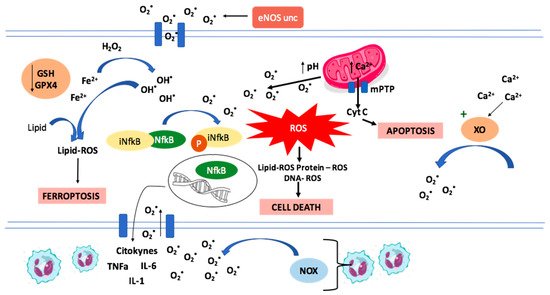
During myocardial ischemia there is an overload in intracellular Ca2+ that cannot be captured by the Ca2+ ATPase (SERCA) in the sarcoplasmic reticulum due to the lack of ATP. The overload of Ca2+ induces enzymatic changes. One of them is the conversion of xanthine dehydrogenase in endothelial cells to xanthine oxidase (XO), an enzyme that generates superoxide anion radicals [5][18]. Another example is the oxidation of tetrahydrobiopterin and the subsequent uncoupling of endothelial nitric oxide synthase (eNOS), resulting in superoxide production instead of nitric oxide [6][19]. These changes are related to a burst in ROS production during reperfusion, overwhelming the antioxidant defenses.
There are multiple mechanisms involved in cellular damage and subsequent cellular death during the ischemia/reperfusion (I/R) process. Some of them involves endoplasmic reticulum stress, mitochondrial dysfunction, and inflammation mediated damage. This myocardial cellular injury is mediated through necrosis, apoptosis and even ferroptosis.
4. Resveratrol
Resveratrol is a natural polyphenol with multiple biological activities [8][90]. Different onstudies have evidenced that it has various properties, including anti-inflammatory, antioxidant, anti-diabetic, antihypertensive, anti-cancerous and cardioprotective effects [8][9][90,92]. Some of the pathways involved in its cardioprotective protective effects will be reviewed. in the next sections
4.1. SIRT1 Activation
SIRT1 regulates oxidative stress-related proteins and other proteins that affect the function of cardiomyocytes. Resveratrol was proposed as a SIRT1 activator, resulting in a cardioprotective response via reduction of Ca2+ overload [10][95]. Accordingly, recent studies on mice demonstrates that resveratrol determines the increase of SIRT1 levels during I/R injury, resulting in a decrease in the incidence of atrioventricular block and letality, and a decrease of UCP-2 expression, an apoptosis mediator [8][11][90,96].
4.2. Ferroptosis Inhibition
The addition of Resveratrol in cell cultures reduced oxidative stress and the content of Fe2+. The effect was explained by changes in the regulation of gene expression, in which resveratrol down-regulated transferrin receptor 1 expression and up-regulated the expression of ferritin heavy chain 1 and GPX4, leading to inhibition of ferroptosis and potentiation of the antioxidant defenses, respectively [12][89].
4.3. Attenuation of Inflammation and Apoptosis
Different studies have suggested that resveratrol might inhibit apoptosis through multiple ways. One of them is the activation of PI3K/AKT signaling pathway, which down-regulates the expression of apoptotic genes and regulates cell proliferation [13][14][98,99], leading to decreased ROS levels, increased catalase and glutathione peroxidase activities, and increased cell viability [15][97]. Also, resveratrol could reduce caspase 3 expression [16][101]. Moreover, resveratrol attenuates necroptosis after I/R injury by inhibition of TNF-α/RIP1/RIP3/MLKL signaling pathway [17][102]. Effects evidenced in a dose-dependent manner. Furthermore, resveratrol treatment resulted in a significant reduction of inflammatory mediators in serum and cardiac tissue cells [18][103].
4.4. Nrf2 Activation
The beneficial effects of resveratrol in I/R injury could also be mediated via up-regulation of Keap1/Nrf2 signaling pathway. Nrf2 up-regulates the expression of proteins involved in the antioxidant response. This is suggested due to the reversion of the beneficial effects of resveratrol when a knock down or inhibition of Nrf2 is ensued [19][104].
4.5. Reduced Mitochondrial Dysfunction
A recent study suggested that resveratrol via activation of PI3K/AKT signaling pathway, reduced mitochondrial oxidative stress damage, increasing catalase, and glutathione peroxidase activity, and cell viability [15].[97].
4.6. Associations between Resveratrol and Other Antioxidants
Resveratrol interferes with many of the mechanisms underlying myocardial I/R injury, but there are others that are not covered by it. In this context, it is reasonable to propose an association of resveratrol with other antioxidant compounds that have their effects on other targets. As an example, vitamin C down-regulates NOX activity and prevent eNOS uncoupling, which could synergize with the increased expression of antioxidant enzymes induced by resveratrol via Nrf2 signaling pathway activation.[7][50].
5. Quercetin
Quercetin is a flavonoid with anti-aggregating, anti-cancer, anti-inflammatory, anti-aging, and antioxidant properties. It is not toxic even in high doses, and recent studies have shown it to have tremendous potential to reduce myocardial damage that occurs after I/R. Although Que has a low bioavailability, many efforts are being made to increase its solubility [20][21][115,116].
5.1. Properties of Quercetin against Oxidative Stress
Quercetin treatment has demonstrated to reduce oxidative stress through several mechanism. It reduces xanthine oxidase expression and activity [22][9, [23]120], and attenuate the expression of NOX2, which is one of the more active isoforms of NOX during I/R injury. Also, quercetin can significantly inhibit Fenton reaction, another relevant source of ROS [24][126]. Moreover, quercetin administration increased the selenoprotein TrxR2, which acts as an antioxidant and an indirect redox activity modulator [25][82, [26]128].
5.2. Anti-Inflammatory and Anti-Apoptotic Effects
Acute inflammatory reactions are intensified in cardiomyocytes following I/R injury. This is due to the neutrophilic granulocytes, which are the ones that explain most of the reduced exudation and even the diffusion of these neutrophils through the blood vessels. Inflammation alter the function of endotheliocytes, reduce the relaxation capacities of coronary arteries, and promote coagulation [27][133]. Quercetin has been shown to improve inflammation and apoptosis of the myocardial tissue, resulting in a decrease of the final infarct size [28][131].
5.3. Associations between Quercetin and Other Antioxidants
Not many associations have been tested, one of them is quercetin and α-tocopherol in rats. The combined pretreatment normalized all biochemical parameters and minimized ECG alterations, exhibiting enhanced cardioprotective effects against isoproterenol-induced cardiotoxicity. Furthermore, the combined pretreatment was more effective than each of them separately [29][138]. The combination of quercetin and lycopene in an animal model also prevented myocardial damage induced by isoproterenol, reducing oxidative stress [30][139].
6. Discussion
Oxidative stress constitutes an essential mechanism of damage involved in I/R injury in acute myocardial infarction. Even if multiple individual antioxidants have been tested to prevent or minimize this damage, an effective treatment is not available. This problem might be related to the fact that oxidative stress results from different pathways that lead to an imbalance between ROS generation and antioxidant activity. The comprehension of oxidative stress mechanisms makes us realize that the treatment alternatives based on monotherapy are not the appropriate solution, a view that has not been changed for more than a decade. Thus, some antioxidants are iron chelators (deferoxamine), some are ROS scavengers (N-acetylcysteine), some activate the Nrf2 antioxidant response pathway (naringenin, melatonin, sulforaphane), and others exert influence on alternative edges of ROS production, resulting in effects that could be synergic and beneficial (Table 1). In the case of resveratrol and quercetin, these molecules have several cardioprotective effects making them suitable to be included as part of a multitarget therapy.
It is important to note that resveratrol and quercetin molecular sites of action are still not fully elucidated, but there are many proven targets. In the case of resveratrol, activation of Nrf2 and SIRT1 occurs through increased antioxidant proteins expression and PGC-1α deacetylation [140]. In addition, resveratrol also activates the PI3K/AKT pathway during I/R injury, resulting in decreased mitochondrial pathway-mediated apoptosis [97].
On the other hand, quercetin exerts its protective effects mainly through the inhibition of ROS-producing enzymes, such as NADPH oxidase and xanthine oxidase. The exact mechanism whereby this is achieved has been only partially described. A recent study shows that NOX may be inhibited for the enhanced expression of the antioxidant enzyme heme oxygenase-1 (HO-1) by quercetin [141]. In the case of xanthine oxidase, quercetin acts as a reversible inhibitor of the enzyme action [142].
6. Concluding Remarks
7. Concluding Remarks
Ischemia/reperfusion injury occurring in AMI patients undergoing PCI is a complex process involving pathophysiological cascades leading to cellular disturbances ranging from metabolic changes to cell death. The administration of several antioxidant molecules could give rise to an additive or synergistic pharmacological effect, leading to an improvement of previous studies on antioxidants that use them on monotherapy. tudies about associations of these compounds with others that have previously shown cardioprotective effects could be analyzed in isolated heart rat Langendorff model and, subsequently, in clinical trials aimed to reduce the infarct size due to the increased efficacy of this therapeutic association. This could lead to a better prognosis and quality of life after an acute myocardial infarction, decreasing complications, such as heart failure and arrhythmias, and reducing the associated costs.
Even if effective clinical treatment for I/R injury has not been found yet, resveratrol and quercetin constitute attractive natural pharmacological agents to be used in a combined therapy aimed to reduce cardiac tissue damage and infarct size due to their cardioprotective effects. Randomized double-blind clinical trials should be made to test the therapeutic efficacy as well as safety of these associations.