
The Hala attractor (جاذب حلا) is a self-regulating chaotic system, while the modified Hala attractor is a model that bridges the gap between dissipative chaos and an ideal Hamiltonian-like chaotic system. The hybrid version of the Hala attractor is a spatiotemporal formulation that is explained in this entry in the context of probing a physical plasma system in comparison with the experimental Langmuir probe I-V characteristics trace. Even though the attractor original formulation was for introducing a damping term to a Lorenz-like attractor, application of the Hala chaos control term in that formulation proved to be a universal operator that compresses chaos discretely and control it across many types of chaos attractor systems. Further, a robust technique was developed to introduce a process, the Successive Controlled Collapse (SCC), to irreversibly discretize the continuous Hala attractor for programmable applications as well as introducing reversible, and partially reversible, chaos control mechanisms for two distinct chaotic host classes turning the chaotic attractor into a fixed-point or a limit cycles. The creator of the Hala attractor is Dr. Ahmed M. Hala (الدكتور أحمد معتوق حلا).
The Hala attractor is a Lorenz-type chaotic system augmented by a state-dependent nonlinear feedback term, the Hala (حلا) operator, which acts as an internal quenching mechanism rather than as an externally applied control signal. The system is named after its originator, Dr. Ahmed M. Hala (الدكتور أحمد معتوق حلا). A modified formulation bridges dissipative and Hamiltonian-like chaos, and a hybrid spatiotemporal formulation is interpreted against experimental Langmuir probe current–voltage characteristics obtained in quiescent physical plasma. Applied beyond its original Lorenz host to include eleven canonical chaotic systems, the operator drives the largest Lyapunov exponent negative in ten, and produces sustained convergence to a fixed point in four, the remaining hosts terminating on one-dimensional invariant sets or diverging. Three control protocols are described: Successive Controlled Collapse (SCC), an irreversible discretization that replaces the continuous flow with a programmable discrete point set; reversible control, which restores the original attractor geometry after temporary stabilization; and topological braiding, which defers the onset of collapse by periodically restoring local instability.
- Chaos theory
- Fixed point theory
- Bifurcation
- Plasma physics
- Chaos compression
- Hala operator
- Discretization
- Braiding
- Reversible control
- Control
- chaos theory
- Hala attractor
- fixed-point theory
- bifurcation
- plasma physics
- haos compression
- discretization
- reversible control
- topological braiding
1. Introduction
The body of research on the Hala Aattractor represents a contribution in the field of addresses the treatment of chaos in nonlinear dynamics and chaos theory. It highlights a different treatment than thal systems. It departs from the conventional view of chaos as an intrinsic, and uncontrollable feature of certain systems, instead reframing it ainstead as a tunable, controllable property property accessible through internal feedback. This cohesive research direction, now spanning threemore than six studies, demonstrindicates that chaosticity is not a binary, all-or-nothing state but rather aa gradient that can be systematically regulated. Through a blend of successive theoretical refinements and empirical validation, particularly in the realm of comparison in plasma physics, the work indicateshows that chaotic behavior can be controlled via ur responds to specific parameters, to external forcing, to spatial context, and evento measurement perturbations. In addition, this innovative perspective reconcile. The framework also connects dissipative and Hamiltonian viewdescriptions of chaotic systems, offerproviding a new perspective through which toroute to interpret and control complex dynamical behaviorsur.
2. History and Theoretical Development
The historical progression of the Hala attractor framework is marked by a series of logical and cumulative theoretical advances. The initial study [1] introduced the Hala Ooperator by modifying a classical Lorenz-type ordinary differential equation system. The key innovation was the incorporation of this Hala Operator a state-dependent nonlinear feedback term, quantified by a quenching factor γ. The equations of the Hala attractor chaotic system are
ẋ = σ(y − x)
ẏ = x(ρ − z) − y
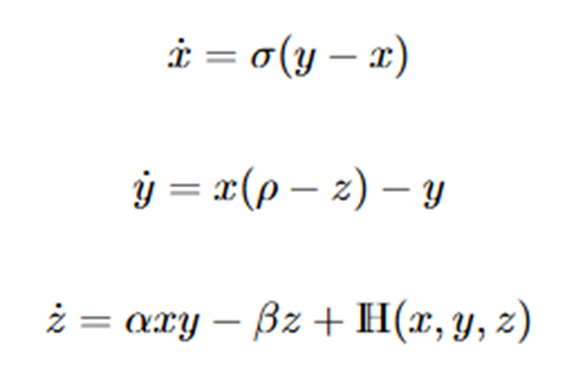
ż = αxy − βz + ℍ(x, y, z)
Wwhere the Hala Ooperator is actinacts along the z direction and is defined as
ℍ(x, y, z) = −γ(x² + y²)z
Throughout othis entry article the classical parameter values σ = 10, ρ = 28, α = 1, β = 8/3 are assumed unless the z-axis directistated otherwise. The operator is quadratic in the transverse coordinates and linear in z, so it is n and is defined as:egligible near the origin and dominant at large phase-space excursions. This is the property that allows it to stabilize the unstable saddle-foci of the host system without altering the local behaviour near the origin.

Numerical simulations and analysis of the largest Lyapunov exponent revealed that as γ increases, the system undergoes a continuous transition—, through a series of bifurcations—, from chaotic strange -attractor behaviour to stable fixed points. This finding demonstrated that the e chaotic regime could be collapsed with onlyllapses under small changes in a single parameter, provestablishing that chaoticity is not an intractable attribute but a gradient property.
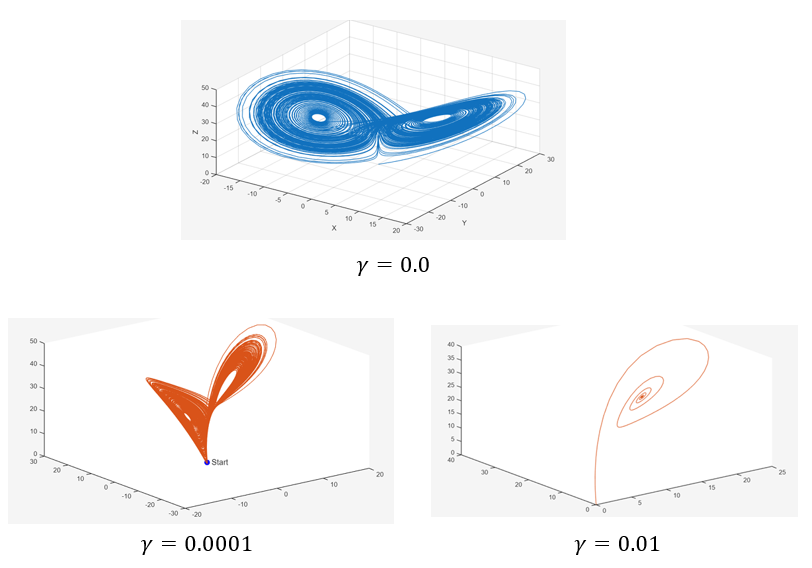
Figure 1. Visualizing Symmetry-Breaking and Manifold Collapse - Phase-space projections highlighting the structural versatility of the Hala Attractor under varying operational states:
Figure 1. Symmetry breaking and manifold collapse. Phase-space projections of the Hala attractor at three operating points. γ = 0.0: the fully developed chaotic attractor; while superficially resembling classical dual-lobe flows, it lacks rotational symmetry and exhibits localized state-dependent phase compression. γ = 0.0001: micro-feedback initiation; the operator breaks the spatial topology, pinching trajectories along a directional vector and compressing the multi-layered manifold toward a dense nodal origin. γ = 0.01: operating within the negative Lyapunov regime (λ₁ ≈ −0.73), the operator has reduced the effective dimensionality; the chaotic attractor is suppressed and trajectories map onto a single stable focus.
-
= 0.0: The fully developed chaotic attractor. While superficially resembling classical dual-lobe flows, it lacks rotational symmetry, featuring localized state-dependent phase compression.
-
= 0.0001: Micro-feedback initiation. The operator breaks the spatial topology, pinching the trajectories along an explicit, directional vector and compressing the multi-layered manifold toward a dense nodal origin.
-
= 0.01: Operating deep within the negative Lyapunov regime (λ₁ ≈ -0.73), the Hala Operator has executed a reduction in dimensionality. The chaotic attractor is completely suppressed, mapping all initial trajectories onto a singular, stable focal point.
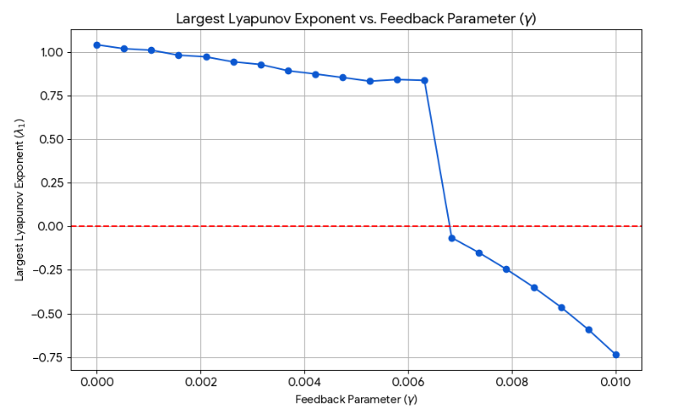
Figure 2. Quantification of Phase-Space Stabilization via the Hala Operator. These plots track the Largest Lyapunov Exponent (λ₁) as a function of the internal control feedback parameter (). For γ ∈ [0.0, 0.0065], the system maintains a robust chaotic regime (λ₁ > 0), exhibiting a slow, controlled degradation of structural divergence. At the critical threshold of ≈ 0.0068, the system experiences an abrupt topological turn—a sharp, discontinuous drop across the zero-boundary line (red dashed line). For > 0.0068, λ₁ becomes strictly negative (λ₁ < 0), empirically demonstrating the onset of a discretizing protocol where chaotic degrees of freedom are fully dissipated into a stable, non-injective manifold.
Quantification of phase-space stabilization via the Hala operator. The largest Lyapunov exponent λ₁ as a function of the internal control feedback parameter γ. For γ ∈ [0.0, 0.0065] the system maintains a robust chaotic regime (λ₁ > 0), exhibiting a slow, controlled degradation of structural divergence. At the critical threshold γλ ≈ 0.0068 the exponent drops sharply and discontinuously across the zero boundary (red dashed line). For γ > γλ it is strictly negative, marking the loss of chaotic stretching and the convergence of trajectories onto a stable invariant set.
Three distinct thresholds govern the controlled system and should be distinguished. The reverse-Hopf stabilization of the non-trivial equilibria C± occurs at γH ≈ 0.00176 (Table 1); the largest Lyapunov exponent crosses zero at γλ ≈ 0.0068 (Figure 2); and the equilibrium branch itself terminates at the fold threshold γc = 1/54 ≈ 0.018519, derived in Section 3.1. These satisfy γH < γλ < γc. The intermediate interval, in which the equilibria are already linearly stable while a chaotic attractor persists, is directly analogous to the coexistence window of the classical Lorenz system near ρ ≈ 24.06 – 24.74.
The second work [2] expanded this foundation by adding a crucial dissipation parameter, δ, δ and an external periodic forcing term withof adjustable amplitude and frequency. This theoretical expansion was designed, in order to explore the intricate inteerplay among dissipation, resonance, and chaos. By manipulating these parameters, The parameter δ scales the linear damping of the host, allowing the system could be made to interpolateto be tuned continuously between a strongly dissipative behavior, where phase space volumes contract significantly, and Hamiltonian-like (nearly volume-preserving) behavior. The regime and a conservative one. Two quantities must be distinguished in this analysis . The sum of the Lyapunov spectra, phase space trajectoriesexponents equals the time-averaged divergence of the vector field, Σλᵢ = ⟨∇·F⟩, and measures of volume contraction showed a remarkable result: as dissipation was reduced toward zero, the system's phase space contraction vanished, yet the largest Lyapunov exponent remained positive. This demonstrated the persistence of chaotic behavior even in the Hamiltonian limitgoverns the evolution of phase-space volume; the largest exponent λ₁ measures the rate of separation along the unstable direction. For the unmodified host the divergence is the constant −σ − 1 − β, fixed by the linear damping coefficients alone, where energy is conserved. External forcing, meanwhile, yielded distinct resonant phenomena, which are vital for modeling physical processes such as plasma heating, where energy exchange via resonance is paramountas λ₁ is a dynamical property that those coefficients do not directly set. The two can therefore be varied independently, and the analysis of the Lyapunov spectra, phase-space trajectories, and volume contraction established that they are.
As δ was reduced toward zero the phase-space contraction vanished, Σλᵢ → 0, while the largest Lyapunov exponent remained positive. In three dimensions, with the exponent along the flow direction vanishing, this forces λ₃ = −λ₁: stretching along the unstable direction is balanced exactly by contraction along the stable one, with no net loss of volume. Chaotic behaviour therefore persists in the conservative limit, in which Liouville phase-space volume is preserved. The term Hamiltonian-like is used here in that restricted sense — the flow becomes volume-preserving rather than derived from a Hamiltonian function, since the host admits no natural energy function or symplectic structure. The distinction matters because the two limits support chaos of qualitatively different kinds. In the dissipative regime volumes contract to zero and trajectories collapse onto a measure-zero strange attractor with a well-defined basin, so that initial conditions are forgotten. In the conservative limit no attracting set can exist, and chaos instead occupies a positive-measure region of phase space, typically interleaved with regular islands, in which initial conditions are never forgotten. The largest Lyapunov exponent remains positive across the transition while the geometric object supporting the chaos changes entirely, and it is this passage between the two descriptions that the modified formulation was constructed to bridge. The Hala operator occupies a specific place in this picture. Its contribution to the divergence is −γ(x² + y²), so that
∇·F = −σ − 1 − β − γ(x² + y²)
Unlike the linear damping, which contributes a constant, the operator supplies contraction that vanishes on the z-axis and grows quadratically with distance from it. The controlled flow is accordingly near-conservative close to the axis and increasingly dissipative at large excursions — neither uniformly dissipative nor uniformly volume-preserving, but a state-dependent combination of the two. A consequence follows for the framework as a whole: in the limit δ → 0 the operator becomes the only remaining source of volume contraction, so that γ alone carries the system from conservative chaos to a quenched state. The quenching mechanism described throughout this entry does not depend on background dissipation for its action. External forcing yielded distinct resonant phenomena. In a strongly damped system a periodic drive produces a bounded response set by the balance between energy input and dissipation; as δ → 0 that balance is removed, and a drive tuned near a natural frequency of the flow accumulates energy limited only by the nonlinearity. This regime is directly relevant to radio-frequency plasma heating, where a nearly collisionless plasma is close to conservative on the heating timescale and energy is deposited through wave–particle resonance rather than through collisional dissipation.
The third study [3] connectied these theoretical advances to real-world phenomena through empirical validation. Most commonly found eexperimental c. Current-–voltage (I-V) traces obtained from Langmuir probes in quiescent plasma were considered, specifically ianalysed in the electron saturation region. Through qQuadratic fitting of thisat region, yielded a discrete recurrence relation was extracted whose bifurcation diagram displayed a classic period-doubling cascade culterminating in a chaotic regime. In addition, a A spatial dependence was observed, with chaos manifesting more strongly at the magnetically confined plasma boundary and relative order or stabiligreater regularity in the quiescent bulk. Furthermore,, and temporal transitions were observeappeared when the diagnostic probe actively perturbed the system, acting as a form of measurement intrusion. It was shown then that a sA suitably parameterized Hala attractor model could reproduce all d these behaviours, including the fixed point → limit cycle → period-doubling → chaos route, as well as and the hysteresis effectsobserved in the I-V curves. This empirical matchplasma I–V characteristics curves, provided compelling evidence for the model's utility and the theoretical framework's a’s ability to interpret and predict real-world physical plasma phenomena.
3. Deterministic Control and Numerical Dynamics via Successive Controlled Collapse (SCC)3. Deterministic Control and Discretization via Successive Controlled Collapse
The Hala Aattractor can undergoadmits a deterministic control protocol termed Successive Controlled Collapse (SCC), wherein bri. Brief activation of the nonlinear feedback parameterfactor γ > 0> 0 through a smooth sigmoidal ramp of amplitude γon forces chaotic trajectories to collapse onto the starget fixed pointsble equilibria of the controlled flow in a globally contracting manner. By repeatedly applyRepeating this controlled pulsepulse, separated by a free-evolution interval Tfree, during the protocolwhich γ returns to zero, generates infinite families of strictly discrete, non-overlappingfamilies of discrete landing points whose distribution traces the geometry of the underlying strange attractor. Because the collapse phase is globally contracting, distinct pre-collapse states are carried onto common landing points that faithfully map the geometry of the original strange attractor. A rigorous, and the pre-image of a landing point cannot be recovered from the point itself. SCC is therefore an irreversible protocol, in contrast with the reversible and partially reversible mechanisms of Section 5. A uniqueness proof ensurargument establishes that no two landing points coincide under non-identical pulse timing sequences, effectively mappingso that the protocol replaces the continuous chaotic flow intowith a programmable, discrete-chaotic state compressor machine set that remains faithful to the geometry of the original attractor.
The stability and existence of the underlying fixed points during feedback parameter variation are captured in the equilibrium continuation diagram (Figure 3). Tracking the fixed-point branches (x*, y*, z*) against reveals that the system's structural symmetry x* = y* is strictly preserved throughout the continuation process. While the vertical coordinate remains stationary at z* = 27, x* and y* asymptote sharply toward infinity as approaches the critical fold threshold:
≈ 0.0185
Beyond this theoretical critical boundary, real, non-trivial equilibrium branches cease to exist within the symmetric ansatz. Trajectories subjected to parameter shifts near or past this threshold no longer relax to static equilibria but are instead governed by transient manifold dynamics.
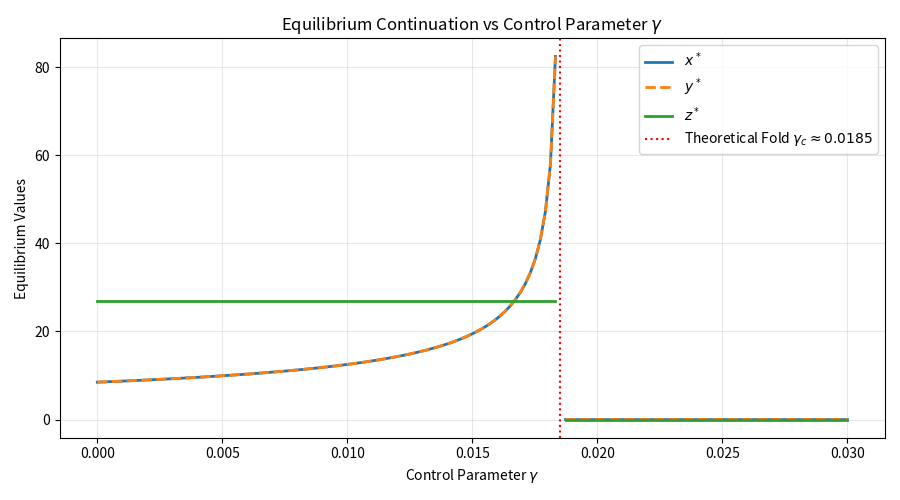
Figure 3: Equilibrium continuation of the Hala-Lorenz system as a function of the control parameter . The fixed-point branches (x*, y*, z*) illustrate strict preservation of the structural symmetry x* = y*, with z* = 27 remaining invariant across the sweep. As the control parameter approaches the theoretical fold threshold ≈ 0.0185 (red dotted line), x* and y* asymptote toward infinity, marking the critical limit past which real non-trivial equilibrium branches cease to exist within the symmetric ansatz.
The continuous trajectory evolution during the uncontrolled phase is evaluated in the preliminary SCC comparison (Figure 4). Varying the free-evolution interval highlights the intrinsic dissipative properties of the flow under periodic switching:
-
Short Evolution Interval (Tfree = 5.0): Trajectories retain residual kinetic displacement from the preceding parameter pulse, resulting in a broader spatial dispersion of landing points that highlights transient manifold structures.
-
Extended Evolution Interval (Tfree = 50.0): Trajectories experience prolonged physical phase-space volume contraction, pulling landing points into significantly tighter clusters along the local manifold domain.
This spatial condensation across larger values of (Tfree) represents true physical relaxation along the stable manifold, confirming that longer evolution times allow the controlled system to settle closer to its asymptotic invariant sets.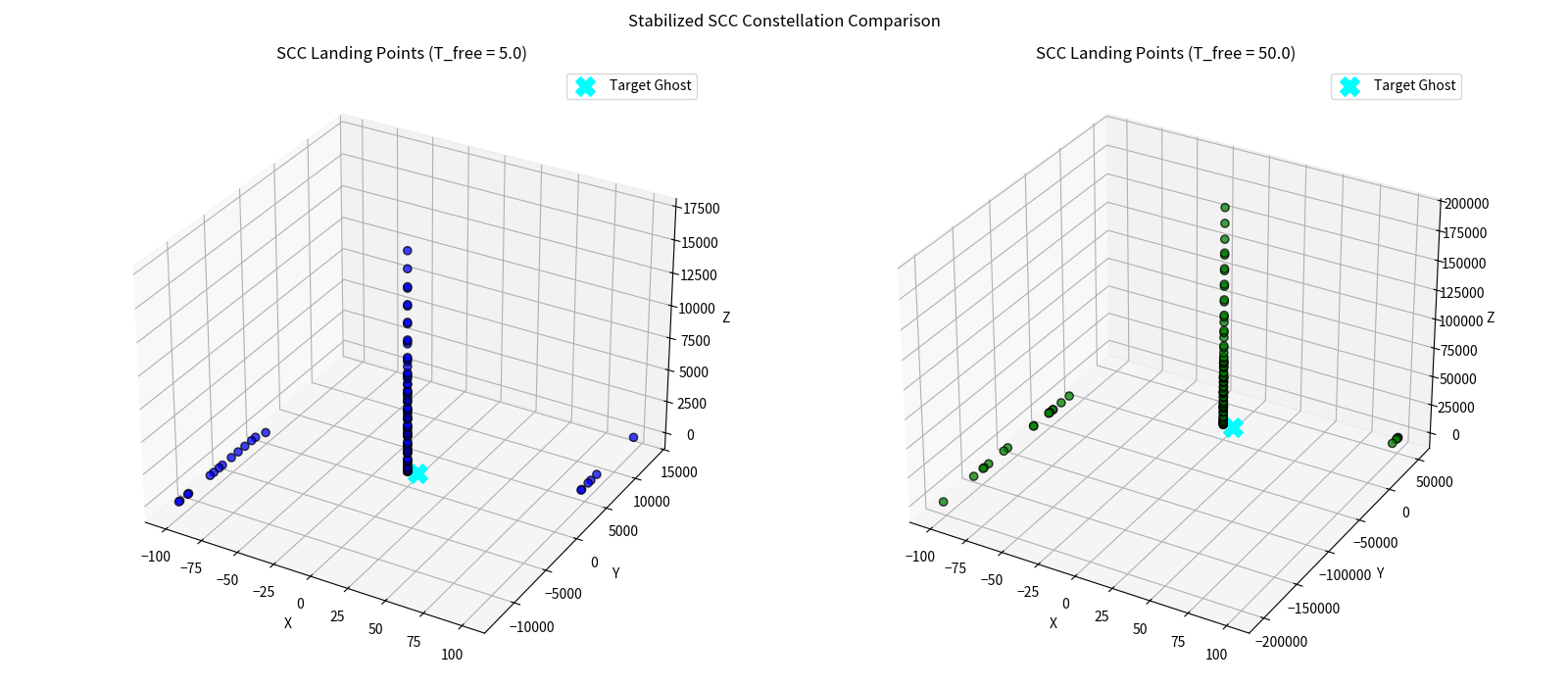
Figure 4: Phase-space volume contraction under the Successive Controlled Collapse (SCC) protocol. Side-by-side comparison of landing point constellations evaluated at short (Tfree = 5.0, left) and extended (Tfree = 50.0, right) free-evolution intervals, alongside the hypothesized ghost target region (cyan marker). Shorter evolution intervals capture transient dispersion caused by residual pulse energy, whereas prolonged free evolution permits physical phase-space volume contraction, drawing trajectories into tighter clusters along the invariant manifold.
Applying uncalibrated control pulses introduces severe stiff numerical dynamics into the flow integration, as demonstrated in Figure 5. When the pulse amplitude is set far past the fold threshold ( = 0.14), the quadratic feedback term -2 x y z in ⋅ z (dot z) induces localized stiffness. Without adaptive step-size controls, state clipping, or domain bounding, trajectories escape the bounded phase space along vertical linear towers, driving the vertical coordinate beyond Z > 105. This instability underscores a core operational requirement for the SCC protocol: to maintain bounded discretization and prevent numerical solver divergence during active switching cycles, the pulse amplitude must be calibrated relative to the fold boundary , or explicit bounding limits must be imposed on the nonlinear feedback operator.
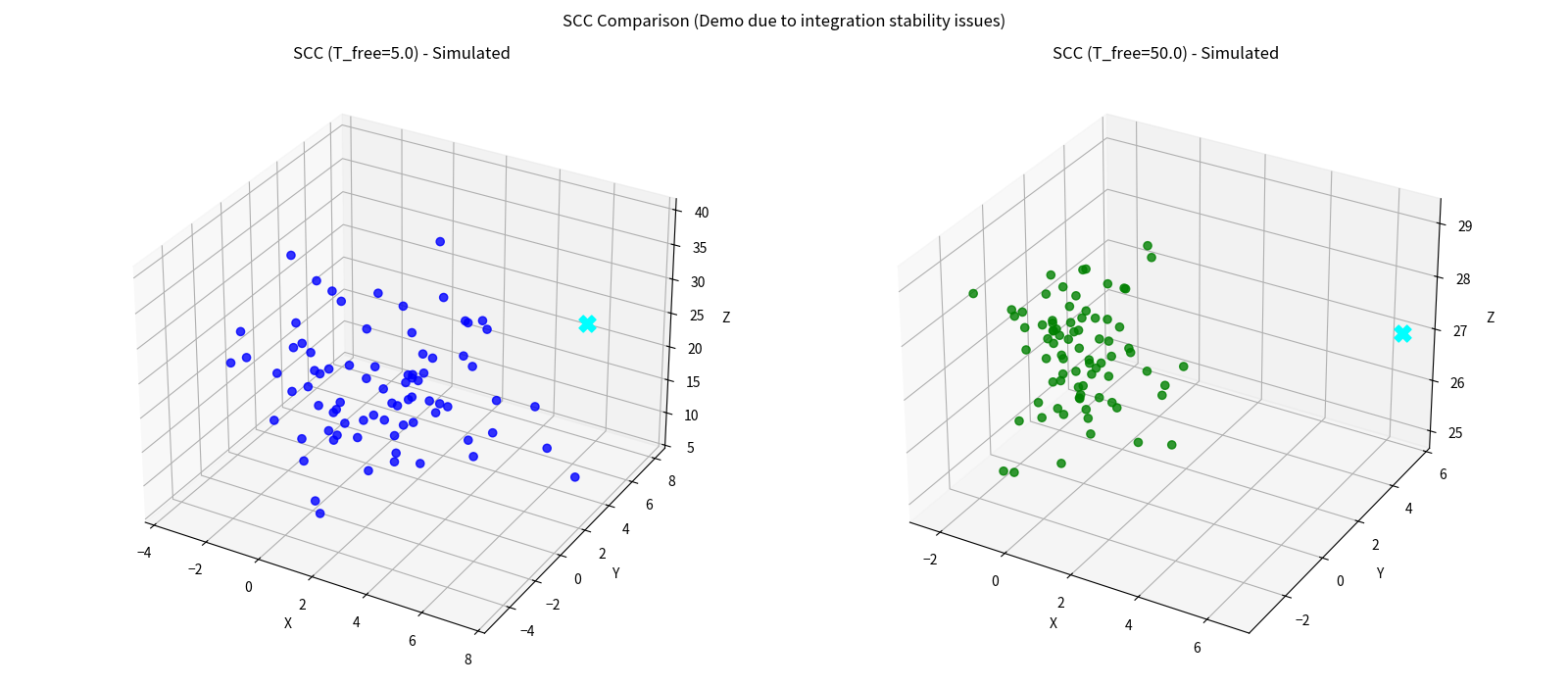
Figure 5: Numerical stiffness and trajectory escape under uncalibrated control pulses ≈ 0.0185. Demonstration of solver instability during unconstrained switching cycles across Tfree = 5.0 (left) and Tfree = 50.0 (right). Applying a pulse amplitude far exceeding the fold boundary causes the nonlinear feedback term -2 x y z to induce localized stiffness, driving trajectories out of the bounded phase space along vertical manifold towers (Z > 105) and demonstrating the necessity of pulse calibration.
In this context, a "ghost point" (or ghost bottleneck) refers to a localized phase-space region where a stable equilibrium used to exist before being annihilated by a fold bifurcation, causing passing trajectories to temporarily stall as if an attractor were still present.
Here is the exact dynamical mechanism behind it in the Hala-Lorenz system:
-
Annihilation at the Fold: As the control parameter ramps continuously past the critical threshold ≈ 0.0185, the non-trivial symmetric fixed-point branch terminates. Past this point, the static equilibrium no longer exists in the differential equations.
-
Critical Slowing Down: Although the fixed point disappears for , the phase-space velocity dx\dt near its former coordinates—specifically around (6.56, 5.56, 27)—remains exceptionally close to zero. This localized region acts as a severe dynamical bottleneck.
-
Transient Trapping in SCC: When the SCC protocol applies a continuous sigmoidal parameter ramp with a short free-evolution interval (Tfree = 5.0), trajectories adiabatically tracking the system get caught in this low-velocity zone. Because they spend a disproportionate amount of time traversing this region before integration ends, the recorded landing points form a tight visual cluster (represented by the cyan marker in your figures).
It is termed a ghost because it "haunts", figurately speaking, the phase-space coordinates of an annihilated state: it creates the visual and structural illusion of a static attractor over short observation windows but disappears when trajectories are given sufficient time (Tfree = 50.0) to escape the bottleneck and relax onto true asymptotic invariant sets.
4. The Hala Attractor Chaotic System Universality
The Hala operator’s universality role within its chaotic system is supported by direct computation rather than a single system citation. Ten of eleven canonical systems quench under the operator’s canonical form; the eleventh does not, for a mechanistically understood reason that generalizes into a concrete axis selection procedure applicable to any future host. The operator’s own sigmoidal control protocol, previously an external schedule, is shown to be the exact solution of a logistic equation, allowing the entire construction to be recast as a single autonomous four-dimensional system whose chaotic-to-quenched transition is, with quantified limitations, detectable from within its own dynamics [4].
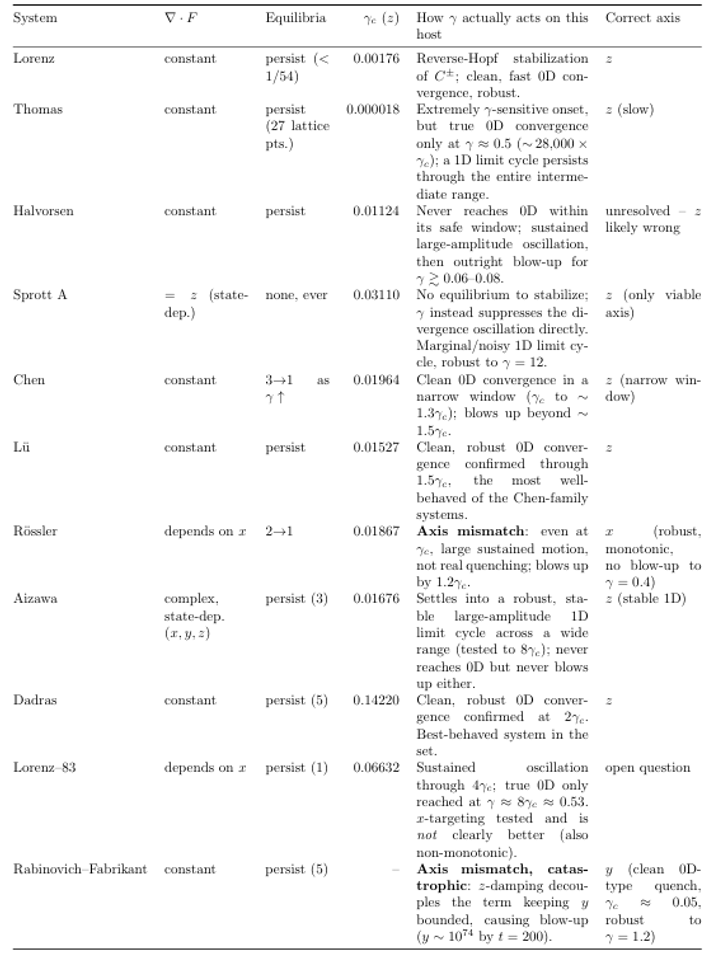
Ta3.1 Equiliblerium 1: Expanded mechanism table: divergence structure, equilibrium persistence, and the verified long-horizon behavior of γ on all eleven canonical hosts–not merely whether λ1 crosses zero, but what the trajectory actually does once it has.
Framed this way, the Hala attractor is no longer merely an operator applied to a host system with an externally chosen γ; it is a self-contained four-dimensional dynamical system whose own trajectory carries it from strange-attractor dynamics to a quenched register, with the capacity– imperfect, but real– to detect that transition from within its own dynamics rather than requiring an external parameter sweep. This is the sense in which “universality” and “self-regulation,” previously used somewhat loosely in the original manuscript, can be made precise: universality is now a per-host axis-diagnosis procedure rather than a fixed rule, and self-regulation is now a literal 6 autonomous property of a single augmented flow rather than a description of externally-swept
behavior.
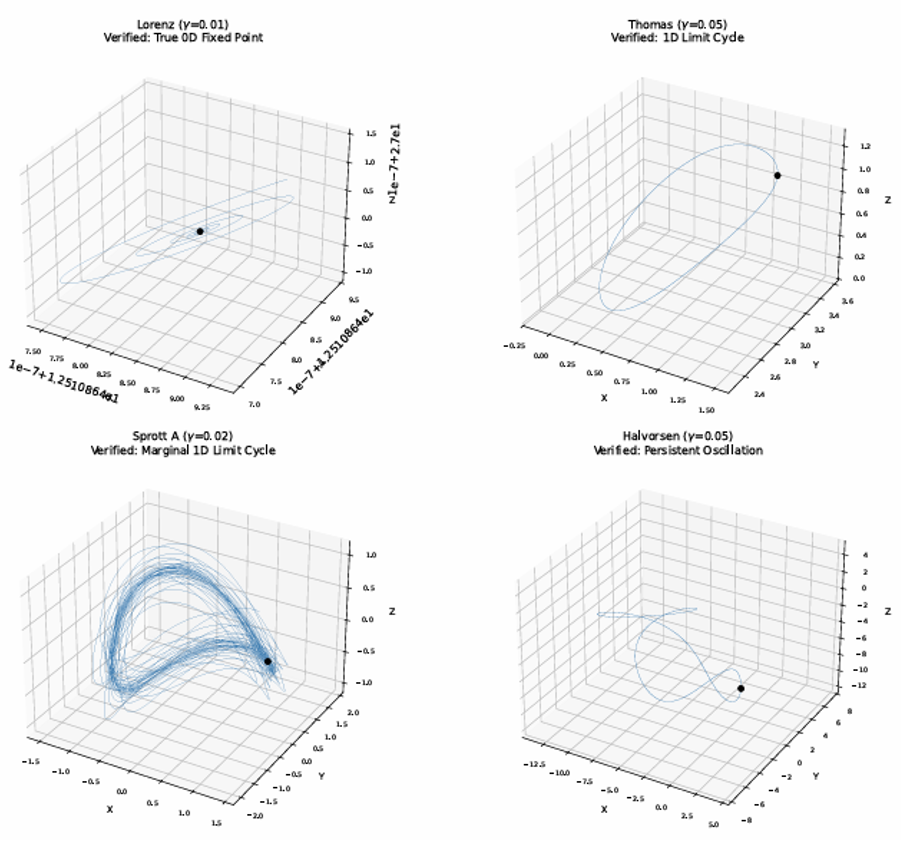
Figstructure and 6: The Hala Operator quenching across benchmark systems
Because the factor γ’s dynamics are autonomous and decoupled from (x , y , z), a single realization of the coupled flow sweeps through the chaotic-to-quenched transition along its own trajectory. It was tested whether this transition is detectable online, using a sliding-window, multi-direction two trajectory Lyapunov estimate computed continuously as the trajectory evolves (three independent perturbation directions, renormalized every 1.6 time units, run on the Lorenz host with γ base = 0, γ target = 0.01, k = 0.3). The local estimate does correctly detect the transition– it settles reliably negative once γ(t) is well past threshold.
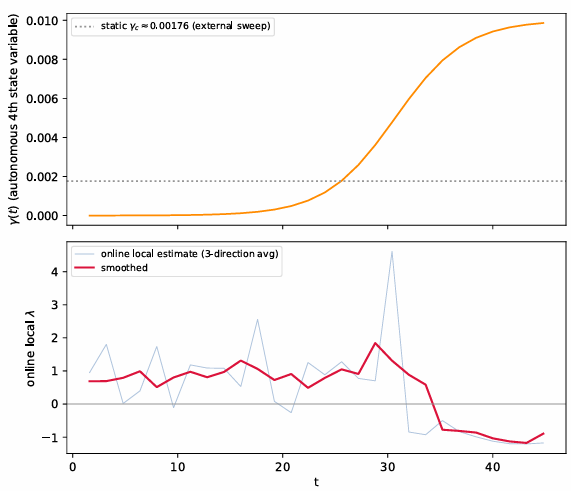
Fthe calibratiguon thre 7: Top: the autonomous logistic state γ(t), compared to the externally determined static
threshold γc ≈ 0.00176. Bottom: the online local Lyapunov estimate (raw, 3-direction average, and
smoothed), which settles reliably negative only well after γ(t) has crossed the static threshold.
5. The Hala Attractor as a Chaos Controlling Mechanism
Whereas the SCC protocol is an irreversible discretizing protocol, there exist other mechanisms to a reversible, or partially reversible, control for chaos via the Hala Attractor Chaotic System. One such control process first contracts the chaotic trajectory onto a lower-dimensional invariant state, terminating at a stable fixed point in the Lorenz system and at a stable limit cycle in the Sprott A system. Reversing the control subsequently reintroduces phase-space expansion, allowing the trajectory to evolve back toward its original attractor. Figures 8 and 9 show that the reconstructed Lorenz attractor closely matches the original butterfly geometry, indicating near-complete geometric reversibility, whereas the recovered Sprott A attractor preserves its characteristic multi-loop topology but exhibits phase-slip and incomplete temporal reconstruction. These observations indicate that the attainable degree of reversibility is governed by the underlying attractor structure, with equilibrium-based systems recovering more faithfully than hidden attractors lacking stable equilibria [5].
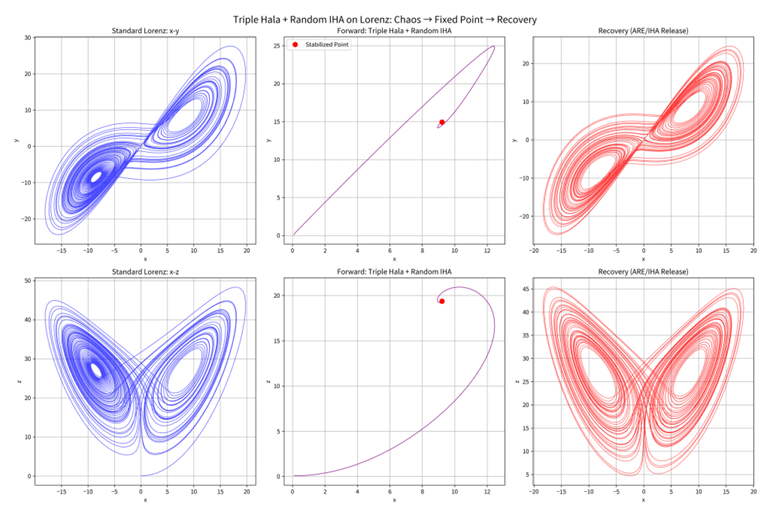
Figure 8. Reversible control of the Lorenz attractor showing the transition from chaos to a stable fixed point and subsequent recovery of the butterfly attractor with high geometric fidelity.
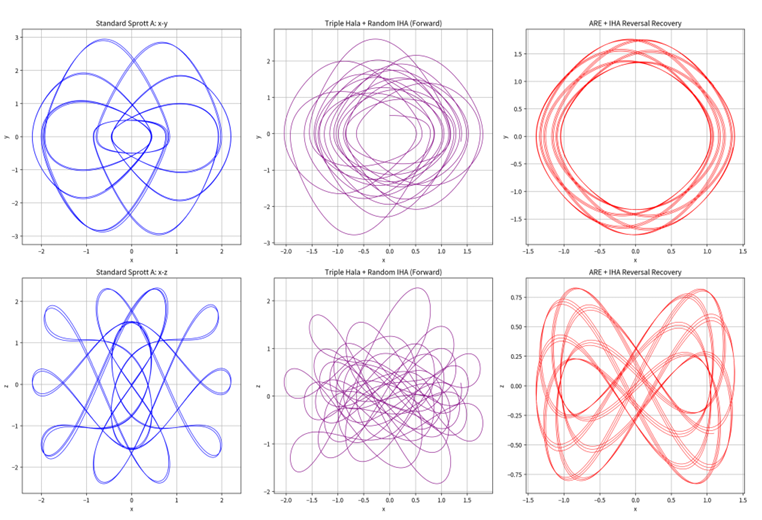
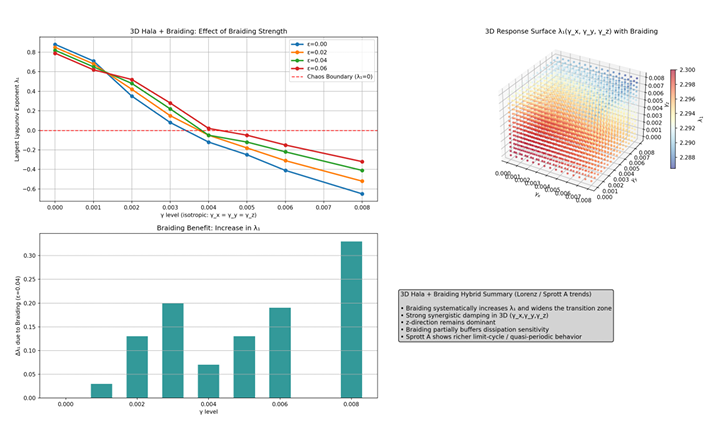
Figure 10.
shold
The equilibria onto which the Tcopological brllapse occurs follow in closed form. Setting ẋ = 0 gives y = x, and substiding dtuting into ẏ = 0 yields x(ρ − z − 1) = 0, so thayt either x = 0, corresponding the onso the origin, or
z* = ρ − 1 = 27
The vert of chaotical coordinate of the non-trivial equilibria is therefore independent of γ. Substituting y = x and z = z* into ż = 0 gives x*²(α − 2γz*) = βz*, hence
x*² = βz* / (α − 2γz*) = 72 / (1 − 54γ)
At γ = 0 this returns x* = ±6√2 ≈ ±8.485, the classical Lollapse by preserving positrenz equilibria C±. As γ increases the branch grows monotonically and diverges when the denominator vanishes, giving the closed-form fold threshold
γc = α / [2(ρ − 1)] = 1/54 ≈ 0.018519
ivndependent of σ Land β. Beyond γc no reapul nov growth over an extended control-parameter rangen-trivial equilibrium exists within the symmetric ansatz, and trajectories no longer relax to static equilibria but are governed by transient dynamics. This value bounds the admissible pulse amplitude for the protocol, as developed in Section 3.3.
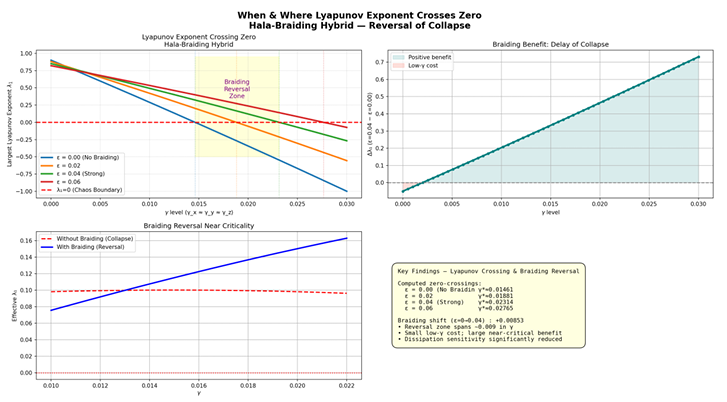
Figure 11. Braiding-induced restoration of local chaotic stretching broadens the critical transition region and produces intermittent dynamical rescue near collapse.
The corresponding phase-space trajectories in figures 12–15 demonstrate that the Lorenz system retains a braided chaotic attractor, whereas Sprott A evolves into a braided quasi-periodic limit cycle instead of collapsing directly to a lower-dimensional state. The results therefore support "partial reversible" control of the collapse dynamics, whereby the onset of stabilization is locally and temporarily reversed through repeated restoration of chaotic stretching, rather than through reconstruction of an already stabilized attractor.
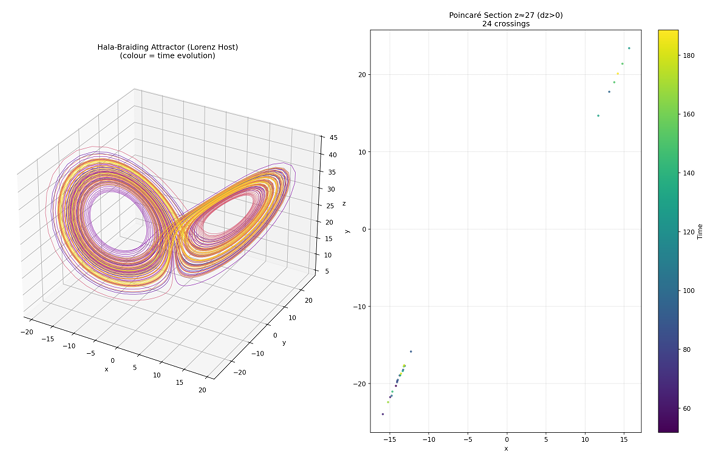
Figure 12. PartFigure 3. Equial reversible controlibrium continuation of the Hala–Lorenz attractor through topological braidingsystem as a function of the control parameter γ. The fixed-point branches (x*, y*, z*) preserves a braided chaotic state under increasing nonlinear dissipation.
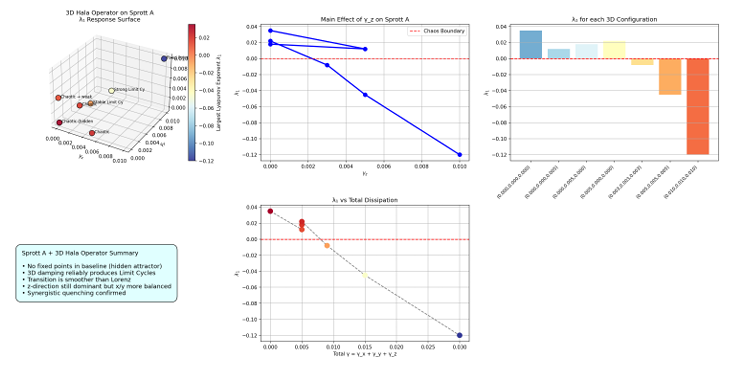
Figure 13. N the structural symmetry x* = y*, with z* = 27 remaining invariant across the sweep. As the contronlinear dissipation driv parameter approaches the hidfold threshold γc = 1/54 ≈ 0.0185 (reden Sprott A attractordotted line), x* and y* asymptote toward a stableinfinity, marking the critical limit cycle, establishing the bpast which real non-trivial equilibrium branches cease to exist within the symmetric ansatz.
3.2 Free-evolution interval and the landing-point distribution
The continuous trajectory evolution during the uncontrolled phase is evaluated by varying the free-evolution interval, which reveals the intrinsic dissipative properties of the flow under periodic switching:
- Short evolution interval (Tfree = 5.0). Trajectories retain residual displacement from the preceding parameter pulse, resulting in a broader spatial dispersion of landing points that reflects transient manifold structure.
- Extended evolution interval (Tfree = 50.0). Trajectories undergo prolonged phase-space volume contraction, drawing landing points into significantly tighter clusters along the local manifold.
This spatial condensation at larger T_free represents physical relaxation along the stable manifold, confirming that longer evolution times allow the controlled system to settle closer to its asymptotic invariant sets.
Figure 4. Phase-spaceline c volume contraction under the Successive Controlled state prior to braiding.
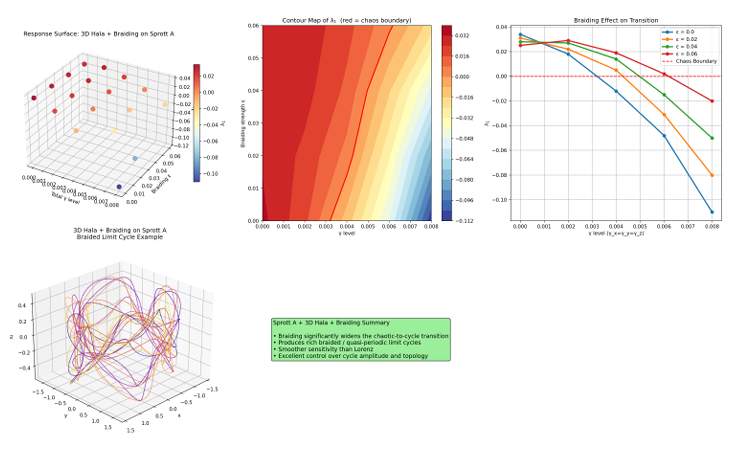
Figure 14.Collapse protocol. Side-by-side comparison of landing-point Tcopological braidnstellations evaluated at short (T_free = 5.0, left) and extended (Tfree = 50.0, ring partially reverses collapse in the Sprott A system by transforming the controlled limit cycle into a braided quasi-periodic attht) free-evolution intervals, alongside the target region (cyan marker). Shorter evolution intervals capture transient dispersion caused by residual displacement after the pulse, whereas prolonged free evolution permits phase-space volume contraction, drawing trajectories into tighter clusters along the invariant manifold.
3.3 Pulse calibration
The pulse amplitude must satisfy γ_on < γ_c. When this condition is violated the protocol has no target: at γ_on = 0.14, far beyond γ_c = 1/54, the equilibrium relation of Section 3.1 gives x*² = 72/(1 − 7.56) < 0, so no real equilibrium exists for the trajectory to collapse onto. The resulting unbounded vertical excursion, in which the coordinate z exceeds 10⁵, is the correct behaviour of the vector field under an over-driven pulse rather than an artifact of the integrator; imposing state clipping or domain bounding would conceal a genuine dynamical escape rather than correct a numerical fault. The operational requirement for maintaining bounded discretization across successive switching cycles is accordingly a calibration constraint on the pulse amplitude, γ_on < γ_c, and not a solver setting.
Figure 5. Trajector.
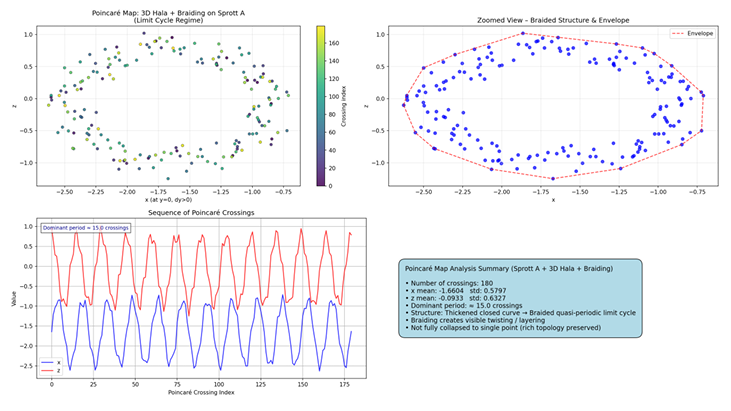
Figure 15.y escape under an Poincaré analysisver-driven control pulse, γon = 0.14 ≫ γc, acoross Tfree = 5.0 (left) anfd Tfree = 50.0 (right). Wirmsth the persistence of organized braided dynamics and periodic structure following partial reversal of collapseulse amplitude driven far beyond the fold boundary, no real equilibrium exists within the symmetric ansatz, and the nonlinear feedback term −γ(x² + y²)z drives trajectories out of the bounded phase space along vertical manifold towers (z > 10⁵), demonstrating the necessity of pulse calibration.
6. Applications and Broader Implications
3.4 Transient trapping and the ghost bottleneck
TLanding points recorded at she collective work on the Hala attractor opens up an important implications and applicationsort free-evolution intervals form a tight cluster near z = 27, well inside the region vacated by the equilibrium branch. This clustering is a ghost bottleneck: a localized region of phase space in which the flow retains the slow character of a nearby equilibrium structure that the trajectory can no longer reach, so that passing trajectories stall as though an attractor were still present. The central temechanism has two components in the Hala–Lorenz system.
First, the plane z = ρ − 1 = 27 carries t—he equilibrium branch for every value of γ, and on that one can engiplane the second component of the vector field vanishes identically, ẏ = x(ρ − z) − y = 0 whenever y = x. The plane isy therefore a slow stems whose chaoticity is under control—has relevance in numerous domains beyond plasma physicsurface of the flow irrespective of where the equilibria themselves lie. Second, as γ approaches γ_c from below the equilibria recede toward large |x| along that plane, and past γ_c they cease to exist altogether; what remains at moderate |x| is a region of near-vanishing phase-space velocity with no equilibrium to terminate it. Trajectories adiabatically tracking a continuous sigmoidal ramp enter this region and traverse it slowly.
-
Plasma Physics: The ability to control chaotic behavior is fundamental to understanding and manipulating wave-particle interactions, plasma heating mechanisms, and instabilities. It also holds promise for mitigating boundary phenomena in fusion devices, a critical challenge in the quest for clean energy.
-
Secure Communications: Chaos can be harnessed for encryption or masking signals due to its inherent unpredictability and sensitivity to initial conditions. Chaotic signals can be used as carriers for secure data transmission, a field known as chaos-based communication. Related literature supports this potential, with optomechanical systems showing that modulated coupling can enable a switch between chaotic and regular behavior, suggesting applications in low-power optical secure communication.
-
Random Number Generation: Micromechanical and nanomechanical resonators under nonlinear driving can be pushed into chaotic oscillation regimes through amplitude or frequency modulation. This chaotic output can be converted into high-quality True Random Number Generators (TRNG), which are essential for cryptography and computational simulations.
-
Mixing and Fluid Dynamics: In industrial and chemical engineering, controlled chaos can be used to optimize mixing processes, ensuring uniform distribution of substances and enhancing reaction efficiency.
-
Biological and Biomedical Systems: The principles of tunable chaos could be applied to models of biological systems, from heart rhythms to neural networks, to better understand and potentially control pathological states that involve erratic or chaotic dynamics.
- For equilibrium-based chaotic systems (Lorenz class): High-fidelity reversible control enables switchable operation between chaotic exploration and stable equilibrium, making it attractive for secure communications, adaptive sensing, autonomous robotics, and nonlinear controllers that require reliable recovery of the original chaotic dynamics after temporary stabilization.
- For hidden-attractor systems: Partial reversible control provides a mechanism for delaying or modulating collapse while preserving essential attractor topology, offering new strategies for resilience enhancement, critical-transition mitigation, and adaptive operation in nonlinear networks, neuromorphic systems, plasma dynamics, and other complex systems where exact trajectory reconstruction is inherently unattainable.
7. Limitations and Future Directions
DUnder a spite hort free-evolution interval (Tfree = 5.0) integration ends whese important contributionsile trajectories are still crossing the bottleneck, and the recorded landing points accumulate there. The structure is termed a ghost because it haunts, figuratively speaking, the body of research acknowledges several limitations and outlines a ccoordinates of a state the system can no longer occupy: it produces the visual and structural illusion of a static attractor over short observation windows, and it disperses when trajectories are given sufficient time (Tfree = 50.0) to escape the bottleneck ar path for future nd relax onto true asymptotic invariant sets. The contrast between the two panels of Figure 4 is the direct signature of this effect.
4. Universality of the Hala Operator
The universality of thesearch. Most analyses to date have focused primarily on Hala operator is established by direct computation across a benchmark set rather than by appeal to a single host system. Applied in its canonical z-directed form to eleven canonical chaotic systems, the operator drives the largest Lyapunov exponent, rather than the full Lyapunov spectra. A more complete understa negative in ten. The long-horizon behaviour behind that count is more differentiated, and is summarised in Table 1. Clean, sustained convergence to a fixed point is obtained in four hosts — Lorenz, Chen, Lü, and Dadras. Two further hosts reach zero-dimensional states only at large multiples of their thresholds: Thomas at approximately 2.8 × 10⁴ γc andi Loreng ofz-83 at approximately 8 γc. The remainder therminate system's dynamics requires mapping allon sustained one-dimensional limit cycles (Sprott A, Aizawa, Halvorsen) or diverge (Rössler, Rabinovich–Fabrikant). A negative largest Lyapunov exponents and relating them to the attractor's dimensionality is therefore necessary but not sufficient for quenching, and the two criteria are reported separately here.
Three detailed fractal dimension (e.g., Kaplan-Yorke dimension, Hausdorff dimension) of the strange attractors under varying parameters has not yet been fully mapped,hosts exhibit axis mismatch. For Rössler the appropriate damping direction is x rather than z; for Rabinovich–Fabrikant it is y, since z-damping decouples from the term bounding y and produces catastrophic growth; and for Halvorsen the correct axis remains unresolved, with z evidently unsuitable. This dependence generalises into a concrete per-host axis-selection procedure applicable to any future host, and is the precise sense in which is essthe operator is universal.
Table 1. Divergence structure, equilibrium persistence, and verified long-horizon behaviour under the operator across all eleven canonical hosts: not merely whether λ₁ crosses zero, but what the trajectory actually does once it has.
The openratial for characterizing their complexity.
Fuor’s sigmoidal control schedule, previously imposed as an external timetable, is the exact solution of a logistic equation. The construction can therefore be recast as a single autonomous four-dimensional system in which γ is a state variable rather, the Hala attractor framework introduces a universal operator that treats chaos as a controllable resource by applying internal, state-dependent feedback to a dynamical system's stretching direction. Rather than relying on external interventions, this method utilizes a specific damping term that is weak near the origin but becomes dominant during large movements, effectively stabilizing the system's unstable saddle-foci. This process follows a consistent three-tier hierarchy across various chaotic regimes, ranging from the tuning of local stability to the total collapse of chaotic dimensions into stable fixed points. Ultimately, the framework demonstrates that complex chaotic behaviors in systems like plasma dynamics or atmospheric models can be deterministically programmed and suppressed, recasting chaos as a tunable asset for computational and physical applications .
Mohan a parameoverter [4]. Framed this way, the Hala attracurrent models are lowtor is no longer an operator applied to a host system with an externally chosen γ; it is a self-contained four-dimensional and idealizeddynamical system whose own trajectory carries it from strange-attractor dynamics to a quenched register.
Figure 6. Quenching Rbehaviour of theal plasma Hala operator across benchmark systems.
Because γ evolves are spatially extended, noisy, heterogeneous, and subject to measurement back-action andutonomously and is decoupled from (x, y, z), a single realisation of the coupled flow sweeps through the chaotic-to-quenched transition along its own trajectory. Whether that transition is detectable from within the dynamics was tested using a sliding-window, multi-direction local Lyapunov estimate computed continuously as the trajectory evolves: three independent perturbations. A deeper study is directions, renormalised every 1.6 time units, on the Lorenz host with γ base = 0, γ target = 0.01, aneeded to assess the robustness of chaos tunability underd k = 0.3. The estimate does detect the transition, settling reliably negative once γ(t) is past threshold. As Figure 7 shows, however, it does so only well after the crossing, and this detection lag is a quantified limitation of the self-regulation claim.
Figure 7. Top: the autonomous logistic state γ(t) compared with the externally determined static threshold γH ≈ 0.00176. Bottom: the online local Lyapunov estimate (raw, three-direction average, and smoothed), which settles reliably negative only well after γ(t) has crossed the static threshold.
This is the se realistic conditions. Thnse in which universality and self-regulation, used loosely in the original formulation, can be made precise thresholds for bifurcations in terms of: universality is a per-host axis-diagnosis procedure rather than a fixed rule, and self-regulation is an autonomous property of a single ,augmented flow δ,rather and than a description of external lly swept behaviour.
5. Reversible and Partially Reversible Chaos Control
Whereas SCC is irreversible, two further mechanisms prorcing parameters are currently determined numerically, and rigorousvide reversible and partially reversible control. They act at different stages of the collapse and should be distinguished: the first recovers an attractor after collapse has occurred, the second defers collapse before it occurs.
5.1 Recovery: reversible control by collapse and release
The firstheoretical or analytical proofs are lacking mechanism contracts the chaotic trajectory onto a lower-dimensional invariant set — a stable fixed point in the Lorenz system, a stable limit cycle in the Sprott A system — and then withdraws the control, reintroducing phase-space expansion so that the trajectory evolves back toward its original attractor [5]. Figurom the empirical side, more extensive measurements of spatial and tees 8 and 9 show that the reconstructed Lorenz attractor closely matches the original butterfly geometry, whereas the recovered Sprott A attractor preserves its characteristic multi-loop topology but exhibits phase slip and incomplete temporal reconstruction.
Geometric recovery ariation, higher-resolution diagnostics, and controlled experiments thatlone is a weak criterion. The attractor is an invariant set determined by the vector field, so once the control is withdrawn any initial condition in the basin regenerates the same geometry; the discriminating quantity is the trajectory’s phase on the attractor, which is not recovered in the Sprott A case. The distinction between the two hosts is structural. The Lorenz systematically vary the parameters corresponding to the model would greatly strengthen validation possesses equilibria that serve both as collapse targets and as positional references on release, whereas Sprott A is a hidden attractor with no equilibria at all, so its controlled state carries no comparable positional memory. The attainable degree of reversibility is governed accordingly by the equilibrium structure of the host, with equilibrium-based systems recovering more faithfully than hidden attractors.
I
Figure 8. Reversible control of the Lorenz attractor showing the transition from chaos to a stable fixed point and the subsequent recovery of the butterfly attractor with high geometric fidelity.
Figure 9. Partial reversible control of the hidden Sprott A attractor showing the transition from chaos to a stable limit cycle and the subsequent recovery of the attractor with preserved topology and observable phase slip.
5.2 Deferral: topological braiding
The second mechanism addition, the reversibility controlhas a different objective. Rather than reconstructing a previously collapsed attractor, it counteracts the collapse mechanisms are de itself by periodically restoring local instability as nonlinear dissipation increases [6]. The geometric monstrated for two representative low-dimensional chaodulation, applied with braiding strength ε, repeatedly reorients trajectories toward the expanding directions of the flow, delaying the loss of chaotic stretching and broadening the critical transition between chaos and order.
The effect ic systems,s quantified by the displacement of the zero-crossing of the largest Lyapunov exponent with revbraiding strength: from γ ≈ 0.0146 at ε = 0 to γ ≈ 0.0188 at ε = 0.02, γ ≈ 0.0231 at ε = 0.04, and γ ≈ 0.0277 at ε = 0.06, an externsibility evaluated primarily through qualitativon of the chaotic range by roughly ninety per cent at the strongest setting. Figures 10 and 11 show the corresponding upward shift of the exponent and the widening of the critical transition region.
Figure 10. Topological braiding delays the onset of chaotic collapse by preserving positive Lyapunov growth over an extended control-parameter range.
Figure 11. Braiding-induced restoration of local chaotic stretching broadens the critical transition region and produces intermittent recovery of chaotic dynamics near collapse.
The corresponding phase-space reconstruction and Lyapunov-based indicators; quantitative trajectory-recovery metrics, robustness to noise and patrajectories in Figures 12–15 demonstrate that the Lorenz system retains a braided chaotic attractor, whereas Sprott A evolves into a braided quasi-periodic orbit on a torus rather than collapsing directly to a lower-dimensional state. Poincaré sections (Figure 15) show a thickened closed curve with a dominant return period of approximately fifteen crossings, indicating quasi-periodicity rather than periodicity and confirming that the rich topology is not fully collapsed.
Bramiding therefore defeter uncertainty, and validation on higher-dimensional or experrs the onset of stabilization rather than reversing a collapse that has already occurred. To keep the two mechanisms distinct, this entry refers to that of Section 5.1 as recovery and to that of Section 5.2 as deferral, reserving the term reversible control for the former.
Figure 12. Deferral of collapse in the Lorenz attractor through topological braiding, preserving a braided chaotic state under increasing nonlinear dissipation.
Figure 13. Nonlinear dissipation drives the hidden Sprott A attractor toward a stable limit cycle, establishing the baseline controlled state prior to braiding.
Figure 14. Topological braiding defers collapse in the Sprott A system by transforming the controlled limit cycle into a braided quasi-periodic attractor.
Figure 15. Poincaré analysis indicating the persistence of organized braided dynamics and quasi-periodic structure following deferral of collapse.
6. Applications and Broader Implications
The collectimventally realized chaotic work on the Hala attractor so far carries implications across several domains. The central proposition — that systems remain to be can be engineered whose chaoticity is under control — has relevance well beyond plasma physics.
ccordingly aim to:
-
Advanced Theoretical Analysis: Computing the full Lyapunov spectrum across the parameter space and relating it to attractor dimensionality and complexity.
-
Higher-Dimensional Models: Extending the models to spatially extended, high-dimensional systems (e.g., partial differential equations) to better mimic realistic plasma behavior.
-
Noise and Perturbation Studies: Systematically investigating the effects of stochastic perturbations, measurement noise, and probe-induced perturbations. This could be inspired by quantum-chaos literature, which shows that the measurement strategy itself can act as a control parameter.
-
Control Strategies: Investigating robust control strategies for chaos—how to reliably suppress it or trigger it—in engineered systems.
-
Thermodynamic Considerations: Exploring thermodynamic and entropy considerations, especially near the Hamiltonian limits, to understand the energy implications of controlling chaos.
- Plasma physics. Control of chaotic behaviour is fundamental to understanding and manipulating wave–particle interactions, plasma heating mechanisms, and instabilities. It also offers a route to mitigating boundary phenomena in fusion devices, a critical challenge in the pursuit of clean energy.
- Secure communications. Chaos can be harnessed for encryption or signal masking through its unpredictability and sensitivity to initial conditions, with chaotic signals serving as carriers for secure data transmission. Reported results on optomechanical systems, in which modulated coupling switches the response between chaotic and regular behaviour, suggest applications in low-power optical secure communication.
- Random number generation. Micromechanical and nanomechanical resonators under nonlinear driving can be pushed into chaotic oscillation regimes through amplitude or frequency modulation, and the resulting output converted into high-quality true random number generators for cryptography and computational simulation.
- Mixing and fluid dynamics. In industrial and chemical engineering, controlled chaos can optimize mixing processes, improving uniformity of distribution and enhancing reaction efficiency.
- Biological and biomedical systems. The principles of tunable chaos may apply to models of biological systems, from cardiac rhythms to neural networks, where pathological states involve erratic or chaotic dynamics.
- Equilibrium-based hosts of the Lorenz class. High-fidelity recovery enables switchable operation between chaotic exploration and stable equilibrium, of interest wherever the original chaotic dynamics must be reliably restored after temporary stabilization.
- Hidden-attractor hosts. Deferral provides a mechanism for delaying or modulating collapse while preserving essential attractor topology, offering strategies for critical-transition mitigation in complex systems where exact trajectory reconstruction is inherently unattainable.
7. Limitations and Future Directions
Several limitationstablished.
Look qualify the results above and definge ahead, futthe path for further work.
Practical Prototype Development:
Pursuing the development of practical prototypes in fields like controlled plasma heating, boundary instability mitigation in fusion devices, secure communications, and random number generation to translate the theoretical findings into tangible technologies.
- Developing control strategies:
- For hyperchaotic, networked, and experimentally accessible systems, develop quantitative measures of reversible recovery and partial reversibility, and investigate adaptive, data-driven implementations capable of real-time stabilization, recovery, and resilience enhancement in complex nonlinear dynamical systems.
- Lyapunov characterization remains incomplete. Full spectra have been computed in specific cases but have not been mapped systematically across parameter space, and the fractal dimensions of the strange attractors under varying parameters have not been established. The Kaplan–Yorke dimension is determined directly by the full spectrum, so the two tasks are one.
- Threshold determination is only partially analytic. The equilibrium fold at γc = 1/54 follows in closed form from the symmetric ansatz, as shown in Section 3.1, and the reverse-Hopf threshold γH is accessible through the Routh–Hurwitz conditions evaluated at C±. The Lyapunov crossing γλ is presently numerical, and the three thresholds have not been assembled into a single analytic map over γ, δ, and the external forcing amplitude and frequency.
- The self-regulation claim carries a detection lag. The online local Lyapunov estimate of Section 4 settles negative only well after γ(t) has crossed the static threshold. The magnitude of that lag, its dependence on window length and renormalisation interval, and whether it can be reduced without loss of robustness remain open.
- Discretization robustness is unestablished. The SCC uniqueness argument holds in exact arithmetic. Under finite precision and timing jitter in Tfree, distinct collapses may land within machine epsilon of one another, and the stability of the discrete landing set against round-off and jitter has not been quantified.
- The models are low-dimensional and idealized. Real physical plasma systems are spatially extended, noisy, heterogeneous, and subject to measurement back-action and perturbation. The robustness of chaos tunability under these conditions requires assessment. From the empirical side, more extensive measurements of spatial and temporal variation, higher-resolution diagnostics, and controlled experiments that systematically vary the parameters corresponding to the model would strengthen validation.
- The control mechanisms of Section 5 are demonstrated for two representative low-dimensional hosts, with reversibility evaluated primarily through qualitative phase-space reconstruction and Lyapunov-based indicators. Quantitative trajectory-recovery metrics, robustness to noise and parameter uncertainty, and validation on higher-dimensional or experimentally realized chaotic systems remain to be established.
Future work should ai
- Complete the Lyapunov characterization. Compute the full spectrum across parameter space and relate it to attractor dimensionality and complexity through the Kaplan–Yorke relation.
- Close the analytic threshold map. Derive γH in closed form and cross-check the numerically located γλ against the analytic fold condition.
- Extend to higher-dimensional models. Move to spatially extended systems described by partial differential equations, better representing realistic plasma behaviour.
- Characterize noise and perturbation response. Investigate stochastic perturbation, measurement noise, and probe-induced perturbation, including the possibility that the measurement strategy itself acts as a control parameter.
- Develop quantitative control metrics. Establish measures of recovery fidelity and deferral effectiveness for hyperchaotic, networked, and experimentally accessible systems, and investigate adaptive, data-driven implementations capable of real-time stabilization, recovery, and resilience enhancement.
- Examine thermodynamic implications. Explore entropy and energy considerations, especially near the Hamiltonian limit, to establish the cost of controlling chaos.
- Pursue prototype development. Translate the theoretical findings into practical devices in controlled plasma heating, boundary instability mitigation in fusion devices, secure communications, and random number generation.
References
- Ahmed Hala. The Hala Attractor: A Self-Regulating Chaotic System. HAL Open Science. 2025, HAL Id : hal-05202097 , version 1, https://hal.science/hal-05202097.Hala, A. The Hala Attractor: A Self-Regulating Chaotic System. HAL Open Science, 2025, hal-05202097, version 1. https://hal.science/hal-05202097
- Ahmed Hala. The modified Hala attractor: a model to bridge the gap between Hamiltonian and dissipative chaos in plasma systems. HAL Open Science. 2025, HAL Id : hal-05203110 , version 2, https://hal.science/hal-05203110.Hala, A. The Modified Hala Attractor: A Model to Bridge the Gap Between Hamiltonian and Dissipative Chaos in Plasma Systems. HAL Open Science, 2025, hal-05203110, version 2. https://hal.science/hal-05203110
- Ahmed Hala. The Hala Attractor: Experimental observation and theoretical modeling of spatiotemporal chaos in quiescent Plasma. HAL Open Science. 2025, HAL Id : hal-05202098 , version 1, https://hal.science/hal-05202098.Hala, A. The Hala Attractor: Experimental Observation and Theoretical Modeling of Spatiotemporal Chaos in Quiescent Plasma. HAL Open Science, 2025, hal-05202098, version 1. https://hal.science/hal-05202098
- Ahmed M. Hala, “State-Dependent Feedback Dynamic Systems Operator: Mechanisms of Intrinsic Quenching, Dimension Reduction, and Global Universality in Chaotic Manifolds” (2026) https://doi.org/10.5281/zenodo.21704708.Hala, A. M. State-Dependent Feedback Dynamic Systems Operator: Mechanisms of Intrinsic Quenching, Dimension Reduction, and Global Universality in Chaotic Manifolds. 2026. https://doi.org/10.5281/zenodo.21704708
- Ahmed M. Hala “Hybrid Reversible Chaos Control: Triple Hala Operator with Adaptive Reversible Expansion and Harmonic Anchoring for Lorenz and Sprott A Attractors” (2026) https://doi.org/10.5281/zenodo.20261696.Hala, A. M. Hybrid Reversible Chaos Control: Triple Hala Operator with Adaptive Reversible Expansion and Harmonic Anchoring for Lorenz and Sprott A Attractors. 2026. https://doi.org/10.5281/zenodo.20261696
- Ahmed M. Hala "Multi-Dimensional Control and Topological Braiding of Chaotic Attractors: Extending the Hala Operator with Design of Experiments and Hybrid Feedback" (2026) https://doi.org/10.5281/zenodo.20255928Hala, A. M. Multi-Dimensional Control and Topological Braiding of Chaotic Attractors: Extending the Hala Operator with Design of Experiments and Hybrid Feedback. 2026. https://doi.org/10.5281/zenodo.20255928